Search results for: “viscous”

  • Magma Mixing

    Magma Mixing

    Magmas typically consist of a mixture of molten liquid, bubbles, and solid crystals. As they mix, those crystals can sink from one viscous layer into another. To investigate this sort of process, researchers studied solid particles sinking across an interface between two viscous liquids. This is what we see above. One fluid is clear; the other is dyed red, and gravity points toward the left so the particles fall from right to left.

    What happens when the particle reaches the interface between fluids depends on three main factors: the gravitational force acting on the particle, the surface tension at the interface, and the ratio of the viscosities of the two fluids. The researchers observed two main outcomes. In one (top), the particle slows at the interface and breaks through slowly, its surface wetted by the second fluid so that it drags little to none of the previous fluid with it. The researchers named this the film drainage mode. It tends to occur when the viscosity ratio between fluids is large.

    The second method, shown in the bottom image, is the tailing mode. As the particle approaches, the interface deforms. A thick layer of the first fluid coats the particle even as it pass through, forming a tail that destabilizes behind the falling particle. This mode occurs when the viscosity ratio is small or the gravitational force is large compared to the surface tension. (Image and research credit: P. Jarvis et al.)

  • How the Hagfish Deploys Its Slime

    How the Hagfish Deploys Its Slime

    Hagfish – an eel-like species – are known for their prodigious slime production, which helps them escape predators (and, in some cases, seriously muck up highways). Part of the hagfish’s slime consists of ~10 cm fibers that the creature deploys in tiny skeins (bottom) only a hundred microns across. To form the viscoelastic slime that thwarts its predators, those skeins of fiber have to unravel and do so in only tenths of a second. A new study shows that viscous drag plays a major role in that unraveling. 

    Most fish use a suction method to catch prey. In the hagfish’s case, that does the predator more harm than good because the very flow it creates to try and catch the hagfish pulls the slime skein apart and helps the slime expand 10,000 times in volume, creating a mess that chokes the gills of the attacking fish. (Image credit: top – L. Böni et al.; bottom – G. Choudhary et al., source; research credit: G. Choudhary et al.; via Ars Technica; submitted by Kam Yung Soh)

  • Viscoelasticity and Liquid Armor

    Viscoelasticity and Liquid Armor

    One proposed method for improving bulletproof armor is adding a layer of non-Newtonian fluid that can help absorb and dissipate the kinetic energy of impact. Thus far researchers have focused on shear-thickening fluids – like cornstarch-based oobleck – filled with particles that jam together if anything tries to deform them quickly. But is it really the shear-thickening properties that matter for high-speed impacts?

    To test this, researchers studied projectile impact on three fluids: water (left), a cornstarch mixture (not shown), and a shear-thinning polymer mixture (right). Water is Newtonian, and it slows down the projectile but doesn’t stop it. Both the shear-thickening cornstarch and the shear-thinning polymer mixture do stop the projectile. And by modeling the impacts, researchers concluded that the key to that energy dissipation isn’t their shear-related behaviors: it’s the fact that both fluids are viscoelastic.

    That means that these fluids show both viscous (fluid-like) and elastic (solid-like) responses depending on the timescale of an impact. The high speed of the impact triggered a strong viscous response in both fluids, bringing the projectile to a halt. And if, as the researchers suggest, it’s a fluid’s viscoelasticity that matters most, that widens the field of candidates when it comes to developing a fluid-based armor. (Image and research credit: T. de Goede et al.)

  • Landslide Lubrication

    Landslide Lubrication

    In 2008, an 8.2 magnitude earthquake in China caused the enormous Daguangbao landslide, which loosed over one cubic kilometer of rocks and debris. That material rushed down the mountainside, running more than 4 kilometers before coming to a stop. A new study uses field measurements and laboratory experiments to explain how the landslide could run so far from its source.

    The researchers found that friction between the sliding material and the stable rock heated that layer to over 850 degrees Celsius, hot enough to start decomposing the dolomite in the fall. That vaporized carbon dioxide out of the rock, which helped lower the friction. Simultaneously, the high temperatures and high pressures within in the landslide caused recrystallization in the falling rocks; this created a viscous layer that helped lubricate the slide. The team estimated that the two mechanisms working in tandem enabled the landslide to reach an estimated 60 m/s. (Image and research credit: W. Hu et al.; via Nature; submitted by Kam-Yung Soh)

  • Ice Cream Vortex

    [original media no longer available]

    Here’s a fun demonstration of vorticity: sticking an ice cream cone in a bathtub vortex. Now, before someone points out that this is clearly a sink, not a bathtub, the term “bathtub vortex” actually has a standard scientific usage; it’s used to describe a vortex that forms when water drains out a small hole in a larger container.

    Vortices like this have a surprisingly complex flow structure. Although there is some flow dragged into the vortex near the surface, flow visualization shows that most of the flow actually occurs along the bottom of the container. Fluid there gets dragged along the surface, then sucked upward near the center of the vortex, and finally gets pulled down the drain.

    So what’s going on here? As long as the ice cream cone stays balanced inside the center of the vortex, it spins with the fluid due to viscous drag. When it’s unbalanced – like when it precesses too far or throws a chunk of cone off –  I suspect the bottom of the cone is encountering that area of upwelling, which tips the cone completely. The surface flow then pulls it back into the center of the vortex, allowing it to right itself. (Video credit: Cheesemadoodles; research credit: A. Anderson et al.; submitted by randumblrposts and eclecticca)

  • Flow in the Heart

    Flow in the Heart

    Few flows are more integral to our well-being than blood flow through the heart. Over the course of our lives, our hearts develop from a few cells pushing viscous blood through tiny arteries to the muscular center of a vast circulatory network, capable of powering us through incredible physical feats. What’s most astonishing about all this is that the heart goes through all these changes and adaptations without ever pausing. 

    Peering into the heart to see it in action is difficult, but researchers today are combining imaging techniques like CT and MRI with computational fluid dynamics to build patient-specific heart models. Not only does this help us understand hearts in general; it’s paving the way toward predicting how a specific treatment may affect a patient. Imagine, for example, being able to simulate and compare different models of an artificial heart valve to see which will work best for a particular patient. We’re not to the point of doing so yet, but it’s a very real possibility in the future. 

    To see some examples of predicted and measured heart flows, check out this video by J. Lantz. In the meantime, happy Valentine’s Day! (Image credits: Linköping University Cardiovascular Magnetic Resonance Group, video source; via Another Fine Mesh)

  • Inside Fondue

    Inside Fondue

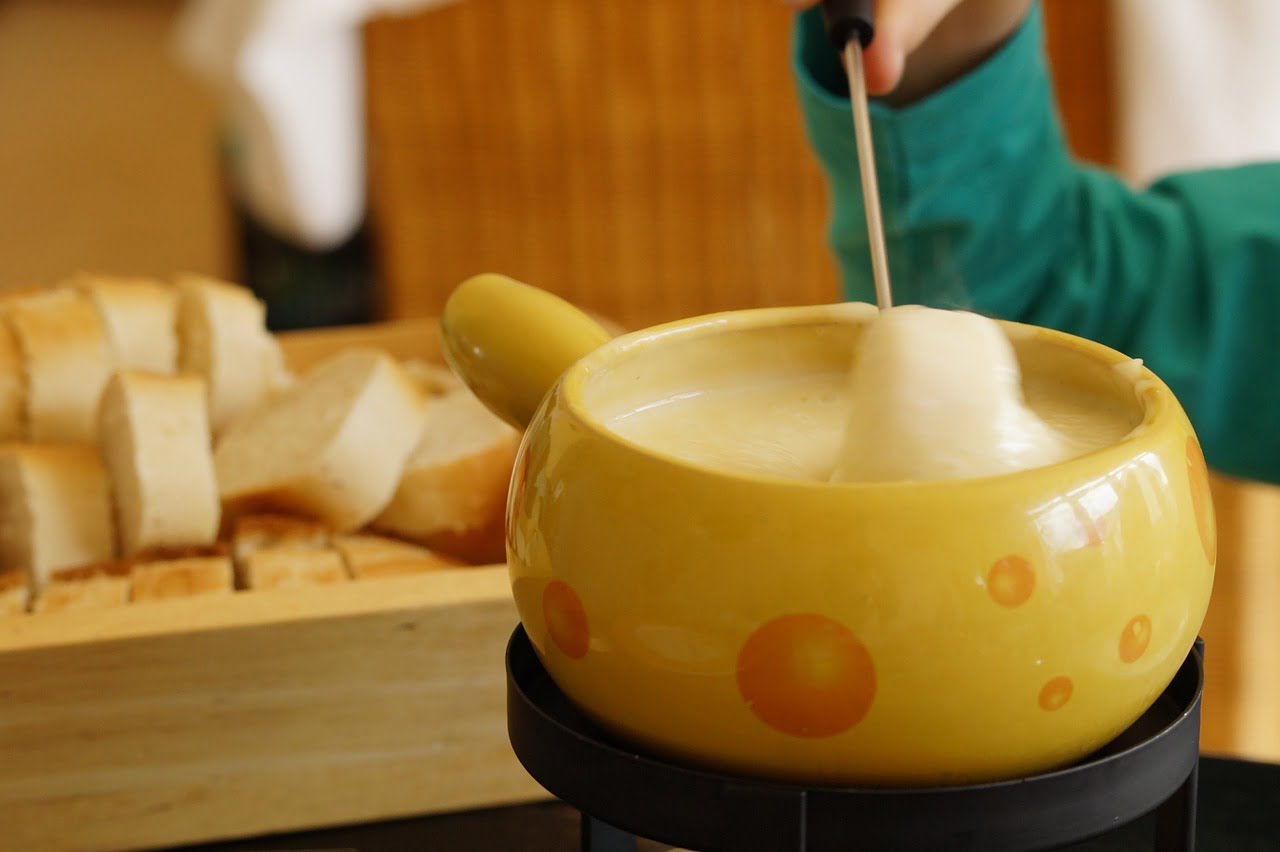
    Cheese fondue is a complex – and delicious – Swiss delicacy. The perfect fondue requires the right mix of ingredients and preparation to get the rheology – the flow character – just right. Fondue is a colloid, a fluid containing a mixture of suspended insoluble particles.

    The major components, rheologically speaking, are fat globules and casein proteins from the cheese, ethanol from the wine, and some added starch. Left on their own, the fat and casein tend to separate, something that’s sure to ruin the fondue. Adding the right amount of starch prevents that separation and keeps the fondue together. The viscosity of fondue is very important as well. If it’s too runny or too gummy, the mouthfeel will be wrong and it may not stick to the bread when dipped. Adding wine decreases the viscosity.

    All in all, the quality and perception of a good fondue relies heavily on its rheological character. Without the right proportion of ingredients to set the perfect viscous and chemical character, the dish literally comes apart. (Image credit: Pixabay; research credit and submission: P. Bertsch et al.)

  • Collective Motion: Worms

    Collective Motion: Worms

    Although most animals are more solid than fluid, what happens when you put many of them together can be strikingly fluidic. Above you see the black aquatic worm, Lumbriculus variegatus, which must keep moist to stay alive. An individual worm will die within an hour of being removed from the water, but, in a group, the worms can survive far longer. They do so, in part, by acting like a viscoelastic fluid, a material with both solid (elastic) and fluid (viscous) properties.

    In small groups, the worms squirm tightly together to minimize their collective surface area and prevent themselves from drying out. But in larger groups, the worm blobs begin sending out feelers, searching for more advantageous circumstances. In the top image, you can see this causes three of the blobs to ultimately merge into an even bigger one. The worm collective can also “liquify”, allowing the blob to change shape and tackle obstacles like flowing through a pipe. (Image and research credit: Y. Ozkan-Aydin et al.; via Science)

    This is the second post in our series on collective motion. Check out the first post here.

  • Featured Video Play Icon

    Dripping Down the Rivulet

    If you’ve ever watched water running down the side of the street, you’ve probably noticed that it doesn’t flow smoothly. Instead, you’ll see waves, rivulets, and disturbances that form. That’s because the simple action of flowing down an incline is unstable. Water and other viscous liquids can’t flow downhill smoothly. Any disturbances – an uneven surface, the rumble of passing cars, a pebble in the way – will create a disruption that grows, often until the entire flow is affected. This video shows some of the complex and beautiful patterns you get then. (Video and image credit: G. Lerisson et al.)

  • Dip Coating

    Dip Coating

    Imagine dipping a rod into a liquid mixture filled with particles. When you pull the rod out, do particles stick to it? The answer depends on the relative importance of two sets of forces: the viscous drag as you lift the rod and adhesive power of surface tension. Scientists express this as a dimensionless ratio known as the capillary number.

    When the capillary number is small, viscous drag dominates, and any particles that try to stick to the rod get pulled away (upper left). But as you increase the capillary number, surface tension helps particles clump together and stick to the rod (lower left and right). If the surface tension forces are strong enough – meaning that the capillary number is high –  you can actually get multiple layers of particles adhering to the dipped surface. (Image and research credit: E. Dressaire et al.)