Search results for: “viscous”

  • The Microscopic Ocean

    The Microscopic Ocean

    When you’re the size of plankton, water may as well be molasses. Viscosity rules at these scales, and swimming plankton leave distinctive wakes that are slow to dissipate. Fish that feed on plankton use these trails to find their prey. But this microscopic world is changing as the ocean warms.

    At higher temperatures, water is less viscous, and plankton wakes don’t last as long. To make matters worse for hungry fish, warmer waters have led to an explosion in a species of faster plankton, capable of moving hundreds of body lengths a second. This species is far more difficult to catch, which may explain some of the collapses we’re observing in populations of fish like cod and haddock. (Video and image credit: BBC Earth Lab)

  • Pollock Avoided Coiling

    Pollock Avoided Coiling

    Streaks of black and gray in the Jackson Pollack painting the researchers studied.

    Artists are often empirical masters of fluid dynamics, as they must be to achieve the effects they want. Jackson Pollock was particularly known for his so-called dripping technique, in which he dropped filaments of paint from brushes, cans, and even syringes as he moved around a horizontal canvas. (Scientifically speaking, this wasn’t really dripping since the paint wasn’t breaking up into droplets for the most part, but that’s another story.)

    What Pollock was doing, fluid dynamically speaking, is the subject of a new study. Researchers analyzed historical footage of Pollock painting to measure the typical heights from which he dropped paint and the speed at which he moved. Then they built their own apparatus to mimic the painting style with modern paints and study the flow regime Pollock’s technique falls into. 

    Since much of the paint falls in a steady stream, like syrup falling onto pancakes, the researchers wondered whether the paint was likely to coil the way other viscous fluids do. What they found, however, is that Pollock’s choice of height and speed when applying paint seems deliberately designed to avoid the coiling instability. That fact suggests that art historians might identify forged paintings in part from the presence of too much coiling among the paint filaments. (Image credits: photo – M. Holmes/LIFE, painting – J. Pollock; research credit: B. Palacios et al; via Ars Technica; submitted by Kam-Yung Soh)

  • Reader Question: Exoplanetary Life

    Reader orbiculator asks:

    I’ve been having this thought regarding biological adaptations to viscous mediums. In a hypothetical exoplanet where the ocean is this thick, aqueous gel – could we assume that the native macroscopic species would have morphologies similar to Earth’s plankton despite their large sizes? That is, instead of being propelled by fins like our fish and whales, they’d go around using large ciliar or flagella?

    Propulsion-wise, that’s a reasonable theory. If the ambient environment were viscous enough that macroscopic creatures would still be limited to laminar flow, then, yes, you could expect them to use something like cilia or flagella to move. They’d be restricted by the same reversibility that microscopic species are here on Earth.

    But there are other factors that could come into play. Many microscopic species rely on diffusion for survival, whether that’s chemical diffusion across their exterior or diffusion within their body. As a species gets larger, the distance diffusion has to occur across grows, and diffusion becomes harder and harder to sustain. 

    So while hydrodynamic constraints might result in an exoplanet’s fauna having features similar to Earth’s microscopic life, it probably wouldn’t be as simple as merely enlarging the species we see here on Earth. Some of the key biophysics that goes on inside cellular life as we know it just doesn’t hold at larger scales.

  • Escaping the Limits of Viscosity

    Escaping the Limits of Viscosity

    For large creatures, it’s not hard to feel the evidence of someone else swimming nearby. But to tiny swimmers water is incredibly viscous and hard to move. These creatures have to swim very differently than their larger cousins, and evidence of their motion dies out quickly. But at least one microorganism,  Spirostomum ambiguum, has discovered a method for overcoming the limits of size and viscosity.

    The single-celled swimmer, when threatened, contracts its body in milliseconds, generating accelerations greater than those seen by fighter pilots. That acceleration is strong enough that it generates a burst of turbulence powerful enough to overcome the natural damping of its viscous surroundings. Within their colonies, S. ambiguum seem to use contraction to send out hydrodynamic signals to neighbors, who pass on the call to arms. To see the colonies in action, check out this previous article. (Image and research credit: A. Mathijssen et al.; via Physics Today; submitted by Kam-Yung Soh)

  • Breaking Up

    Breaking Up

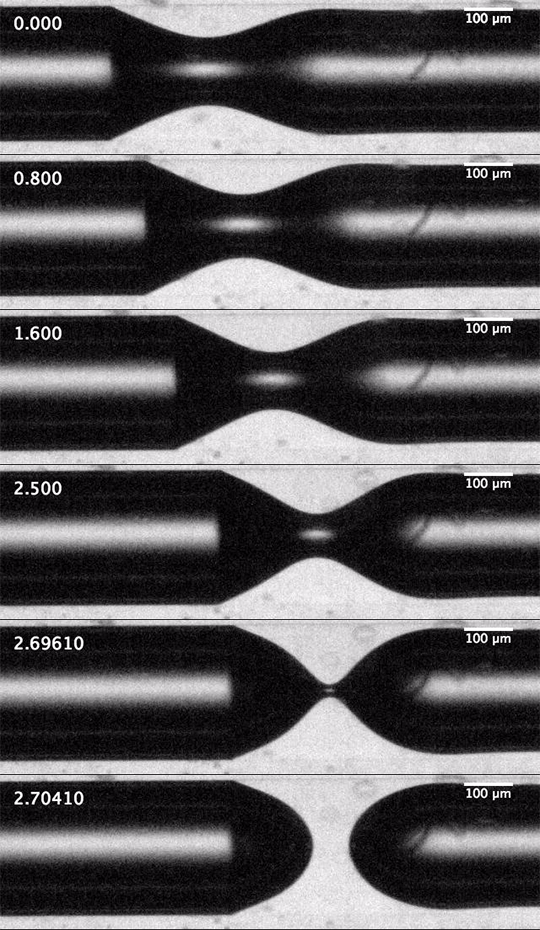
    The dripping of a faucet and the break-up of a jet into droplets is universal. That means that the forces – the inertia of the fluid, the capillary forces governed by surface tension, and the viscous dissipation – balance in such a way that the initial conditions of the jet – its size, speed, etc. – don’t matter to the process of break-up. 

    We’d expect that the inverse situation – the breakup of a gas into bubbles in a liquid – would be similarly universal, but it’s not. When unconfined bubbles pinch off, the way they do so is heavily influenced by initial conditions. But that changes, according to a new study, if you confine the gas to a liquid-filled tube before pinch-off. Confinement forces a different balance between viscous and capillary effects, one which effectively erases the initial conditions of the flow and restores universality to the pinch-off process. (Image and research credit: A. Pahlavan et al.; via phys.org)

  • Featured Video Play Icon

    Pouring a Liquid Mirror

    In this video, the Slow Mo Guys play with liquid gallium, giving us a chance to see how molten metals behave (outside of, say, the Terminator movies). Near its melting point, gallium is about six times denser than water, with a viscosity three times higher, and a surface tension about ten times greater. So how do those properties affect its behavior?

    You may be surprised that when watching the gallium vibrate on a speaker or get poured into a pan, it doesn’t look all that different from water. Yes, it’s highly reflective, but, on the whole it doesn’t look radically different from a distance. We can use the Reynolds number to quantify what’s going on here. It’s a dimensionless number that compares the fluid’s inertial force to the viscous force. Imagine we have two versions of an experiment, one where we pour gallium at a given speed and one pouring at the same volume and speed but with water. If we compared the Reynolds numbers of the water and the gallium, they only differ by a factor of two. Overall, that’s not very much. That’s why the two pours look similar.

    The story is different, though, if we look at individual drops of gallium and water, like when the first few drops of our pour hit the surface. Check out the gallium drops below. They’re conical on either end! This looks very different from what we expect with water droplets. You might think that’s because the metal is more viscous, but if we compare a water drop with a gallium drop of the same characteristic size and impact speed, we find a different story. For this, we’ll use the Ohnesorge number, which compares the viscous forces to a combination of inertia and surface tension. In this case, we find that the gallium drop’s Ohnesorge number is almost an order of magnitude smaller than the water droplet’s. That means that viscosity isn’t a major factor for our gallium drop. Both surface tension and inertia are more important.

    But if the surface tension is so high, then why aren’t the droplets spherical? Mostly because they don’t have time to form spheres before they hit. Their shape suggests that they’ve only just broken into droplets, which makes sense if the pour is fast and the surface tension is strong. (Video and image credit: The Slow Mo Guys)

  • Featured Video Play Icon

    Fingers of Clay

    Take a mixture of a viscous liquid – like clay mud – and squeeze it between two glass plates and you’ll create a mostly-round layer of liquid. As you pry the two glass plates apart, air will push its way into that layer, forcing through the mud in a dendritic pattern. This is called the Saffman-Taylor instability or viscous fingering. It occurs because the interface between the air and mud is unstable.  (Image and video credit: amàco et al.)

  • Floccing Particles

    Floccing Particles

    Adding particles to a viscous fluid can create unexpected complications, thanks to the interplay of fluid and solid interactions. Here we see a dilute mixture of dark spherical particles suspended in a layer of fluid cushioned between the walls of an inner and outer cylinder. Initially, the particles are evenly distributed, but when the inner cylinder begins to rotate, it shears the fluid layer. Hydrodynamic forces assemble the particles together into loose conglomerates known as flocs. Once the particles form these log-like shapes, they remain stable thanks to the balance between viscous drag on particles and the attractive forces that pull particles toward one another. (Image and research credit: Z. Varga et al.; submitted by Thibaut D.)

  • Pluto’s Subsurface Ocean

    Pluto’s Subsurface Ocean

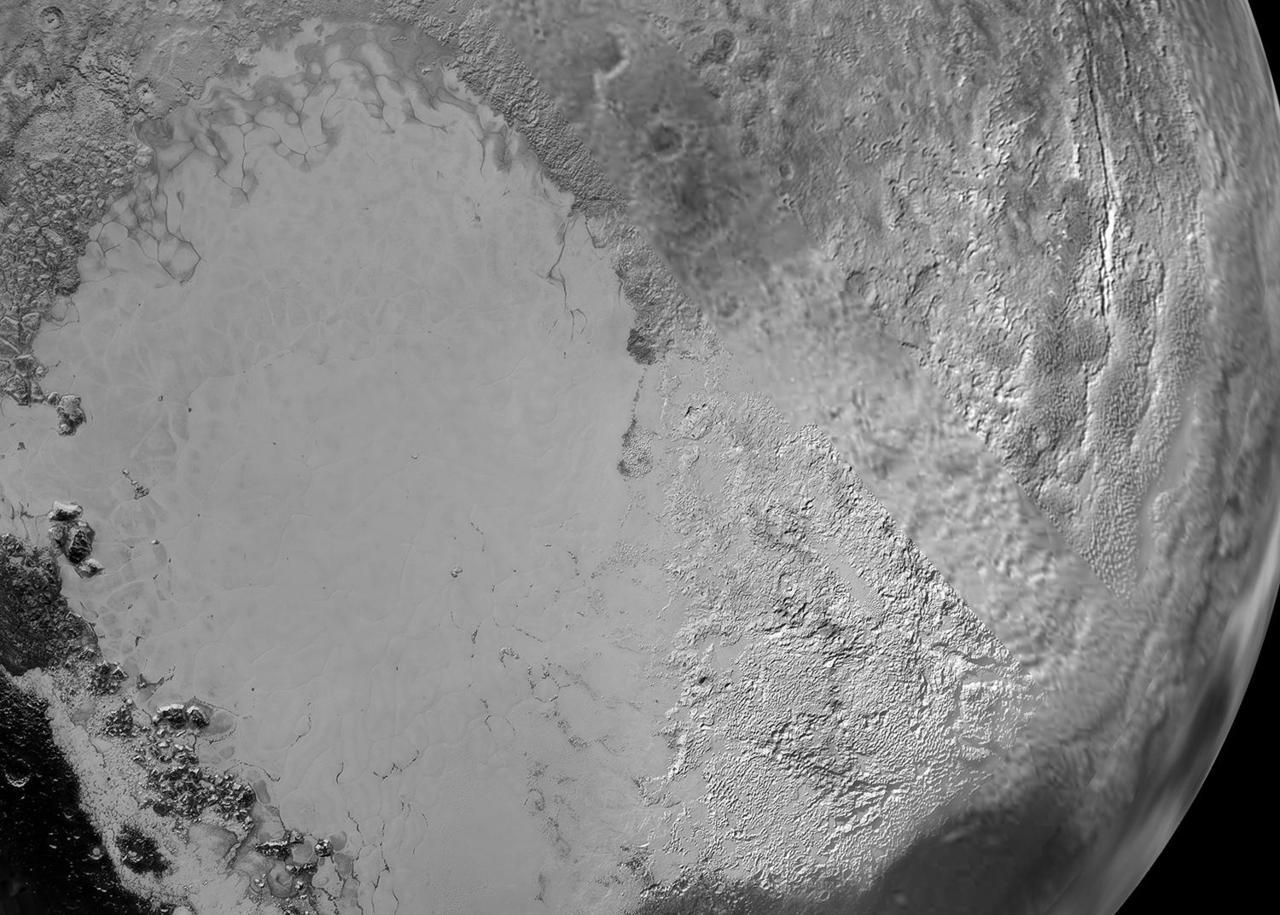
    Since the New Horizons probe visited Pluto in 2015, scientists have suspected that Sputnik Planitia (a.k.a. Pluto’s Heart), shown above, may hide a subsurface ocean. But it’s tough to explain how that ocean could stay warm enough to be liquid while the surface ice remains cold and viscous enough to support the variations in thickness we see. One theory cites the possibility of ammonia in the ocean, essentially serving as anti-freeze, but that would require much higher concentrations of ammonia than have been observed in comets – which, like Pluto, spend most of their time in the icy, frigid regions of the Kuiper Belt.

    A new study suggests another theory: a layer of gas-trapping hydrates between the liquid ocean and its icy cap. A thin layer of clathrate hydrates, as proposed by the authors, would trap gases like methane and create a thermally-insulating layer between a warm ocean and much colder ice cap. Because heat would struggle to cross the insulation layer, the water beneath would stay above the freezing point without the cold ice above leeching all of its warmth away.

    It would likely require future missions to Pluto or other potential ocean worlds to confirm the presence of such a hydrate layer, but, for now, the theory provides a possible new explanation for how icy objects like Pluto maintain liquids. (Image credit: NASA/JHU Applied Physics Laboratory/SwRI; research credit: S. Kamata et al.; via Gizmodo)

  • Featured Video Play Icon

    The Art of Paper Marbling

    Known as ebru in Turkey and suminagashi in Japan, the art of paper marbling has flourished in cultures around the world since medieval times. The details of methods vary, but in general, the technique uses a base of oily water to float various dyes and pigments. Artists then use brushes, wires, and other tools to manipulate the dyes into the desired pattern. Paper is spread over the top to soak up the color pattern before being hung to dry. Every print made in this manner is a unique result of buoyancy, surface tension variation, and viscous manipulation. Check out the video above to watch a timelapse video showing the technique in action. (Video and image credit: Royal Hali)