Search results for: “viscous”

  • Bacterial Turbulence

    Bacterial Turbulence

    Conventional fluid dynamical wisdom posits that any flows at the microscale should be laminar. Tiny swimmers like microorganisms live in a world dominated by viscosity, therefore, there can be no turbulence. But experiments with bacterial colonies have shown that’s not entirely true. With enough micro-swimmers moving around, even these viscous, small-scale flows become turbulent.

    That’s what is shown in Image 2, where tracer particles show the complex motion of fluid around a bacterial swarm. By tracking both the bacteria motion and the fluid motion, researchers were able to describe the flow using statistical methods similar to those used for conventional turbulence. The characteristics of this bacterial turbulence are not identical to larger-scale turbulence, but they are certainly more turbulent than laminar. (Image credits: bacterium – A. Weiner, bacterial turbulence – J. Dunkel et al.; research credit: J. Dunkel et al.; submitted by Jeff M.)

  • Branching Gels

    Branching Gels

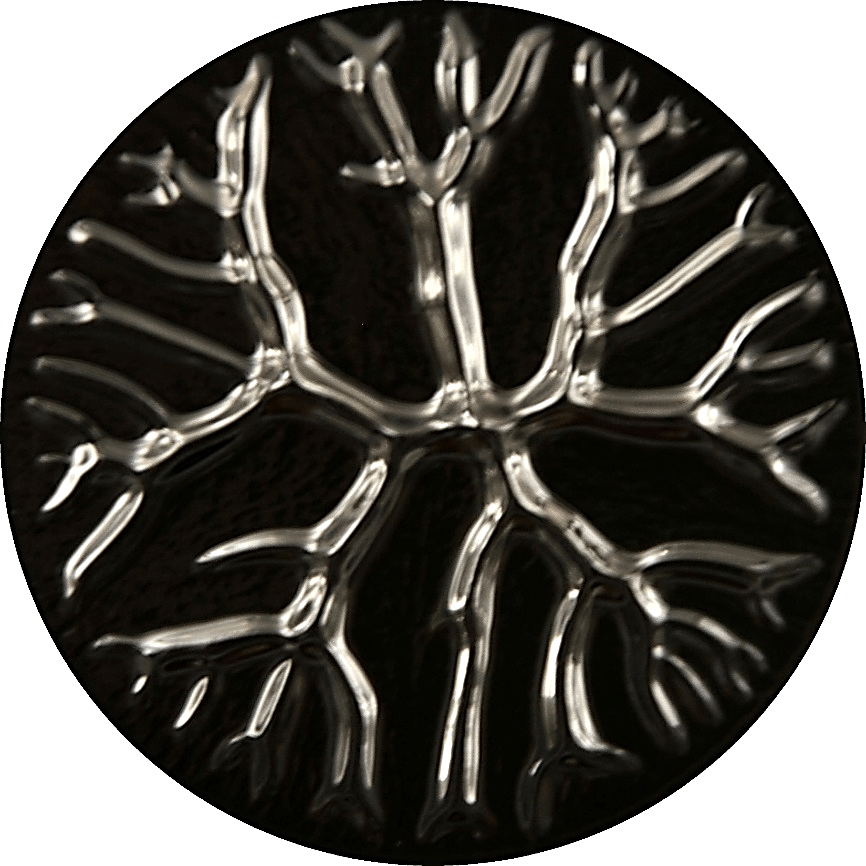
    If you sandwich a viscous fluid between two plates, then pull the plates apart, you’ll often get a complex branching pattern that forms as air pushes its way into the fluid. But the exact results depend strongly on what kind of viscous fluid you used. A new study looks specifically at what happens when that fluid is a yield-stress gel.

    Yield-stress fluids behave like a solid until a critical amount of force causes them to flow. Think about your toothpaste. When you take the cap off, the toothpaste stays put until you squeeze the tube enough to make it flow. The gels used in this experiment behave similarly.

    The researchers found that their gels required a critical energy input in order to branch and flow. If the energy applied in pulling the plates apart was too low, no branching occurred (Image 1). But beyond that critical energy, separating the plates created intricate branching patterns consistent with those seen in simpler, Newtonian fluids. (Image, research, and submission credit: T. Divoux et al.; via APS)

  • Artificial Microswimmers

    Artificial Microswimmers

    Tiny organisms swim through a world much more viscous than ours. To do so, they swim asymmetrically, often using wave-like motions of tiny, hair-like cilia along their bodies. Mimicking this behavior in artificial swimmers is tough; how would you actuate so many micro-appendages? A new study offers a different method: inducing cilia-like waves using magnetic fields.

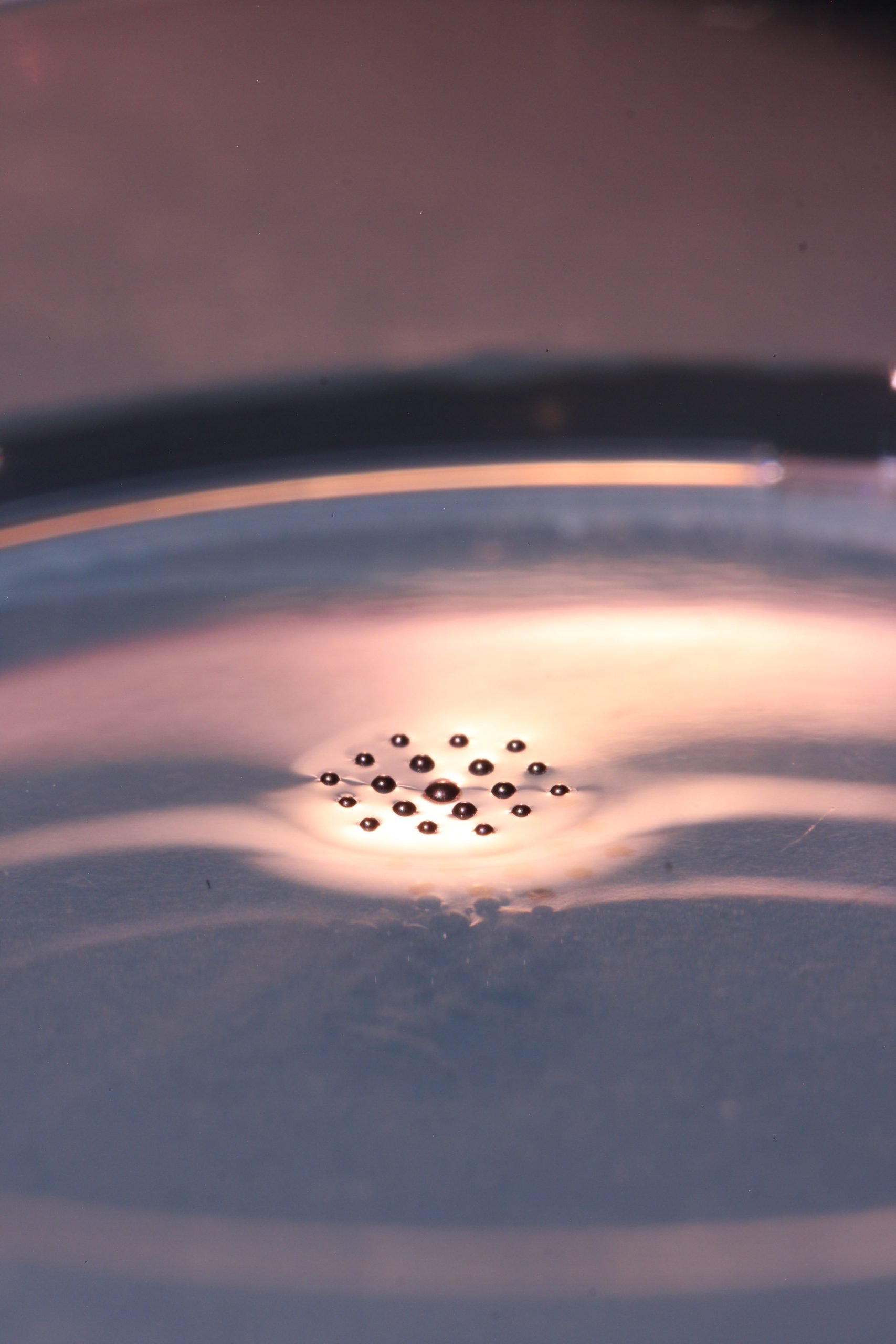
    The researchers’ microswimmers are actually arrays of ferromagnetic particles. The Cheerios effect helps draw the particles together, while magnetic repulsion pushes them apart. Together, these forces help the particles assemble into crystal-like arrays.

    To make the particles swim, the researchers shift the magnetic field. All of the outer particles of the array behave like individual cilia. As the magnetic field moves, the cilia-particles move in waves, much like their natural counterparts. Using this technique, the researchers were able to demonstrate both rotational and straight-line (translational) swimming. (Image, research, and submission credit: Y. Collard et al.)

  • Featured Video Play Icon

    Exploring Martian Mud Flows

    When looking at Mars and other parts of our solar system, planetary scientists are faced with a critical question: if what I’m looking at is similar to something on Earth, did it form the same way it does here? In other words, if something on Mars looks like a terrestrial lava flow, is it actually made of igneous rock or something else?

    To tackle this question, a team of researchers explored mud flows in a pressure chamber under both Earth-like and Martian conditions. They found that mud flowed quite freely on Earth, but with Martian temperatures and pressures, the flows resembled lava flows like those found in Hawaii or the Galapagos Islands.

    On Mars, mud begins boiling once it reaches the low pressure of the surface. This boiling cools it, causing the outer layer of the mud to freeze into an increasingly viscous crust, which changes how the mud flows. In this regard, it’s very similar to cooling lava, even though the heat loss mechanisms are different. (Video and research credit: P. Brož et al.; image credit: N. Sharp; see also P. Brož; submitted by Kam-Yung Soh)

  • A Microfluidic Zoo

    A Microfluidic Zoo

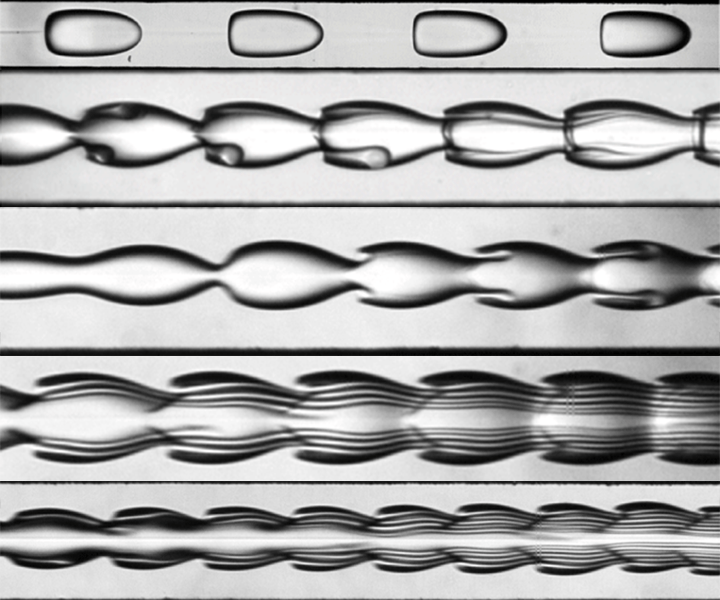
    Microfluidic channels are excellent at creating a steady supply of droplets. But depending on the characteristics of the two viscous fluids being used, as well as factors like flow rate and channel geometry, the results can be anything from well-defined and separated drops to steady jets to wild instabilities. The image above shows a series of different outcomes, including waves that break on the edges of drops and ligaments that stretch around the central fluid. (Image and research credit: X. Hu and T. Cubaud)

  • Using Electric Fields to Avoid Dripping

    Using Electric Fields to Avoid Dripping

    Anyone who’s painted a room at home is familiar with the frustration of drips. At certain inclinations, practically every viscous liquid develops these gravity-driven instabilities. They’re troublesome in manufacturing as well, where viscous films are often used to coat components and unexpected drips can ruin the process.

    To avoid this, researchers are adding electric fields into the mix. For dielectric fluids — liquids sensitive to electric fields — this addition acts like extra surface tension, stabilizing the film and preventing drips from forming. The researchers’ mathematical models predict the electric field strength necessary for a given fluid layer depending on its inclination. (Image credit: stux; research credit: R. Tomlin et al.; via APS Physics)

  • Featured Video Play Icon

    Coalescence in Heavy Metal Droplets

    When a drop of water falls into a pool, it doesn’t always coalesce immediately. Instead, it can go through a coalescence cascade in which the drop partially coalesces, a daughter drop bounces off the surface, settles, and itself partially coalesces. We’ve seen this many times before, but today’s video shows something a little different: here the drop and pool in question are made of a gallium alloy immersed in a background of sodium hydroxide. This means that the drop has very high surface tension (and density) but does not form an oxidation layer on its surface that could inhibit coalescence. And just like the water droplet, the gallium alloy undergoes a series of partial coalescences.

    A heavy metal droplet undergoes partial coalescence with a pool of the same liquid.

    There’s one key difference, though. Did you notice that the water droplets bounce higher as the drops get smaller, but the gallium droplets do the opposite? Previous research suggested that the droplet rebound height is driven by capillary forces, but the high surface tension of both of these liquids means that capillary forces should be large for both of them. Perhaps there’s much more viscous drag in the gallium and sodium hydroxide case? (Image, video, and research credit: R. McGuan et al.)

  • Featured Video Play Icon

    A Dance of Hydrogen Bubbles

    Hydrogen bubbles rise off zinc submerged in hydrocholoric acid in this short film from the Beauty of Science team. In high-speed video, the rise of the bubbles is stately and mesmerizing. Notice how the smallest bubbles appear as perfect spheres; for them, surface tension is strong enough to maintain that spherical shape even against the viscous drag of their buoyant rise. Larger bubbles, formed from mergers both seen and unseen, have a harder time staying round. In them, surface tension must battle gravitational forces and drag from the surrounding fluid. (Image and video credit: Beauty of Science; via Laughing Squid)

  • Kneading Dough

    Kneading Dough

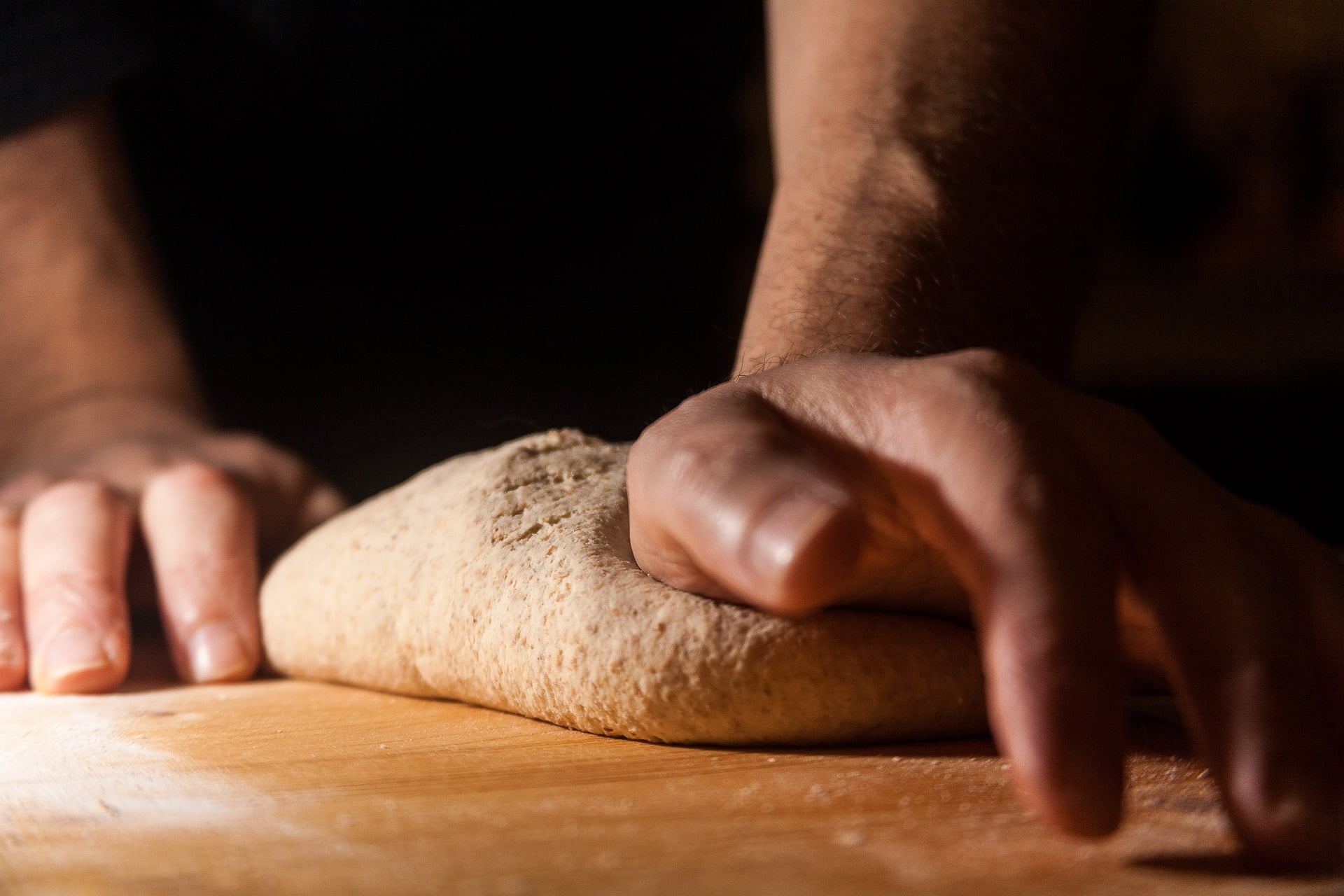
    Kneading bread dough is something of an art. The process binds flour, water, salt, and yeast into a network that is both elastic and viscous. It also traps pockets of air that will determine the texture of the final loaf. Underknead and the bubbles won’t form; overknead and the result will be a dense loaf that doesn’t rise in the oven.

    Capturing all of that physics in a realistic model is tough, but researchers have done so and validated their digital dough against experiments. The group focused on simulating industrial mixers, which knead dough with a moving, spiral-shaped rod rotating around a stationary vertical one. They found the industrial set-up did not mix as well as kneading by hand, but that could be improved by swapping the stationary rod for a second spiral one. (Image credit: G. Perricone; research credit: L. Abu-Farah et al.; via Physics World; submitted by Kam-Yung Soh)

  • CU Flow Vis 2019

    CU Flow Vis 2019

    I love when science and art come together, which is why I’ve long been a fan of the Flow Vis course at CU Boulder. Some of my earliest posts on FYFD date from previous editions of the course. Here are a few of my favorite images from the Fall 2019 class, from the top:

    •  Ferrofluid and India ink merge in this colorful photo. A magnet underneath the mixture on the left side causes the dark spikes of ferrofluid, but without magnetic influence, the ink and ferrofluid form cell-like droplets.
    • Although it looks like a shower head, this is actually fluorescent oobleck dripping through a strainer. A relatively long exposure time means that it’s impossible to tell whether the oobleck is falling in a fluid stream or broken-up chunks.
    • These colorful water droplets are sitting on a hydrophobic surface, hence their extremely rounded edges. I particularly like how this makes each one like a little lens for the light shining through them and into their shadows.
    • A thin layer of ferrofluid reacts to the magnet beneath. Gotta love those little streaks left behind the flow.

    For those in the Front Range area, the Flow Vis class will be showcasing their work on Saturday, December 14th at the Fiske Planetarium. Snacks are at 4:30 pm and the show starts at 5 pm. For those not nearby, you can peruse the art from this semester and previous ones at your leisure online. (Image credits: colorful ferrofluid – R. Drevno; falling oobleck – A. Kumar; droplets – A. Barron; macro ferrofluid – A. Zetley)