
The daily ebb and flood of the tides results from the competing forces of the Earth’s rotation and the sun and moon’s gravitational pull on the oceans. In a few areas, the local topography funnels the incoming water into a tidal bore with a distinctive leading edge. The photo above comes from the Turnagain Arm of the Cook Inlet in Alaska, where bore tides can reach a height of 7 ft and move as quickly as 15 mph. For surfers, the bore can provide a long ride–40 minutes in this case–but they can be extremely dangerous as well. Bore tides are associated with intense turbulence capable of ripping out moorings and structures; the waves are often accompanied by a roar caused by air entrainment, impact on obstacles, and the erosion of underlying sediment. (Photo credit: S. Dickerson/Red Bull Illume; via Jennifer Ouellette)
Search results for: “turbulence”

Fluids Round-up – 11 January 2014
It’s a big fluids round-up today, so let’s get right to it.
- Over at txchnologist, there’s a great article on controlling combustion instabilities in rocket engines with sound.
- Quanta Magazine asks if knot theory can help unravel turbulence. (submitted by iamaponyrocket)
- SciAm takes a look at how FIFA finally got their aerodynamics right so that their video game football (soccer) balls fly correctly.
- The Smithsonian considers an important question: can you fry foods in space?
- The Navy unveiled a fantastic new facility for simulating ocean waves (via J. Ouellette)
- At SciAm, there’s a nice explanation of the polar vortex and its effects on recent freezing weather. For additional background, check out this excerpt from a presentation by meteorology professor Jennifer Francis. (via Nicholas Travers)
- Cold weather also brings a host of new viral videos; NatGeo explains some of the science behind instant snow, ice fog, and frozen bubbles. See also: our own explanation of the instant snow phenomenon.
- io9 looks at the physics of knuckleballs.
- Over at Wired, Rhett Allain questions whether dwarves should stand in floating barrels. Also on the subject of The Hobbit, here’s an analysis of fire-breathing in dragons.
- At SciAm, Kyle Hill explains how inertia lets one pour a drink toward the sky.
- SciAm reports on a manufacturing process for superhydrophobic paper.
- I don’t know what banking has to do with a pool of non-Newtonian fluids, but this Malaysian ad sure makes it look fun. (via physicsphysics and jmlinhart)
- Wired has a great write-up on the mantis shrimp, which kills its prey with cavitation.
- io9 tackles explaining one of the most vexing brain teasers in fluid dynamics, the Feynman sprinkler.
- Finally, today’s lead image comes from our friends at Think Elephants, who study elephant intelligence over in Thailand and occasionally capture the animals’ mastery of fluid dynamics. Be sure to check them out and follow them on Twitter and Facebook.
(Photo credit: Think Elephants International/R. Shoer)

Fluids Round-up – 7 December 2013
Fluids round-up time! I missed out last weekend because of the holidays, so this is a long list of links. There’s a lot of really great stuff here, including some neat fluidsy geophysics and astronomy.
- xkcd’s Randall Munroe explains why you can’t boil your tea by stirring it.
- LATimes describes a flying jellyfish robot.
- Wired takes a detailed look at archerfish physics, including some of the fluid dynamics we’ve discussed previously. (via iamaponyrocket)
- Several readers have also pointed out this ASCII CFD simulator, seen in action in this video.
- New models suggest that Europa’s chaotic terrain features may be due to turbulence in its lower latitudes.
- In a similar vein, nearby Jupiter’s Great Red Spot may owe its longevity to existing in three-dimensions.
- NASA revealed new movies and images of Saturn’s polar hexagon this week. For more, see some of the earlier photos and laboratory recreations of the hexagon and this summary from io9. (submitted by @AndrisPiebalgs)
- Continuing with the astronomical bent, check out Anders Sandberg’s musings on what a habitable planet twice the size of Earth would be like.
- Back here on Earth, NASA released some impressive images of global weather patterns as computed by their high-resolution models.
- PhysicsBuzz takes a look at the fluid dynamics of flying fish.
- I’ve seen plenty of videos of people doing crazy things with non-Newtonian fluids, but Hard Science adds an interesting new one: attempting to ride a bike across a pool of oobleck.
- PopSci reported from CES 2013 about a non-Newtonian fluid for protecting tech gadgets from impacts.
- Drummer Ali Siadat shows how to blow the perfect smoke rings using a bass drum. (via Jennifer Ouellette)
- Finally, this week’s lead image comes from the Grand Canyon where a strong temperature inversion created spectacular fog-filled vistas.
(Photo credit: E. Whittaker)
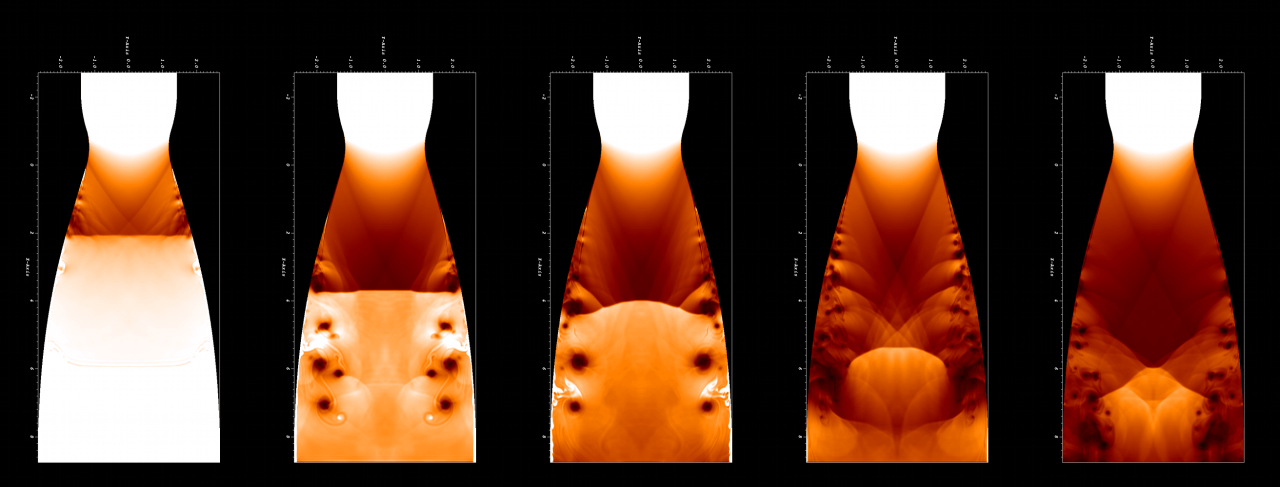
Start Your Rocket Engine
When supersonic flow is achieved through a wind tunnel or rocket nozzle, the flow is said to have “started”. For this to happen, a shock wave must pass through, leaving supersonic flow in its wake. The series of images above show a shock wave passing through an ideal rocket nozzle contour. Flow is from the top to bottom. As the shock wave passes through the nozzle expansion, its interaction with the walls causes flow separation at the wall. This flow separation artificially narrows the rocket nozzle (see images on right), which hampers the acceleration of the air to its designed Mach number. It also causes turbulence and pressure fluctuations that can impact performance. (Image credit: B. Olson et al.)

Flow Behind a Cylinder
Flow over blunt bodies produces a series of alternating vortices that are shed behind an object. The image above shows the turbulent wake of a cylinder, with flow from right to left. Red and blue dyes are used to visualize the flow. This flow structure is known as a von Karman vortex street, named for aerodynamicist Theodore von Karman. The meander of the wake is caused by the shed vortices, each of which has a rotational sense opposite its predecessor. The rapid mixing of the two dyes is a result of the flow’s turbulence. In low Reynolds number laminar cases of this flow the structure of individual vortices is more visible. Similar flow structures are seen behind islands and in the wakes of flapping objects. (Photo credit: K. Manhart et al.)

Mixing Flows
Turbulence is an excellent mixer. Here two fluorescent dyes are injected into a turbulent water jet. Flow is from the bottom of the image toward the top. The dyes are quickly mixed into the background fluid by momentum convection, their concentration decreasing with increased distance from the source. Large-scale structures like the eddies visible in this image drive this convection of momentum in turbulent flows. In contrast, consider laminar flows, where momentum and molecular diffusion dominate how fluids move. In such laminar flows, it’s even possible to unmix two fluids, a feat that cannot be accomplished in the jet above. (Photo credit: M. Kree et al.; via @AIP_Publishing)

Oil Flow Viz
Fluorescent oil sprayed onto a model in the NASA Langley 14 by 22-Foot Subsonic Wind Tunnel glows under ultraviolet light. Airflow over the model pulls the initially even coat of oil into patterns dependent on the air’s path. The air accelerates around the curved leading edge of the model, curling up into a strong lifting vortex similar to that seen on a delta wing. At the joint where the wings separate from the body those lifting vortices appear to form strong recirculation zones, as evidenced by the spiral patterns in the oil. Dark patches, like those downstream of the engines could be caused by an uneven application of oil or by areas of turbulent flow, which has larger shear stress at the wall than laminar flow and thus applies more force to move the oil away. Be sure to check out NASA’s page for high-resolution versions of the photo. (Photo credit: NASA Langley/Preston Martin; via PopSci)

Fluid Dynamics and the Nobel Prize

Last night marked the 2013 Ig Nobel Prize Award Ceremony, in which researchers are honored for work that “makes people LAUGH and then THINK”. Historically, the field of fluid dynamics has been well-represented at the Ig Nobels with some 13 winners across the fields of Physics, Chemistry, Mathematics, and–yes–Fluid Dynamics since the awards were introduced in 1991. This is in stark contrast to the awards’ more famous cousins, the Nobel Prizes.
Since the introduction of the Nobel Prize in 1901, only two of the Physics prizes have been fluids-related: the 1970 prize for discoveries in magnetohydrodynamics and the 1996 prize for the discovery of superfluidity in helium-3. Lord Rayleigh (a physicist whose name shows up here a lot) won a Nobel Prize in 1904, but not for his work in fluid dynamics. Another well-known Nobel laureate, Werner Heisenberg, actually began his career in fluid dynamics but quickly left it behind after his doctoral dissertation: “On the stability and turbulence of fluid flow.”
This is not to suggest that no fluid dynamicist has done work worthy of a Nobel Prize. Ludwig Prandtl, for example, revolutionized fluid dynamics with the concept of the boundary layer (pdf) in 1904 but never received the Nobel Prize for it, perhaps because the committee shied from giving the award for an achievement in classical physics. General consensus among fluid dynamicists is that anyone who can prove a solution for turbulence using the Navier-Stokes equation will likely receive a Nobel Prize in addition to a Millennium Prize. In the meantime, we carry on investigating fluids not for the chance at glory, but for the joy and beauty of the subject. (Image credits: Improbable Research and Wikipedia)

Shocking Instabilities
The Richtmyer-Meshkov (RM) instability occurs when the interface between two fluids of different density is impulsively accelerated – usually by the passage of a shock wave. The image above shows a thin layer of gaseous sulfur hexafluoride embedded in air. Each vertical line, from left to right, shows the distortion of the two fluids at subsequent time steps after a Mach 1.2 shock wave passes through the gases. The interface’s initial waviness grows into mushroom-like shapes that mix the two gases together, ultimately leading to turbulence. Scenarios involving the RM instability include supersonic combustion ramjet engines, supernovas, and inertial confinement fusion. The RM instability is closely related to Rayleigh-Taylor instability and shares a similar morphology. (Photo credit: D. Ranjan et al.)

H Booms
Holidays involving fireworks deserve high-speed videos of hydrogen explosions. Although Periodic Table of Videos focuses on the chemistry involved in setting hydrogen on fire, there are some lovely fluid dynamics on display, too. There’s turbulence, combustion (obviously), and, if you watch closely, you can even see the initial vorticity caused by the rubber’s burst twisting the growing flames. (Video credit: Periodic Table of Videos)
