Search results for: “shear”

  • Devising Greener Chemistry

    Devising Greener Chemistry

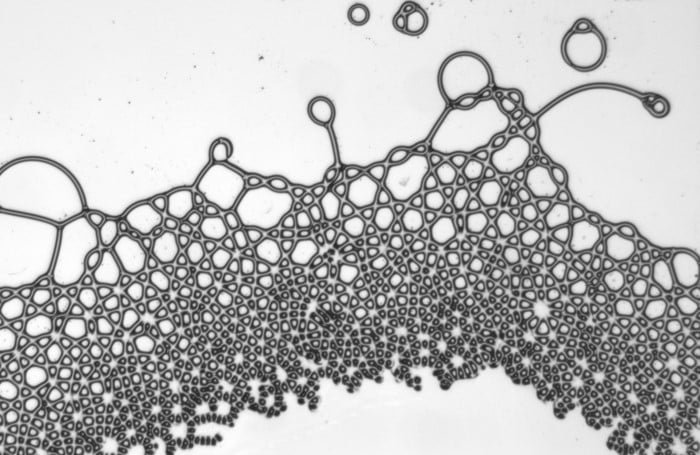
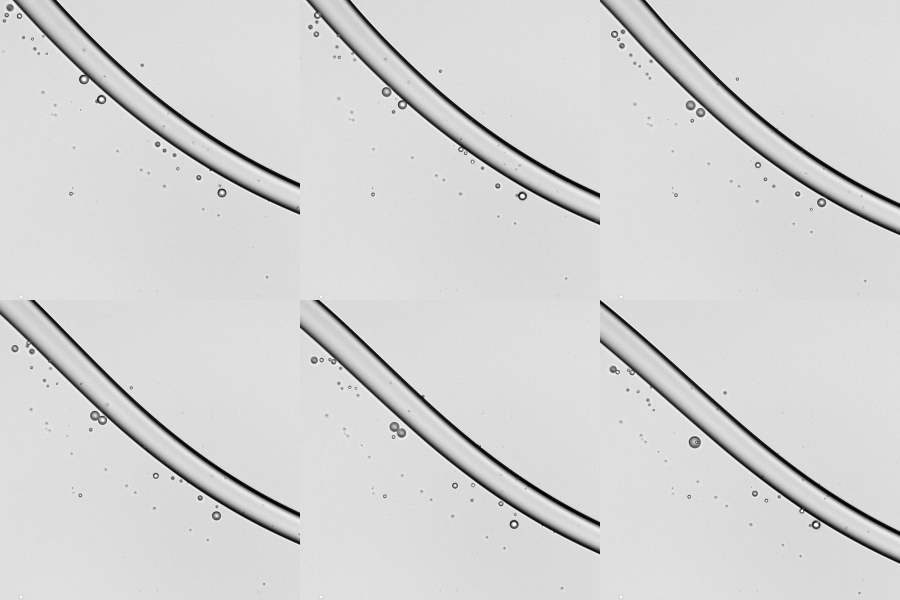
    Not all microfluidic devices use tiny channels to pump and mix fluids. Some, like the Vortex Fluidic Device (VFD), conduct their microfluidic mixing in thin films of fluid. The VFD is essentially a tube spinning at several thousand RPM that can be tilted to various angles. Coriolis forces, shear, and Faraday instabilities in the thin fluid film create a complex microfluidic flow field that’s excellent for mixing, crystallization, and processing of injected chemicals. One rather notorious application of this device was unboiling an egg, a feat for which the researchers won an Ig Nobel Prize. But other, more practical applications abound, including a waste-free method for coating particles. (Image and research credit: T. Alharbi et al.; video credit: Flinders University; via Cosmos; submitted by Marc A.)

  • Snail Locomotion

    Snail Locomotion

    Snails and other gastropods move using their single muscular foot and a viscoelastic fluid they secrete. Muscular waves in the foot run from tail to head and are transmitted to the ground through the thin, sticky mucus layer without the snail ever fully detaching from the surface. The characteristics of this mucus layer are critical to the snail’s locomotion. As a movement cycle begins, the mucus behaves like an elastic solid. As the muscular wave approaches, it shears the fluid, increasing its stress and ultimately reaching the yield point, where the gel begins to flow. Once the wave passes, the mucus quickly transitions back to its elastic solid behavior. The net result of each cycle is an asymmetric force that propels the snail forward while keeping it adhered to whatever surface it’s crawling on.

    Many animals rely on similarly complex fluids to move, attack prey, defend against predators, or enable their reproduction. Check out this review article for more examples. (Image credit: A. Perry; see also P. Rühs et al.; submitted by Pascal B.)

  • Jovian Auroras

    Jovian Auroras

    Like Earth, Jupiter is home to polar auroras that light the sky as charged particles interact with the planet’s magnetosphere. A recent paper identifies interesting features in the aurora that appear similar to expanding vortex rings (see inset below). Although the researchers cannot yet identify the origin of the rings, they hypothesize that the process begins at the far edges of Jupiter’s magnetosphere where it interacts with the incoming solar wind. One theory posits that shear flows and Kelvin-Helmholtz instabilities where the magnetosphere and solar wind meet drive the phenomenon. (Image credit: Jupiter – NASA, ESA, and J. Nichols, aurora features – NASA/SWRI/JPL-Caltech/SwRI/V. Hue/G. R. Gladstone/B. Bonfond; research credit: V. Hue et al.; via Gizmodo)

    Diagram showing an inset of Jupiter's northern aurora, with further insets showing the expanding ring features.
  • Featured Video Play Icon

    Protecting From Storm Surge

    The most dangerous and destructive part of a tropical cyclone isn’t the wind or rain; it’s the storm surge of water moving inland. This landward shift of ocean takes place because of a cyclone’s strong winds, which drive the water via shear. The depth storm surges reach depends on the wind speed and direction, shape of the shoreline, and many other factors, making exact predictions difficult.

    Fortunately, engineers can — with enough foresight and investment — build structures and networks to help protect developed land from storm surge flooding. (Image and video credit: Practical Engineering)

  • Featured Video Play Icon

    Chasing Tornadoes

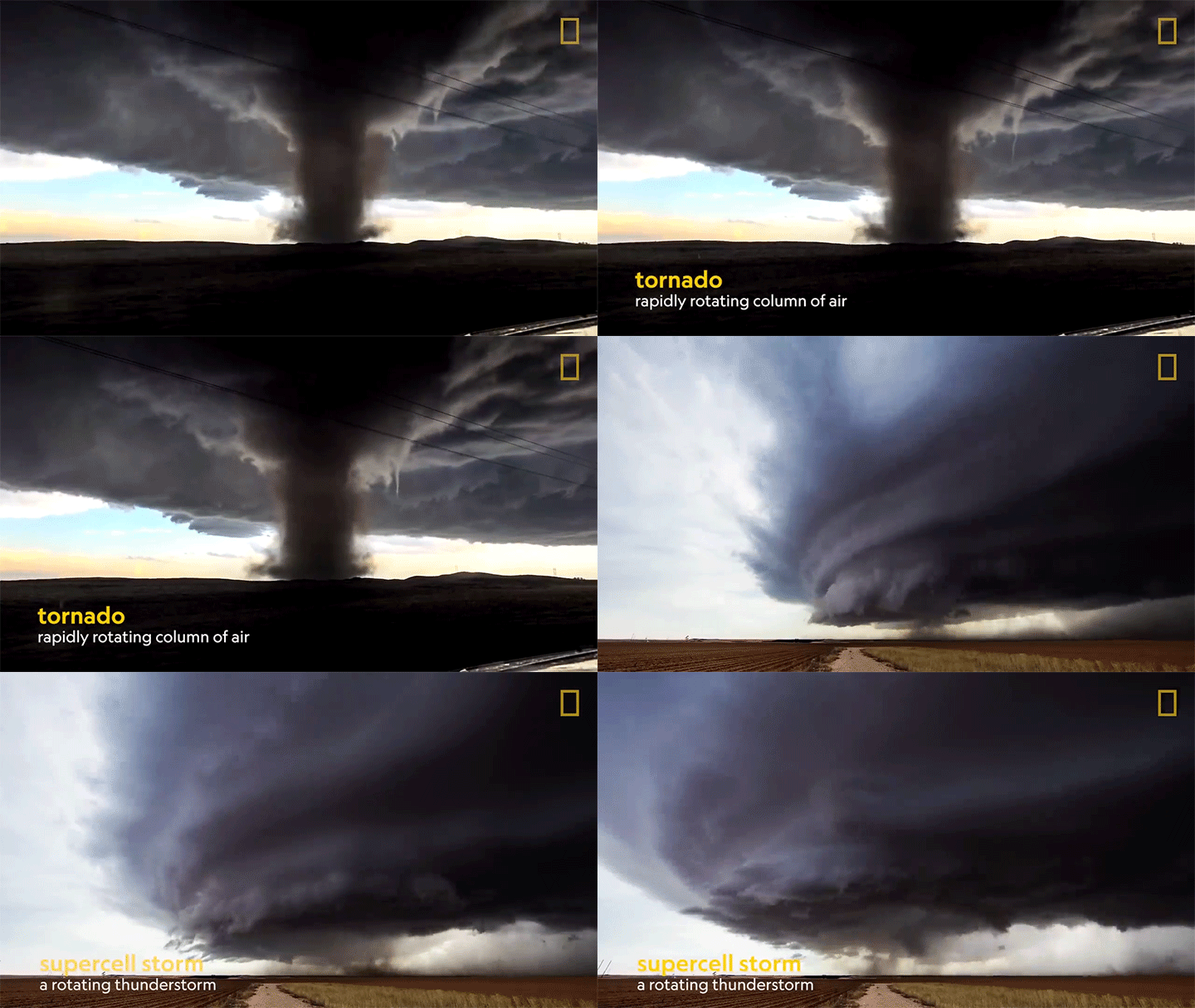
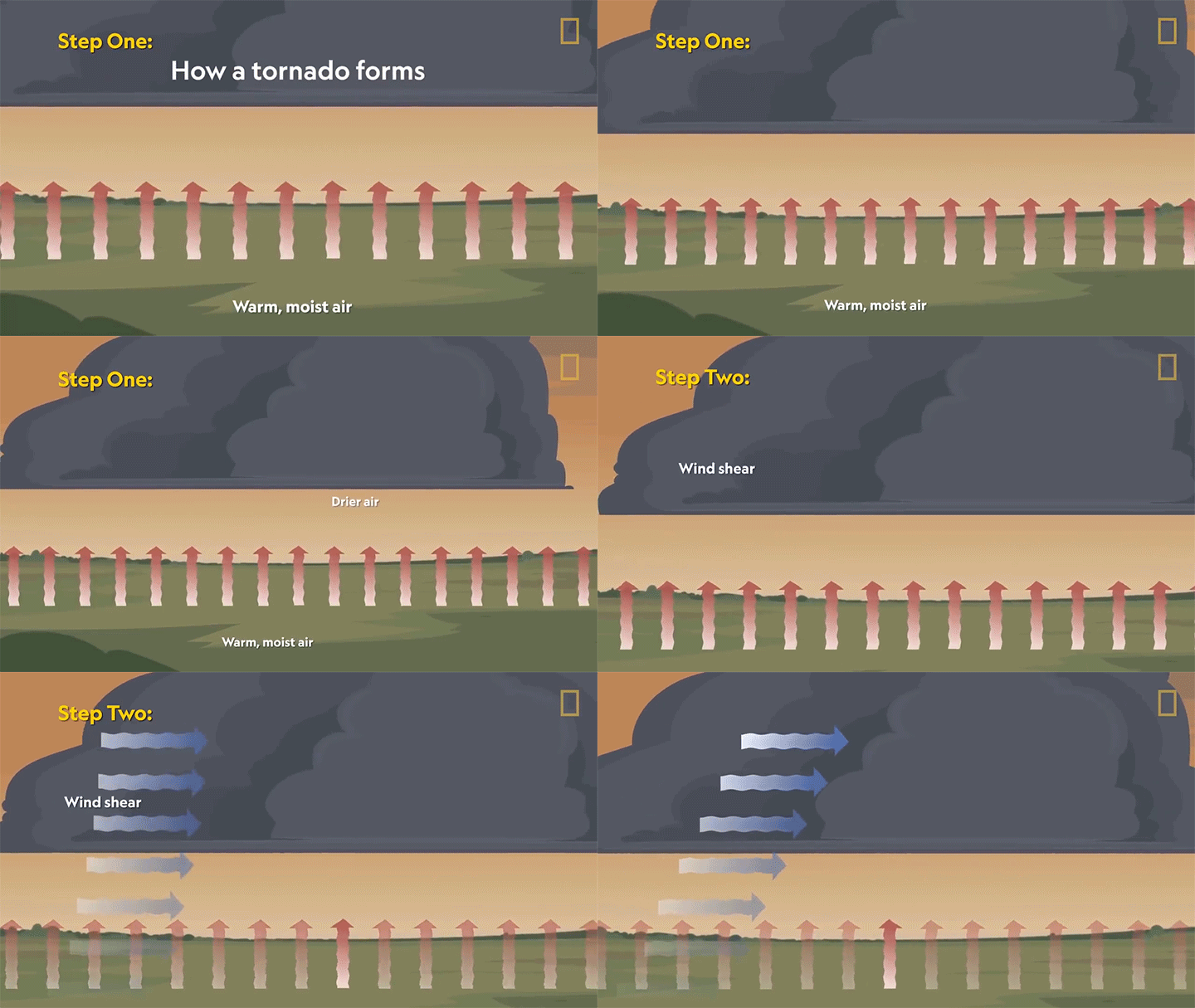
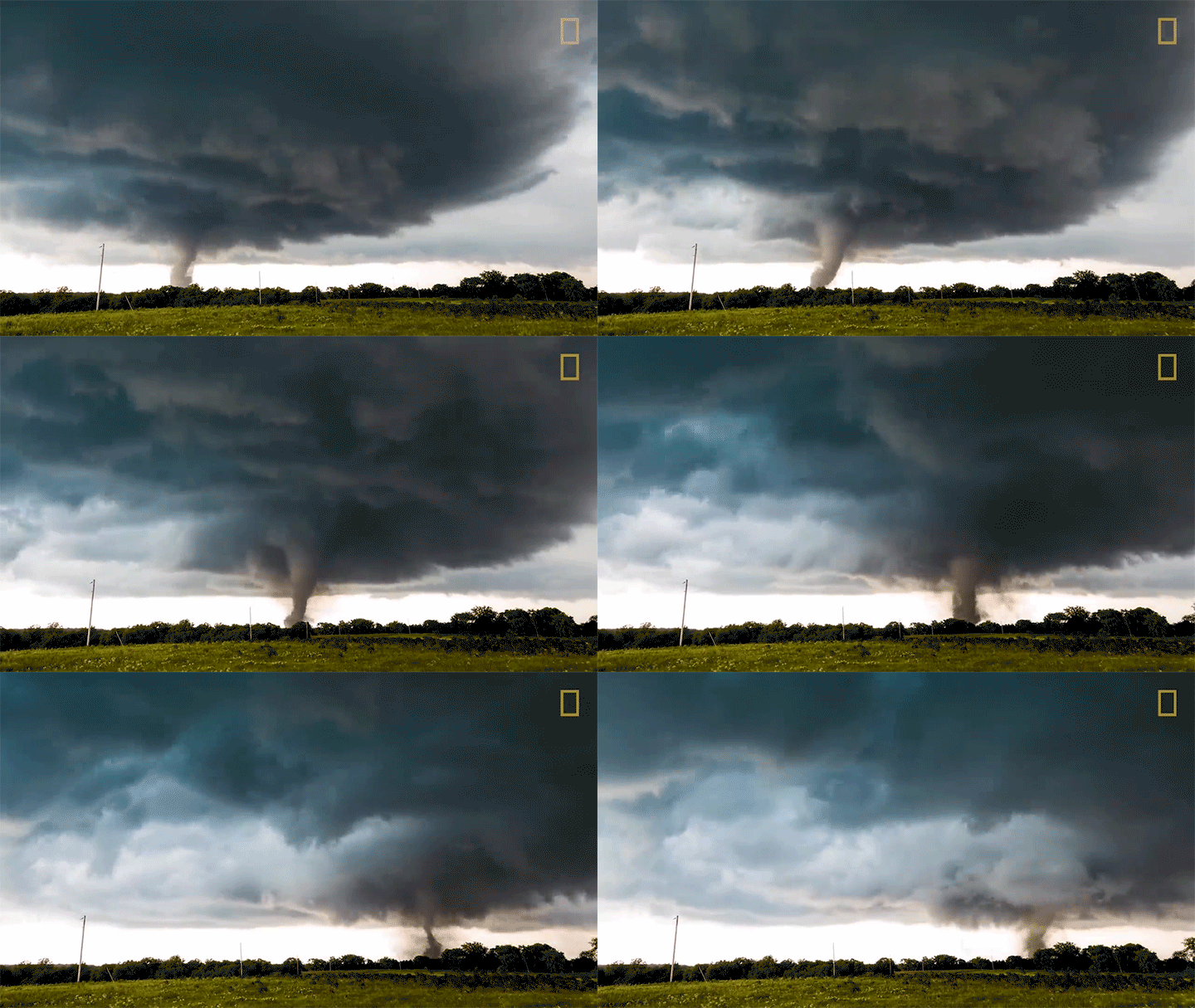
    Tornadoes are some of the most powerful storms on Earth. Their difficult-to-predict nature means that we still have a relatively scant understanding of exactly how they form. We know the conditions that promote their development — warm, moist rising air, wind shear, and rotation — but how and when those translate into a dangerous funnel cloud is harder to pin down. In this video, we hear from one of National Geographic’s storm researchers, Anton Seimon, who chases these storms in search of answers. (Image and video credit: National Geographic)

  • Sunset Swirls

    Sunset Swirls

    This gorgeous photograph of Kelvin-Helmholtz clouds was taken in late December in Slovenia by Gregor Riačevič. The wave-like shape of the Kelvin-Helmholtz instability comes from shear between two fluid layers moving at different relative speeds. Here on Earth, clouds like these are often short-lived, but we see similar structures in the atmospheres of gas giants like Jupiter and Saturn. (Image credit: G. Riačevič; submitted by Matevz D.)

  • Colorful Kelvin-Helmholtz Clouds

    Colorful Kelvin-Helmholtz Clouds

    Like breaking waves at the beach, these wavy clouds curl but only for a moment. The photo was captured near sunset on a late August evening in Arlington, MA. This short-lived cloud shape forms due to the Kelvin-Helmholtz instability, which is driven by shear forces between two layers of air moving at different speeds. The situation is a common one in the atmosphere, where air layers at altitude move in different directions and at different speeds. Most of the time we cannot see the curls that form between these air layers because of air’s transparency. But occasionally the mismatch happens right at a cloud layer and the condensation of the cloud gets pulled into these distinctive curls. (Image credit: B. Bray; submitted by Mark S.)

  • Ghostly Chandeliers

    Ghostly Chandeliers

    Highlighter ink sinks from the surface of water, like upside-down green mushrooms.

    Under a black light, highlighter fluid creates ghostly trails as it drips through water. The vortices that form and break into this chandelier-like shape are the result of density differences between the ink and water. Since ink is heavier than water, it sinks, but as the two fluids flow past, they shear one another, forming elaborate shapes. Formally, this is known as the Rayleigh-Taylor instability. While you may be most familiar with it from pouring cream into coffee, it’s also a key to mixing in the ocean and the explosions of supernovas. (Image credit: S. Adams et al.; via Flow Vis)

  • The Vortex Beneath a Drop

    The Vortex Beneath a Drop

    While we’re most used to seeing levitating Leidenfrost droplets on a solid surface, such drops can also form above a liquid bath. In fact, the smoothness of the bath’s surface, combined with mechanisms discussed in a new study, means that drops will levitate at a cooler temperature over a liquid than they will over a solid surface.

    Researchers found that a donut-shaped vortex forms in the bath beneath a levitating droplet, but the direction of the vortex’s circulation is not always the same. For some liquids, the flow moves radially outward from beneath the drop. In this case, researchers found that the dominant force was shear stress caused by the vapor escaping from under the droplet.

    With other droplet liquids, the flow direction instead moved inward, forming a sinking plume beneath the center of the drop. In this situation, researchers found that evaporative cooling dominated. As the liquid beneath the droplet cooled, it became denser and sank. At the same time, the lower temperature changed the bath’s local surface tension, creating the inward surface flow through the Marangoni effect. (Image credit: F. Cavagnon; research credit: B. Sobac et al.)

  • A Lenticular Cloud With a Curl

    A Lenticular Cloud With a Curl

    Lens-shaped lenticular clouds are not terribly rare in mountainous areas, but observers at Mount Washington caught a very unusual cloud near sunrise in late February. This lenticular cloud had an added curl on top thanks to the Kelvin-Helmholtz instability!

    Lenticular clouds form when air is forced to flow up over a mountain in such a way that its temperature and pressure drop and water vapor in the air condenses. The resulting water droplets form a cloud that appears stationary over the mountain, even though the air continues to flow.

    To get that added wave-like curl, there needs to be another, faster-moving layer of air just above the cloud. As that air flows past, it shears the cloud layer, causing the interface to curl. Neither of these cloud types is long-lived — Kelvin-Helmholtz formations often last only a few minutes — so catching such a great dual example is lucky, indeed! (Image credit: Mount Washington Observatory; via Smithsonian Magazine; submitted by Kam-Yung Soh)