Search results for: “rayleigh taylor”

  • A Stellar Look at NGC 602

    A Stellar Look at NGC 602

    The young star cluster NGC 602 sits some 200,000 light years away in the Small Magellanic Cloud. Seen here in near- and mid-infrared, the cluster is a glowing cradle of star forming conditions similar to the early universe. A large nebula, made up of multicolored dust and gas, surrounds the star cluster. Its dusty finger-like pillars could be an example of Rayleigh-Taylor instabilities or plumes shaped by energetic stellar jets. (Image credit: NASA/ESA/CSA/JWST; via Colossal)

    Fediverse Reactions
  • Growing Flexible Stalactites

    Growing Flexible Stalactites

    Icicles and stalactites grow little by little, each layer a testament to the object’s history. Here, researchers explore a similar phenomenon, grown from a dripping liquid. They’re called “flexicles” in homage to their natural counterparts, and they start from a thin layer of elastomer liquid. Though it begins as a liquid, elastomer solidifies over time.

    Timelapse video showing the formation of an initial layer of flexicles from a dripping elastomer.
    Timelapse video showing the formation of an initial layer of flexicles from a dripping elastomer.

    To form flexicles, the researchers spread a layer of elastomer on an upside-down surface and allow gravity to do its thing (above). Thanks to the Rayleigh-Taylor instability, the dense elastomer forms a pattern of drips that, after hardening, creates a pebbled surface. Subsequent layers of elastomer will drip from the same spots as before, slowly growing longer flexicles (below). The team envisions using them for soft robotics, but, personally, I just really want poke at them and wiggle them. (Image and research credit: B. Venkateswaran et al.; via APS Physics)

    A stitched composite photo showing flexicles on a cylinder growing layer by layer.
    A stitched composite photo showing flexicles on a cylinder growing layer by layer.
  • Featured Video Play Icon

    “Ink In The Water. Mix One.”

    In this ASMR video, black ink diffuses in water. When the video starts, the ink is so diffuse that it’s not apparent the video is playing backward. It’s only as specific structures — things like Rayleigh-Taylor instabilities, plumes, and jets — coalesce from the background that we recognize the time reversal. Though it’s probably unintentional, this makes for a neat, subtle commentary on the nature of isotropic turbulence. (Video and image credit: Wryfield Lab)

  • Featured Video Play Icon

    “Aquakosmos – Ch. 2”

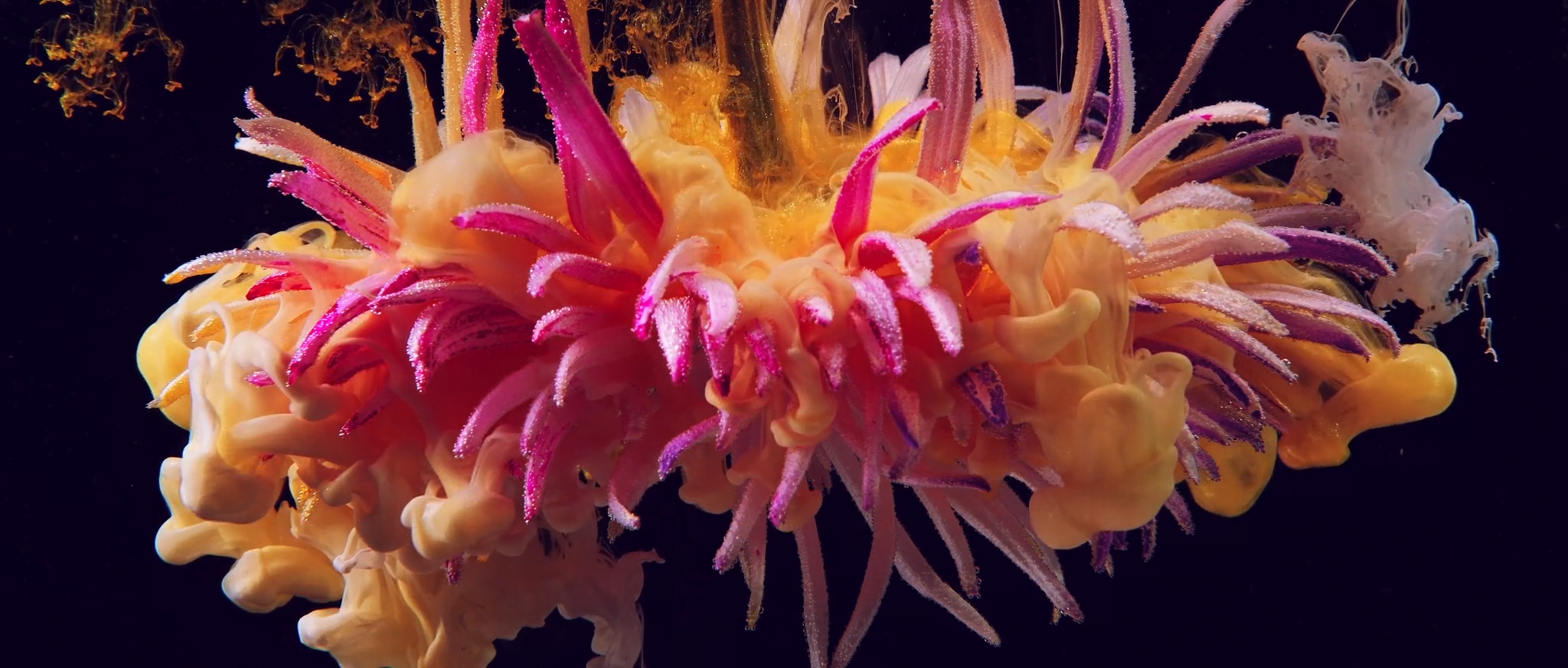
    Colored inks bulge and billow around flowers in filmmaker Christopher Dormoy’s “Aquakosmos – Ch. 2”. Because ink is denser than the surrounding water, it sinks, forming mushroom-like shapes as the Rayleigh-Taylor instability takes over. One of the fun things about this particular video is that we see the Rayleigh-Taylor instability at many different sizes, depending on the size and speed of different falling dyes. (Video and image credit: C. Dormoy)

  • Featured Video Play Icon

    “Emitter”

    For this latest experimental film, artist Roman De Giuli provides a glimpse of the unique fluid art machine he’s built over the last 3.5 years. With 10 channels driven by peristasltic tube pumps and stepper motors, his “printer” drips up to 10 colors on a paint-covered, tilted canvas to create these beautiful images. As he says in his description of the invention, the set-up produces paint layering that’s almost impossible to create by hand. Fluid dynamically speaking, we’re seeing gravity currents like a lava flow or avalanche that are mixing together viscously. There’s also some added effects from density differences between different layered paint colors. Artistically, this machine offers an infinite palette of visual opportunities; financially, though, De Giuli admits its an absolute beast at consuming paint! (Image and video credit: R. De Giuli)

  • Dripping Viscoelastics

    Dripping Viscoelastics

    An ultrasoft viscoelastic fluid drips in this research poster from the Gallery of Soft Matter. Complex materials like this one have stretchy, elastic behaviors typical of a solid along with the flowing, viscous properties of a fluid. Here, gravity overcomes the material’s elasticity, leaving it to sag and flow. As that happens, the fluid must slide past air, and the density difference between the two fluids creates the small distortions seen on the liquid sheet. This is an example of a Rayleigh-Taylor instability. (Image credit: J. Hwang et al.)

  • Featured Video Play Icon

    “Origin”

    Billowing turbulence, mushroom-like Rayleigh-Taylor instabilities, and spreading flows abound in Vadim Sherbakov’s “Origin.” The short film takes a macro looks at fluids — inks, alcohols, soaps, and other household liquids. It was filmed entirely on a DJI Pocket 2, a rather small, stabilized pocket camera. It’s a testament to what you can achieve with some experimentation and relatively inexpensive equipment. (Video and image credit: V. Sherbakov)

  • Featured Video Play Icon

    “Aquakosmos”

    Colorful chandeliers, passing spirits, sprouting mushrooms, and fountains of falling ink appear in Christopher Dormoy’s “Aquakosmos.” Driven by the slight density difference between ink and water, many of these elaborate shapes result from the Rayleigh-Taylor instability. Anytime you see mushroom-like plumes and chandelier-like splitting vortex rings, there’s probably a Rayleigh-Taylor instability behind it. Check out the full video above, and, if you want to give this kind of flow visualization a try yourself, a glass of water and vial of food coloring is a great place to start. (Video and image credit: C. Dormoy)

  • Featured Video Play Icon

    “Space Iris”

    Ruslan Khasanov’s “Space Iris” explores the similarities between nebulae and eyes. Made entirely with common fluids like paint, soap, and alcohol, the film shows off the gorgeous possibilities of surface-tension- and density-driven instabilities. Marangoni flows abound! I even see some hints of solutal convection, perhaps? (Video and image credit: R. Khasanov; via Colossal)

  • Instabilities on Instabilities

    Instabilities on Instabilities

    The world of fluid instabilities is a rich one. Combine fluids with differing viscosities, densities, or flow speeds and they’ll often break down in picturesque and predictable manners. Here, researchers explore the Rayleigh-Taylor instability (RTI), which occurs when a denser fluid sits above a less dense one (in a gravitational field). It’s an extremely common instability, showing up in both the cream in your ice coffee and the shape of a supernova’s explosion. It’s very difficult to set up and observe, though, which is where the real cleverness of this experiment stands out.

    To study the RTI, these researchers first created another instability, the Saffman-Taylor instability. They filled the space between two glass plates with a viscous fluid, then injected a less viscous one. That created the distinctive viscous fingering pattern seen in the top image. In addition to being less viscous, the injected fluid was also less dense. As it pushed into the original fluid, it displaced some of it, creating a three-layer structure with dense fluid over less-dense fluid over dense fluid. That laid the groundwork for the Rayleigh-Taylor instability form.

    A side-view through the fluid mixture shows the characteristic mushroom-like plume of the Rayleigh-Taylor instability.
    A side-view through the fluid mixture shows the characteristic mushroom-like plume of the Rayleigh-Taylor instability.

    Check out the cell-like pattern distributed across the fluid in the top image. These are plumes formed in the RTI as dense fluid sinks into the less-dense fluid below it. From the side (see second image), each plume takes on the distinctive mushroom-like shape of a Rayleigh-Taylor instability. Given time, the two fluids mix and the cellular pattern disappears. But until then, this set-up uses one instability to study a second one. How cool is that?! (Image and research credit: S. Alqatari et al., see also)