This high-speed video reveals a fascinating bit of kitchen sink physics. When a water droplet pinches off from the nozzle, the thin filament of fluid that connected the droplet to the water on the nozzle often breaks off as well. Surface tension snaps the filament together into a sphere, causing wild oscillations and even ejection of microjets in the tiny satellite droplet. (Video from S. Thoroddsen et al. 2008’s Annual Review)
Search results for: “high-speed video”

Soap Bubbles Bursting
To the human eye, the burst of a soap bubble appears complete and instantaneous, but high-speed video reveals the directionality of the process. Surface tension is responsible for the spherical shape of the bubble, and, when the bubble is pierced, surface tension is broken, causing the soap film that was the bubble to contract like elastic that’s been stretched and released. Droplets of liquid fly out from the edges of the sheet until it atomizes completely.
Bursting Bubbles
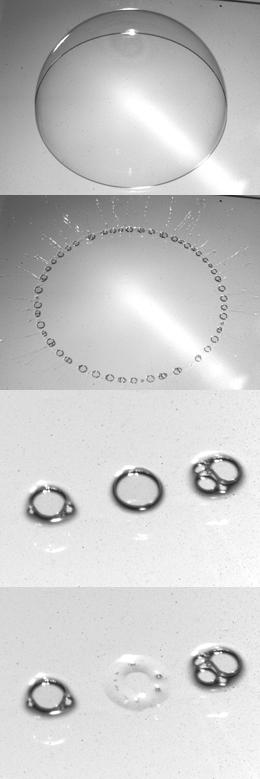
Sometimes bursting one bubble just leads to more bubbles. This high-speed video shows how popping a bubble sitting on a fluid surface can lead to a ring of daughter bubbles. When the surface of the bubble is ruptured, filaments of the liquid that made up the surface are drawn back toward the pool by surface tension, trapping small pockets of the air that had been inside the bubble. A dimple forms on the surface and rebounds as a jet that lacks the kinetic energy to eject droplets. Watch as the jet returns to the interface, and you will notice the tiny bubbles around it. At 56 ms, one of the daughter bubbles on the left bursts. See Nature for more. (Video credit: J. Bird et al)
Flapping to Fly Efficiently
High-speed video shows that bats achieve some of their efficiency in flight by pulling their wings inward on the upstroke, as seen above. While this does affect drag forces on the wing slightly, the primary energy savings comes from the inertial ease of lifting the folded wing. Much the way it is easier to lift your arm when it is folded than when you stretch it outright, it takes less energy for the bat to lift a folded wing than one that is fully extended. (via Wired Science)
Vibrating Oil
This high-speed video shows the behavior of oil on a vibrating surface. As the amplitude of the vibration is altered various behaviors can be observed. Initially small waves appear on the surface of the oil, then the surface erupts into a mass of jets and ejected droplets, reminiscent of a vibrated interfaces within a prism or vibration-induced atomization. When the amplitude is reduced after about half a minute, we see Faraday waves across the surface, as well as tiny droplets that bounce and skitter across the surface. They are kept from coalescing by a thin layer of air trapped between the droplet and the oil pool below. Because of the vibration, the air layer is continuously refreshed, keeping the droplet aloft until its kinetic energy is large enough that it impacts the surface of the oil and gets swallowed up.
Jumping Water Droplets
Superhydrophobic surfaces resist wetting from water, but it turns out they can also trigger interesting behaviors in the tiny droplets condensing on the surface. High-speed video reveals that when two condensate droplets coalesce, the energy released by surface tension causes the new droplet to jump off the surface. The phenomenon is the same as one observed in some types of mushroom–when a condensate droplet touches a wetted spore, the spore is ejected from the mushroom. (Video credit: J. Boreyko)
Soap Film Breakup
This high-speed video shows a soap film formed across two rings and its deformation and breakup as the two rings are pulled apart. As the rings get further apart, surface tension deforms the soap film until the distance is too great to continue sustaining that shape. The film breaks into two–a sheet of soap film in each ring–and a little satellite bubble. Note the similarities in breakup between this soap film and a thin liquid column or water from a faucet.
Water Drops on Sand
This high-speed video captures the impact of liquid droplets onto a granular surface. While there is some similarity to liquid-solid and liquid-liquid impacts, the permeability of the granular surface helps to “freeze” the splash rather quickly. Energy is dissipated in the initial impact, causing a splash of grains. Then the surface tension, viscosity and inertia of the droplet compete in causing the deformations seen in the video. The deformation appears strongly dependent on the kinetic energy with which the droplet hits the surface (i.e. proportional to the height from which it is dropped). (Video credit: G. Delan et al)
Dove in Flight
This spectacular high-speed video shows a dove in flight. Note how its wings flex through its stroke and the way the wings rotate over the course of the downstroke and reversal. There is incredible beauty and complexity in this motion. The change in wing shape and angle of attack is what allows the bird to maximize the lift it generates. Note also how the outer feathers flare during the downstroke. This promotes turbulence in the air moving near the wing, which prevents separated flow that would cause the dove to stall. (See also: how owls stay silent. Video credit: W. Hoebink and X. van der Sar, Vliegkunstenaars project)
Inside a Blender
[original media no longer available]
High-speed video visualizes the complicated flow field inside a blender. Note that the video is placed in reverse for artistic effect. This flowfield is clearly too turbulent for reversible flow. That said, it is possible to mix two fluids and then unmix them, under the right circumstances.