For a little more than century, mankind has taken flight in fixed-wing aircraft. But other species have flown for much longer using flapping techniques, the details of which humans are still unraveling. To really appreciate flapping flight, it helps to have high-speed video, like this beautiful footage of a goshawk attacking a water balloon. The motion of the hawk’s wings is far more complex than the simple up and down flapping we imitate as children. On the downstroke, the wings and tail stretch to their fullest, providing as large an area as possible for lift. During steady flight, the bird flaps while almost horizontal for minimal drag, but as it approaches its target, it rears back, allowing the downstroke to both lift and slow the bird. In the upstroke, the bird needs to avoid generating negative lift by pushing air upward. To do this, it pulls its wings in and simultaneously rotates them back and up. Its tail feathers are also pulled in but to a lesser extent. Leaving them partially spread probably maintains some positive lift and provides stability. At the end of the upstroke, the hawk’s wings are ready to stretch again, and so the cycle continues. (Video credit: Earth Unplugged/BBC; h/t to io9)
Search results for: “high-speed video”

Shooting a Bullet Through a Water Balloon
This high-speed video of a bullet fired into a water balloon shows how dramatically drag forces can affect an object. In general, drag is proportional to fluid density times an object’s velocity squared. This means that changes in velocity cause even larger changes in drag force. In this case, though, it’s not the bullet’s velocity that is its undoing. When the bullet penetrates the balloon, it transitions from moving through air to moving through water, which is 1000 times more dense. In an instant, the bullet’s drag increases by three orders of magnitude. The response is immediate: the bullet slows down so quickly that it lacks the energy to pierce the far side of the balloon. This is not the only neat fluid dynamics in the video, though. When the bullet enters the balloon, it drags air in its wake, creating an air-filled cavity in the balloon. The cavity seals near the entry point and quickly breaks up into smaller bubbles. Meanwhile, a unstable jet of water streams out of the balloon through the bullet hole, driven by hydrodynamic pressure and the constriction of the balloon. (Video credit: Keyence)
Impacts on Sand
Granular materials like sand are sometimes very fluid-like in their behaviors. The high-speed video above shows a ball bearing being dropped into packed sand. Many features of the splash are fluid-like; the initial impact creates a spreading crownlike splash, followed by a strong upward jet that eventually collapses back into the medium. At the same time, many of the impact characteristics are decidedly non-fluidic. Sand has no surface tension, so both the crown and the jet readily break up into small particles. The granular jet is very narrow and energetic, reaching heights greater than the impacter’s drop height. Interestingly, the column begins collapsing on its lower end before the jet even reaches its highest peak. This may be due to the lower energy of the sand particles that were ejected later in the crater formation process. (Video credit: J. Verschuur, B. van Capelleveen, R. Lammerink and T. Nguyen)
Holiday Fluids: What is Fire?
Snowy holidays and long, dark nights are a great time to sit by the fire or enjoy some candlelight. We’ve talked before about how buoyancy affects a flame’s shape, how atomization mixes liquid fuel and oxidizers, how flames propagate, how internal combustion works and how instabilities can end combustion. But in all that we haven’t addressed what fire actually is! Combustion is a chemical process–a reaction between a hydrocarbon fuel and oxygen, but the flame we’re accustomed to seeing is a combination of blue light produced by the complete reaction and incandescent red/orange/yellow light from glowing soot particles produced when there is insufficient oxygen for the reaction. If you have time after the Minute Physics version, this video from Ben Ames has a wonderful explanation of flames. Of course, if you just prefer your holiday fun with more explosive high-speed videos, you’re going to want to see this Christmas tree made from detonation cord (see 2:40 for the start of the best part). This wraps up our holiday-themed fluid dynamics series. Happy holidays from FYFD! (Video credit: Minute Physics)
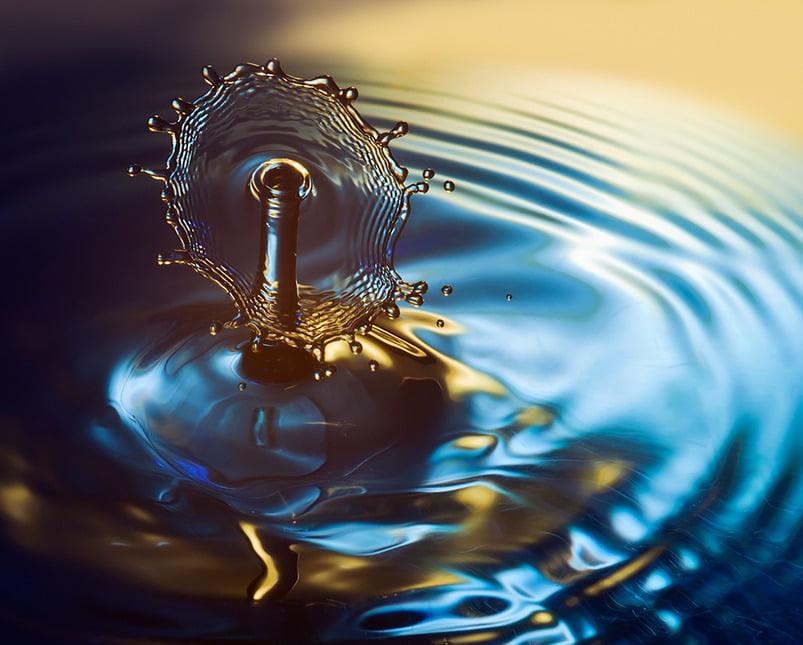
Liquid Umbrella
When a water drop strikes a pool, it can form a cavity in the free surface that will rebound into a jet. If a well-timed second drop hits that jet at the height of its rebound, the impact creates an umbrella-like sheet like the one seen here. The thin liquid sheet expands outward from the point of impact, its rim thickening and ejecting tiny filaments and droplets as surface tension causes a Plateau-Rayleigh-type instability. Tiny capillary waves–ripples–gather near the rim, an echo of the impact between the jet and the second drop. All of this occurs in less than the blink of an eye, but with high-speed video and perfectly-timed photography, we can capture the beauty of these everyday phenomena. (Photo credit: H. Westum)
Avoiding Splashback
Here’s a likely Ig Nobel Prize candidate from the BYU SplashLab: a study of splashing caused by a stream of fluid entering a horizontal body of water or hitting a solid vertical surface. In other words, urinal dynamics. The researchers simulated this activity using a stream of water released from a given height and angle and observed the resulting splash with high-speed video. They found a stream falls only 15-20 centimeters before the Plateau-Rayleigh instability breaks it into a series of droplets, and that this is the worst-case scenario for splash-back. The video above shows how a stream of droplets hits the pool, creating a complex cavity driven deeper with each droplet impact. Not only does each impact create a splash, the cavity’s collapse does as well. Similarly, when it comes to solid surfaces, they found that a continuous stream splashes less. They’ve also put together a helpful primer on the best ways to avoid splash-back. (Video credit: R. Hurd and T. Truscott; submitted by Ian N., bewuethr, John C. and possibly others)
For readers attending the APS DFD meeting, you can catch their talk, “Urinal Dynamics,” Sunday afternoon in Session E9 before you come to E18 for my FYFD talk.

Fluids Round-up – 13 July 2013
Prepare yourselves for lots of links in today’s fluids round-up!
- Longtime FYFD favorite Mark Stock (see here, here, and here) and his collaborator James Susinno have unveiled a new interactive art piece, “Everything is Made of Atoms” that utilizes some impressive real-time fluids simulation. NVIDIA’s blog has some details on the computing.
- ScarbsF1 takes a detailed look at the F-duct used to stall an F1 car’s rear wing to reduce drag. (submitted by Vinnie)
- Just in time for summer fun, National Geographic talks about the physics of water slides.
- SpaceX’s reusable Grasshopper rocket has set a new altitude test of over 1000 ft. Check out this feat of aerodynamic control over at io9.
- Stanford engineers are using high-speed video of birds in the wild to study the mechanics of flapping flight. If you check out their video, you’ll notice how the birds rotate their wings as they flap in order to maximize lift throughout the flapping cycle. (via io9)
- Speaking of io9, they highlighted a couple of great examples of meteorological fluid dynamics recently: roll clouds and water spouts.
- New research suggests that thresher sharks may whip their tails quickly enough to produce cavitation-induced shockwaves to stun their prey. If so, they join the pistol and mantis shrimp in utilizing this technique for hunting.
- If you’re looking for some casual games, Liquid Sketch is a fun fluids puzzle game for iOS (submitted by Keri B)
- Finally, congratulations to Toronoto’s AeroVelo for capturing the AHS Sikorsky Prize with their human-powered helicopter. Check out this video from their historic flight (submitted by Chris R).
(Photo credit: AeroVelo)
H Booms
Holidays involving fireworks deserve high-speed videos of hydrogen explosions. Although Periodic Table of Videos focuses on the chemistry involved in setting hydrogen on fire, there are some lovely fluid dynamics on display, too. There’s turbulence, combustion (obviously), and, if you watch closely, you can even see the initial vorticity caused by the rubber’s burst twisting the growing flames. (Video credit: Periodic Table of Videos)
Droplet Bounce
This high-speed video shows the remarkable resilience of a water droplet upon impact against as a solid surface. The droplet deforms into a pancake-shape, with its center depressing almost flat before rebounding upward. The rest of the drop follows, splitting into several droplets as capillary waves dance across its surface. When one satellite drop almost escapes, the main droplet just barely comes in contact with it, the coalescence enough to tip surface tension into pulling them together instead of breaking them apart. (Video credit: K. Suh/ChemistryWorldUK)
Inside a Blender
The fluid dynamics of a commercial-quality blender amount to a lot more than just stirring. Here high-speed video shows how the blender’s moving blades create a suction effect that pulls contents down through the middle of the blender, then flings them outward. This motion creates large shear stresses, which help break up the food, as well as turbulence that can mix it. But if you watch carefully, you’ll also see tiny bubbles spinning off the blades. These bubbles, formed by the pressure drop of fluid accelerated over the arms of the blades, are cavitation bubbles. When they collapse, or implode, they create localized shock waves that further break up the blender’s contents. This same effect is responsible for damage to boat propellers and lets you destroy glass bottles. (Video credit: ChefSteps; via Wired; submitted by jshoer)