In this high-speed video, two flexible spheres are dropped from the same height. The one on the left is filled with air, the other is partially filled with a liquid. Although both spheres rebound to nearly the same height after the first bounce, their behavior differs drastically after that. The sloshing of the liquid inside the sphere acts as a damper, absorbing energy that would otherwise cause the ball to continue bouncing. The effects of contained liquids sloshing are important for understanding the dynamics of tankers, fuel on spacecrafts, and even how to walk without spilling your coffee.
Search results for: “high-speed video”
Seed-Ejection via Raindrop
[original media no longer available]
We don’t often think of plants as using fluid dynamics aside from capillary action drawing water from their roots, but many plants also use fluid dynamics to disperse reproductive materials. This high-speed video explores the efficacy of splashing raindrops at ejecting seeds from different blossoms. (Video credit: G. Amador et al)

Stone-Skipping Physics
Many people have learned to throw skipping stones across a pond or lake, but how many have considered the physics of how it happens? In this video, researchers use high-speed video to explore the skipping of various balls across water. The deformation of the ball as well as the shape of the cavity its impact creates determines whether it rebounds off the water’s surface.
Sewer Combustion
Enjoy a little high-speed video of combustion (the safe way!) this Thanksgiving holiday. For non-U.S. folks, have a great Thursday!
Diesel Ignition
In a diesel engine, ignition of the injected fuel occurs due to the heat caused by the compression of the fuel/air mixture. (In petrol/gasoline engines, spark plugs are used for ignition.) The subsequent expansion of gases drives the pistons of the engine downward, creating mechanical energy. This high-speed video shows the in-cylinder combustion within a diesel engine. Note the symmetry and vorticity of the flow.
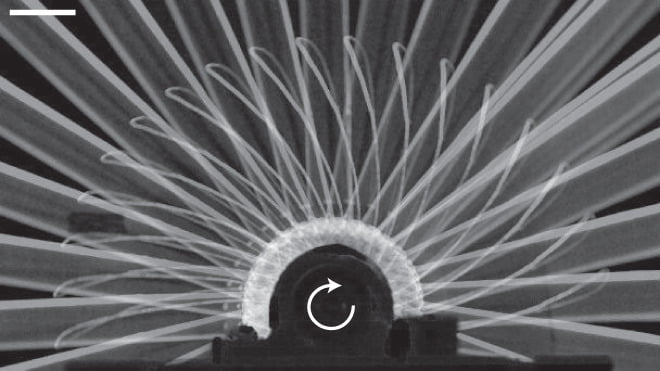
Jump Rope Aerodynamics
Researchers have used high-speed video and numerical simulation to capture the effects of aerodynamics on jump roping. After videoing an athlete jumping rope and constructing a jump roping robot (shown above imaged multiple times with a strobe light), they found that the U-shaped tip of the jump rope bends away from the direction of motion. When they built a computer model capable of deforming the jump rope based on its drag, they found the same behavior. They concluded that the “best” jump ropes are lightweight, short, and have small diameters to maximize speed and minimize the drag. #
Bullet Shock Wave and Cavitation
A 9mm bullet impacts a falling jet of water. High-speed video reveals the formation of a shock wave inside the jet. Because this shock wave is confined inside the jet, it causes strong secondary cavitation–the bubble that seems to explode in front of the bullet.
Soap Bubble Burst
High-speed video of a soap bubble being popped reveals the directionality of the process. Like a the rubber of a bursting balloon, the soap film rushes away from the point of rupture, disintegrating as the information about a sudden lack of surface tension is propagated across the remaining film surface. In this regard, it is much like what happens when you drop a slinky toy.
Blast Waves
[original media no longer available]
Watch closely in this high-speed video of a bomb exploding and you will see the spherical blast wave moving outward as a visual distortion. The increase in temperature caused by the leading shockwave changes the index of refraction of the air, bending the light and distorting our view of the background. The mechanism is similar to schlieren photography, which has been used for more than a century to capture images of compressible flows.
Atomization
Atomization–breaking a flowing liquid into a fine spray–is important for fuel injection in a variety of engines, including automobiles, jet engines, ramjets, scramjets, and rockets. The more effectively a liquid fuel can be dispersed as a spray in an engine, the more efficient and stable the combustion will be. The apparatus in this high-speed video injects an annular water sheet with concentric jets of air on either side of the water. The video series shows the effects of increasing the outer and inner air velocities relative to the water on the breakup of the liquid. What to the naked eye looks like a deluge, high-speed video reveals as a complex undulating structure.