Search results for: “flow visualization”

  • Psychedelic Cymatics

    Psychedelic Cymatics

    image

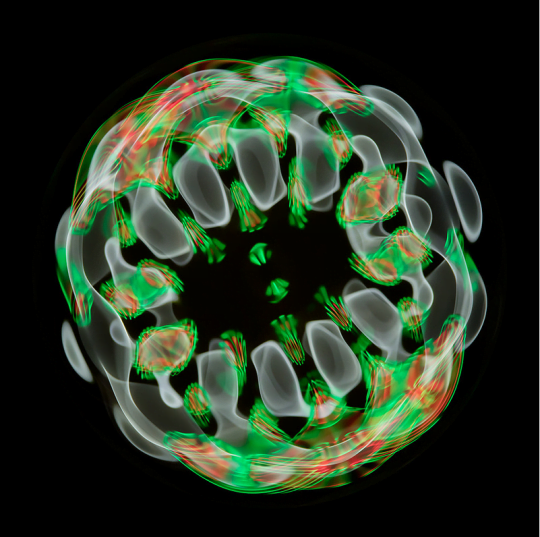
    Cymatics are the visualization of vibration and sound. Here photographer Linden Gledhill has taken a simple speaker vibrating a dish of water and turned it into some incredible art. When you vibrate liquids like water up and down, it disturbs the usually flat air-water interface and creates waves on the surface. These Faraday waves are a standing wave pattern that differs depending on which sound is being played. By combining the wave patterns with LED lighting and strobe effects, Gledhill creates some remarkable images that combine sound, light, and fluid dynamics all in one. If you watch the video (make sure to hit the HD button!), you’ll see the patterns in motion and hear the sounds used to generate them. In the last clip (around 0:19), he’s added glitter to the set-up, which highlights the circulation within the vibrating fluid. As you can see, there are strong recirculating regions in each lobe of the pattern, but other areas, like the center region are almost entirely stationary. You can see more photos from the project in his Flickr feed. Special thanks to Linden for letting me post the video of his work, too! (Video and image cred

    its and submission: L. Gledhill)

    If you enjoy FYFD, please consider becoming a patron to help make sure the Internet keeps getting its daily dose of fluid dynamics!

  • Featured Video Play Icon

    Bullet-Time Inferno

    Remember the bullet time effect from The Matrix? This spectacular video gives you a similar effect with the turbulent flames created by firebreathers. To capture this level of detail, Mitch Martinez uses an array of 50 cameras placed around the performers, allowing him to reconstruct the full, three-dimensional representation of the flames. Similarly, some scientists use arrays of high-speed video cameras to collect 3D, time-resolved data about phenomena like combustion. Because these flows are so complex in terms of their fluid dynamics and chemistry, capturing full 3D data is important to help understand and model the flow better. (Video credit: M. Martinez; via Rakesh R.)

  • Featured Video Play Icon

    The Upside-Down Jellyfish

    The upside-down jellyfish Cassiopea lives along the sea bottom in coastal regions. As its name suggests, the jellyfish rests upside-down with its bell against the sea floor and its frilly oral arms pointed upward. This jellyfish is a filter feeder, and it draws water up and through its arms by pulsing its bell. The video above visualizes this flow using dye. Each pulse propels fluid up through the arms and draws in fresh water from the surroundings. The frilly arms break up any large vortices from the pulsed flow and diffuse the filtered water as it moves upward. (Video credit: Applied Fluid Mechanics Laboratory at Oklahoma State University)

  • Rowing Water Striders

    Rowing Water Striders

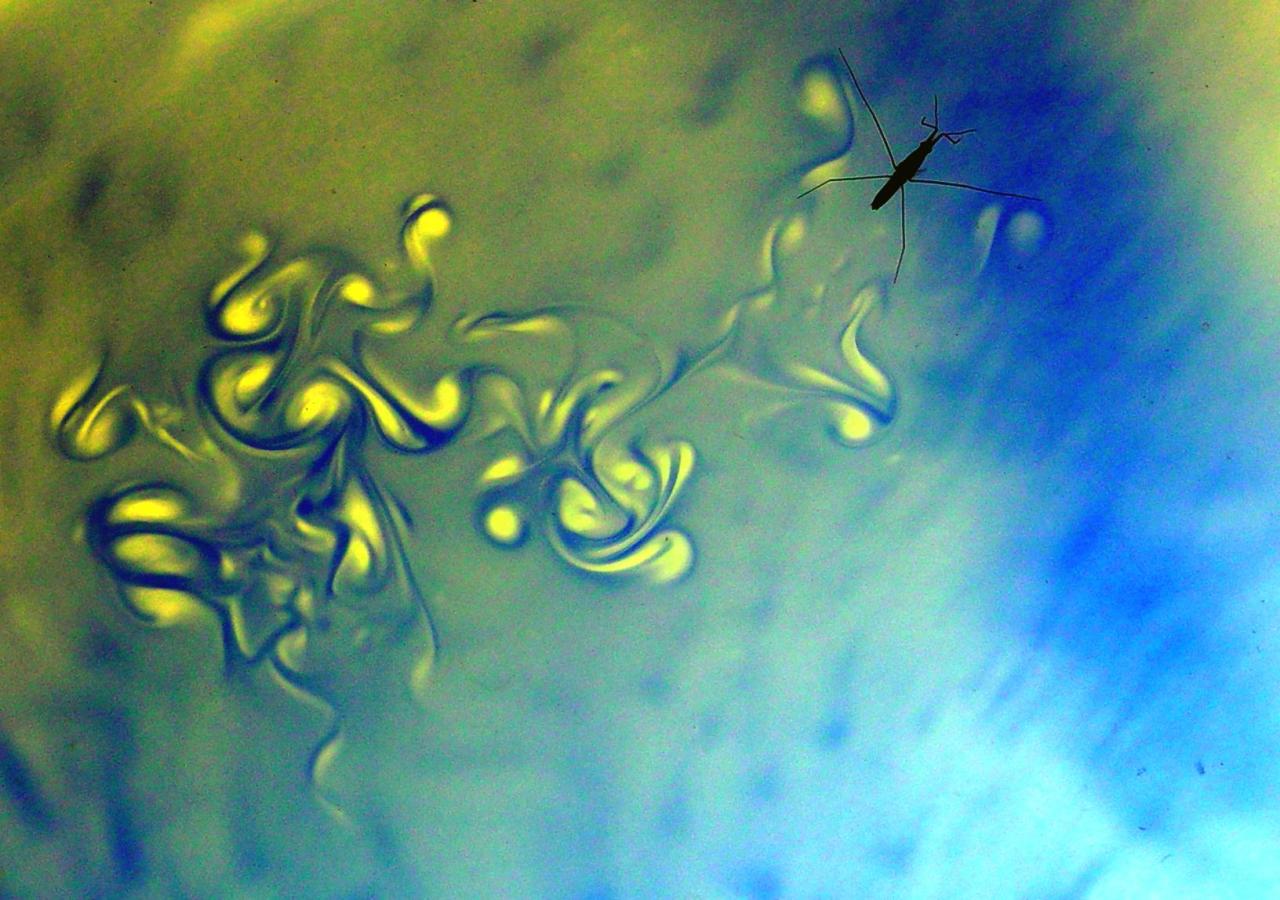
    Water strider insects are light enough that their weight can be supported by surface tension. For some time, they were thought to propel themselves by using their long middle legs to generate capillary waves–ripples– that pushed them forward, but juvenile water striders are too small for this technique to work. Instead researchers found that water striders move by using their middle legs like oars. The leg motion creates vortices about 4 mm below the water surface, and this water moving backward propels the insect forward. In the photos above, the scientists visualized the flow by sprinkling thymol blue on the water and letting the striders move freely. You can learn more about the work here or in this Science Friday episode. (Photo credits: J. Bush et al.)

  • Interrupting Sediments

    Interrupting Sediments

    The pier at Progreso extends 6.5 kilometers into the Gulf of Mexico, creating an artificial obstruction to ocean flow and sediment transport near the shore. The first 2 kilometers of the pier are built on arches that allow some flow through, but the newer sections do not. Prevailing winds act from the east-northeast, driving flow roughly right to left in the image. The sediment traces flow around the pier and reveals the complicated flow-shadow downstream of the newer parts of the pier. (Image credit: NASA Earth Observatory)

  • Vertical-Axis Wind Turbines

    Vertical-Axis Wind Turbines

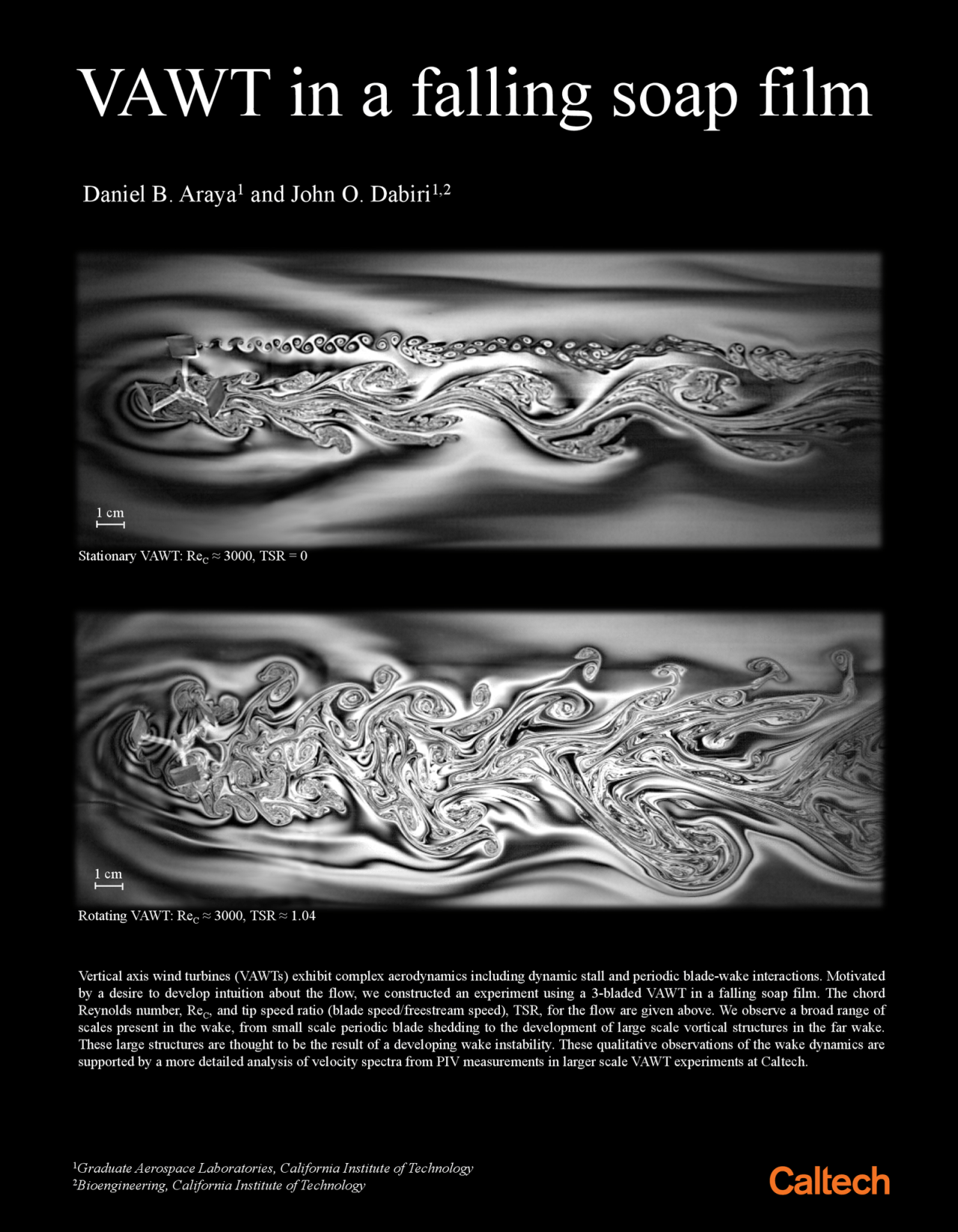
    Vertical-axis wind turbines (VAWT) are an alternative to traditional wind turbine designs. Unlike their more common cousins, VAWTs rotate about a vertical axis and are omni-directional, meaning that they do not have to be pointed into the wind to produce power. While their size allows VAWTs to be packed much closer to one another than traditional turbines, a clear understanding of the flow around the turbines is needed in order to place the turbines for effective and efficient operation. The images above show the complicated and turbulent wake of a three-bladed VAWT when stationary (top) or rotating (bottom). The flow is visualized using a gravity-driven soap film (flowing left to right in the images) pierced by a model VAWT (seen at the left). The wakes contain many scales from simple, periodically-shed vortices off a blade to very large-scale vortical structures forming downstream of the turbine. This work originally appeared as a poster in the Gallery of Fluid Motion at the 2014 APS DFD Annual Meeting. (Image credit: D. Araya and J. Dabiri)

  • Filter-Feeding

    Filter-Feeding

    Sponges are filter-feeding marine animals that rely on water flow to obtain their nutrients and remove waste. By injecting non-toxic fluorescein dye at their base, one can visualize the flow they induce in the water. Only seconds after the dye is introduced, the sponges have pumped it in, through, and out. Different parts of the sponge filter particles of various sizes for food. Oxygen and carbon dioxide are transported, respectively, into and out of cells via diffusion. In this way, the sponge’s pumping fulfills digestive, respiratory, and excretory functions.  (Image credit: Jonathan Bird’s Blue World, source video; submitted by Jason C)

  • Colonial Life

    Colonial Life

    Hydroids are small underwater animals that often live in colonies made up of individual polyps. The colony is interconnected through the gastrovascular system, which is responsible for both digestion and respiration. In the images above, a single polyp in the colony has been fed food dyed with a fluorescent tracer. The polyp serves as a circulating pump and, as the food is digested and the tracer released, more and more of the colony becomes visible. Watch the full video and read more about the experiment. (Video credit and submission: L. Buss Lab)

  • Featured Video Play Icon

    Inside the Strait of Gibraltar

    When a fluid is stratified into layers, it’s possible to have waves generated and transmitted along the interface between layers. Because these waves remain inside the bulk fluid, they are called internal waves. They often occur in the atmosphere or the ocean as fluids with different properties move past changing terrain. The Strait of Gibraltar is an excellent source of internal waves. The tidal exchange of waters between the Mediterranean Sea and Atlantic Ocean takes place through a narrow corridor interrupted by the peak of Camarinal Sill. The internal waves generated by the constriction are large enough that their effect on the surface flow is visible to satellites. The video above visualizations data from a numerical simulation of flow through the Strait, showing the obstacles, flow, and wave structures generated. (Video credit: J.C. Sanchez Garrido et al.)

  • Tip Vortex

    Tip Vortex

    Smoke released from the end of a test blade shows the helical pattern of a tip vortex from a horizontal-axis wind turbine. Like airplane wings, wind turbine blades generate a vortex in their wake, and the vortices from each blade can interact downstream as seen in this video. These intricate wakes complicate wind turbine placement for wind farms. A turbine located downstream of one of its fellows not only has a decreased power output but also has higher fatigue loads than the upstream neighbor. In other words, the downstream turbine produces less power and will wear out sooner. Researchers visualize, measure, and simulate turbine wakes and their interactions to find ways of maximizing the wind power generated. (Photo credit: National Renewable Energy Laboratory)