Search results for: “droplet”

  • Bouncing to Mix Oil and Water

    Bouncing to Mix Oil and Water

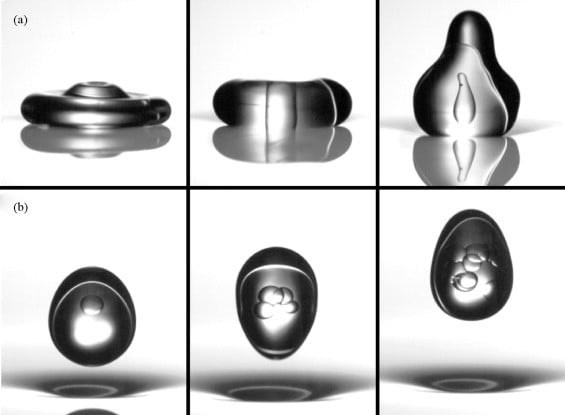
    Mixing immiscible liquids–like oil and water–is tough. The best one can usually do is create an emulsion, in which droplets of one fluid are suspended in another. The series of images above shows a double emulsion consisting of oil and water that’s been formed by bouncing the compound droplet on a vibrating bath. The vibration of the liquid surface keeps the droplet from coalescing with the bath and the deformation provides mixing. The top row shows the initial impact while the bottom row of images shows the droplet after many bounces. As time goes on, the layer of oil around the compound drop becomes a cluster of tiny droplets contained within the water portion of the drop. (Photo credit: D. Terwagne et al.)

  • Stopping Jet Break-Up

    Stopping Jet Break-Up

    When a stream of liquid falls, a surface tension effect called the Plateau-Rayleigh instability causes small variations in the jet’s radius to grow until the liquid breaks into droplets. For a kitchen faucet, this instability acts quickly, breaking the stream into drops within a few centimeters. But for more viscous fluids, like honey, jets can reach as many as ten meters in length before breaking up. New research shows that, while viscosity does not play a role in stretching and shaping the jet as it falls–that’s primarily gravity’s doing–it plays a key role in the way perturbations to the jet grow. Viscosity can delay or inhibit those small variations in the jet’s diameter, preventing their growth due to the Plateau-Rayleigh instability. In this respect, viscosity is a stabilizing influence on the flow. (Photo credit: Harsha K R; via Flow Visualization)

  • Colorful Spirals

    Colorful Spirals

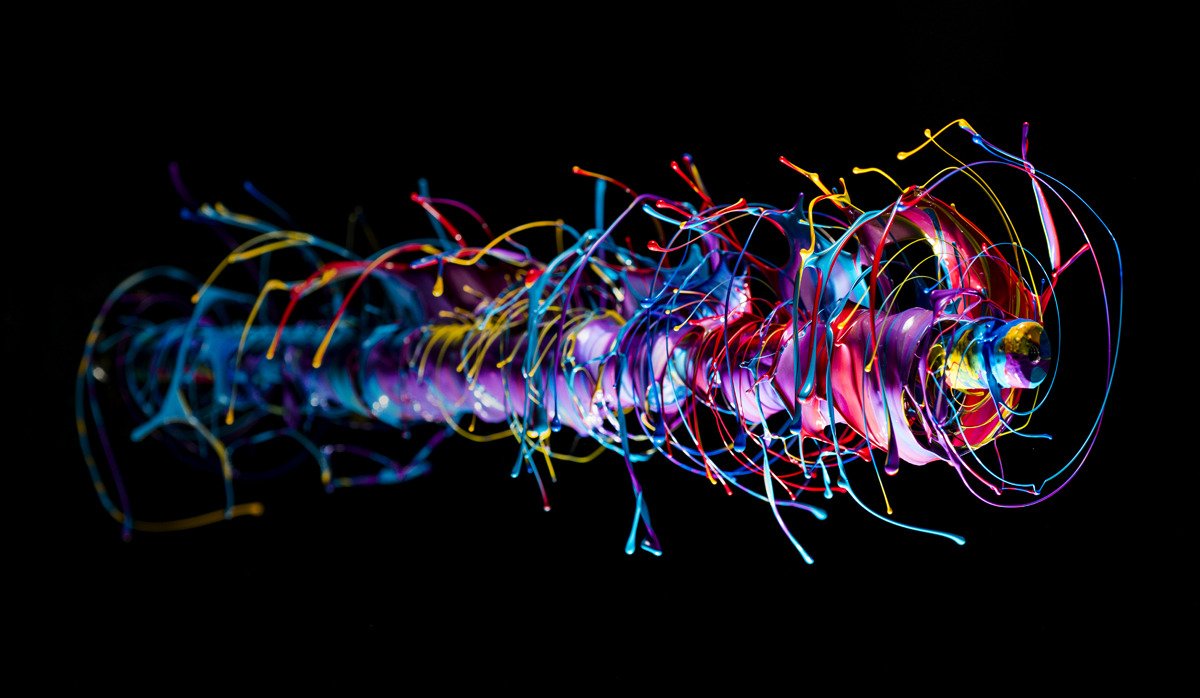
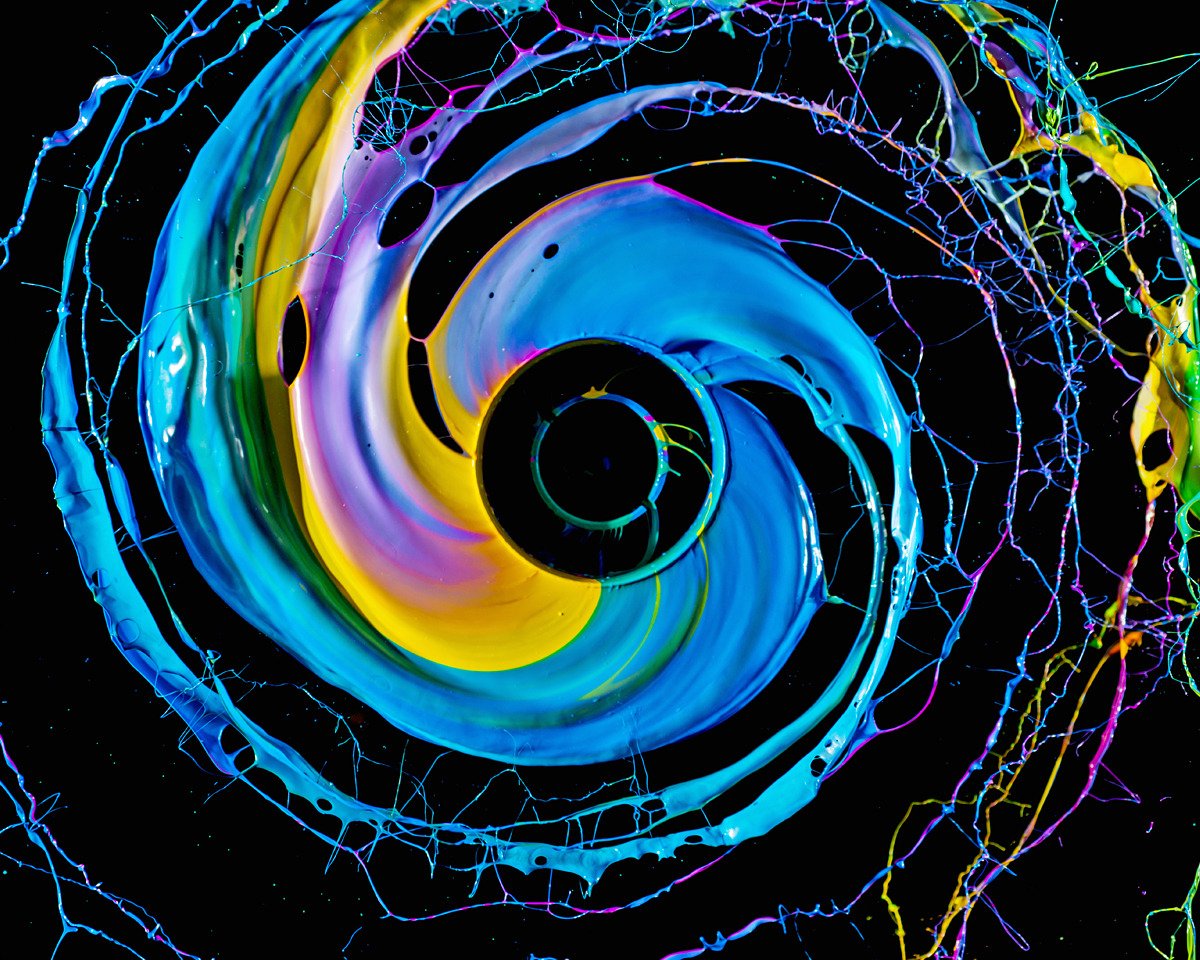
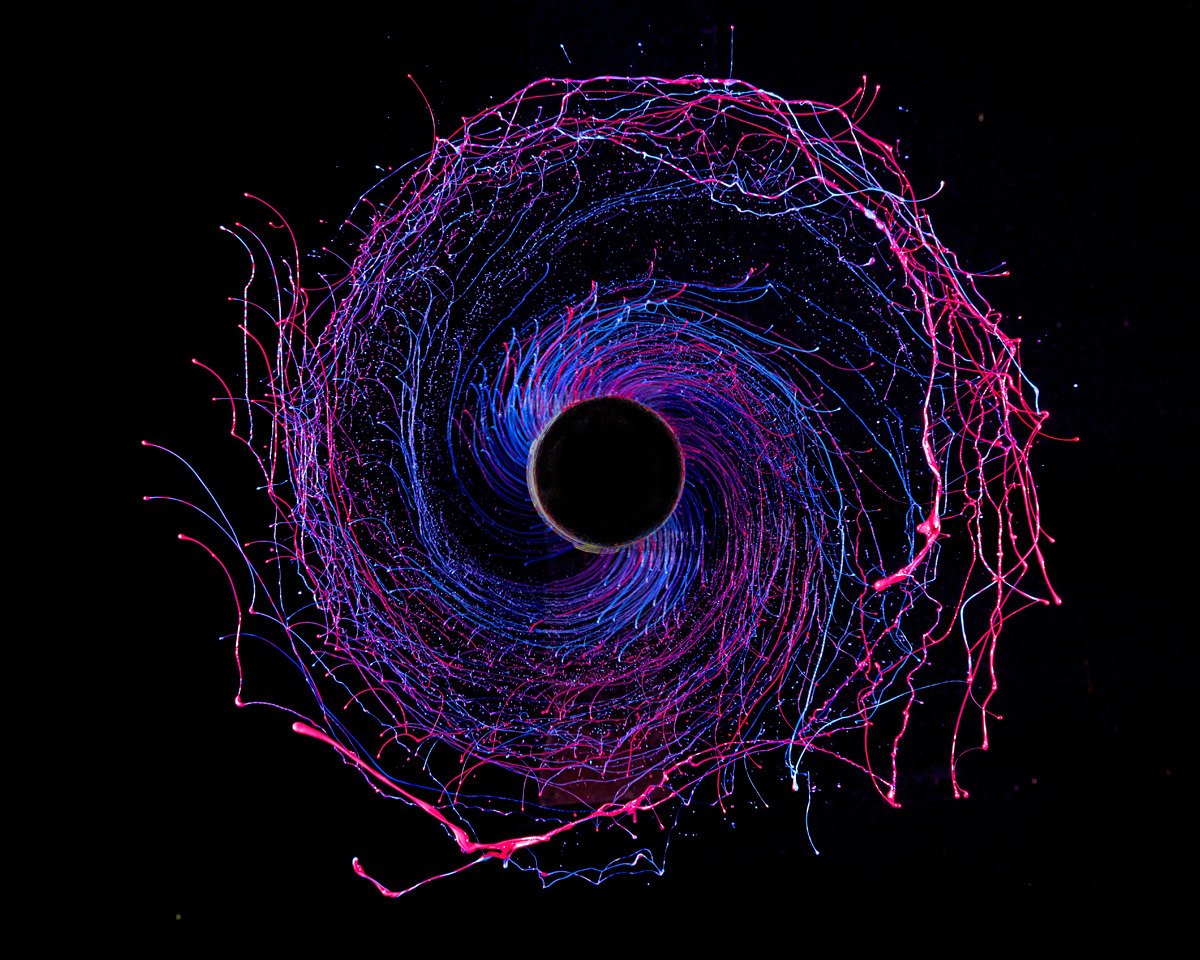
    Artist Fabian Oefner captures these colorful portraits of fluid instability by dripping acrylic paints onto a metal rod, which is connected to a drill. When the drill is switched on, paint is flung away from the rod, creating these snapshots of centripetal force and surface tension. Note how droplets gather at the ends of the spiral arms like in a Plateau-Rayleigh or a rimming instability. For more, check out Oefner’s webpage, which includes a video showing how the images are made, or his previously featured work, “Millefiori”. (Photo credit: F. Oefner; submitted by Stephen D.)

  • Featured Video Play Icon

    Tuning Fork Fluids

    This high-speed video shows a liquid crystal fluid vibrating on a tuning fork. As the surface moves, tiny jets shoot upward, sometimes with sufficient energy that the fluid column is stretched beyond surface tension’s ability to keep it intact, resulting in droplet ejection. The jets and surface waves create a mesmerizing pattern of fluid motion. (Video credit: J. Savage) 

  • Featured Video Play Icon

    Breaking Up Falling Beads

    In a stream of falling liquid, surface tension instabilities cause the fluid to break up into droplets. This video shows a similar experiment with a stream of glass beads, a granular material. The whole system is housed under a vacuum to eliminate the effects of air drag on the stream, and a camera rides alongside the stream to track the evolution of the falling material in a Lagrangian fashion. As with a liquid stream, we see the granular flow develop undulations as it falls, ultimately breaking up into clusters of beads. The authors suggest that nanoscale surface roughness and van der Waals forces may be responsible for the clustering behavior in the absence of surface tension. (Video credit: J. Royer et al.)

  • Featured Video Play Icon

    Making Metal Water-Repellent

    Chemical treatments can be used to render metals hydrophobic, causing water to bead on the surface rather than spreading to wet it. Treating the surface by immersing it in boiling water before applying the chemicals creates a nanoscale texture that accentuates the hydrophobicity. Even on a common metal like aluminum, this combination of texturing and chemical treatment leads to superhydrophobic behavior. Here the technique is demonstrated by spraying water droplets on a piece of treated aluminum. (Video credit: B. Rosenberg et al.; submitted by D. Quinn)

  • The Red Crown

    The Red Crown

    A drop of red dye falls into a thin layer of milk, forming a crown splash. Notice the pale edges of the droplets at the rim of the crown; this is milk that has been entrained by the original drop. The rim and satellite droplets surrounding the splash are formed due to surface tension effects, chiefly the Plateau-Rayleigh instability–the same effect responsible for breaking a falling column of liquid into droplets like in a leaking faucet. The instability will have a most unstable wavelength that determines the number of satellite droplets formed. (Photo credit: W. van Hoeve et al., University of Twente)

  • Fishbones

    Fishbones

    When two liquid jets collide, they can form an array of shapes ranging from a chain-like stream or a liquid sheet to a fishbone-type structure of periodic droplets. This series of images show the collision of two viscoelastic jets–in which polymer additives give the fluids elasticity properties unlike those of familiar Newtonian fluids like water. The jet velocities increase with each image, changing the behavior from a fluid chain (a and b); to a fishbone structure (c and d); to a smooth liquid sheet (e); to a fluttering sheet (f and g); to a disintegrating ruffled sheet (h), and finally a violently flapping sheet (i and j). The behavior of such jets is of particular interest in problems of atomization, where it can be desirable to break an incoming stream of liquid up into droplets as quickly as possible. (Photo credit: S. Jung et al.)

  • Liquid Sculptures

    Liquid Sculptures

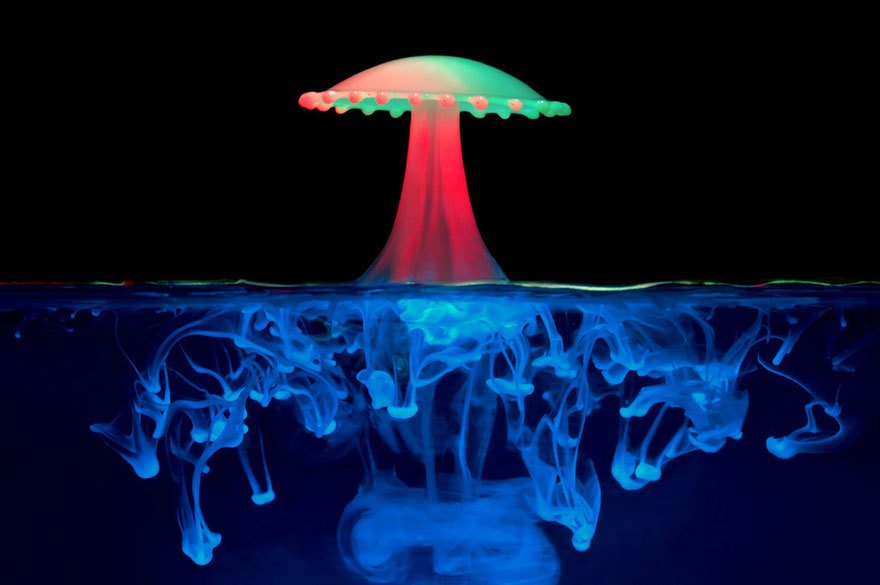
    Artist Corrie White uses dyes and droplets to capture fantastical liquid sculptures at high-speed. The mushroom-like upper half of this photo is formed when the rebounding jet from one droplet’s impact on the water is hit by a well-timed second droplet, creating the splash’s umbrella. In the lower half of the picture, we see the remains of previous droplets, mixing and diffusing into the water via the Rayleigh-Taylor instability caused by their slight difference in density relative to the water. There’s also a hint of a vortex ring, likely from the droplet that caused the rebounding jet. (Photo credit: Corrie White)

  • Featured Video Play Icon

    Dropping Through Strata

    When a droplet falls through an air/water interface, a vortex ring can form and fall through the liquid. In this video, the researchers investigate the effects of a stratified fluid interface on this falling vortex ring. In this case, a less dense fluid sits atop a denser one. Depending on the density of the initial falling droplet and the distance it travels through the first fluid, the behavior and break-up of the vortex ring when it hits the denser fluid differs. Here four different behaviors are demonstrated, including bouncing and trapping of the vortex ring. (Video credit: R. Camassa et al.)