
Instabilities in fluids are sometimes remarkable in their uniformity. Here we see a hollow spinning cup with a thin film of fluid flowing down the interior. The rim of fluid at the cup’s lip stretches into long, evenly spaced, spiraling threads. These filaments stretch until centrifugal forces overcome surface tension and viscous forces and break the liquid into a multitude of tiny droplets. This process is called atomization and is vital to everyday applications like internal combustion and inkjet printing. (Photo credit: R. P. Fraser et al.)
Search results for: “droplet”

The Real Raindrop
What is the shape of a falling raindrop? Surface tension keeps only the smallest drops spherical as they fall; larger drops will tend to flatten. The very largest drops stretch and inflate with air as they fall, as shown in the image above. This shape is known as a bag and consists of a thin shell of water with a thicker rim at the bottom. As the bag grows, its shell thins until it ruptures, just like a soap bubble. The rim left behind destabilizes due to the surface-tension-driven Plateau-Rayleigh instability and eventually breaks up into smaller droplets. This bag instability limits the size of raindrops and breaks large drops into a multitude of smaller ones. The initial size of the drop in the image was 12 mm, falling with a velocity of 7.5 m/s. The interval between each image is 1 ms. (Photo credit: E. Reyssat et al.)

Evaporating Drops
When still drops evaporate from a surface, they do so in several phases, as illustrated in the video above. Initially, the drop forms a spherical cap. At this point the velocity within the droplet is so small that it is difficult to resolve, but particles within the drop move outward toward the contact line. As the drop evaporates, they form a circle of sediment – the familiar coffee ring. As the drop flattens, radial velocity increases, drawing more and more particles to the coffee ring. Eventually the drop pulls away from the ring, leaving surface tension and evaporation to compete in driving the internal flow. During this phase, some parts of the contact line try to re-establish the flow pattern that made the first ring; this leaves behind circular segments broken up by the increasing instabilities in the contact line. In the final stage, surface tension smooths some of the irregularities and drives an inward velocity that leaves behind radial sediment segments. (Video credit: G. Hernandez-Cruz et al.)
Rebounding Off Dry Ice
Droplet rebound is frequently associated with superhydrophobic surfaces but can also be generated by very large temperature differences. For very hot substrates, a thin layer of the drop vaporizes on contact via the Leidenfrost effect and helps a drop rebound by preventing it from wetting the surface. This video shows almost the opposite: a water droplet hitting solid carbon dioxide (-79 degrees C). Upon contact, the solid carbon dioxide sublimates, creating a thin layer of gas that separates the droplet from the surface. You can also see the vortex ring that accompanies the drop’s impact. Water vapor near the carbon dioxide surface has condensed into tiny airborne droplets that act as tracer particles that reveal the vortex’s formation and the rebounding droplet’s wake. (Video credit: C. Antonini et al.; Research paper)

Bouncing in Lockstep
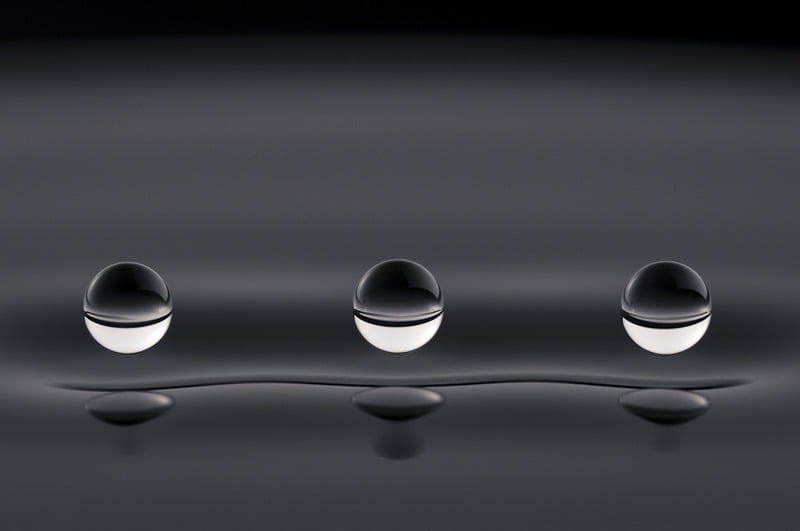
Droplets of silicone oil bounce on a pool of the same thanks to the vibration provided by a loudspeaker. Each droplet’s bounce causes ripples in the pool and the interference between these ripples fixes the droplets in lockstep with one another. As long as the vibration continues to feed the thin layer of air that separates the droplets from the pool during each bounce and no impurities break the surface tension at the interface, the droplets will bounce indefinitely on their liquid trampoline. Such systems can be used to observe quantum-mechanical behavior like wave-particle duality on a macro-scale. (Photo credit: A. Labuda and J. Belina)
Self-Assembling Ferrofluids
Ferrofluids–colloidal suspensions made up of ferromagnetic nanoparticles and a carrier liquid–are known for their interesting and sometimes bizarre behaviors due to magnetic fields. The video above shows how, when subjected to an increasing magnetic field, a single droplet of a ferrofluid on a superhydrophobic surface will split into several droplets. The process is called static self-assembly, and it results from the ferrofluid seeking a minimum energy state relative to the force supplied by the magnetic field. Change the magnetic field and the droplets shift to the next energy minimum. But what happens when you change the magnetic field continuously and too quickly for the droplets to respond? A whole different set of structures and behaviors are observed (video link). This is dynamic self-assembly, a different ordered state only achieved when the ferrofluid is forceably kept away from the energy minima seen in the first video. For more, see the additional videos and the original paper. (Video credit: J. Timonen et al.; via io9)
Bursting Bubble
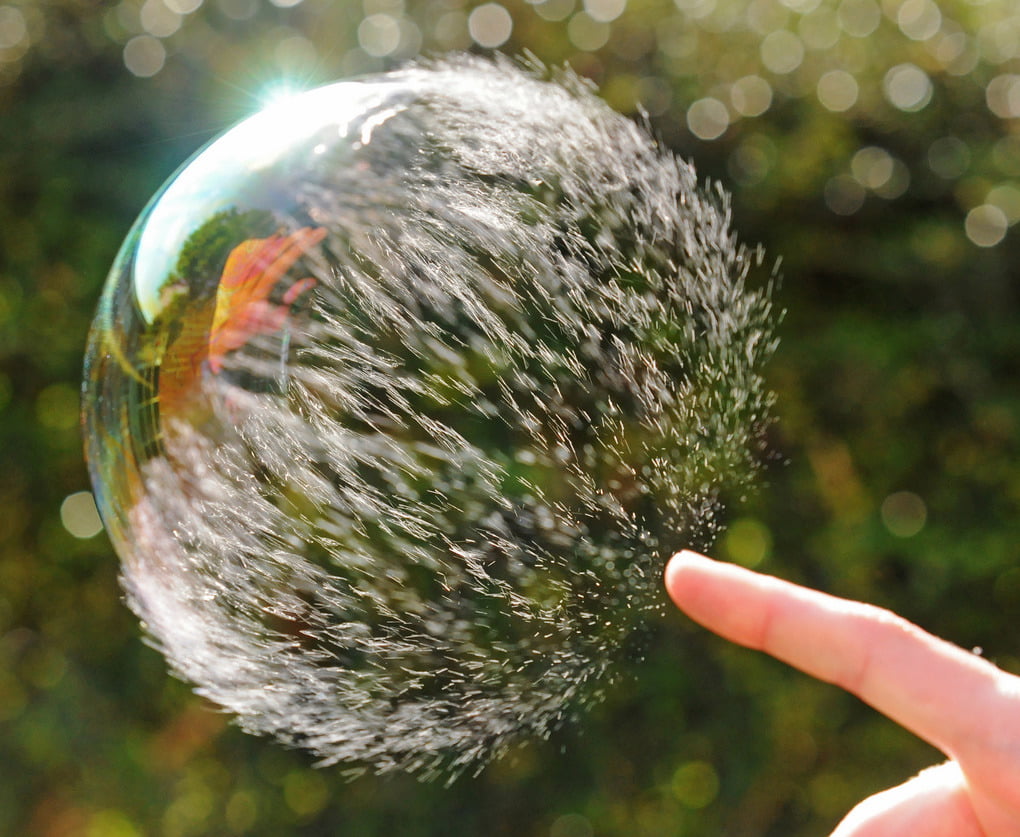
Originally posted: 24 Aug 2011 That soap bubbles burst in the blink of an eye is a pity considering how fascinating their disappearing act is. This photo set from photographer Richard Heeks captures the bubbles mid-burst. Once the bubble’s film is breached, surface tension rips the smooth film back like a broken balloon, causing the liquid that used to be part of the bubble to erupt into droplets. (Photo credit: Richard Heeks)
Reminder: Many thanks to those who have filled out the survey! There are some great responses so far. If you haven’t done so, won’t you please fill out our reader survey?
Fire-Breathing Physics
One of the most dangerous stunts for any fire-eater is breathing fire. Dr. Tim Cockerill explains some of the science behind the feat in this video. Volatility–the tendency of the liquid fuel to vaporize–is actually the enemy of a fire-eater. Use a fuel that is too volatile and it will catch fire too easily when the vaporous fuel mixes with the air. Instead fire-eaters use less volatile fuels and spray a mist of fine droplets to mix the air and fuel. This atomization of the fuel creates a spectacular fireball without endangering the fire-eater (as much). To see a similar fireball in high-speed, check out this post. (Video credit: T. Cockerill/The Ri Channel; via io9)

Dancing Jets
Vibrating a gas-liquid interface produces some exciting instability behaviors. The photo above shows air and silicone oil vibrated vertically within a prism. For the right frequencies and amplitudes, the vibrations produce liquid jets that shoot up and eject droplets as well as gas cavities and bubble transport below the interface. To see a similar experiment in action, check out this post. (Photo credit: T. J. O’Hern et al./Sandia National Laboratories)
Hydrophobia
Hydrophobic literally means water-fearing, and, once a surface is treated with a hydrophobic coating, the effect on water droplets is stark. The tendency of the non-polar hydrophobic molecules to repel the polar water molecules leads to high contact angles – which make the droplets almost spherical as they glide along the surface. The droplets dance across the surface, colliding and bouncing and coalescing. (Video and submission credit: M. Bell)