Champagne owes much of its allure to its tiny bubbles. Unlike other wines, champagne undergoes a secondary fermentation in the bottle, during which the yeasts in the wine consume sugars and produce carbon dioxide, which dissolves into the wine. When opened, the carbon dioxide can begin to escape. Bubbles form in the glass around imperfections, either due to intentional etching of the glass or impurities left behind by cleaning. Once formed, trails of bubbles rise to the surface, swelling as more dissolved carbon dioxide is absorbed into each bubble. The bubbles then cluster near the surface of the champagne, occasionally popping and creating a flower-like distortion of the surrounding bubbles. The gases within the bubbles contains higher concentrations of aromatic chemicals than the surrounding wine, and the bursting of each bubble propels tiny droplets of these aromatics upwards, carrying the scent of the champagne to the drinker. For more beautiful champagne photos, I recommend this LuxeryCulture article; for more on the science of champagne, see Chemistry World’s coverage. Happy 2014! (Image credits: G. Liger-Belair et al.)
Search results for: “droplet”

Frozen Bubbles

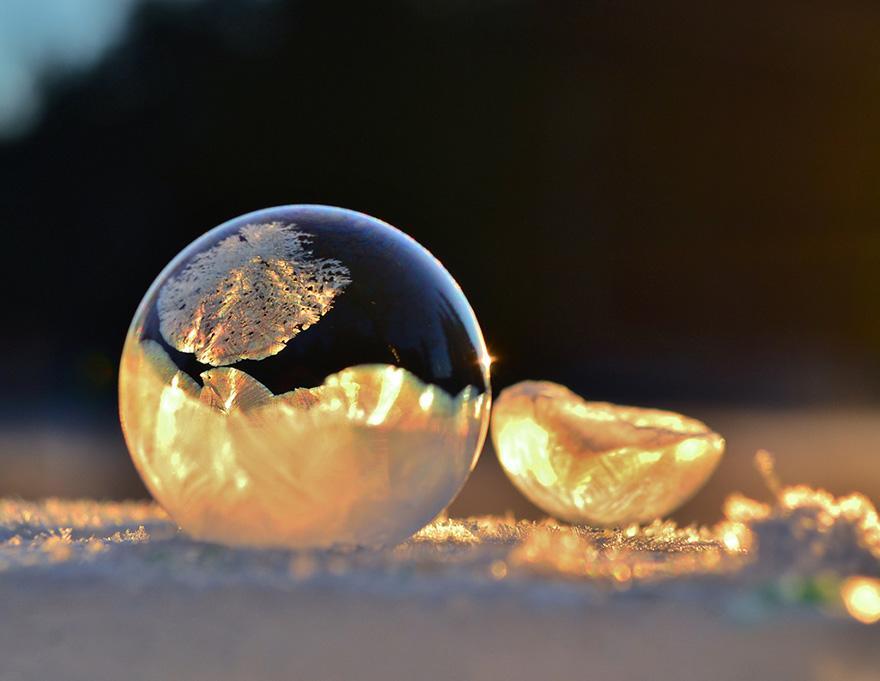
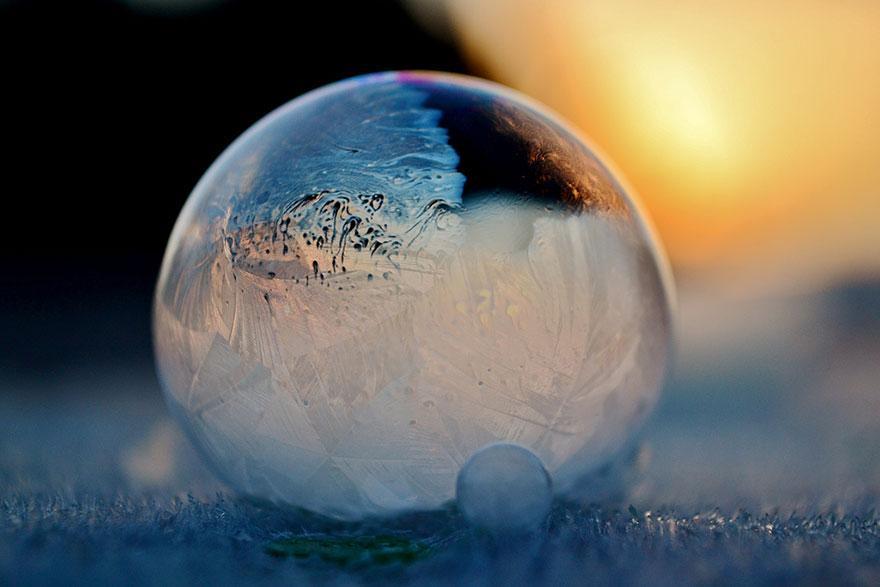
Snowflakes aren’t the only frozen crystals to play with outside in the winter. Photographer Angela Kelly recently posted a series of frozen soap bubbles made by her and her son. In temperatures well below freezing, the thin film of the soap bubble does not survive long before it begins to freeze. The bubbles do not freeze all at once; instead the frost creeps gradually across it. For bubbles sitting on a surface, the ice front expands upward, much the same as with a freezing water drop. Once frozen, the bubbles crack or rip when touched instead of melting and popping. (Photo credit: A. Kelly; via BoredPanda; submitted by jshoer)

Holiday Fluids: Snowflakes
Just about everyone wishes for a White Christmas, but even when that happens, it’s rare to get a good look at the beauty of individual snowflakes. Alexey Kljatov’s macro photography of snowflakes is simply stunning and highlights the incredible variety of forms snowflakes take. A snowflake forms when a water droplet freezes onto dust or other particles and grows as more water vapor freezes onto the initial crystal. The symmetry of the snowflakes, as with any crystal, comes from the internal order of its water molecules. The shape and features that form vary due to the local temperature and humidity level while vapor is freezing onto the crystal. Check out this handy graph showing which shapes form for various situations. Since snowflakes can encounter wildly different conditions on their path to the ground, it’s rare or next-to-impossible to find any two alike. Join us all this week at FYFD as we look at holiday-themed fluid dynamics. (Photo credit: A. Kljatov)

Vibrating Paint
Paint is probably the Internet’s second favorite non-Newtonian fluid to vibrate on a speaker–after oobleck, of course. And the Slow Mo Guys’ take on it does not disappoint: it’s bursting (literally?) with great fluid dynamics. It all starts at 1:53 when the less dense green paint starts dimpling due to the Faraday instability. Notice how the dimples and jets of fluid are all roughly equally spaced. When the vibration surpasses the green paint’s critical amplitude, jets sprout all over, ejecting droplets as they bounce. At 3:15, watch as a tiny yellow jet collapses into a cavity before the cavity’s collapse and the vibration combine to propel a jet much further outward. The macro shots are brilliant as well; watch for ligaments of paint breaking into droplets due to the surface-tension-driven Plateau-Rayleigh instability. (Video credit: The Slow Mo Guys)

Lenticular Clouds Over Ice

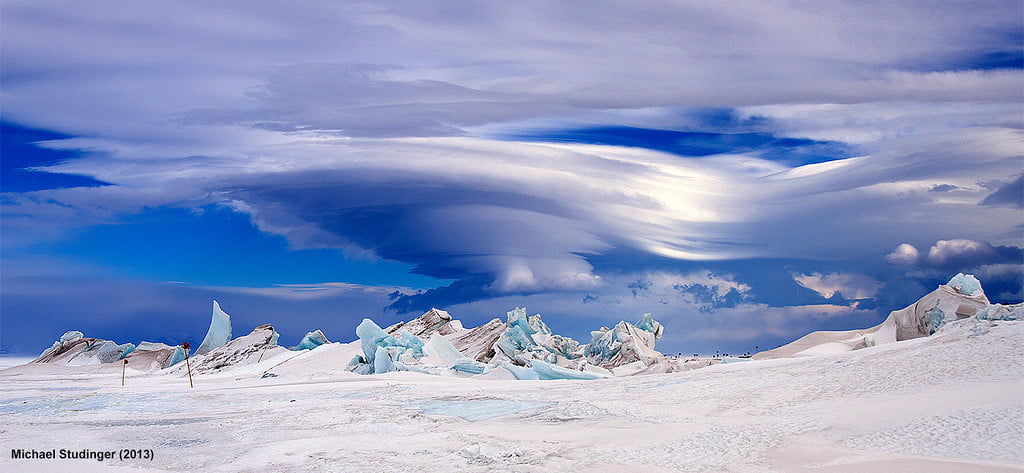
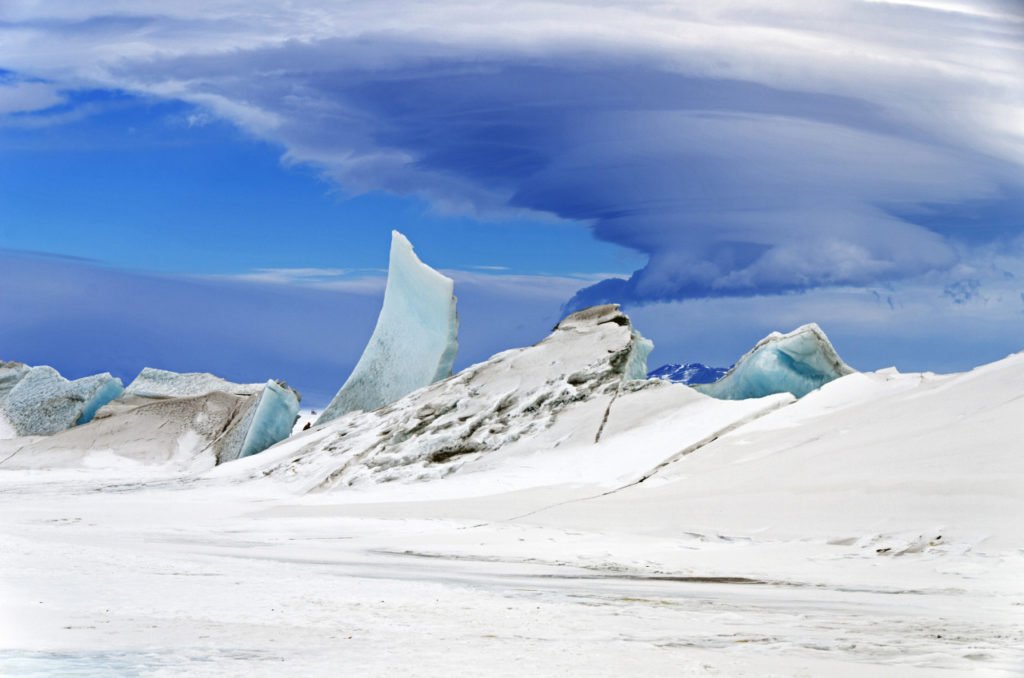
Lenticular clouds, like the one shown above, often attract attention due to their unusual shape. These stationary, lens-shaped clouds can form near mountains and other topography that force air to travel up and over an obstacle. This causes a series of atmospheric gravity waves, like ripples in the sky. If the temperature at the wave crest drops below the dew point, then moisture condenses into a cloud. As the air continues on into a warmer trough, the droplets can evaporate again, leaving a stationary lenticular cloud over the crest. This particular lenticular cloud was captured by Michael Studinger during Operation IceBridge in Antarctica. The line of ice in the foreground is a pressure ridge of sea ice formed when ice floes collided. (Photo credit: M. Studinger; via NASA Earth Observatory)

Liquid Umbrella
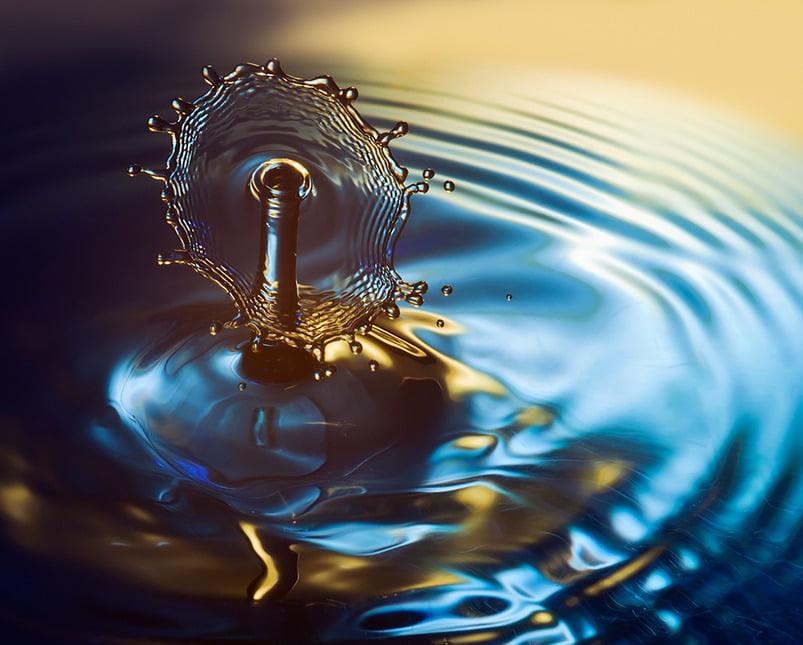
When a water drop strikes a pool, it can form a cavity in the free surface that will rebound into a jet. If a well-timed second drop hits that jet at the height of its rebound, the impact creates an umbrella-like sheet like the one seen here. The thin liquid sheet expands outward from the point of impact, its rim thickening and ejecting tiny filaments and droplets as surface tension causes a Plateau-Rayleigh-type instability. Tiny capillary waves–ripples–gather near the rim, an echo of the impact between the jet and the second drop. All of this occurs in less than the blink of an eye, but with high-speed video and perfectly-timed photography, we can capture the beauty of these everyday phenomena. (Photo credit: H. Westum)

Put the Lid Down When You Flush
Hospital-acquired infections are a serious health problem. One potential source of contamination is through the spread of pathogen-bearing droplets emanating from toilet flushes. The video above includes high-speed flow visualization of the large and small droplets that get atomized during the flush of a standard hospital toilet. Both are problematic for the spread of pathogens; the large droplets settle quickly and contaminate nearby surfaces, but the small droplets can remain suspended in the air for an hour or more. Even more distressing is the finding that conventional cleaning products lower surface tension within the toilet, aggravating the problem by allowing even more small droplets to escape. To learn more, see the Bourouiba research group’s website. (Video credit: Bourouiba research group)

Avoiding Splashback
Here’s a likely Ig Nobel Prize candidate from the BYU SplashLab: a study of splashing caused by a stream of fluid entering a horizontal body of water or hitting a solid vertical surface. In other words, urinal dynamics. The researchers simulated this activity using a stream of water released from a given height and angle and observed the resulting splash with high-speed video. They found a stream falls only 15-20 centimeters before the Plateau-Rayleigh instability breaks it into a series of droplets, and that this is the worst-case scenario for splash-back. The video above shows how a stream of droplets hits the pool, creating a complex cavity driven deeper with each droplet impact. Not only does each impact create a splash, the cavity’s collapse does as well. Similarly, when it comes to solid surfaces, they found that a continuous stream splashes less. They’ve also put together a helpful primer on the best ways to avoid splash-back. (Video credit: R. Hurd and T. Truscott; submitted by Ian N., bewuethr, John C. and possibly others)
For readers attending the APS DFD meeting, you can catch their talk, “Urinal Dynamics,” Sunday afternoon in Session E9 before you come to E18 for my FYFD talk.

Beads-on-a-string
Viscoelastic fluids are a type of non-Newtonian fluid in which the stress-strain relationship is time-dependent. They are often capable of generating normal stresses within the fluid that resist deformation, and this can lead to interesting behaviors like the bead-on-a-string instability shown above. In this phenomenon, a uniform filament of fluid develops into a series of large drops connected by thin filaments. Most fluids would simply break into droplets, but the normal stresses generated by the viscoelastic fluid prevent break-up. For this particular photo, the stresses are generated by clumps of surfactant molecules within the wormlike micellar fluid. Similar effects are observed in polymer-laced fluids. (Photo credit: M. Sostarecz and A. Belmonte)

Holey Splashes
A liquid’s surface tension can have a big effect on its splashes. In this video, a 5-mm droplet hits a surface covered in a thin layer of a liquid with lower viscosity and surface tension. The result is a dramatic effect on the spreading splash. As the initial curtain grows and expands, the lower surface tension of the impacted fluid thins the splash curtain. Fluid flows away from these areas due to the Marangoni effect, causing holes to grow. The sheet breaks up into a network of liquid filaments and ejected droplets before gravity can even bring it all to rest. For more, see this previous post and review paper. (Video credit: S. Thoroddsen et al.)