
Viscoelastic fluids are a type of non-Newtonian fluid in which the stress-strain relationship is time-dependent. They are often capable of generating normal stresses within the fluid that resist deformation, and this can lead to interesting behaviors like the bead-on-a-string instability shown above. In this phenomenon, a uniform filament of fluid develops into a series of large drops connected by thin filaments. Most fluids would simply break into droplets, but the normal stresses generated by the viscoelastic fluid prevent break-up. For this particular photo, the stresses are generated by clumps of surfactant molecules within the wormlike micellar fluid. Similar effects are observed in polymer-laced fluids. (Photo credit: M. Sostarecz and A. Belmonte)
Search results for: “droplet”

Holey Splashes
A liquid’s surface tension can have a big effect on its splashes. In this video, a 5-mm droplet hits a surface covered in a thin layer of a liquid with lower viscosity and surface tension. The result is a dramatic effect on the spreading splash. As the initial curtain grows and expands, the lower surface tension of the impacted fluid thins the splash curtain. Fluid flows away from these areas due to the Marangoni effect, causing holes to grow. The sheet breaks up into a network of liquid filaments and ejected droplets before gravity can even bring it all to rest. For more, see this previous post and review paper. (Video credit: S. Thoroddsen et al.)
Liquid Sculptures
[original media no longer available]
Water sculptures–a marriage of liquids, photography, and timing–are spectacular form of fluid dynamics as art. Artist Markus Reugels is a master of the form. This video captures the life and death of such water sculptures at 2,000 fps, beginning with the fall of the initial blue droplet. The droplet’s impact causes a rebounding Worthington jet, which reaches its pinnacle just as a second droplet strikes. The impact spreads into an umbrella-like skirt consisting of a thin, expanding liquid sheet with a thicker rim. The rim itself is unstable, breaking into regularly spaced filaments and tiny satellite droplets that shoot outward before the entire structure collapses into the pool. One especially cool aspect of watching this in video is seeing how the blue dye from each droplet spreads as the water splashes and rebounds. You can see the set-up Reugels uses for his photography here. (Video credit: M. Reugels and L. Lehner)
How Fast Do Holes Grow?
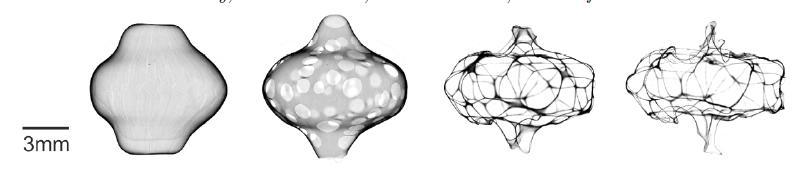
Taylor and Culick predicted a constant velocity for the rim of an opening hole in a soap film of uniform thickness. Unfortunately, it is difficult to experimentally produce a soap film of uniform thickness. It is much easier to create films of uniform thickness with liquid crystals in their smectic-A phase, in which the molecules are ordered in layers along a single direction. When smectic-A bubbles burst, however, it bears little resemblance to a soap bubble. Smectic-A bubbles burst spontaneously during oscillations, the holes in the film growing until a network of filaments is left behind. The filaments themselves will rapidly break up into droplets due to the Plateau-Rayleigh instability. (Photo credit: R. Stannarius et al.)
The Vortex Under a Falling Drop
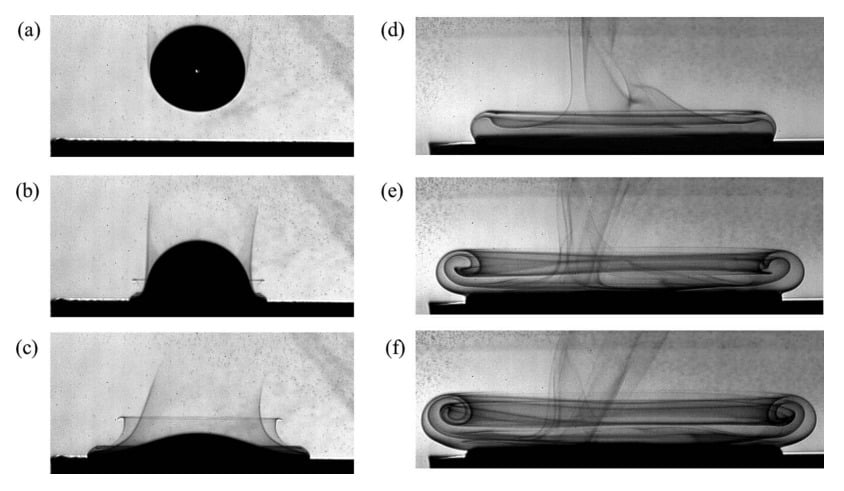
We take for granted that drops which impact a solid surface will splash, but, in fact, drops only splash when the surrounding air pressure is high enough. When the air pressure is low enough, drops simply impact and spread, regardless of the fluid, drop height, or surface roughness. Why this is and what role the surrounding air plays remains unclear. Here researchers visualize the air flow around a droplet impact. In (a) we see the approaching drop and the air it pulls with it. Upon impact in (b) and © the drop spreads and flattens while a crown of air rises in its wake. The drop’s spread initiates a vortex ring that is pinned to the drop’s edge. In later times (d)-(f) the vortex ring detaches from the drop and rolls up. (Photo credit: I. Bischofberger et al.)
Fluid Sculptures From Bursting Bubbles
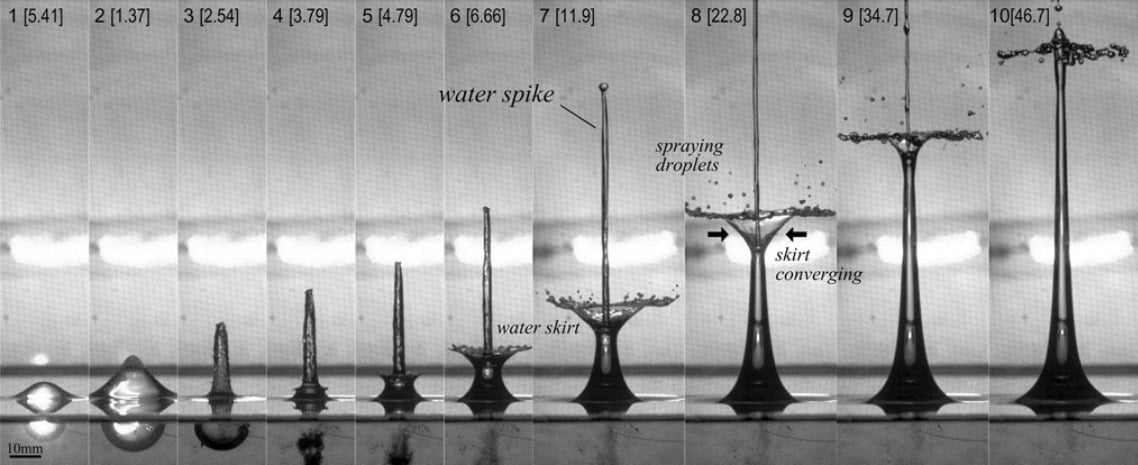
A bubble initiated near a free surface–like the air-water interface here–can generate some spectacular dynamics. Beginning at the far left, the expanding subsurface bubble causes a dome at the surface that sharpens into a spike. By Frame 3, the bubble is collapsing but overshoots and rebounds, which introduces the tiny instability in Frame 4 that grows in subsequent time steps to form the water skirt that surrounds the spike. Although generated entirely differently, the end result is reminiscent of the water sculptures made by artists like Marcus Reugels, Corrie White, Jack Long, and others. (Image credit: A. M. Zhang et al.)

Explosive Boiling
A superheated liquid can reach temperatures higher than its boiling point without actually boiling – similar to how liquids can be supercooled below their freezing point without solidifying. The photo sequence above shows how explosive the boiling of a superheated water droplet submersed in sunflower oil can be. Image (a) in the lower left shows the superheated droplet resting on the bottom of its container. Then droplet vaporizes explosively in (b), expanding dramatically. The bubble overexpands and and begins to oscillate around its equilibrium radius. This triggers a Rayleigh-Taylor instability in the bubble’s interface, creating the large lobes in © and enlarged in the upper image. Finally, the bubble fragments in (d). See the original paper for more on superheated droplet boiling. (Image credit: M. A. J. van Limbeek et al.; via @AIP_Publishing)

Fluids Round-up – 5 October 2013
This is the last week that my IndieGoGo project is open for donations. All money above and beyond what is needed for the conference will go toward FYFD-produced videos. Also, donors can get some awesome FYFD stickers.
As a reminder, those looking for more fluids–in video, textbook, or other form–can always check out my resources page. And if you know about great links that aren’t on there, let me know so that I can add them. On to the round-up!
- Popular Science has look at what it was like to fly on the Concorde, the only supersonic commercial airliner ever flown.
- For the cyclists and CFD folks out there, Zipp has put out a new video discussing their Firecrest wheels’ aerodynamics.
- io9 explains how superhydrophobic surfaces impart a charge to water droplets and how this can be used to increase efficiency at power plants.
- BuzzFeed UK has 32 fun science GIFs, several of which are fluids-related, and several of which will look familiar to long-time readers. (via Flow Visualization on FB)
- Wired has an intriguing short on Acoustic Archives, a group that focuses on capturing the acoustic qualities of historic locations using custom-designed 3D microphones.
- Congratulations to Richard over at Flow Viz for hitting his 100th post! Here’s to many more.
- Finally, our lead image comes from Martin Klimas. Smithsonian’s blog has a feature on his work in which he transforms songs from artists like Pink Floyd, Daft Punk, and Bach into sonic sculptures using paint on speakers. (via Flow Visualization on FB)
I had a lot of fun earlier this week giving a talk for the Texas A&M Applied Mathematics Undergraduate Seminar series. I didn’t get a chance to record it, but the slides are up here if anyone is interested.(Photo credit: M. Klimas)Bouncing Atop a Pool
When slowed down, everyday occurrences, like a drop of water falling into a pool, can look absolutely extraordinary. When a falling drop has low momentum, it doesn’t simply disappear into the puddle. It sits on the surface, separated from the main pool by a very thin layer of air. Given time, the air drains away and the droplet cascades its way into the pool via smaller and smaller droplets. By vibrating the surface, the droplet bounces, with each bounce refreshing the layer of air that separates it from the main pool. Minute Lab’s video does a great job of explaining the process from beginning to end, accompanied with wonderful video of each step in action. For even more mind-boggling, check out how these bouncing droplets can demonstrate quantum mechanical behaviors. (Video credit: Minute Laboratory; submitted by Pascal)
Ig Nobel Fluids: Shower Curtain Science
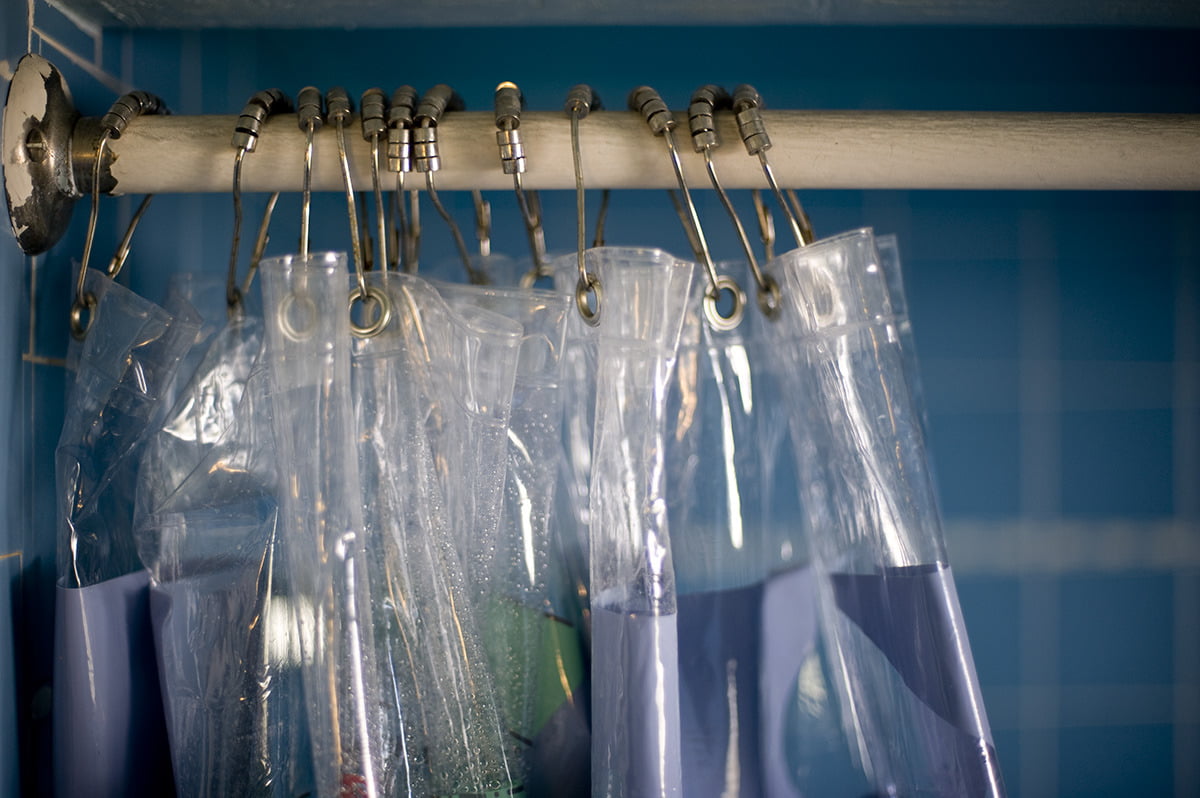
Nearly everyone has faced the frustration of a shower curtain billowing inwards to stick to one’s leg. Various explanations have been offered to explain the effect, but David Schmidt won the 2001 Ig Nobel Prize in Physics for a numerical simulation suggesting that the spray of droplets from the shower head drives a horizontal vortex whose axis of rotation is perpendicular to the shower curtain. Since vortices have a low-pressure region in their core, this weak shower vortex has the power to suck a light curtain inward, much to the chagrin of the shower’s occupant. Of course, a heavier or weighted shower curtain will help avoid the effect. This post is part of a series on fluids-related Ig Nobel Prizes. (Photo credit: W. Taylor; research credit: D. Schmidt)

