When water droplets sit on a cold substrate, they freeze into a shape with a pointed tip. At first glance, this behavior seems very odd since surface tension usually acts to prevent such sharp protrusions. The shape is, however, a result of water’s expansion as it freezes. The droplet freezes from the substrate upward, with a concave shape to the solidification front. The angle of the point does not depend on the substrate temperature or the wetting angle between the water and surface. Instead, it turns out that this concave front shape and water’s expansion are the key factors that determine the pointed cusp’s angle, and that the final geometry of the cusp is essentially universal. (Video credit: M. Nauenberg; additional research credit: A. Marin et al.)
Search results for: “droplet”
Vibrating on a Subwoofer
[original media no longer available]
Vibrating a liquid droplet produces some awesome behavior. The video above shows a water droplet vibrating on a subwoofer at real-time speeds. The behavior and shape of the droplet shifts with the frequency of vibration, which we hear as a change in pitch. To see more clearly the shapes a particular frequency induces, check out this high-speed video of vibrating water droplets. For a given driving frequency, the droplet’s shape, or mode, is distinct and consistent. For a droplet vibrating to a song, though, there is more than one frequency driving its motion. In this case, the droplet’s shape is a superposition of the individual modes, which is just a way of saying adding the shapes together. So frequency determines the droplet’s shape. The vibration amplitude, or audible volume, affects how energetic the drop’s motion is. And the fluid’s surface tension and viscosity act as dampers to the system, controlling how quickly the drop can change shape as well as how well it holds together. (Video credit: A. Read)
Inside a Splash

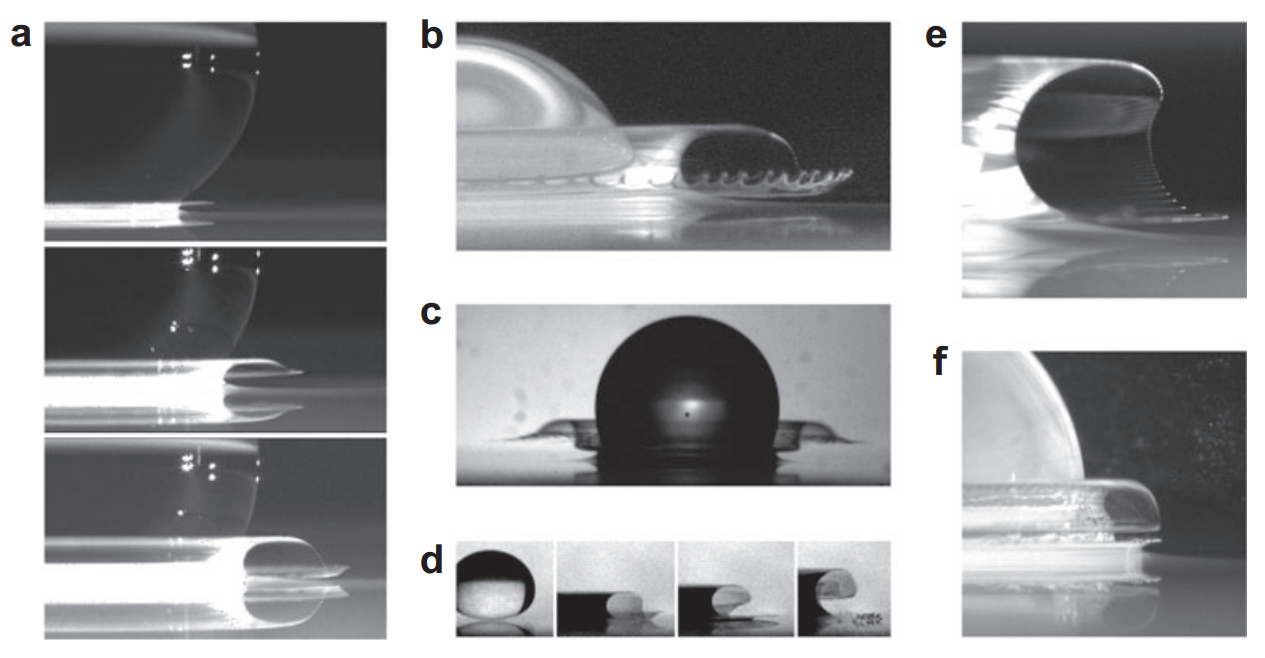
When a droplet strikes a pool, a thin, fast-moving sheet of liquid expands outward from the region of contact. These ejecta sheets come in many forms depending on surface tension, viscosity, air pressure, and droplet momentum. When the ejecta sheet curls downward to touch the pool, it can spray microdroplets outward or trap a layer of air underneath the droplet. For more, see this video by S. Nagel et al., and the papers Thoroddsen (2002) and Thoroddsen et al. (2008). (Photo credits: S. Thoroddsen et al.; GIF from this video by S. Thoroddsen et al.)

Bursting a Bubble
Though seemingly instantaneous to the naked eye, the bursting of a soap bubble is fascinating when slowed down. Here it is at about 2200 frames per second. Initially, the bubble is approximately spherical – its shape determined by a balance between surface tension, gravity, and pressure. The prick of a pinpoint disrupts the balance, and surface tension pulls the thin film away from the defect. The liquid sheet of the bubble retracts swiftly into a filament of fluid and a cloud of tiny droplets. (Video credit: soapbubble.dk)
Rebounding
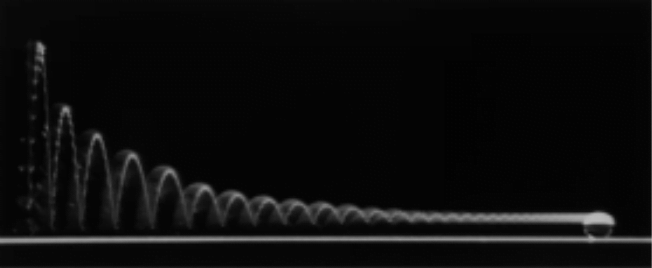
A water droplet can rebound completely without spreading from a superhydrophobic surface. The photo above is a long exposure image showing the trajectory of such a droplet as it bounces. In the initial bounces, the droplet leaves the surface fully, following a parabolic path with each rebound. The droplet’s kinetic energy is sapped with each rebound by surface deformation and vibration, making each bounce smaller than the last. Viscosity damps the drop’s vibrations, and the droplet eventually comes to rest after twenty or so rebounds. (Image credit: D. Richard and D. Quere)
Coalescence
The coalescence of two liquid droplets takes less than the blink of an eye, but it is the result of an intricate interplay between surface tension, viscosity, and inertia. The high-speed video above was filmed at 16000 frames per second, yet the initial coalescence of the silicone oil drops is still nearly instantaneous. At the very instant the drops meet, an infinitesimally small neck is formed between the droplets. Mathematically speaking, the pressure and curvature of the droplets diverge as a result of this tiny contact area. This is an example of a singularity. Surface tension rapidly expands the neck, sending capillary waves rippling along the drops as they become one. (Video credit: S. Nagel et al.; research credit: J. Paulsen)

“Wallwave Vibration”


Loris Cecchini’s “Wallwave Vibration” series is strongly reminiscent of Faraday wave patterns. The Faraday instability occurs when a fluid interface (usually air-liquid though it can also be two immiscible liquids) is vibrated. Above a critical frequency, the flat interface becomes unstable and nonlinear standing waves form. If the excitation is strong enough, the instability can produce very chaotic behaviors, like tiny sprays of droplets or jets that shoot out like fountains. In a series of fluid-filled cells, the chaotic behaviors can even form synchronous effects above a certain vibration amplitude. (Image credit: L. Cecchini; submitted by buckitdrop)
Water and Aerogel
Aerogel is an extremely light porous material formed when the liquid inside a gel is replaced with gas. When combined with water, aerogel powders can have some wild superhydrophobic effects. Here water condensed on a liquid nitrogen cooler has dripped onto a floor scattered with aerogel powder from the nitrogen’s shipping container. The result is that the water gets partially coated in aerogel powder and takes on some neat properties. Its contact angle with the surface increases – in other words, it beads up – which is typical of superhydrophobicity. When disturbed, the water breaks easily into droplets which do not immediately recombine upon contact. With sufficient distortion, they can rejoin. You can see some other neat examples of aerogel-coated water behaviors in this second video as well. (Video credit: ophilcial; submitted by Jason I.)

Sneezes Vs. Coughs
Sneezing and coughing are major contributors to the spread of many pathogens. Both are multiphase flows, consisting of both liquid droplets and gaseous vapors that interact. The image on the left shows a sneeze cloud as a turbulent plume. The kink in the cloud shows that plume is buoyant, which helps it remain aloft. The right image shows trajectories for some of the larger droplets ejected in a sneeze. Like the sneeze cloud, these droplets persist for significant distances. The buoyancy of the cloud also helps keep aloft some of the smaller pathogen-bearing droplets. Researchers are building models for these multiphase flows and their interactions to better predict and counter the spread of such airborne pathogens. For similar examples of fluid dynamics in public health, see what coughing looks like, how hospital toilets may spread pathogens, and how adjusting viscoelastic properties may counter these effects. For more about this work, see the Bourouiba research group’s website. (Image credit: L. Bourouiba et al.)
Flowing Uphill
Science Friday takes an inside look at self-propelled Leidenfrost droplets like those we’ve featured previously. The Leidenfrost effect takes place when a liquid comes in contact with a surface much, much hotter than its boiling point. Part of the liquid is vaporized, creating a thin gas layer that both insulates the remaining liquid and causes it to move with very little friction. Over a flat surface, this underlying vapor will spread in any direction. But by covering the surface with ratchets, it’s possible to direct the vapor in a particular direction, which propels the droplet in the opposite direction. Check out the video and our previous posts for more! (Video credit: Science Friday; via io9 and submitted by Urs)