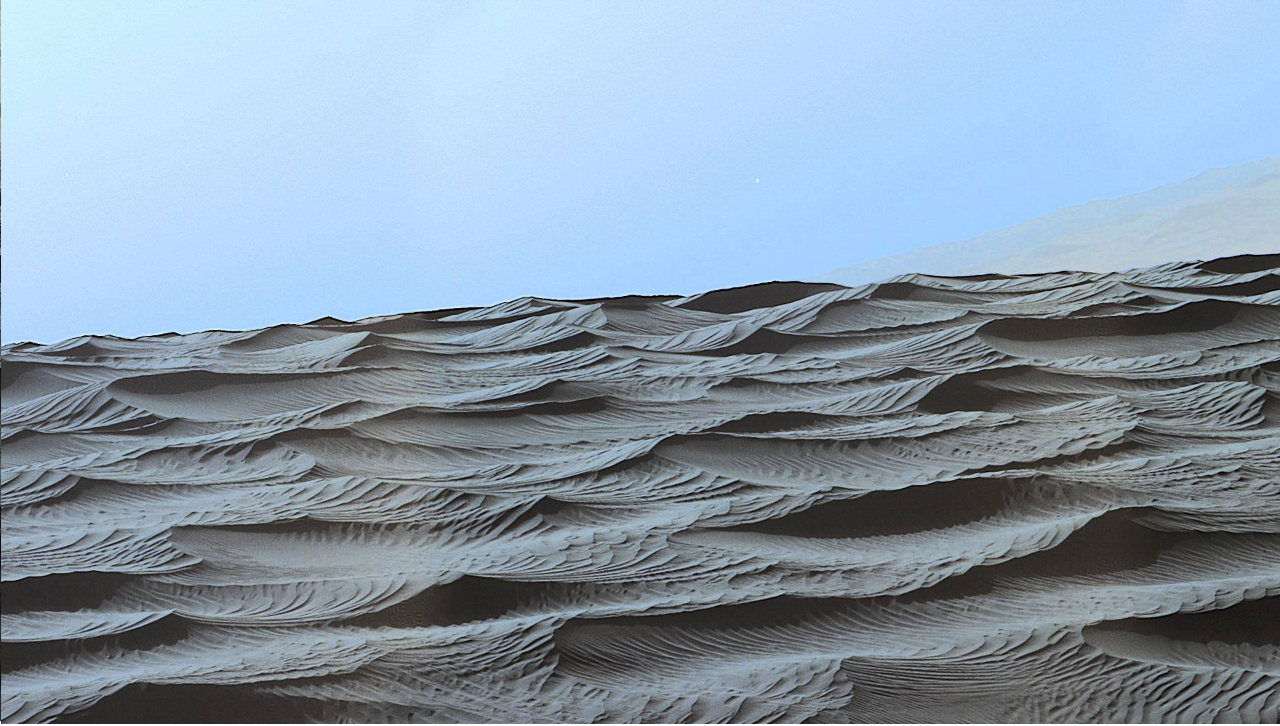
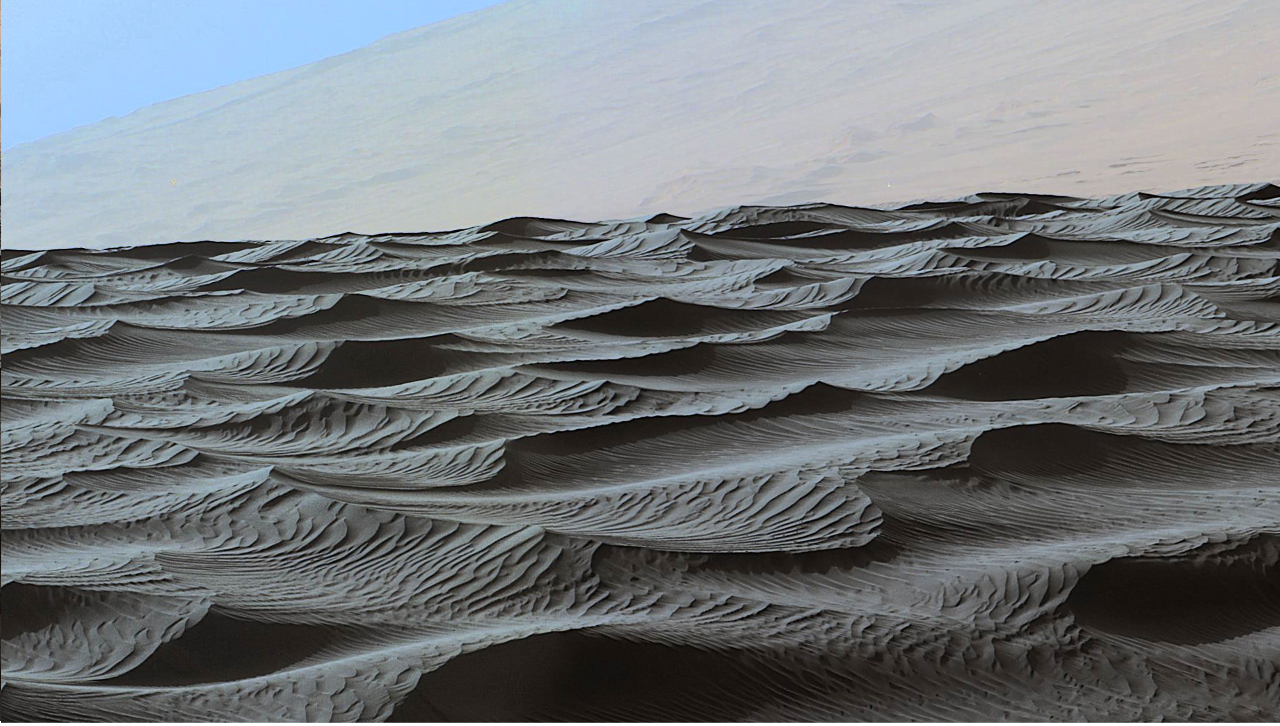
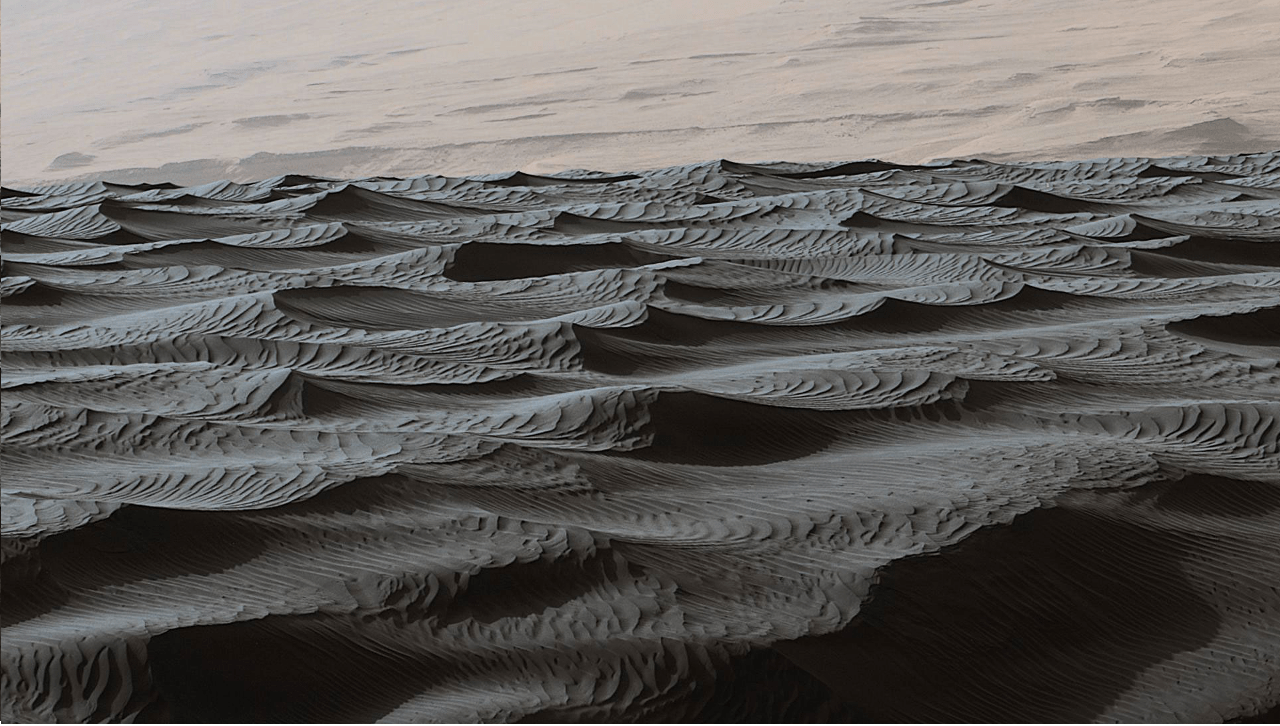
Earth and Mars both feature fields of giant sand dunes. The huge dunes are shaped by the wind and miniature avalanches of sand, and their surface is marked by small ripples less than 30 centimeters apart. These little ripples are formed when sand carried by the wind impacts the dunes. But Martian dunes have a second, larger kind of ripple, too. These sinuous, curvy ripples lie about 3 meters apart and cast the dark shadows seen in the images above. On Earth we see ripples like these underwater, where water drags sand along the surface. On Mars, the same process is thought to play out with the wind, and so scientists have named these wind-drag ripples. (Image credit: NASA/JPL/MSSS; via APOD, full-res; submitted by jshoer)
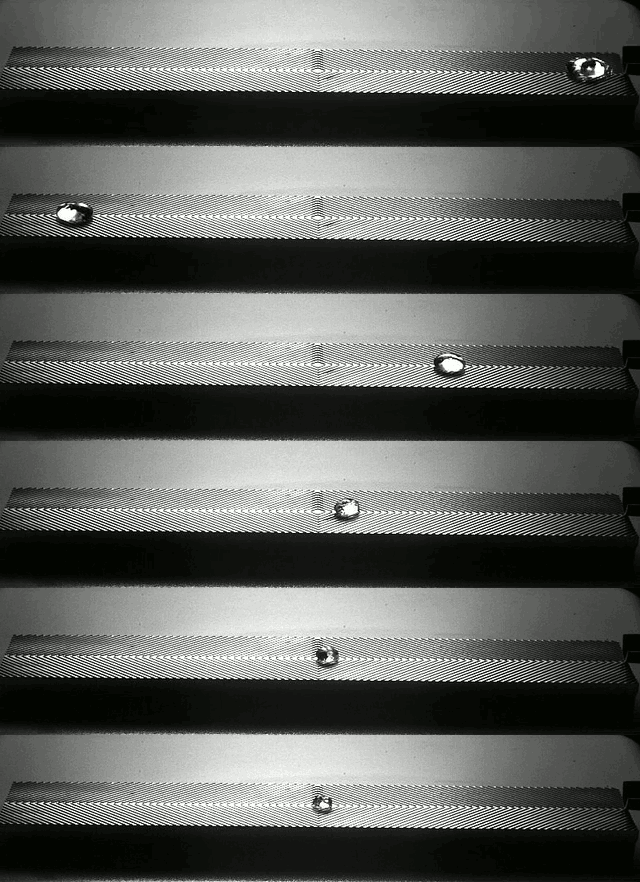
Turn the stove up high enough and you may have noticed that drops of water stop boiling away and instead skate across the surface. This is the Leidenfrost effect, which occurs when a surface is so much hotter than a liquid’s boiling point that any liquid that contacts instantly vaporizes. That thin vapor layer insulates the rest of the drop and makes it skate around on very little friction. Previously, researchers found that putting these drops on patternedsurfaces causes them to self-propel. Here you see Leidenfrost drops on a V-shaped “herringbone” surface. The grooves in the surface catch and direct the vapor out the Vs. If it seems counter-intuitive that the drops move in the same direction as their vapor, you’re not alone! It turns out that Leidenfrost drops aren’t propelled by vapor moving away from them – like, say, a rocket is. Instead the drops are being dragged along by friction between them and the escaping vapor. By controlling the direction of the vapor, researchers were able to create race tracks (top) and even traps (bottom) for the drops. (Image credit: D. Soto et al., from Supplemental Movies 2 and 3)
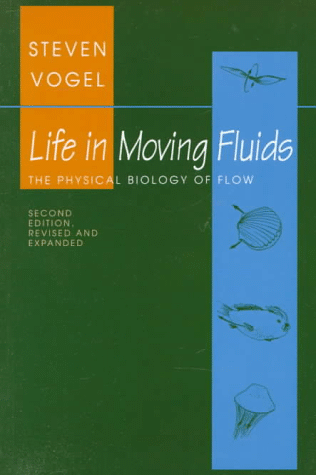
If you liked the prairie dog post earlier this week and you’re interested in more examples of biological fluid dynamics, you may enjoy Steven Vogel’s “Life in Moving Fluids”. I’m often asked for suggestions of readable textbooks for those who want an introduction to fluid dynamics, and this book is a great option. It addresses a wide variety of basic fluids concepts without getting as bogged down mathematically as many of the engineering texts do. It is written as an introduction to fluid dynamics for working biologists, though, so it contains plenty of technical detail – including relevant equations, discussions of basic flow measurement techniques, and overviews of the early academic literature.
It is also chock full of interesting biological applications of fluid dynamics with examples ranging from the growth patterns of barnacles to the shape-shifting drag capabilities of trees. Vogel keeps a light-hearted tone and dry humor throughout and doesn’t shy away from puns.
I read a first edition of the book (copyright 1981). The second edition, from the mid ‘90s, has updated coverage of the research literature, but I dare say the the topic has exploded within the last 20 years, so your mileage may vary with regard to the literature review. However, age in no way impacts the quality of Vogel’s coverage of the basics of fluid dynamics, and I feel confident in recommending this as an introductory text for those who’d like to pursue fluids in more depth. (Images: S. Vogel/Princeton U. Press; h/t to Chris R.)
How fast does a speedster like The Flash or Dash Parr from The Incredibles have to go to run on water? As we saw from other water-walkers like the basilisk lizard and the western and Clark’s grebes, any large creature wanting to run on water needs to generate the necessary vertical impulse by hitting the water hard, pushing off against the cavity that creates, and pulling their foot up before the cavity collapses around it.
Using basilisk lizards as our guide, we can build a simplified hydrodynamic model (following Glasheen and McMahon and Minetti et al.) to describe this process and predict a speedster’s necessary speed. If we assume our runner removes their foot before the cavity collapses, we have a relatively simple relation to satisfy, namely: the vertical impulse from the slap combined with the vertical impulse from the push, or stroke, must equal or exceed the impulse from the runner’s weight:
(Impulse from slap) + (Impulse from stroke) >= Impulse from runner’s weight
The impulse from the runner’s weight is relatively straightforward. It depends on the runner’s mass, gravity, and the time it takes the runner to complete a step. The other two terms are a bit more complicated and require some approximations. One is that we’ll treat the runner’s foot like a circular disk – this makes it easier to figure out the drag while the runner pushes against the water. Ultimately, the model requires five variables (four, if we assume that we’re on Earth):
– the runner’s mass
– the area of the runner’s foot
– the depth the runner’s foot reaches underwater
– the time it takes the runner to take one step
– the acceleration due to gravity
I will spare you the math, but I’ve created an online calculator (now with English or metric versions) with the model, so you can follow along with my math or play around with your own numbers.
Click through to see how fast a human has to go to run on water.
So how fast would The Flash have to run? Barry Allen is grown man, roughly 75 kg in mass, with a foot area of about 314 cm^2. We can assume that he pushes his leg about 0.15 m into the water with each step. The best human sprinters run with a step time of 0.2 – 0.26 seconds, but Barry’s a metahuman, so we’ll give him the benefit of the doubt and say that he can take a step in 0.15 seconds. (Let’s be honest, he’s probably capable of faster than that!)
To keep from sinking, The Flash would have to strike his feet against the water at about 37 m/s. It’s a little tough to say exactly how that would translate into forward speed. Both basilisks and grebes strike the water at a higher speed than their forward velocity. Since their feet are parallel to the surface when they strike, the slap phase only gives them vertical impulse. Their forward velocity comes from the stroke phase where they can push off against the water. This suggests that a runner who generates a lot of their vertical impulse during the slap phase will be able to get more forward velocity out of the stroke phase because they can afford to push forward off the cavity instead of mostly up. That’s consistent with what we observe in the lizards and grebes; the grebe gets more of its impulse from the slap and its forward velocity is a larger percentage of its foot impact velocity compared to the basilisk.
Using the lizards and birds as our guide, we can estimate that The Flash, who gets about 45% of his necessary vertical impulse from slapping, will have a forward velocity of about 27 m/s or 98 kph. That’s a lot faster than any human has ever run – Usain Bolt has managed about 44.7 kph – but it’s not thatfast. In CW’s The Flash TV show, his team estimates that he must run 650 miles per hour, or 1050 kph, to run on water. That is way fasterthan necessary!
How about Dash Parr, though? Dash is about 10 years old, so he’s a lot smaller than Barry. That means he has less mass to keep afloat (about 32 kg), but it also means that he has smaller feet (154 cm^2) and shorter legs (0.1 m foot depth). For the same stride rate, that means that Dash has to hit the water at 47 m/s, about 25% faster than Barry. It also means that Dash gets a tad more oomph from his slap (~46%) and runs across the water at 128 kph, about 30% faster than Barry has to go.
That’s totally doable for a superhero, but what about us regular humans? Sadly, our large mass and small feet won’t let us run on water like The Flash or Dash, but there are ways to bend the rules. One is to reduce gravity – this was the subject of an Ig Nobel prize-winning study by Minetti et al. The researchers put fins on volunteers, suspended them from a harness to reduce their effective weight, and got them to run in place in a pool. They found that fin-augmented humans could run on water in gravity about 20% of Earth’s.
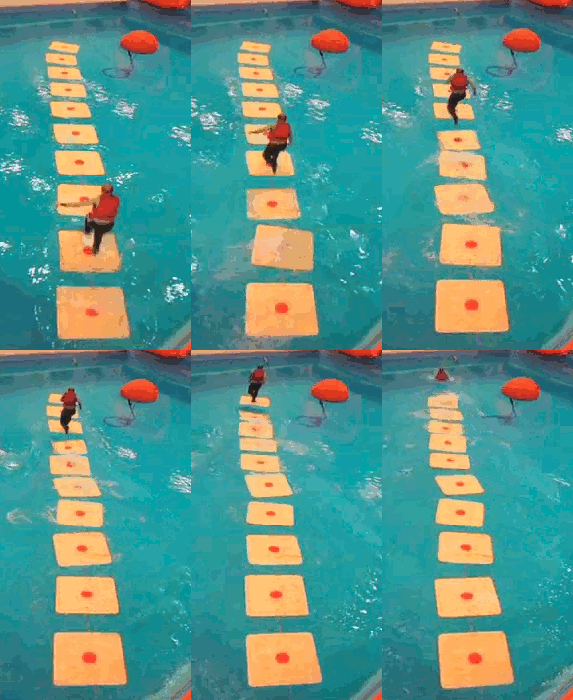
Another technique is to increase a runner’s effective foot area without making them bother to lift the foot out of the water. In essence, a human can run on water across over-sized lily pads. In their study, Lothman and Ruina accomplished this with plywood pads laid out in a pool. The pads were buoyant enough to stay afloat at the water surface but would sink if a person stood still on them. But by running quickly from one to the next, their test subject was able to successfully run across water.
Many insects and arachnids can walk on water by virtue of their hydrophobicity and small size. With their light weight and skinny legs, these invertebrates curve the air-water interface like a trampoline, with surface tension providing the elasticity that keeps them afloat. What’s truly incredible, though, is that many of these creatures, like water striders, can actually jump off the water surface.
The top animation shows high-speed video footage of a water strider leaping off the water. Notice how it distorts the air-water interface but doesn’t break the surface – it makes no splash.
The key is not to push too hard. If the insect exerts a force exceeding the limits of what surface tension can withstand, then its legs will break the water surface and it will lose energy to drag and viscous forces. The insect must generate its jumping force without exceeding a hard limit.
The water strider achieves this feat not by pushing downward but by rotating its middle and hind legs. Rotating its legs allows the insect to maintain contact with the water surface longer and continue deforming the interface as it jumps. This maximizes the momentum it transfers to the water, which, in turn, increases the insect’s take-off velocity. By studying and then emulating this mechanism, scientists were able to successfully create a tiny 68-mg water-jumping robot. (Image credits: J. Koh et al., sources, PDF)
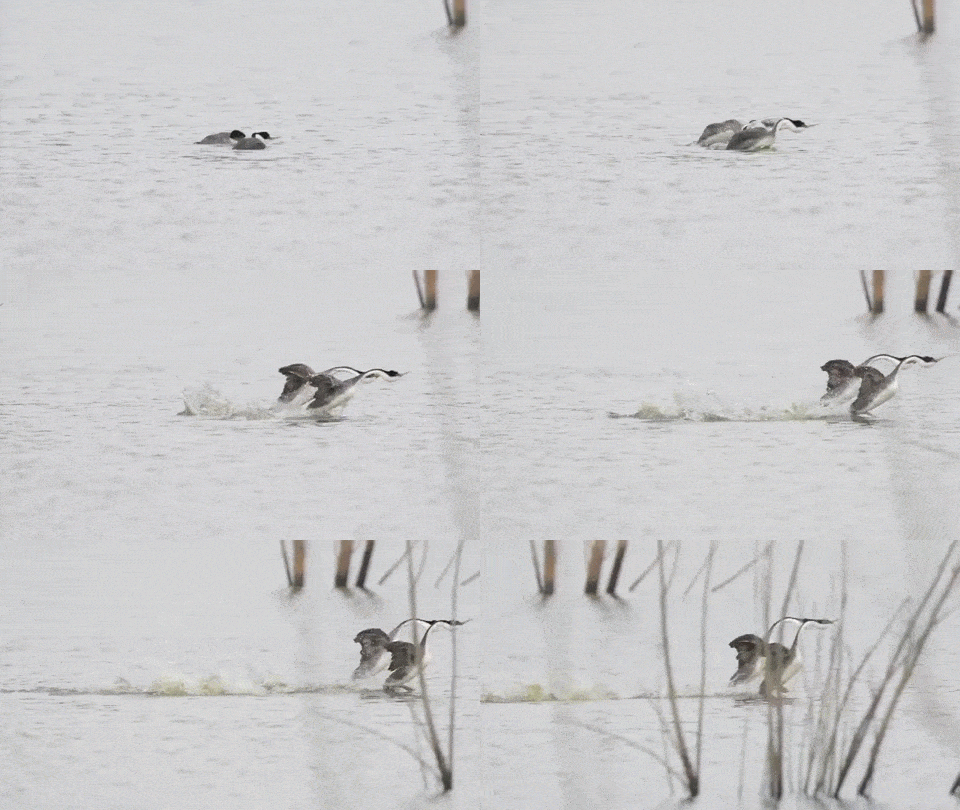
As capable a water-runner as the common basilisk is, the western and Clark’s grebe is even more impressive. Not only do these birds weigh up to three times as much as an adult basilisk, but they start their water-walking from inside the water, which requires overcoming much more hydrodynamic force.
Like the lizards, grebes must slap the water with their feet to generate upward forces capable of supporting their weight above water. The birds take as many as 20 steps a second – an incredible and unmatched stride rate for a creature their size. Their feet impact the water at up at 4.5 m/s, which generates an impulse equivalent to 30-55% of the grebe’s weight. The rest of the necessary impulse comes from the stroke phase, where the bird pushes its foot down against the water.
When retracting its foot, the grebe extracts the foot with a sideways motion through the water – unlike the basilisk which pulls its foot out through the air cavity its stroke created. In order to reduce drag, the grebe’s foot collapses into a more streamlined shape as it gets pulled from the water, letting the bird set up for the next step. (Image/video credit: B. Struck, source; research credit: G. Clifton et al.)
One of the most famous water-walking creatures is the common basilisk lizard. These South American reptiles are far too large to be kept aloft by surface tension and other interfacial effects. They generate the vertical force necessary to stay above water by slapping the water hard and fast. There are three phases to a basilisk’s water running gait: the slap, the stroke, and the retraction.
In the slap phase, the lizard slams its foot flat against the water surface at a peak velocity of about 3.75 m/s. The impact pushes water down and generates an upward force on the lizard that accounts for between 15-30% of the lizard’s body weight, depending on the size of the lizard. The rest of the upward force comes from the stroke phase, where the lizard pushes its foot downward in the water, causing an air cavity to form.
The air cavity is vital for the last phase of the lizard’s step. The basilisk must pull its foot out and prepare for the next slap, ideally doing so without generating too much drag. The lizard does this by pulling its foot through the air cavity before it seals. Doing so through air is much easier than through water.
Water-walking this way requires fast reflexes. Basilisks take up to 20 steps per second when running across water and reach speeds of about 1.6 m/s. Although both juvenile and adult basilisks can run on water, the smaller lizards do better because they can generate more than enough impulse to overcome their weight. (Image credit: T. Hsieh/Lauder Laboratory, source; video credit: BBC; research credits: J. Glasheen and T. McMahon, G. Clifton et al.)
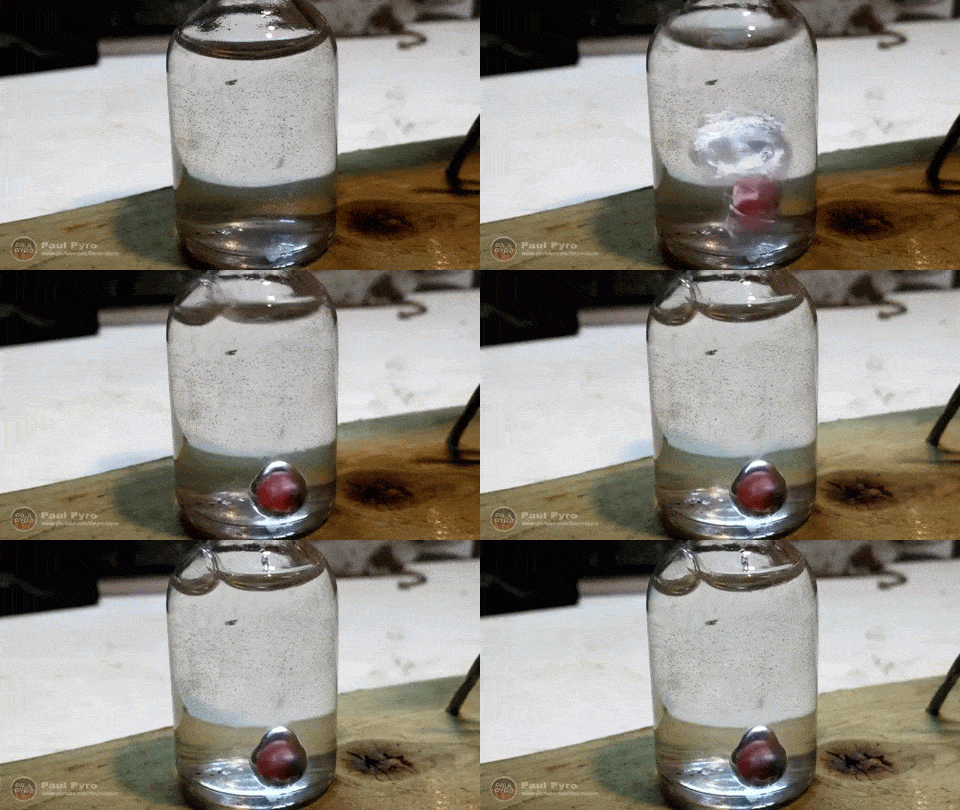
The Leidenfrost effect occurs when a liquid is exposed to a surface so hot that it instantly vaporizes part of the liquid. It’s typically seen with a drop of water on a very hot pan; the drop will slide around, nearly frictionless, upon a cushion of its own vapor. You can see the effect when plunging a hot object into a bath of liquid, too. This is what happens when you quickly dunk a hand in liquid nitrogen (not recommended, incidentally) or when you drop a red hot steel ball into water like above. In this case, the object is so hot that it gets encased in a layer of water vapor. If you could maintain the temperature difference necessary to keep the vapor layer intact, you could move underwater at high speeds with low drag, similar to the effects of supercavitation. (Image credit: Paul Pyro, source)
If you enjoy FYFD, please consider supporting the site by becoming a patron!
Compared to birds, manmade aircraft tend to be quite limited and inelegant. Fixed-wing aircraft, for example, require long, flat areas for take-off and landing, whereas birds of all sizes are adept at maneuvers like perching. This video examines the perching behaviors of large birds and extends the physics to a small unmanned aerial vehicle (UAV). As a bird approaches a perching location, it pitches its body and wings upward. This places the bird in what’s known as deep stall, where air flowing over the upper surface of the wing separates just after the leading edge. This move dramatically increases drag on the bird, slowing it for landing. At the same time, the speed of the pitch maneuver generates a vortex on the wing that helps the bird maintain lift despite the drop in speed. With the help of both forces, the bird can make a graceful, controlled landing in only a short distance. (Video credit: J. Mitchell et. al.)
This video demonstrates one of my favorite effects: the reversibility of laminar flow. Intuition tells us that un-mixing two fluids is impossible, and, under most circumstances, that is true. But for very low Reynolds numbers, viscosity dominates the flow, and fluid particles will move due to only two effects: molecular diffusion and momentum diffusion. Molecular diffusion is an entirely random process, but it is also very slow. Momentum diffusion is the motion caused by the spinning inner cylinder dragging fluid with it. That motion, unlike most fluid motion, is exactly reversible, meaning that spinning the cylinder in reverse returns the dye to its original location (plus or minus the fuzziness caused by molecular diffusion).
Aside from being a neat demo, this illustrates one of the challenges faced by microscopic swimmers. In order to move through a viscous fluid, they must swim asymmetrically because exactly reversing their stroke will only move the fluid around them back to is original position. (Video credit: Univ. of New Mexico Physic and Astronomy)