Search results for: “drag”

  • Rio 2016: Track Cycling

    Rio 2016: Track Cycling

    Track cycling is a sport where speed is everything. As much as 90% of the resistance a rider has to overcome is aerodynamic drag. To minimize drag, riders wear form-fitting one-piece skinsuits and wear special, streamlined helmets. They have aerodynamic bikes (unique left-side-drive ones, if you’re the Team USA women) and ride with their arms close together and thrust in front of them to minimize the frontal area they expose. 

    Even the tactics of racing rely heavily on aerodynamics. In events like team pursuit cyclists stay extremely close to the wheel of the rider ahead of them in order to remain in that rider’s slipstream and experience less drag. When switching off the position of lead rider, cyclists use the curvature of the track to help them move to the back of the paceline quickly to minimize the time spent outside of their teammate’s draft. (Image credits: GettyImages via the Guardian and the IOC, source)

    Previously: Cycling’s aero equipment helps them beat the clock; the effect of cyclists being followed by a motorbike or car

    Join us throughout the Rio Olympics for more fluid dynamics in sports. If you love FYFD, please help support the site!

  • Rio 2016: Whitewater Sports

    Rio 2016: Whitewater Sports

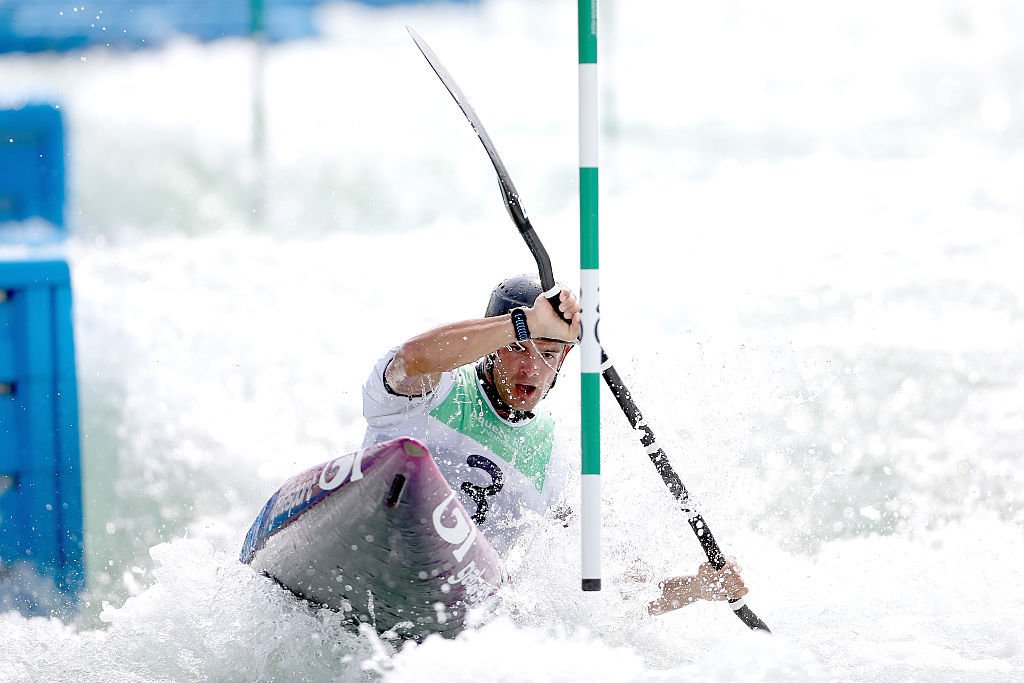
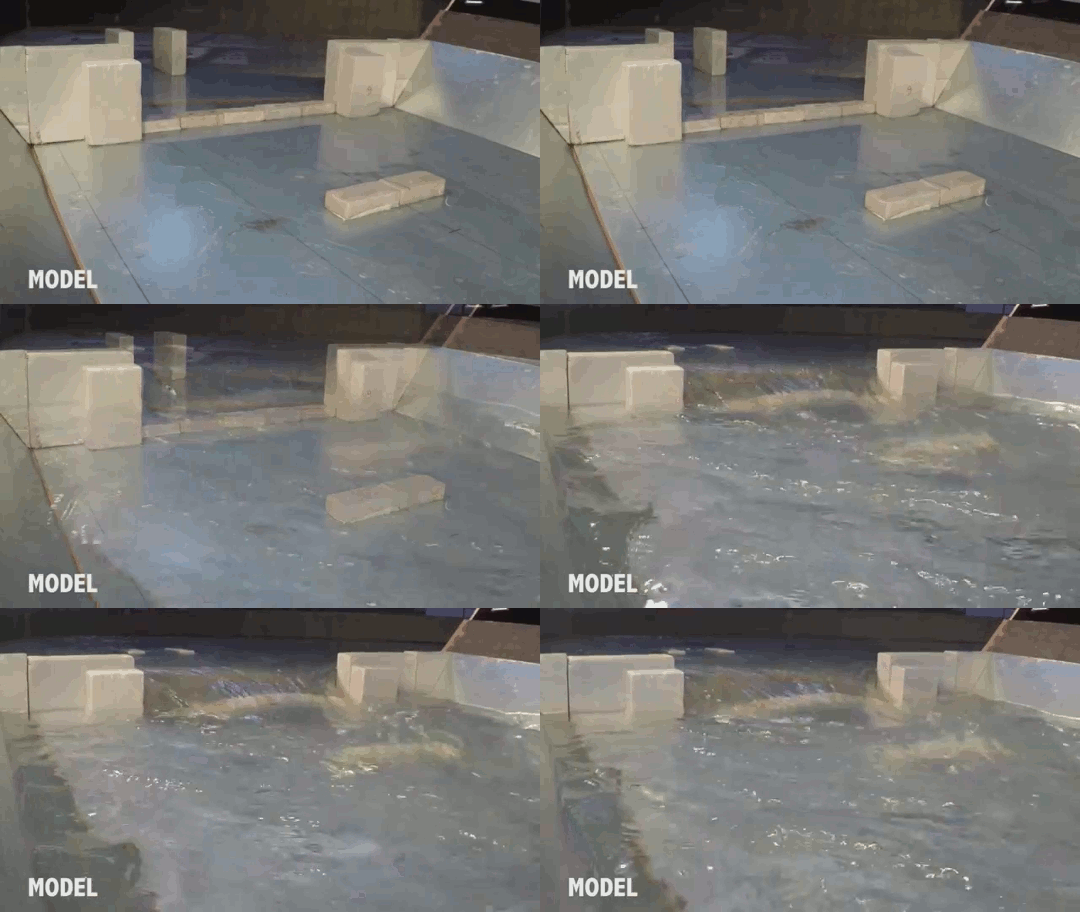
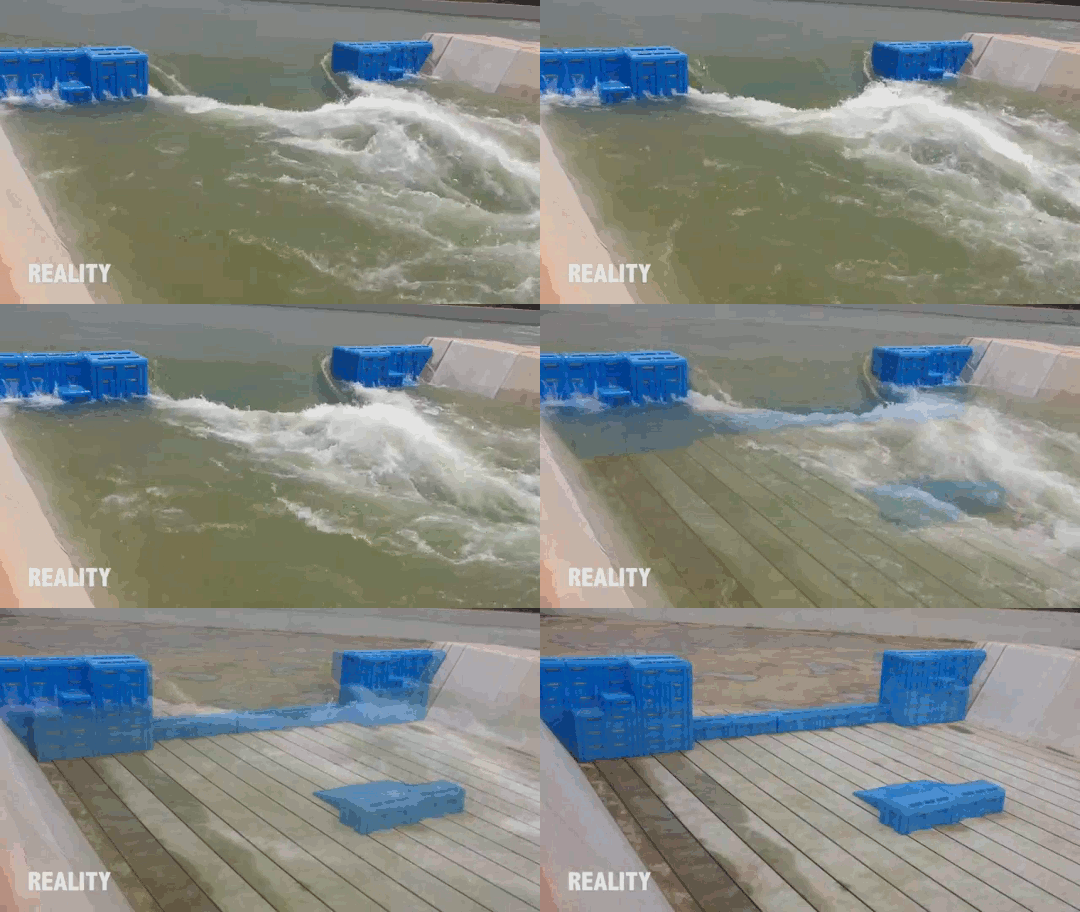
    The whitewater rapids of canoe slalom have their origins in mountain streams. Today the sport’s Olympic venues are artificial rivers, specially designed to provide world-class rapids whatever the geography of the host city. Rio’s course, like London’s, is reconfigurable; its features are controlled by the placement of Lego-like plastic blocks.

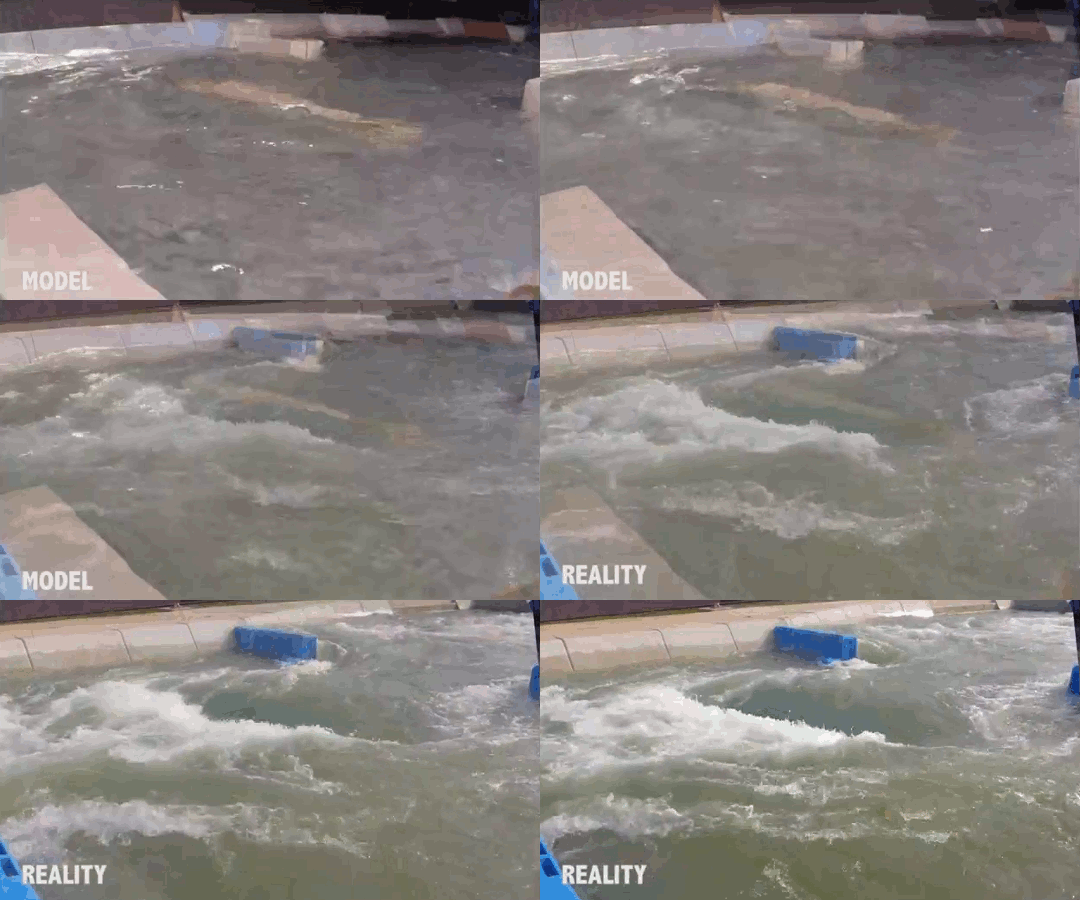
    A key part of the course’s design process was building a small-scale physical model of the course. To maintain the dynamics of the rapids at a smaller physical scale, engineers used a concept called similitude. Surface waves like rapids are a function of the flow’s inertia and the effects of gravity, a ratio that’s captured in the dimensionless Froude number. To match the small-scale model to the real flow, engineers scaled the features of the real course down such that the Froude number stayed the same between the model and the full-scale course. As seen in the animations above, this meant that the model had the same general flow features as the final course, letting engineers and designers test and fine-tune features before construction. Learn more about the model and its construction in these two videos. (Image credits: kayaker – Getty Images; model comparisons – J. Pollert, source)

    Previously: Physics of rowingwhy that octopus kite looks so real

    Join us throughout the Rio Olympics for more fluid dynamics in sports. If you love FYFD, please help support the site!

  • Rio 2016: Rugby

    Rio 2016: Rugby

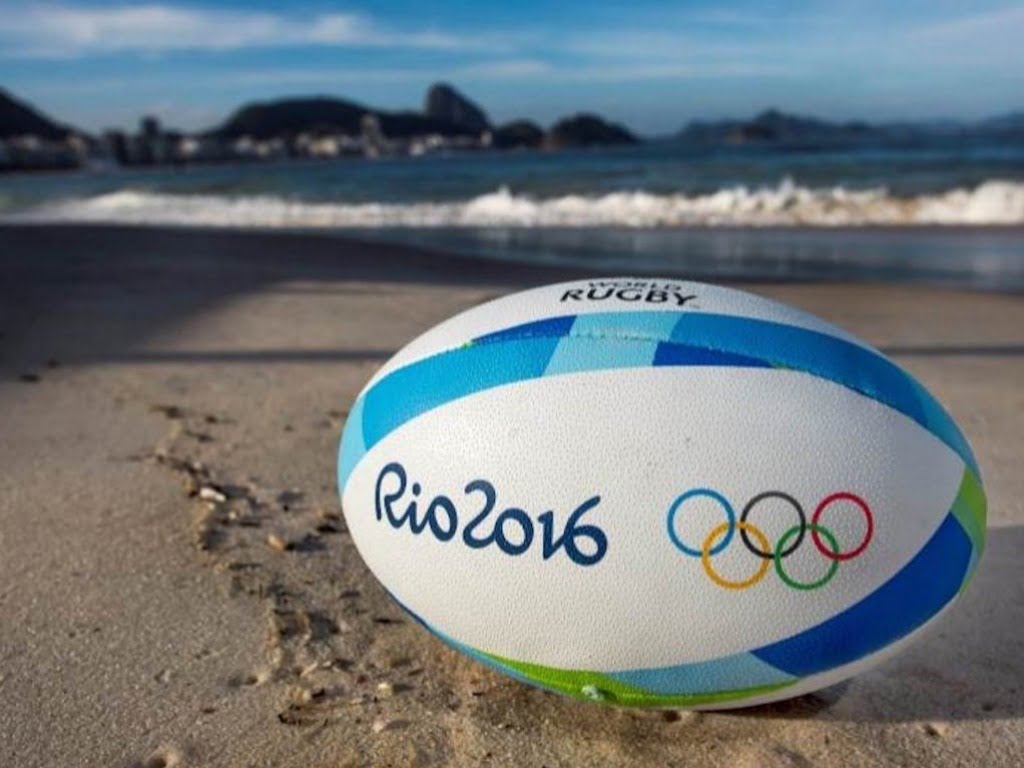
    The sport of rugby returns to the Olympics in Rio this year. Rugby’s ball is somewhat similar in size and shape to an American football, but it is a little wider and more rounded. Aerodynamically, this means that the rugby ball has  more drag, but it is also more stable in flight, allowing players to pass and kick accurately, with or without a spiral.

    As seen in the flow visualizations above, air travels up and around the ball before separating on the far side. The more the ball is tilted, the larger this separated region is and the greater the drag. At the same time, though, that tilt provides lift on the ball. The ideal orientation is the one with the largest ratio of lift force and drag force. For a rugby ball, this occurs at about 40 degrees.(Image credits: Planet Rugby; A. Vance et al.)

    Previously: The aerodynamics of the American football

    Join us throughout the Rio Olympics for more fluid dynamics in sports. If you love FYFD, please help support the site!

  • Rio 2016: Swimming

    Rio 2016: Swimming

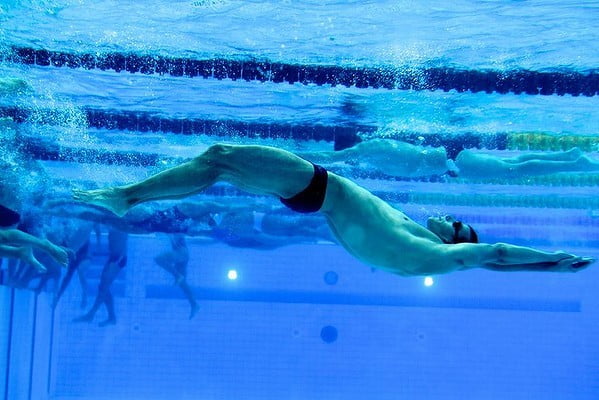
    Strange as it seems, elite swimmers are faster when swimming underwater than they are at the surface. So much so, in fact, that they’re restricted to being underwater only 15 m after a dive or turn. To see just how stark a difference this makes, check out this crazy video.  (I know, right?!)

    To understand how this is possible, it helps to look at the three types of drag a swimmer experiences: pressure drag, skin friction, and wave drag. Pressure drag is probably the most familiar; it’s the drag that comes from the swimmer’s shape and how the fluid moves around it. Skin friction is the drag that comes from viscous friction between the swimmer and the water. The final type, wave drag, comes from the energy expended to create waves at the surface of the water. As you might expect, energy that goes into splashing is energy that isn’t going into propulsion.

    When swimming at the surface, swimmers experience a lot of wave drag. At least one experiment showed that wave drag accounted for most of a surface swimmer’s drag. In contrast, at a depth of more than 0.5 m, a swimmer’s wave drag is virtually negligible. The submersion does come at the cost of higher skin friction (since more of the swimmer is in contact with the water), but there is also more opportunity for useful propulsion since both sides of a kick can move water (and not air.) Bonus read for those interested in more: Is the fish kick the fastest stroke yet? (Image credits: AP; B. Esposito)

    Previously: what makes a pool fast?

    Join us throughout the Rio Olympics for more fluid dynamics in sports. If you love FYFD, please help support the site!

  • Rio 2016: Cycling

    Rio 2016: Cycling

    Today marks the official start of the 2016 Summer Olympics in Rio. Here at FYFD we’ll be celebrating by taking a look at how fluid dynamics affects Olympic sports. You can check out our previous series on the London Olympics here. Since this weekend features the men’s and women’s cycling road races, we’ll get started with cycling!

    In road cycling, equipment and race strategy are all built around aerodynamic efficiency. It’s understood that following a car or motorbike gives a cyclist an unfair advantage, and officials can be quick to punish infractions. What the rules don’t account for, though, is the advantage a cyclist gets when they’re followed by a motorbike (or car). These vehicles are significantly larger than a cyclist, and when they are trailing a cyclist, they have a significant upstream effect. Essentially the higher pressure traveling ahead of the motorbike will counter the low pressure region immediately behind the cyclist. The result is that the cyclist, despite being in front, experiences less drag than they would if the motorbike weren’t there.

    The difference isn’t tiny either: if a motorbike follows a rider at a distance of 0.5 m for just 1 km, the rider saves more than 2 seconds. When events can be won or lost by fractions of a second, those gains are significant. (Image credits: DCMS; B. Blocken et al., GettyImages, Reuters; research credit: B. Blocken et al.; submitted by Marc A.)

  • Sharks Swimming Sideways

    Sharks Swimming Sideways

    Like many sharks, the great hammerhead shark is negatively buoyant, meaning that, absent other forces, it would sink in water. To compensate, sharks generate lift with their pectoral (side) fins to offset their weight. Their dorsal (top) fin is used to generate the horizontal forces needed for control and turning. However, both captive and wild great hammerhead sharks tend to swim rolled partway onto their sides. The reason for this unusual behavior is hydrodynamic – it is more efficient for the shark. Unlike other species, the great hammerhead has a dorsal fin that is longer than its pectoral fins. By tipping sideways, the shark effectively creates a larger lifting span and is able to induce less drag than when it swims upright. Models show that swimming on their sides requires ~8% less energy than swimming upright! (Image credit: N. Payne et al., source)

  • Martian Ripples

    Martian Ripples

    Earth and Mars both feature fields of giant sand dunes. The huge dunes are shaped by the wind and miniature avalanches of sand, and their surface is marked by small ripples less than 30 centimeters apart. These little ripples are formed when sand carried by the wind impacts the dunes. But Martian dunes have a second, larger kind of ripple, too. These sinuous, curvy ripples lie about 3 meters apart and cast the dark shadows seen in the images above. On Earth we see ripples like these underwater, where water drags sand along the surface. On Mars, the same process is thought to play out with the wind, and so scientists have named these wind-drag ripples. (Image credit: NASA/JPL/MSSS; via APOD, full-res; submitted by jshoer)

  • Skating on Vapor

    Skating on Vapor

    Turn the stove up high enough and you may have noticed that drops of water stop boiling away and instead skate across the surface. This is the Leidenfrost effect, which occurs when a surface is so much hotter than a liquid’s boiling point that any liquid that contacts instantly vaporizes. That thin vapor layer insulates the rest of the drop and makes it skate around on very little friction. Previously, researchers found that putting these drops on patterned surfaces causes them to self-propel. Here you see Leidenfrost drops on a V-shaped “herringbone” surface. The grooves in the surface catch and direct the vapor out the Vs. If it seems counter-intuitive that the drops move in the same direction as their vapor, you’re not alone! It turns out that Leidenfrost drops aren’t propelled by vapor moving away from them – like, say, a rocket is. Instead the drops are being dragged along by friction between them and the escaping vapor. By controlling the direction of the vapor, researchers were able to create race tracks (top) and even traps (bottom) for the drops. (Image credit: D. Soto et al., from Supplemental Movies 2 and 3)

  • Review: “Life in Moving Fluids”

    Review: “Life in Moving Fluids”

    If you liked the prairie dog post earlier this week and you’re interested in more examples of biological fluid dynamics, you may enjoy Steven Vogel’s “Life in Moving Fluids”. I’m often asked for suggestions of readable textbooks for those who want an introduction to fluid dynamics, and this book is a great option. It addresses a wide variety of basic fluids concepts without getting as bogged down mathematically as many of the engineering texts do. It is written as an introduction to fluid dynamics for working biologists, though, so it contains plenty of technical detail – including relevant equations, discussions of basic flow measurement techniques, and overviews of the early academic literature.

    It is also chock full of interesting biological applications of fluid dynamics with examples ranging from the growth patterns of barnacles to the shape-shifting drag capabilities of trees. Vogel keeps a light-hearted tone and dry humor throughout and doesn’t shy away from puns.

    I read a first edition of the book (copyright 1981). The second edition, from the mid ‘90s, has updated coverage of the research literature, but I dare say the the topic has exploded within the last 20 years, so your mileage may vary with regard to the literature review. However, age in no way impacts the quality of Vogel’s coverage of the basics of fluid dynamics, and I feel confident in recommending this as an introductory text for those who’d like to pursue fluids in more depth.  (Images: S. Vogel/Princeton U. Press; h/t to Chris R.)

  • Humans Running on Water

    Humans Running on Water

    How fast does a speedster like The Flash or Dash Parr from The Incredibles have to go to run on water? As we saw from other water-walkers like the basilisk lizard and the western and Clark’s grebes, any large creature wanting to run on water needs to generate the necessary vertical impulse by hitting the water hard, pushing off against the cavity that creates, and pulling their foot up before the cavity collapses around it.

    Using basilisk lizards as our guide, we can build a simplified hydrodynamic model (following Glasheen and McMahon and Minetti et al.) to describe this process and predict a speedster’s necessary speed. If we assume our runner removes their foot before the cavity collapses, we have a relatively simple relation to satisfy, namely: the vertical impulse from the slap combined with the vertical impulse from the push, or stroke, must equal or exceed the impulse from the runner’s weight:

    (Impulse from slap) + (Impulse from stroke) >= Impulse from runner’s weight

    The impulse from the runner’s weight is relatively straightforward. It depends on the runner’s mass, gravity, and the time it takes the runner to complete a step. The other two terms are a bit more complicated and require some approximations. One is that we’ll treat the runner’s foot like a circular disk – this makes it easier to figure out the drag while the runner pushes against the water. Ultimately, the model requires five variables (four, if we assume that we’re on Earth):

    – the runner’s mass
    – the area of the runner’s foot
    – the depth the runner’s foot reaches underwater
    – the time it takes the runner to take one step
    – the acceleration due to gravity

    I will spare you the math, but I’ve created an online calculator (now with English or metric versions) with the model, so you can follow along with my math or play around with your own numbers. 

    Click through to see how fast a human has to go to run on water.

    So how fast would The Flash have to run? Barry Allen is grown man, roughly 75 kg in mass, with a foot area of about 314 cm^2. We can assume that he pushes his leg about 0.15 m into the water with each step. The best human sprinters run with a step time of 0.2 – 0.26 seconds, but Barry’s a metahuman, so we’ll give him the benefit of the doubt and say that he can take a step in 0.15 seconds. (Let’s be honest, he’s probably capable of faster than that!)

    To keep from sinking, The Flash would have to strike his feet against the water at about 37 m/s. It’s a little tough to say exactly how that would translate into forward speed. Both basilisks and grebes strike the water at a higher speed than their forward velocity. Since their feet are parallel to the surface when they strike, the slap phase only gives them vertical impulse. Their forward velocity comes from the stroke phase where they can push off against the water. This suggests that a runner who generates a lot of their vertical impulse during the slap phase will be able to get more forward velocity out of the stroke phase because they can afford to push forward off the cavity instead of mostly up. That’s consistent with what we observe in the lizards and grebes; the grebe gets more of its impulse from the slap and its forward velocity is a larger percentage of its foot impact velocity compared to the basilisk.

    Using the lizards and birds as our guide, we can estimate that The Flash, who gets about 45% of his necessary vertical impulse from slapping, will have a forward velocity of about 27 m/s or 98 kph. That’s a lot faster than any human has ever run – Usain Bolt has managed about 44.7 kph – but it’s not that fast. In CW’s The Flash TV show, his team estimates that he must run 650 miles per hour, or 1050 kph, to run on water. That is way faster than necessary!

    How about Dash Parr, though? Dash is about 10 years old, so he’s a lot smaller than Barry. That means he has less mass to keep afloat (about 32 kg), but it also means that he has smaller feet (154 cm^2) and shorter legs (0.1 m foot depth).  For the same stride rate, that means that Dash has to hit the water at 47 m/s, about 25% faster than Barry. It also means that Dash gets a tad more oomph from his slap (~46%) and runs across the water at 128 kph, about 30% faster than Barry has to go.

    That’s totally doable for a superhero, but what about us regular humans? Sadly, our large mass and small feet won’t let us run on water like The Flash or Dash, but there are ways to bend the rules. One is to reduce gravity – this was the subject of an Ig Nobel prize-winning study by Minetti et al. The researchers put fins on volunteers, suspended them from a harness to reduce their effective weight, and got them to run in place in a pool. They found that fin-augmented humans could run on water in gravity about 20% of Earth’s.

    image

    Another technique is to increase a runner’s effective foot area without making them bother to lift the foot out of the water. In essence, a human can run on water across over-sized lily pads. In their study, Lothman and Ruina accomplished this with plywood pads laid out in a pool. The pads were buoyant enough to stay afloat at the water surface but would sink if a person stood still on them. But by running quickly from one to the next, their test subject was able to successfully run across water.

    So, there you have it: speedsters can run on water without breaking autobahn speed limits and the rest of us can cheat. Be sure to check out the online calculator and play with the model yourself. And join me tomorrow for my special webcast with Professor Tadd Truscott and Randy Hurd, who inspired this foray into water-walking!

    ETA: I updated the calculator so that there is now an English unit version as well as a metric unit version.

    image

    Research credits:

    Glasheen and McMahon, “A hydrodynamic model of locomotion in the basilisk lizard”, 1996.

    Minetti et al., “Humans running in place on water at simulated reduced gravity,” 2012.

    Lothman and Ruina, “Humans can run on water using big instantly-changable shoes,” 2012.

    (Image credits: Disney, CW/DC Comics, Lothman and Ruina, source, and The Splash Lab)