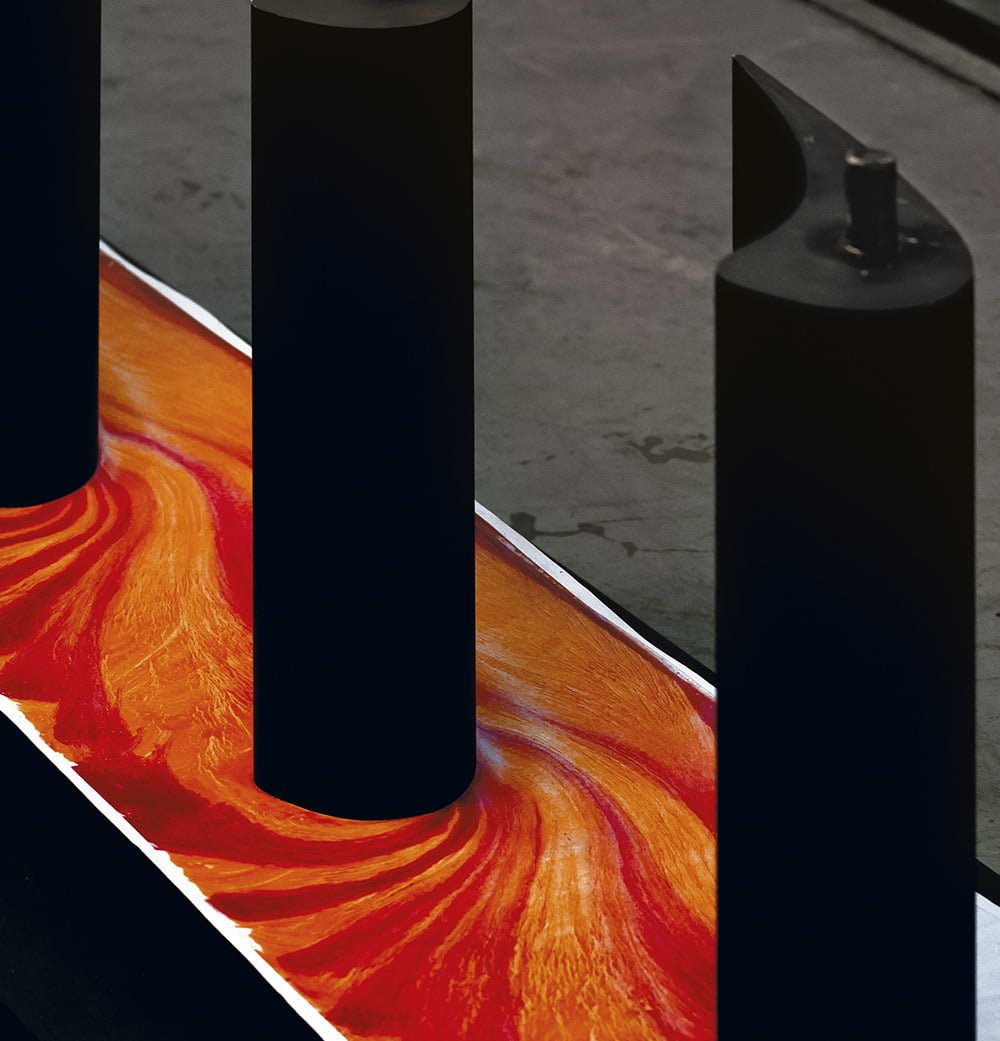
Fluid flows are complex, complicated, and ever-changing. Researchers use many techniques to visualize parts of a flow, which can help make what’s happening clearer. One technique, shown above, uses oil and dye to visualize flow at the surface. The vertical, black, airfoil-shaped pieces are stators, stationary parts within a turbine that help direct flow. After painting the stator mount surface with a uniform layer of oil, the model can be placed in a wind tunnel (or turbine) and exposed to flow. Air moving around the stators drags some of the oil with it, creating the darker and lighter streaks seen here. Notice how the lines of oil turn sharply around the front of the stator and bunch up near its widest point. Those crowded flow lines tell researchers that the air moves quickly around this corner. (Image credit: D. Klaubert et al., source)
Search results for: “drag”

Self-Propelled Hovercraft

When placed on an extremely hot substrate, some drops levitate and can be propelled over specially textured surfaces. Inspired by this work, researchers are using similar principles to explore manipulation of levitating plates using surface texture. Their apparatus consists of a semi-porous, grooved surface that ejects air upward to levitate Plexiglas objects – think air hockey table with grooves. With enough airflow, the Plexiglas levitates. The grooves force air in a particular direction – in the case of the herringbone pattern, this is in the direction of opening – and, as the air moves, it drags its Plexiglas hovercraft along. As shown in the second animation, grooves can do more than move the glass linearly; with patterns offset by 90-degrees, they can make the hovercraft rotate.
Here’s an interesting next step for anyone out there with an air hockey table and a 3D printer: does the directional manipulation work if the grooves are on the object and not the table? In other words, can you create an air hockey puck that preferentially goes to your opponent’s goal? (Image and resource credit: D. Soto et al., source)

Spots of Turbulence
One of the enduring mysteries of fluid dynamics lies in the transition between smooth laminar flow and chaotic turbulent flow in the area near a wall. That region, known as the boundary layer, has a major impact on drag and other effects. The process begins with disturbances that are too tiny to see or measure, but eventually, those disturbances can grow large enough to generated an isolated turbulent spot, like the one imaged above. Flow in the photograph is from left to right. Turbulent spots have a distinctive wedge-like shape that expands as the spot grows and widens. These turbulent spots can merge together to create still larger spots, and when a surface eventually becomes completely covered in them, we call it fully-developed turbulent flow. (Image credit: M. Gad-El-Hak et al.)
The Coalescence Cascade and Surfactants
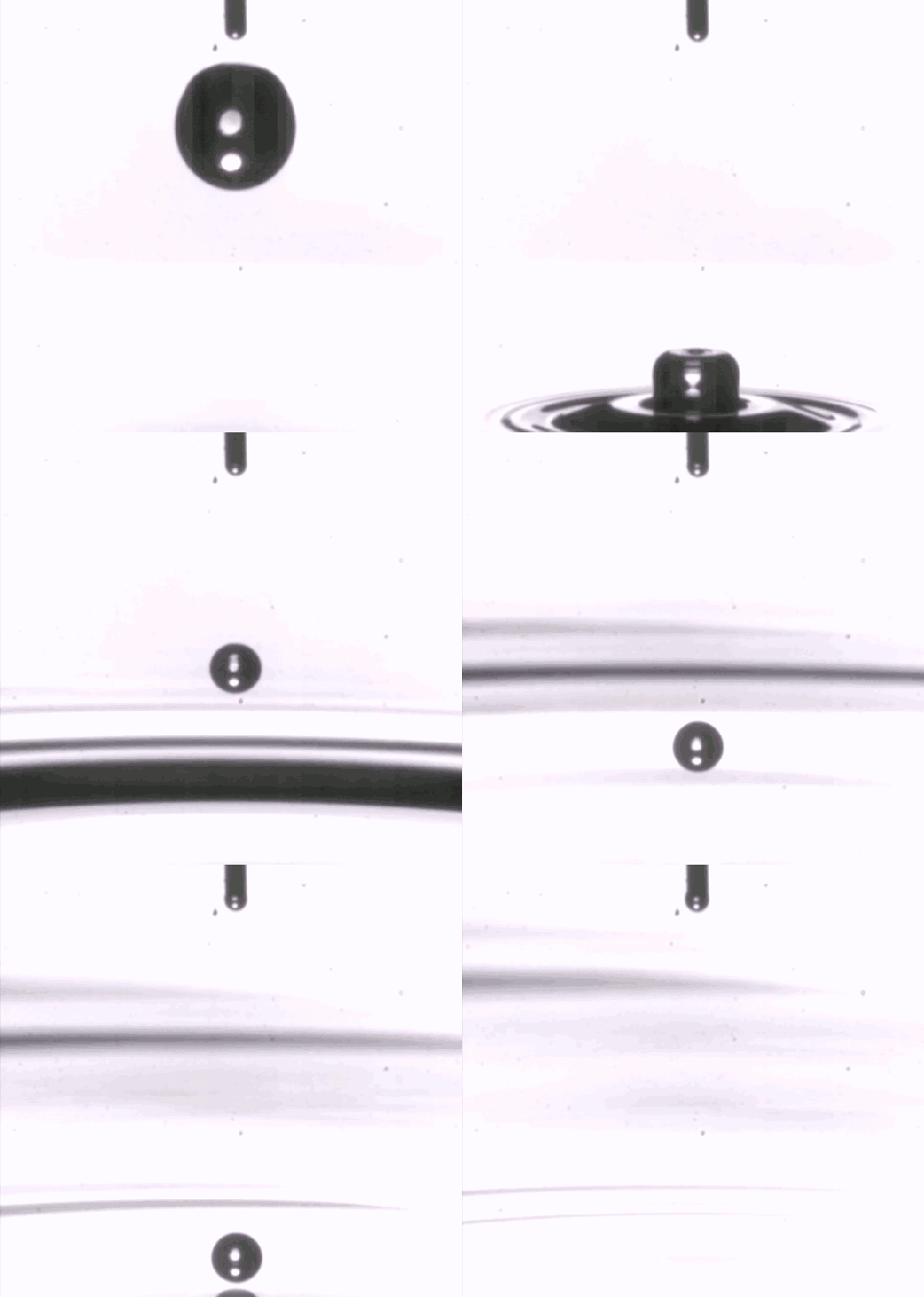
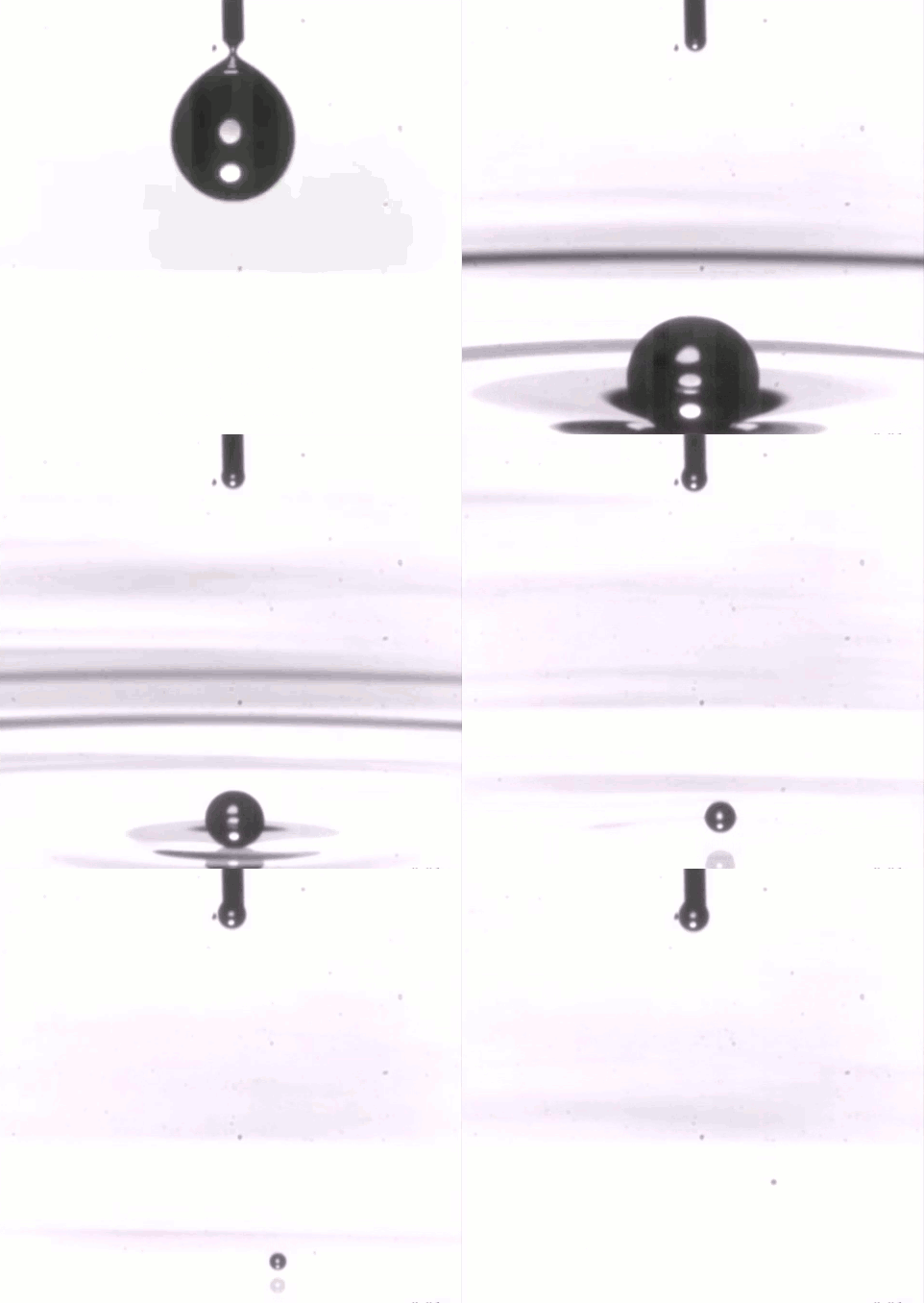
Drops of a liquid can often join a pool gradually through a process known as the coalescence cascade (top left). In this process, a drop sits atop a pool, separated by a thin air layer. Once that air drains out, contact is made and part of the drop coalesces. Then a smaller daughter droplet rebounds and the process repeats.
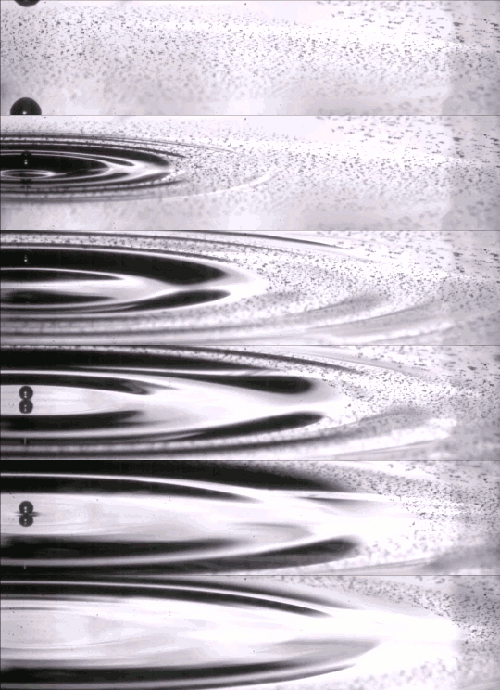
A recent study describes a related phenomenon (top right) in which the coalescence cascade is drastically sped up through the use of surfactants. The normal cascade depends strongly on the amount of time it takes for the air layer between the drop and pool to drain. By making the pool a liquid with a much greater surface tension value than the drop, the researchers sped up the air layer’s drainage. The mismatch in surface tension between the drop and pool creates an outward flow on the surface (below) due to the Marangoni effect. As the pool’s liquid moves outward, it drags air with it, thereby draining the separating layer more quickly. The result is still a coalescence cascade but one in which the later stages have no rebound and coalesce quickly. (Image and research credit: S. Shim and H. Stone, source)

Self-Digging Seeds
Some plants in the Pelargonium family produce seeds with long helical tails. These appendages, formally known as awns, are humidity-sensitive. On humid nights or after rainfall, the awn begins to straighten. With its end anchored on the ground, this unfurling spins the seed and helps it burrow into the soil. A study looking at the physics of this system found that rotating reduces the drag a burrowing seed experiences in a granular material. Normally much of the force that opposes motion into a granular material is the result of intergranular contacts creating what are known as force chains. (Many science museums have great displays that visualize force chains.) The rotating seed drags grains near its surface along with it, helping to break up the force chains and reduce resistance. (Image and research credit: W. Jung et al., source)

Water Skiing Beetles
Waterlily beetles employ an unusual method of getting around: they skim across the water surface. The beetles are mostly covered in tiny hairs that help make their body hydrophobic (water-repellent) – a common adaptation for insects that spend their time sitting on the water’s surface – but the beetles also have hydrophilic claws on their legs that help anchor them to the water’s surface. When they need to move quickly, the beetles lean upright and start flapping their wings, creating thrust that helps push them along the interface. Between water’s viscosity and drag from the waves the insect generates, it has to expend a lot of energy for this method of travel – more than these insects do flying in air – but researchers suspect that staying at the surface could remain beneficial for the beetles because it’s easier to locate their floating food sources this way. (Image credit: H. Mukundarajan et al., source; via New Scientist)
Aerodynamic Leidenfrost Effect
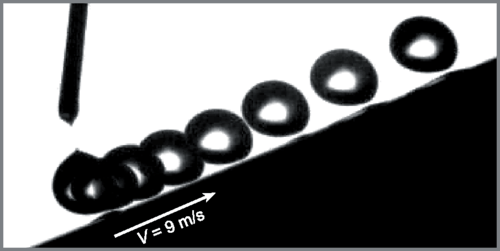
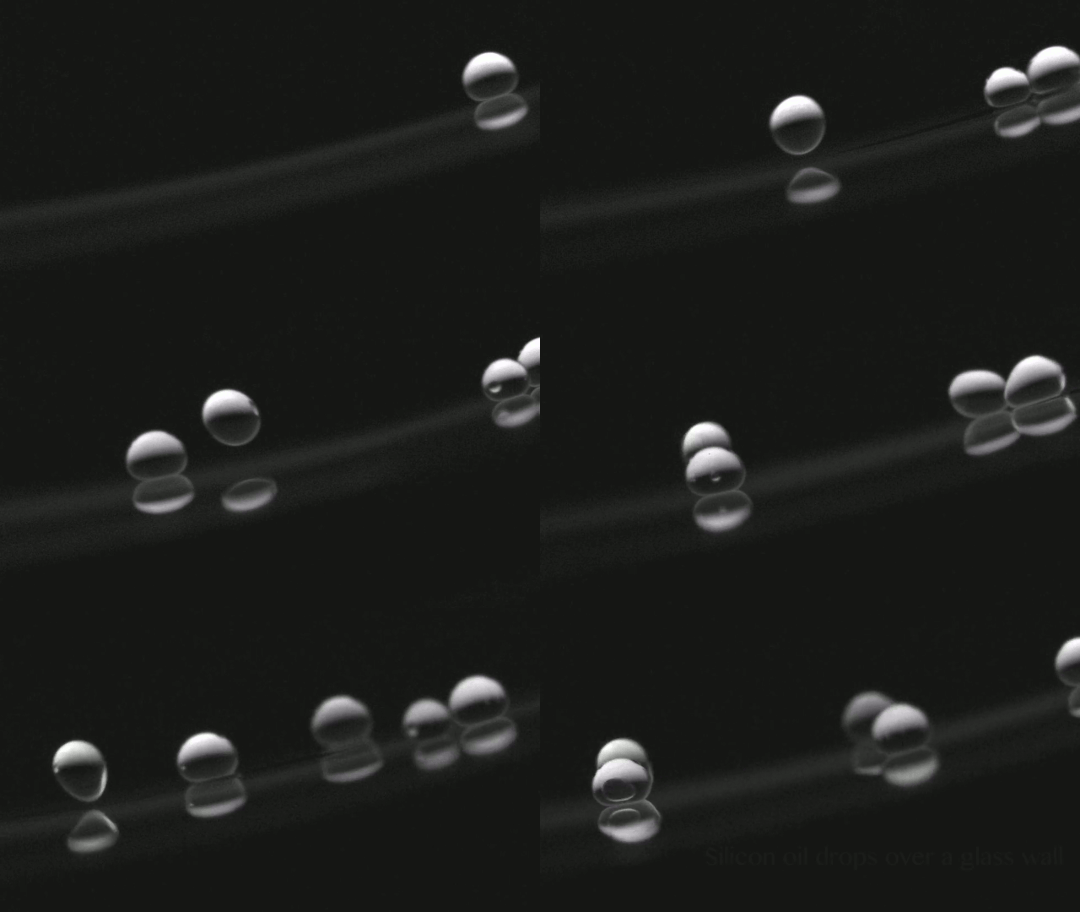
If you place a droplet on a surface much hotter than its boiling point, that droplet will skitter and float almost frictionlessly across the surface on a thin layer of its own vapor. This is what is known as the Leidenfrost effect. But you don’t have to heat a surface to get this behavior. There’s also an aerodynamic Leidenfrost effect, shown above, when the surface is moving. As the surface moves, it drags a layer of air along with it, and that layer of air is capable of keeping droplets aloft indefinitely. The thickness of the air layer depends on speed; the faster the plate moves, the thicker the air layer underneath droplets. The aerodynamic forces generated are large enough to drive a droplet up an incline against the force of gravity (bottom image). (Image credit: animation – M. Saito et al., source; chronophotograph – A. Gautheir et al., pdf)
Swimming with Corkscrews
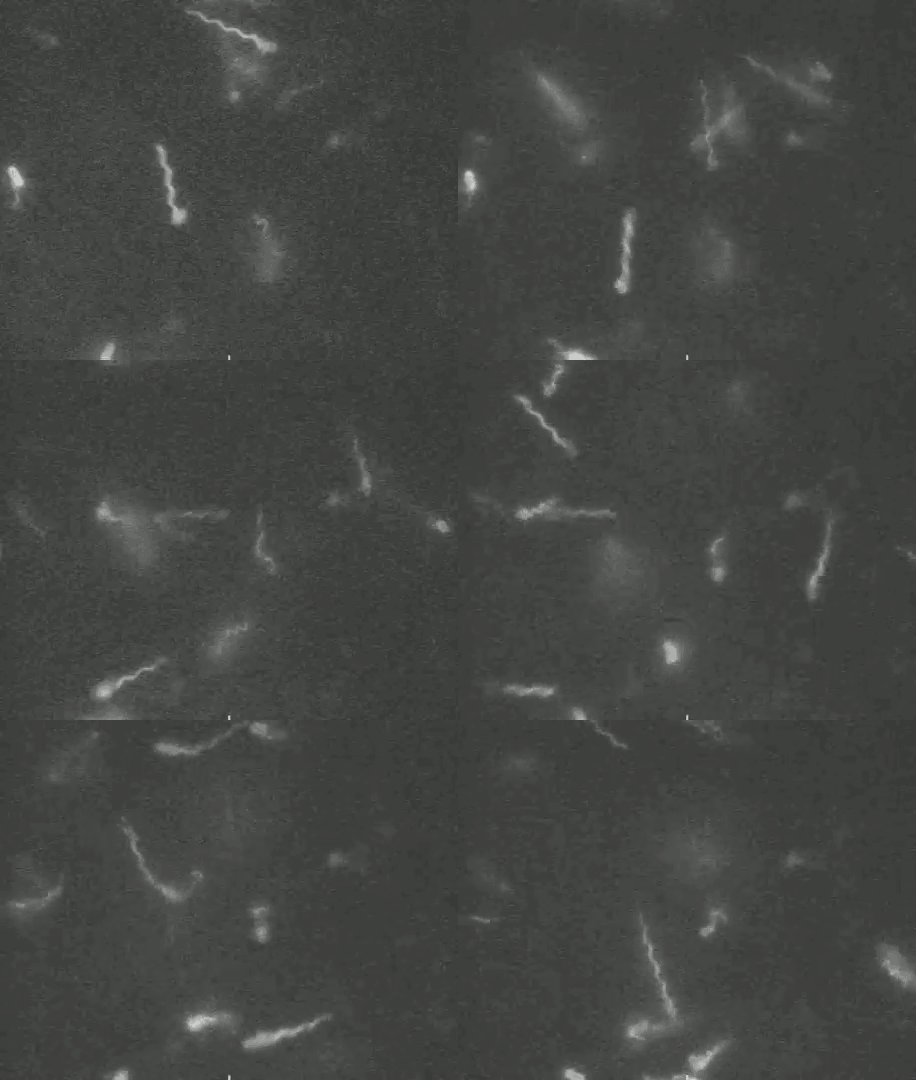
E. coli, like many bacteria, swim using corkscrew-like appendages called flagella. Because the bacteria are extremely tiny – their flagella may be less than ten microns long – their swimming is overwhelmingly dependent on viscosity. (Inertial effects are 100 to 10,000 times smaller than viscous effects for swimming E. coli.) Rotating their helical flagella generates viscous drag along the surface of the corkscrew. Because the flagella is asymmetric when you add all of those drag components together, the net force is thrust that moves the bacterium forward. Watch carefully in the animation above and you’ll see that E. coli have multiple flagella and will swing one out to the side during maneuvers. (Image credit: L. Turner et al., source; reproduced in a review by E. Lauga, pdf)

When Jets Collide
Two liquids that collide don’t always coalesce. The image above shows two jets of silicone oil colliding. On the left, the jets collide and bounce off one another. On the right, at a slightly higher flow rate, the two jets coalesce. This bouncing, or noncoalescence, observed at lower speeds is due to an incredibly thin layer of air separating the two jets. This air layer is constantly being replenished by air that gets dragged along by the flowing oil. But if the oil flows too quickly, that air layer becomes unstable–in the same way that a droplet that falls too quickly will splash on impact. When the separating air layer becomes unstable and breaks down, the jets collide and merge. (Image credit: N. Wadhwa et al., pdf)

Falling Atop Sheets


A sphere falling into water is a classic problem in fluid dynamics, but scientists are becoming increasingly interested in what happens when they introduce new dimensions to the problem. Here researchers float an extremely thin elastic sheet atop water and study how it wrinkles when a steel sphere impacts it. Despite its elasticity, the sheet does not stretch when the ball hits. Instead it compresses and forms wrinkles. Some of those wrinkles deepen into folds, but the wrinkle pattern that forms right at impact determines the way the film will bunch up. If the ball is heavy enough, it will drag the sheet entirely underwater; if not, the sheet will catch the ball and continue floating. Scientists are interested in these interactions between liquids and thin solids because sheets could be used to encapsulate liquids for applications like targeted drug delivery. (Image credit: M. Inizan et al., source)