A bubble rising through water can get caught on an aerophilic (air-attracting) fiber. The bubble will then adhere to the fiber and be guided to the surface by it. In the poster above, the image is a composite photo of such a bubble every 40 milliseconds. Once captured by the fiber, the bubble first accelerates and then reaches a terminal velocity, indicated by the equal spacing of the bubble photos toward the right end of the picture. The terminal velocity strikes a balance between buoyancy, which pulls the bubble upward, and skin friction between the bubble and the water, which acts like drag on the bubble. At the terminal velocity, these forces are equal; neither is able to speed up or slow down the bubble. (Image credit: H. de Maleprade et al.)
Search results for: “drag”

Chains of Salps
Salps are small, jellyfish-like marine invertebrates that swim by ejecting a pulsatile jet. They are unusual creatures whose lives have two major stages: one in which salps swim individually and one in which they link together and swim in large chains. In the chain, salps don’t synchronize their jetting; each salp jets with its own phase and frequency. A new study suggests that, in spite of this lack of synchronicity, the salp chain’s swimming reduces the animals’ drag. There are several factors that contribute to this result. One is that drag is generally lower on a body moving at constant speed compared to one moving in bursts. When linked together and firing randomly, all the individual jets tend to average out into one continuous swimming speed. There’s even a benefit to being out of sync: previous work showed that synchronized jets lose some of their thrust when they are too close together. Salps avoid that loss by keeping to their own beat. (Image and research credit: K. Sutherland and D. Weihs, source; via Gizmodo)

Reader Question: Drafting in Time Trials

In a comment on this recent post regarding drafting advantages to a leader, reader fey-ruz asks:
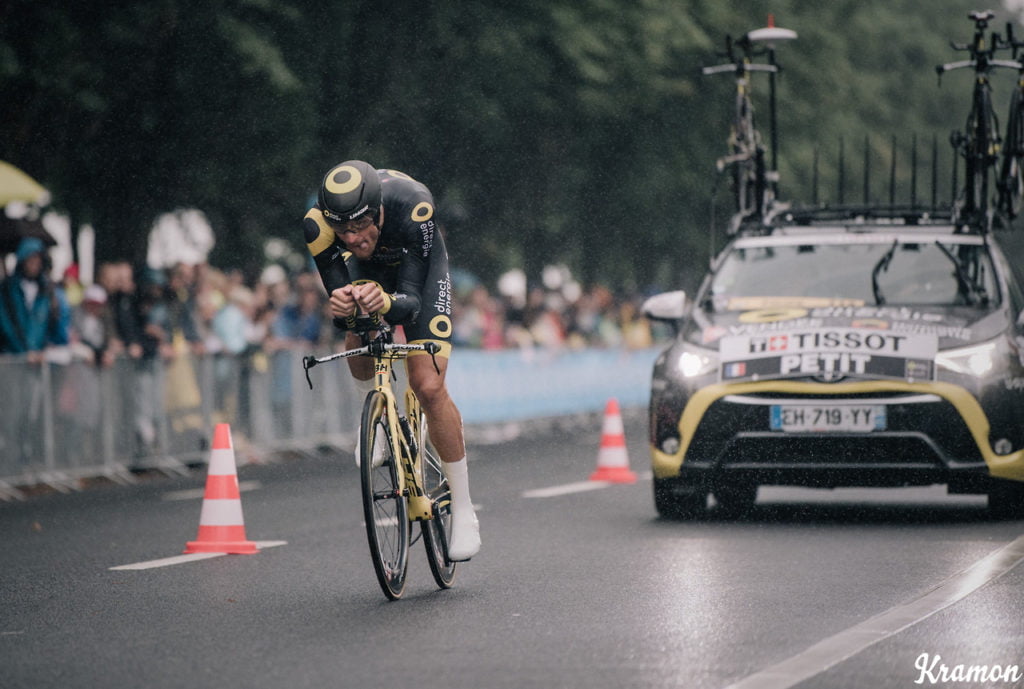
in cycling, team follow cars are required to maintain a minimum distance from their riders during time trials for this very reason (although i imagine the effects in that context are much smaller and dependent on the conditions, esp the wind speed, direction, and strength). FYFD, is there a simple way to understand where this upstream influence comes from? or a specific term in the navier-stokes equations that it results from?
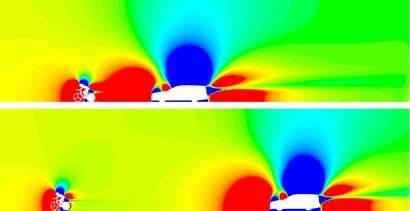
Cars following riders during a time trial can actually make a huge difference! One study from a couple of years ago estimated that a car following a rider in a short (13.8 km) time trial could take 6 seconds off the rider’s time. The images up top show a simulation from that study with a car following at 5 meters versus 10 meters. The colors indicate the pressure field around the car and rider. Red is high pressure, blue is low pressure. Both the car and the rider have high pressure in front of them; you can think of this as a result of them pushing the air in front of them.
A large part of the rider’s drag comes from the difference in pressure ahead and behind them. (For a look at flow around a cyclist that focuses on velocity instead, check out my video on cycling aerodynamics.) When a car drives close behind a cyclist, it’s essentially pushing air ahead of it and into the cyclist’s wake. This actually reduces the difference in pressure between the cyclist’s front and back sides, thereby reducing his drag. Because cars are large, they have an oversized effect in this regard, but having a motorbike or another rider nearby also helps the lead cyclist aerodynamically.
As for the Navier-Stokes equation – this effect isn’t one that you can really pin down to a single term since it’s a consequence of the flow overall. (Image credits: TU Eindhoven; K. Ramon)

Cycling Skinsuits and Vortex Generators
It didn’t take long for an aerodynamic controversy to crop up in this year’s Tour de France. At the 14km individual time trial, riders from Team Sky wore custom Castelli skinsuits with integrated dot-like patterns on their upper arms (shown above). By the next day, a sports scientist with a competing team cried foul play, claiming that these fabrics could have given Team Sky as much as 25 seconds’ advantage over other riders. The Sky team finished with 4 out of the top 10 places on the time trial, and their leader, three-time Tour winner Chris Froome, finished some 35 seconds ahead of his expected competitors for the yellow jersey.
Vortex generators explained
So how could a few dots make a measurable difference? These protrusions are vortex generators meant to modify flow around a cyclist. Humans are not aerodynamic and what typically happens when air flows over a cyclist’s arms is shown in the flow visualization above: the air follows the curve of the arm part way, then it separates from the body, leaving a region of recirculation that increases drag. Vortex generators can help prevent or delay that drag-inducing flow separation by adding extra energy and turbulence to the air near the arm’s surface. Because turbulent boundary layers can follow a curve longer before separating, this helps reduce the drag by reducing the recirculation zone.
About that time savings
Aerodynamically speaking, those vortex generators can make a difference, but the question is, how much? In his complaint, Grappe cites a 2016 paper by L. Brownlie et al. that wind-tunnel tested different vortex generator patterns for use in running apparel. The speeds tested included those relevant to cycling. The specific numbers Grappe quotes aren’t directly relevant, however:
As noted above, race garments that contain VG provide reductions in Fd of between 3.7 and 6.8% compared to equivalent
advanced race apparel developed for the 2012 London Olympics which in turn provided substantially lower drag than
conventional race apparel.the effectiveness of 5, 10 and 15 cm wide strips of VG applied to each flank of a sleeveless singlet revealed that the 5 cm wide
strips provided between 3.1 and 7.1% less Fd than the 10 cm wide strips and between 1.9 and 4.3% less Fd than the 15 cm wide
strips.Here Brownlie et al. are specifically describing the savings for running apparel, which uses vortex generators in very different places than you would on a cyclist. Note the second quote even refers to a sleeveless singlet, so the vortex generators measured are definitely not in the same place as these skinsuits!
The bottom line
I fully expect that vortex generators give a marginal aerodynamic edge, which is why Sky and other teams have already been using them in competition. But I hesitate to declare that the savings is as high as 5-7%, and I have no way to verify Grappe’s subsequent claims that this translates to 18-25 seconds in the time trial. Those are numbers he gives without citing what model is being used to translate drag gains into time.
In the end, what is needed is clarification of the rules. As they stand, one rule seems to allow the skinsuits because the vortex generators are integrated into the fabric, whereas another states clothing is forbidden “to influence the performances of a rider such as reducing air resistance”. Those two stances seems contradictory, and, for now, the race officials’ verdict to allow the suits stands.
If you want to learn more about aerodynamics and cycling, be sure to check out my latest FYFD video. (Image credits: B. Tessier/Reuters; Getty Images; L. Brownlie et al. 2009; h/t to W. Küper)

Schooling in Soap Films
In sports, flocks of birds, and schools of fish, we’re accustomed to thinking that the followers get an aerodynamic or hydrodynamic advantage over the leaders, but this may not always be the case. Here are two flags placed one after another in a soap film flowing from top to bottom. The flags are passive, meaning that their motion is entirely dependent on the flow around them; they cannot exert any resistive force of their own. In this case, scientists observe an effect known as inverted drafting. The lead flag actually experiences less drag – by as much as 50% – than the following flag. This seems to be a result of flow around the second flag having an upstream influence on the motion of the first. (Image and research credit: L. Ristroph and J. Zhang, pdf)

How Cycling Position Affects Aerodynamics
New FYFD video! How much does a rider’s position on the bike affect the drag they experience? To find out I teamed up with folks from the University of Colorado at Boulder and at SimScale to explore this topic using high-speed video, flow visualization, and computational fluid dynamics.
Check out the full video below, and if you need some more cycling science before the Tour de France gets rolling, you can find some of my previous cycling-related posts here. (Image and video credit: N. Sharp; CFD simulation – A. Arafat)
ETA: Please note that the video contained in this post was sponsored by SimScale.

Flow in a Turbine
Fluid flows are complex, complicated, and ever-changing. Researchers use many techniques to visualize parts of a flow, which can help make what’s happening clearer. One technique, shown above, uses oil and dye to visualize flow at the surface. The vertical, black, airfoil-shaped pieces are stators, stationary parts within a turbine that help direct flow. After painting the stator mount surface with a uniform layer of oil, the model can be placed in a wind tunnel (or turbine) and exposed to flow. Air moving around the stators drags some of the oil with it, creating the darker and lighter streaks seen here. Notice how the lines of oil turn sharply around the front of the stator and bunch up near its widest point. Those crowded flow lines tell researchers that the air moves quickly around this corner. (Image credit: D. Klaubert et al., source)

Self-Propelled Hovercraft

When placed on an extremely hot substrate, some drops levitate and can be propelled over specially textured surfaces. Inspired by this work, researchers are using similar principles to explore manipulation of levitating plates using surface texture. Their apparatus consists of a semi-porous, grooved surface that ejects air upward to levitate Plexiglas objects – think air hockey table with grooves. With enough airflow, the Plexiglas levitates. The grooves force air in a particular direction – in the case of the herringbone pattern, this is in the direction of opening – and, as the air moves, it drags its Plexiglas hovercraft along. As shown in the second animation, grooves can do more than move the glass linearly; with patterns offset by 90-degrees, they can make the hovercraft rotate.
Here’s an interesting next step for anyone out there with an air hockey table and a 3D printer: does the directional manipulation work if the grooves are on the object and not the table? In other words, can you create an air hockey puck that preferentially goes to your opponent’s goal? (Image and resource credit: D. Soto et al., source)

Spots of Turbulence
One of the enduring mysteries of fluid dynamics lies in the transition between smooth laminar flow and chaotic turbulent flow in the area near a wall. That region, known as the boundary layer, has a major impact on drag and other effects. The process begins with disturbances that are too tiny to see or measure, but eventually, those disturbances can grow large enough to generated an isolated turbulent spot, like the one imaged above. Flow in the photograph is from left to right. Turbulent spots have a distinctive wedge-like shape that expands as the spot grows and widens. These turbulent spots can merge together to create still larger spots, and when a surface eventually becomes completely covered in them, we call it fully-developed turbulent flow. (Image credit: M. Gad-El-Hak et al.)

The Coalescence Cascade and Surfactants
Drops of a liquid can often join a pool gradually through a process known as the coalescence cascade (top left). In this process, a drop sits atop a pool, separated by a thin air layer. Once that air drains out, contact is made and part of the drop coalesces. Then a smaller daughter droplet rebounds and the process repeats.
A recent study describes a related phenomenon (top right) in which the coalescence cascade is drastically sped up through the use of surfactants. The normal cascade depends strongly on the amount of time it takes for the air layer between the drop and pool to drain. By making the pool a liquid with a much greater surface tension value than the drop, the researchers sped up the air layer’s drainage. The mismatch in surface tension between the drop and pool creates an outward flow on the surface (below) due to the Marangoni effect. As the pool’s liquid moves outward, it drags air with it, thereby draining the separating layer more quickly. The result is still a coalescence cascade but one in which the later stages have no rebound and coalesce quickly. (Image and research credit: S. Shim and H. Stone, source)