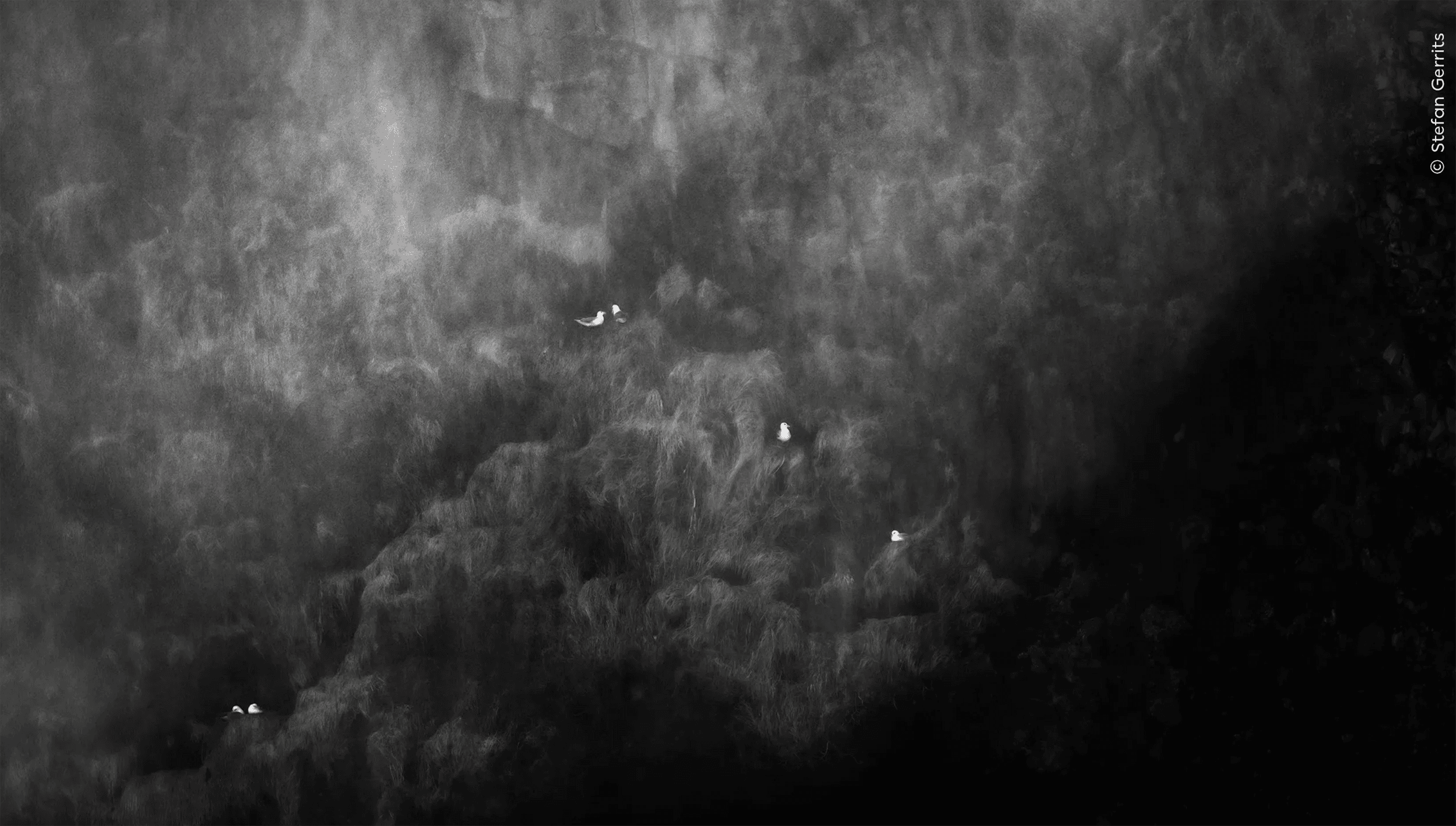
Strong winds blew curtains of mist across Skógafoss in this image of nesting northern fulmars by photographer Stefan Gerrits. Despite water’s high density compared to air, fine droplets are able to stay aloft for long periods, given the right breeze. Mists, fogs, and sea spray can float surprising distances; droplets exhaled from our lungs can persist even farther. (Image credit: S. Gerrits; via Colossal)
Search results for: “density”

Dissolution and Crystallization
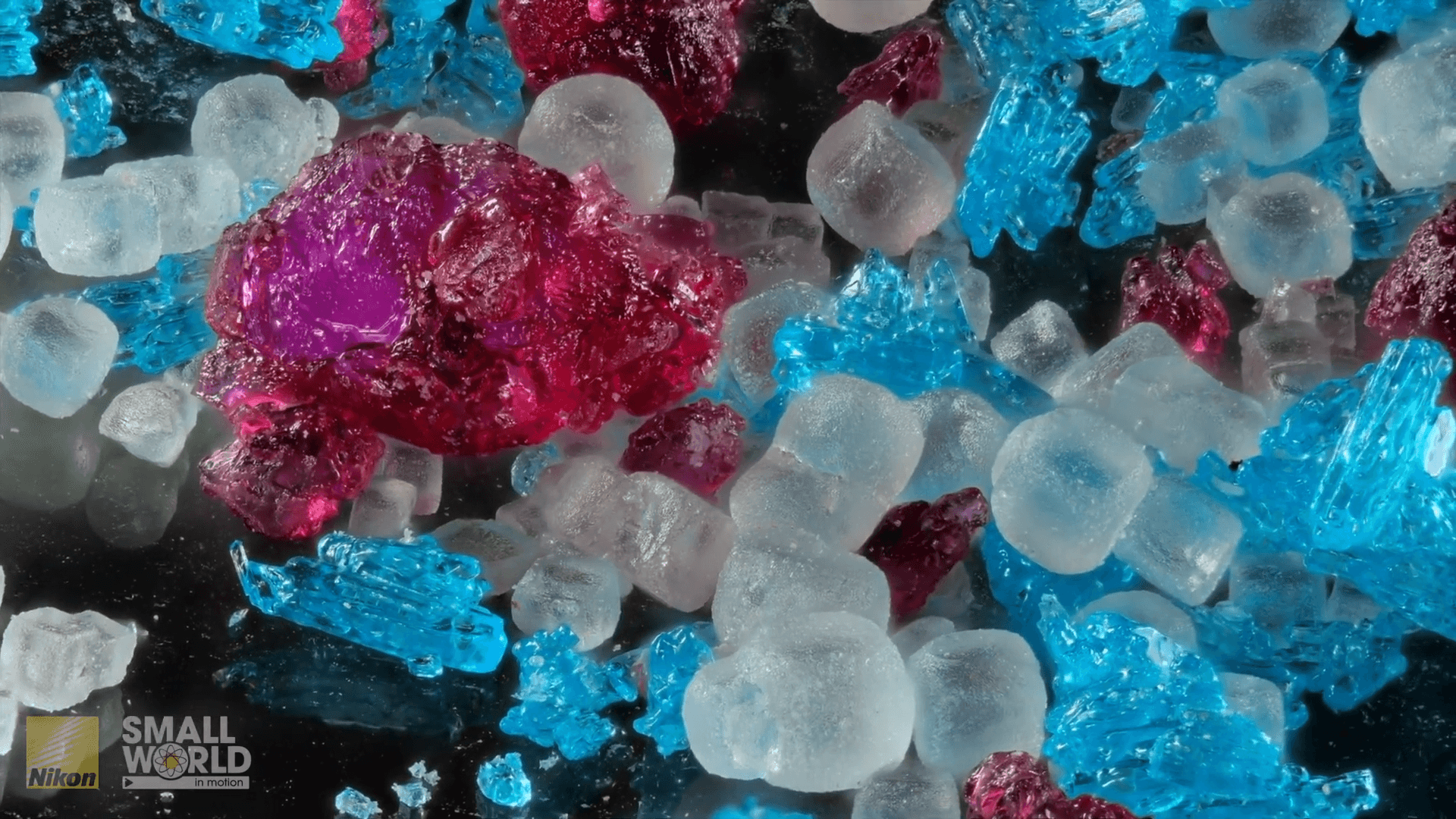
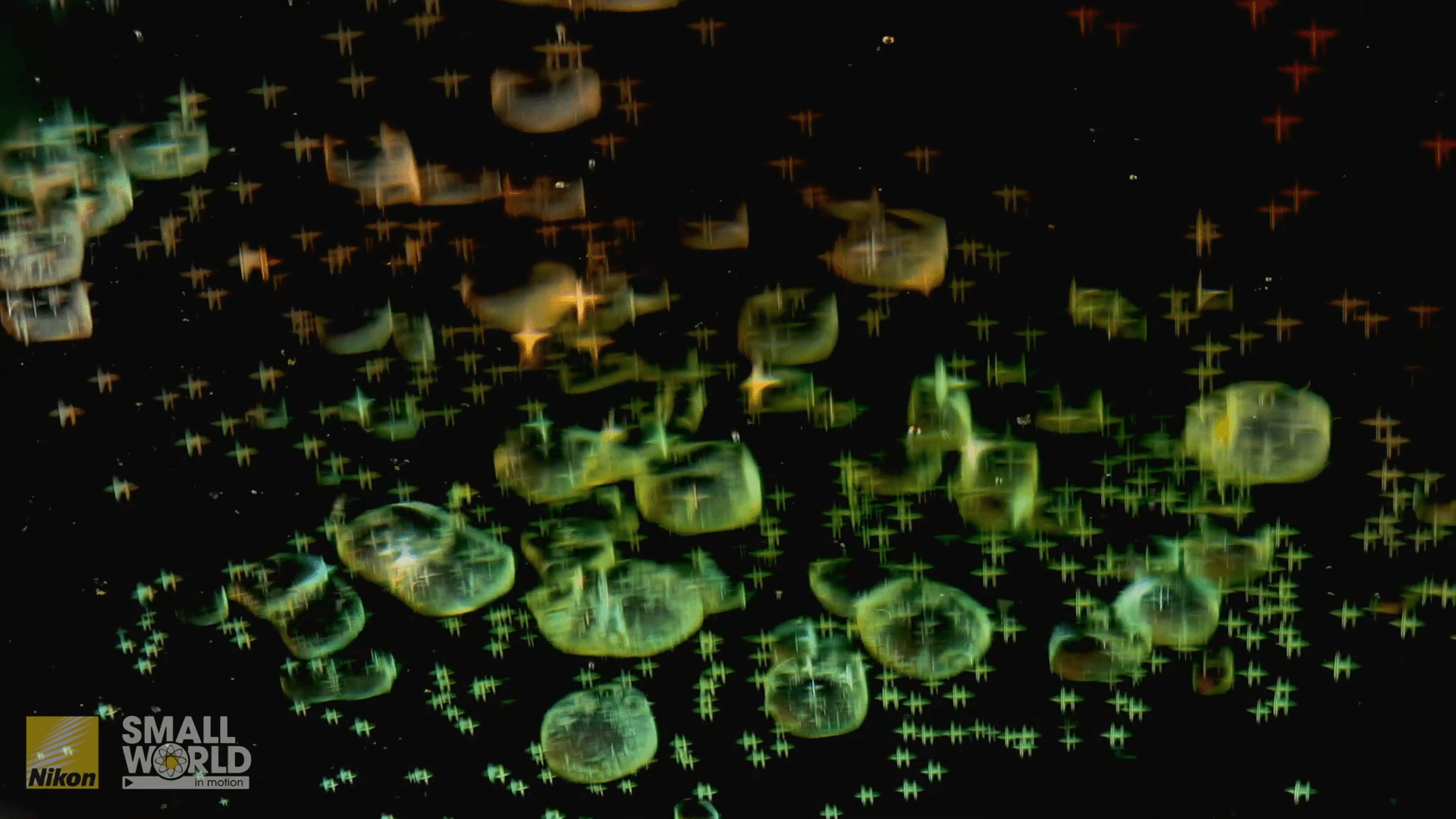
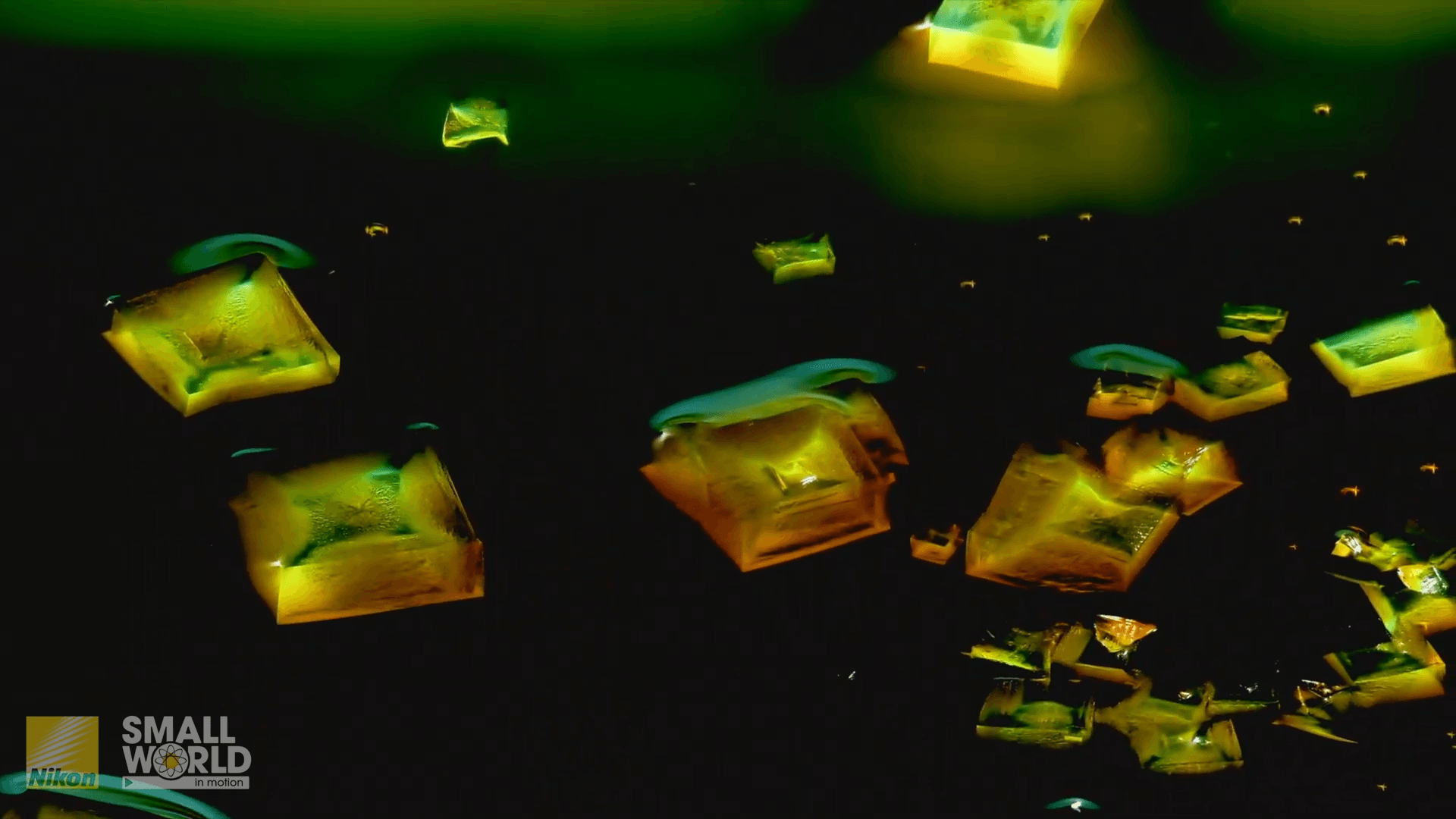
A colorful assortment of salts dissolve and recrystallize in this microscopic timelapse video by retired engineer Jay McClellan. Every step is a gorgeous rainbow of color as the cobalt, copper, and sodium chlorides dissolve, mix, and change. Though we don’t see what’s going on in the water, fluid dynamics are a critical component of both dissolution and crystallization. In the former, concentration gradients change the water’s density, driving buoyant flows. For the latter, crystallization comes out of evaporation, where surface tension often determines where solid particles get left behind. (Video and image credit: J. McClellan; via Colossal)

A New Plasma Wave for Jupiter
Jupiter‘s North Pole has a powerful magnetic field combined with plasma that has unusually low electron densities. This combination, researchers found, gives rise to a new type of plasma wave.
Ions in a magnetic field typically move parallel to magnetic field lines in Langmuir waves and perpendicularly to the field lines in Alfvén waves — with each wave carrying a distinctive frequency signature. But in Jupiter’s strong magnetosphere, low-density plasma does something quite different: it creates what the team is calling an Alfvén-Langmuir wave — a wave that transitions from Alfvén-like to Langmuir-like, depending on wave number and excitation from local beams of electrons.
Although this is the first time such plasma behavior has been observed, the team suggests that other strongly-magnetized giant planets — or even stars — could also form these waves near their poles. (Image credit: NASA / JPL-Caltech / SwR I/ MSSS/G. Eason; research credit: R. Lysak et al.; via APS)

How Particles Affect Melting Ice
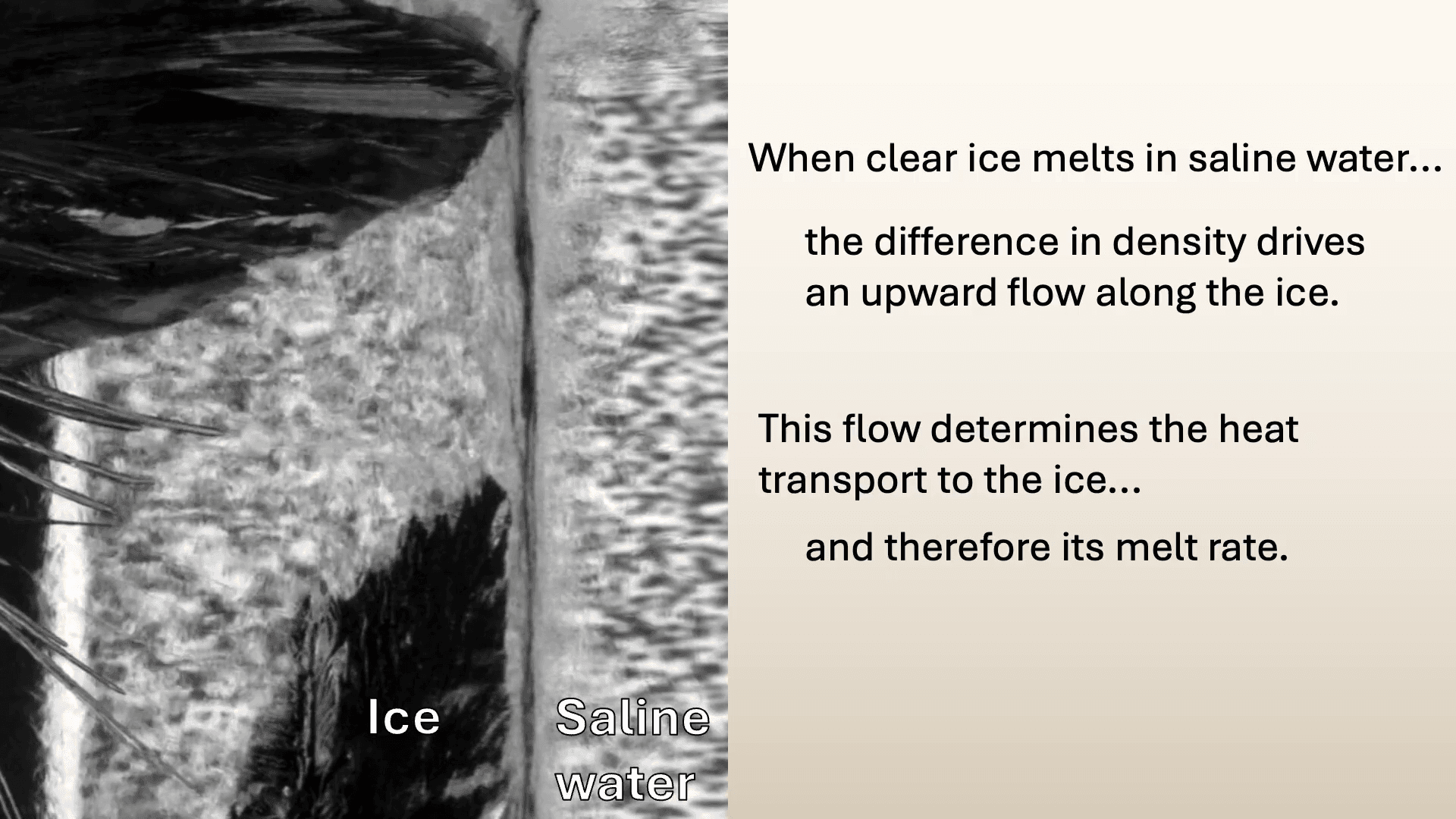
When ice melts in salt water, there’s an upward flow along the ice caused by the difference in density. But most ice in nature is not purely water. What happens when there are particles trapped in the ice? That’s the question this video asks. The answer turns out to be relatively complex, but the researchers do a nice job of stepping viewers through their logic.
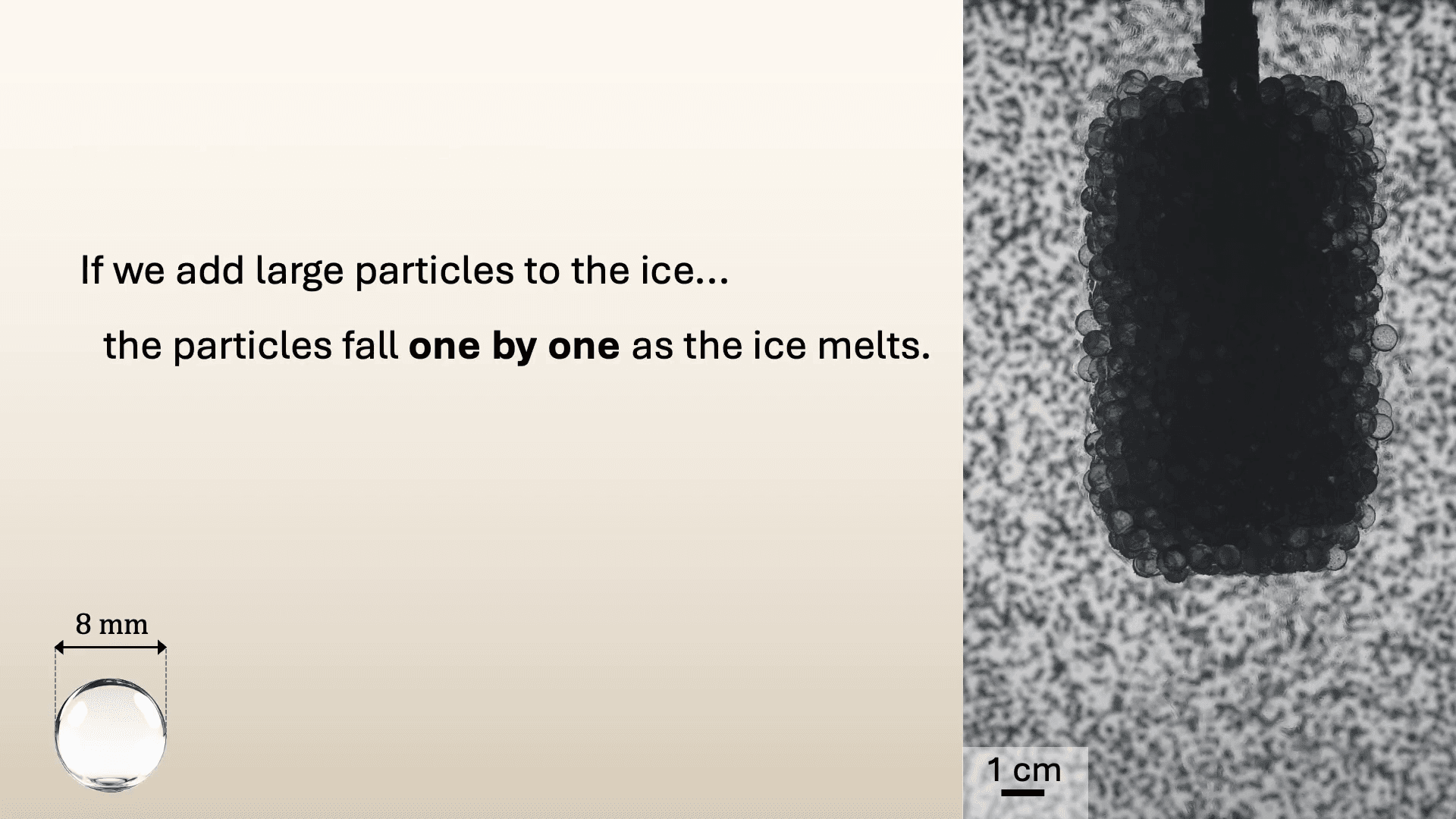
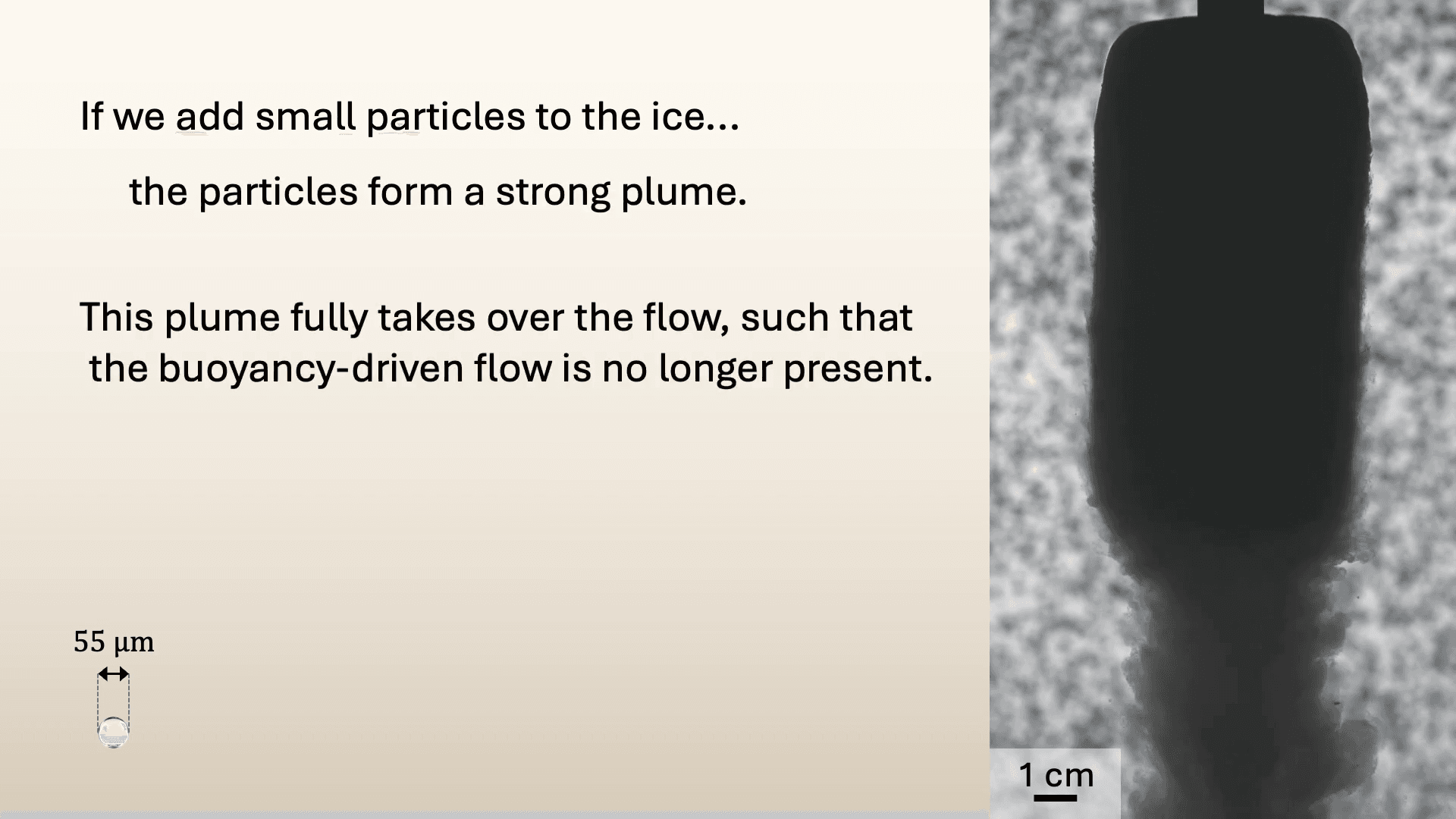
Large particles tend to fall off one-by-one, which doesn’t really affect the buoyant upward flow along the ice. In contrast, smaller particles fall downward in a plume that completely overwhelms the buoyant flow. That strong downward flow makes the ice ablate even faster. (Video and image credit: S. Bootsma et al.)

Bow Shock Instability
There are few flows more violent than planetary re-entry. Crossing a shock wave is always violent; it forces a sudden jump in density, temperature, and pressure. But at re-entry speeds this shock wave is so strong the density can jump by a factor of 13 or more, and the temperature increase is high enough that it literally rips air molecules apart into plasma.
Here, researchers show a numerical simulation of flow around a space capsule moving at Mach 28. The transition through the capsule’s bow shock is so violent that within a few milliseconds, all of the flow behind the shock wave is turbulent. Because turbulence is so good at mixing, this carries hot plasma closer to the capsule’s surface, causing the high temperatures visible in reds and yellows in the image. Also shown — in shades of gray — is the vorticity magnitude of flow around the capsule. (Image credit: A. Álvarez and A. Lozano-Duran)

Stunning Interstellar Turbulence
The space between stars, known as the interstellar medium, may be sparse, but it is far from empty. Gas, dust, and plasma in this region forms compressible magnetized turbulence, with some pockets moving supersonically and others moving slower than sound. The flows here influence how stars form, how cosmic rays spread, and where metals and other planetary building blocks wind up. To better understand the physics of this region, researchers built a numerical simulation with over 1,000 billion grid points, creating an unprecedentedly detailed picture of this turbulence.
The images above are two-dimensional slices from the full 3D simulation. The upper image shows the current density while the lower one shows mass density. On the right side of the images, magnetic field lines are superimposed in white. The results are gorgeous. Can you imagine a fly-through video? (Image and research credit: J. Beattie et al.; via Gizmodo)

“Soap Bubble Bonanza
This video offers an artistic look at a soap bubble bursting. The process is captured with high-speed video combined with schlieren photography, a technique that makes visible subtle density variations in the air. The bubbles all pop spontaneously, once enough of their cap drains or evaporates away for a hole to form. That hole retracts quickly; the acceleration of the liquid around the bubble’s spherical shape makes the retracting film break into droplets, seen as falling streaks near the bottom of the bubble. The retraction also affects air inside the bubble, making the air that touched the film curl up on itself, creating turbulence. Then, as the film completes its retraction, it pushes a plume of the once-interior air upward, as if the interior of the bubble is turning itself inside out. (Video and image credit: D. van Gils)

Playful Martian Dust Devils
The Martian atmosphere lacks the density to support tornado storm systems, but vortices are nevertheless a frequent occurrence. As sun-warmed gases rise, neighboring air rushes in, bringing with it any twisted shred of vorticity it carries. Just as an ice skater pulling her arms in spins faster, the gases spin up, forming a dust devil.

In this recent footage from the Perseverance Rover, four dust devils move across the landscape. In the foreground, a tiny one meets up with a big 64-meter dust devil, getting swallowed up in the process. It’s hard to see the details of their crossing, but you can see other vortices meeting and reconnecting here. (Video and image credit: NASA/JPL-Caltech/LANL/CNES/CNRS/INTA-CSIC/Space Science Institute/ISAE-Supaero/University of Arizona; via Gizmodo)

Salt Fingers
Any time a fluid under gravity has areas of differing density, it convects. We’re used to thinking of this in terms of temperature — “hot air rises” — but temperature isn’t the only source of convection. Differences in concentration — like salinity in water — cause convection, too. This video shows a special, more complex case: what happens when there are two sources of density gradient, each of which diffuses at a different rate.
The classic example of this occurs in the ocean, where colder fresher water meets warmer, saltier water (and vice versa). Cold water tends to sink. So does saltier water. But since temperature and salinity move at different speeds, their competing convection takes on a shape that resembles dancing, finger-like plumes as seen here. (Video and image credit: M. Mohaghar et al.)

Crowd Vortices
The Feast of San Fermín in Pamplona, Spain draws crowds of thousands. Scientists recently published an analysis of the crowd motion in these dense gatherings. The team filmed the crowds at the festival from balconies overlooking the plaza in 2019, 2022, 2023, and 2024. Analyzing the footage, they discovered that at crowd densities above 4 people per square meter, the crowd begins to move in almost imperceptible eddies. In the animation below, lines trace out the path followed by single individuals in the crowd, showing the underlying “vortex.” At the plaza’s highest density — 9 people per square meter — one rotation of the vortex took about 18 seconds.

The team found similar patterns in footage of the crowd at the 2010 Love Parade disaster, in which 21 people died. These patterns aren’t themselves an indicator of an unsafe crowd — none of the studied Pamplona crowds had a problem — but understanding the underlying dynamics should help planners recognize and prevent dangerous crowd behaviors before the start of a stampede. (Image credit: still – San Fermín, animation – Bartolo Lab; research credit: F. Gu et al.; via Nature)