
Typically, shock waves are invisible to the human eye. Using sensitive optical techniques like schlieren photography, researchers in a lab can visualize sharp density gradients like shock waves or even the slight density variations caused by natural convection. But it takes some special conditions to make shock waves visible to the naked eye. The blast wave of the explosion in the photo above is a great example. The leading edge of the shock wave and the heat of the explosion create a strong, sharp change in density. That density change is accompanied by a change in the air’s refractive index. As light travels from the distance toward the camera, it’s distorted–more specifically, refracted–when it travels through the blast wave and its wake. And, in this case, that visual distortion is strong enough that we can clearly see the outlines of the shock waves moving out from the explosion. The apparent horizontal line through the blast wave is probably the intersection of a weaker secondary shock wave with the initial expanding shock wave. (Image credit: Defense Research and Development Canada; via io9)
Search results for: “density”

Simplified Schlieren Set-up
Schlieren photography offers a glimpse into flows that are usually invisible to the human eye. With a relatively simple set-up–a light source, collimating mirror(s), and a razor blade–it becomes possible to see differences in density. The technique lets one visualize temperature-driven flows like the buoyant convection from a flame or other heat source, and it can also be used to visualize shock waves and sound. The video above has several neat schlieren demos, including some non-air examples using hydrogen (lighter than air) and sulfur hexafluoride (denser than air), both of which are transparent to the naked eye. (Video credit: Harvard University, via Jennifer Ouellette)
The Hidden Complexities of the Simple Match
Striking a match and blowing it out seems rather simple to the naked eye. But with high-speed video and schlieren photography, the act takes on new complexity. Schlieren photography is an optical technique that is incredibly sensitive to changes in density, which makes it a prime choice for visualizing flows with temperatures variations or shock waves. Here it shows the hot gases generated as the match is lit. Once the match ignites, the flow calms somewhat into a gently rising plume of exhaust and hot air. When someone enters the frame to blow out the match, the frame rate increases to capture what happens next. The flow field around the match becomes very complex as the air and flame interact. The range of length scales in the flow increases, from scales of several centimeters down to those less than a millimeter. This complexity and range of sizes is a hallmark of turbulence. (Video credit: V. Miller et al.)

Plume Stratification
Clean-up of accidents like the 2010 Deepwater Horizon oil spill can be complicated by what goes on beneath the ocean surface. Variations in temperature and salinity in seawater create stratification, stacked layers of water with differing densities. When less dense layers are on top, the fluid is said to be stably stratified. Since oil is less dense than water, one might assume that buoyancy should make an oil plume should rise straight to the ocean surface. But the presence of additives or surfactants in the oil mixture plume can prevent that. With surfactants present, an oil mixture tends to emulsify, breaking into tiny droplets like a well-mixed salad dressing. Even if the density of the emulsion is smaller than the surrounding fluids, such a plume can get trapped at a density boundary, as seen in the photo above. Researchers report a critical escape height, which depending on the plume’s characteristics and stratification boundary, determines whether a plume escapes or becomes trapped. (Image credit: R. Camassa et al.)
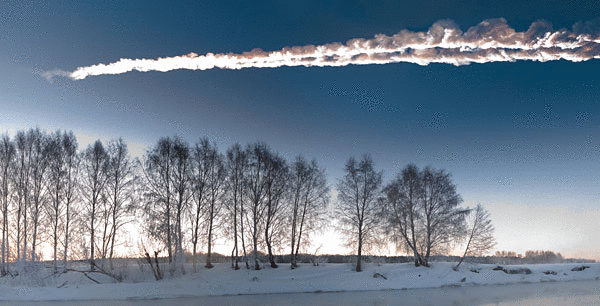
The Chelyabinsk Meteor
In February 2013 a meteor streaked across the Russian sky and burst in midair near Chelyabinsk. A recent Physics Today article summarizes what scientists have pieced together about the meteor, from its origins to its demise. The whole article is well worth reading. Here’s a peek:
The Chelyabinsk asteroid first felt the presence of Earth’s atmosphere when it was thousands of kilometers above the Pacific Ocean. For the next dozen minutes, the 10 000-ton rock fell swiftly, silently, and unseen, passing at a shallow angle through the rarefied exosphere where the molecular mean free path is much greater than the 20-m diameter of the rock. Collisions with molecules did nothing to slow the gravitational acceleration as it descended over China and Kazakhstan. When it crossed over the border into Russia at 3:20:20 UT and was 100 km above the ground, 99.99997% of the atmosphere was still beneath it.
Because the asteroid was moving much faster than air molecules could get out of its way, the molecules began to pile up into a compressed layer of high-temperature plasma pushing a shock wave forward. Atmospheric density increases exponentially with depth, so as the asteroid plunged, the plasma layer thickened and its optical opacity rapidly increased. About one second later, at 95 km above the surface, it became bright enough to be seen from the ground. That was the first warning that something big was about to happen. #
How often are scientific articles that gripping?! Kring and Boslough provide some excellent descriptions of the aerodynamics of the meteor and its airburst. Be sure to check it out. (Photo credit: M. Ahmetvaleev; paper credit: D. Kring and M. Boslough; via io9)
Lighting a Match
The schlieren optical technique is ideal for visualizing differences in fluid density and is an important tool for revealing flows humans cannot see with their naked eyes. In this high speed video, a professor lights a match. The initial strike generates friction and heat sufficient to convert some of the red phosphorus in the match head to its more volatile white phosphorus form. We see this in the schlieren as the cloud-like burst in the first several seconds. The heat from the phosphorus combustion ignites the sulfur fuel and potassium chlorate oxidizer in the match head to create a more sustained flame. During this period, wavy, smoke-like whorls of hot air rise from around the flame as buoyancy takes over. The upward movement of hot air draws in cooler air from the surroundings, providing the flame with an ongoing source of oxygen and allowing it to grow. (Video credit: RMIT University)

Balloon Explosion

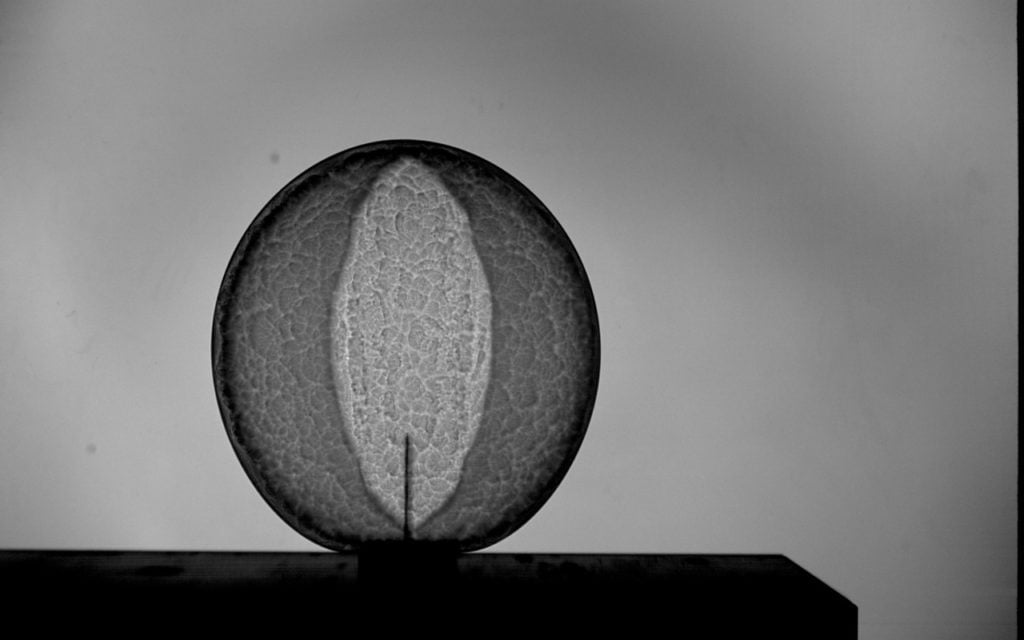
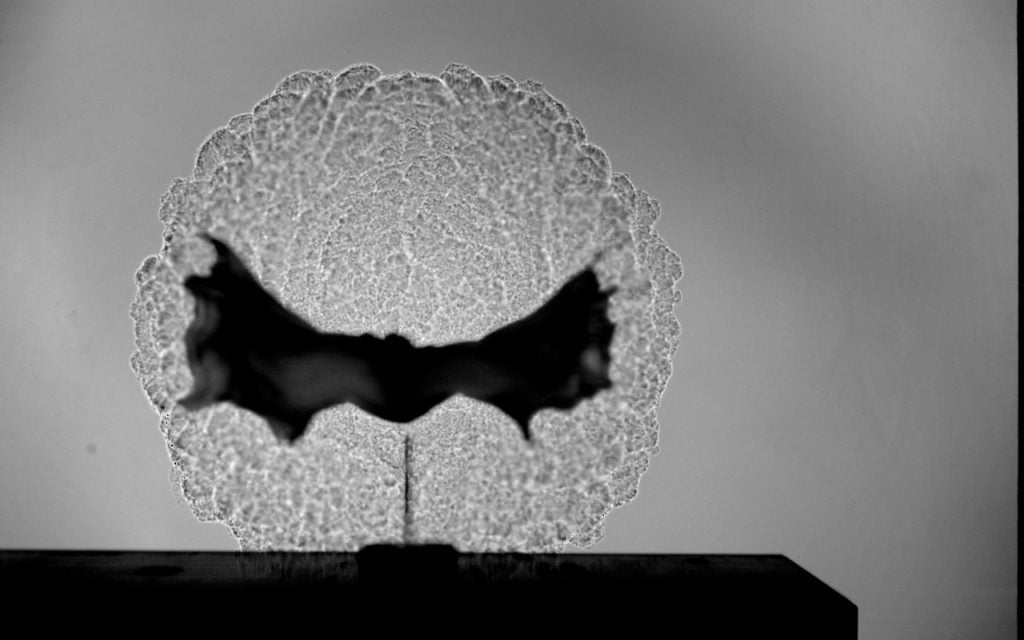


These photos are shadowgraphs of a hydrogen flame exploding inside a balloon. The shadowgraph optical technique highlights density and temperature variations through their effect on a fluid’s refractive index. Here we see that the hydrogen flame has a strong cellular structure and is more turbulent than a methane flame. The cellular structure is a sign of an instability in the curved flame front. The instability and accompanying cellular appearance are a result of the complicated transport and reaction of fuel and oxidizer inside the flame. (Photo credits: P. Julien et al.)

Putting Out Wildfires Using Explosives

Wildfires damage millions of acres of land per year in the United States alone. Using explosives to put out an uncontrolled wildfire sounds a bit crazy, but it’s actually not that far-fetched. The animations above are taken from high-speed footage of a propane fire interacting with a blast wave. The first animation shows what the human eye would see, and the second is a shadowgraph video, a technique which highlights differences in density and makes the flame’s convection and the blast wave itself visible. At close range, the shock wave from the explosion and the high-speed gas behind it push the flames away from their fuel source, stopping combustion almost immediately. For a flame farther away from the blast, the shock wave introduces turbulent disturbances that can destabilize the flame. Much work remains to be done before the technique could be scaled from the laboratory to the field, but it is an exciting concept. You can read more about the work here. (Research credit: G. Doig/UNSW Australia; original videos: here and here; submitted by @CraigOverend)
Double-Diffusive Convection
Convection can be driven several mechanisms, including temperature and concentration differences. The video above shows convection between a a layer of sucrose solution and a layer of saline solution. Initially, the lighter sucrose layer sits over the denser salt water. After the interface is perturbed, the differences in concentration – and thus in density – between the fluids causes diffusion both upward and downward in the form of fingers. This instability behavior is analogous to salt-fingering, which occurs in the ocean when a layer of warm, salty water lies over a layer of cooler, less saline water. In the ocean, these temperature and salinity differences help drive ocean circulation as well as the mixing that occurs between different depths. (Video credit: William Jewell College)
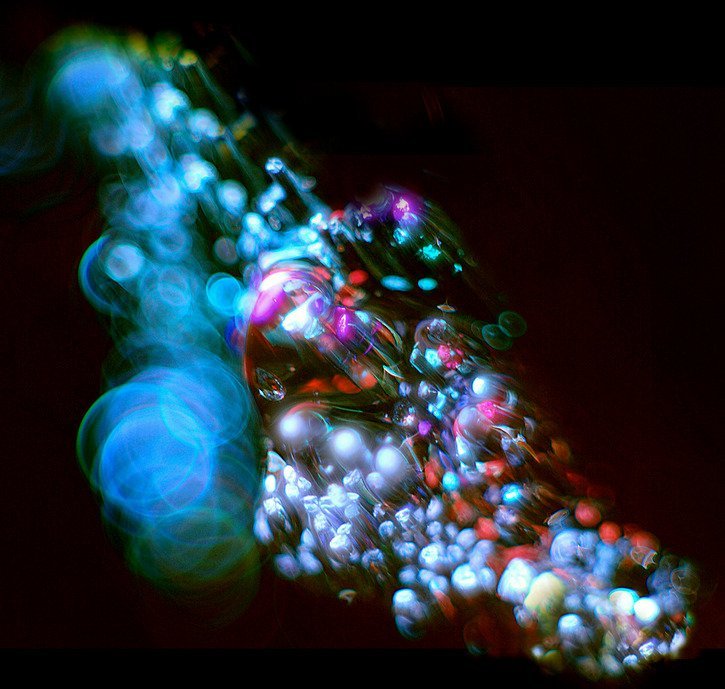
Abstract Fluids
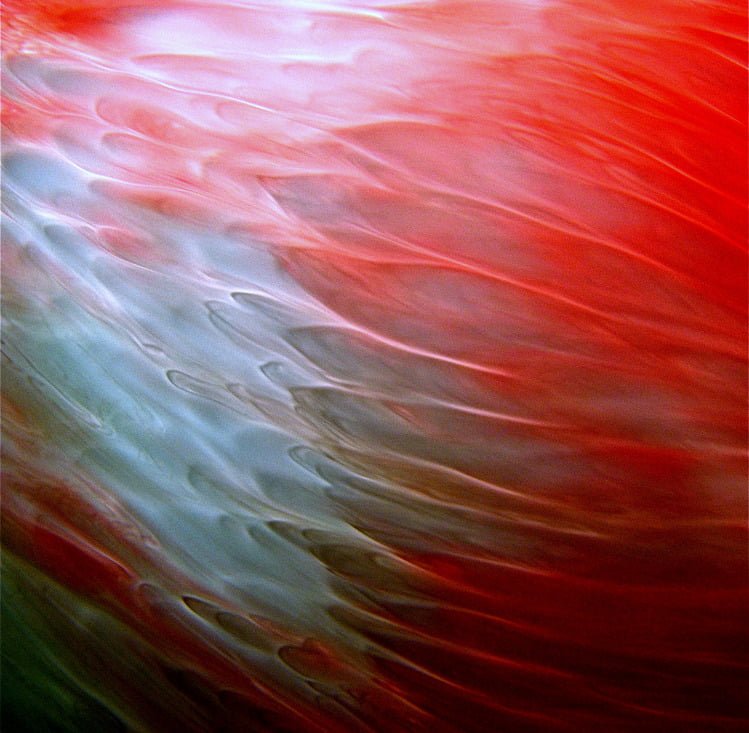
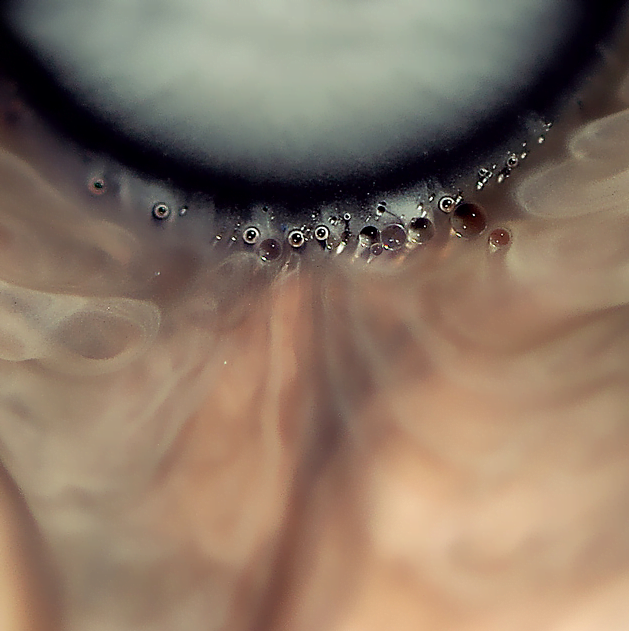
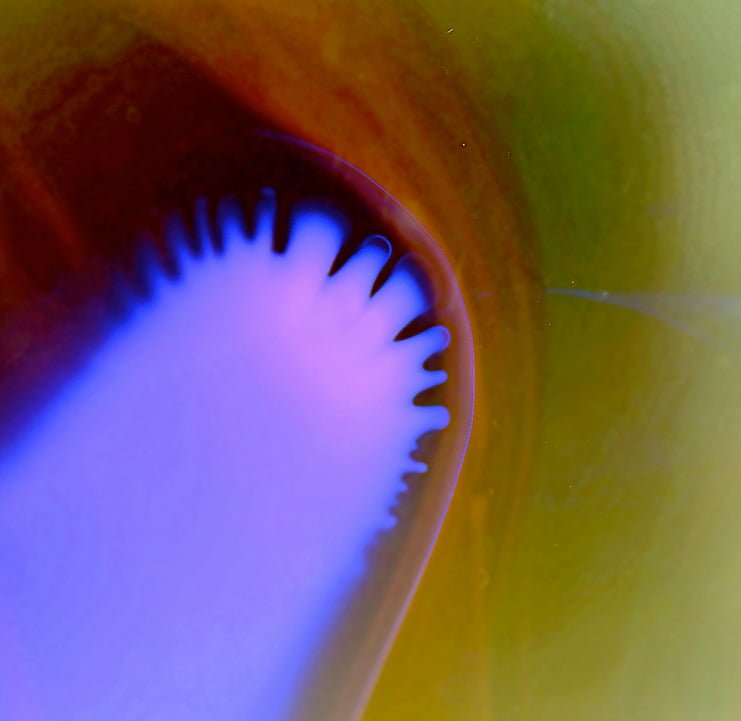
Janet Waters’ abstract photography is full of effects created with fluid dynamics. Diffusion merges different fluids, and gradients in surface tension drive interfacial flows. Changes in density and viscosity produce fingers and streaks and all manner of forms. Be sure to check out her photostream for many more examples of fluids as art. (Photo credits: J. Waters)