
Differences in surface tension cause fluid motion through the Marangoni effect. Because an area with higher surface tension pulls more strongly on nearby liquid than an area of low surface tension, fluid will flow toward areas of higher surface tension. Here surfactants, shown in white, are constantly injected onto a layer of water dyed blue. You can also see the flow in motion in this video. Outside of the central source flow, the pattern features lots of 2D mushroom-like shapes reminiscent of Rayleigh-Taylor instabilities. But these shapes are driven by variations in surface tension rather than unstable density variations. For more, check out the original paper or learn about other examples of Marangoni effect. (Photo credit: M. Roché et al.)
Search results for: “density”

Droplet Collisions
When droplets collide, there are three basic outcomes: they bounce off one another; they coalesce into one big drop; or they coalesce and then separate. Which outcome we observe depends on the relative importance of the droplets’ inertia compared to their surface tension. This is expressed through the dimensionless Weber number, made up of density, velocity, droplet diameter, and surface tension. For a low Weber number droplet, surface tension is still significant, so colliding droplets bounce off one another. At a moderate Weber number, the droplets coalesce. But when the fluid inertia is too high, as in the high Weber number example, the drops will coalesce but still have too much momentum and ultimately separate. (Video credit: G. Oldenziel)
Shock Trains
In compressible flows, shock waves are singularities, a tiny distance across which the density, temperature, and pressure of a fluid change suddenly and discontinuously. In this video, there is a wedge at the top and bottom of the frame and a Pitot probe roughly in the center. Flow is left to right and is initially subsonic. Once Mach 6 flow is established in the wind tunnel, a series of shock waves and expansion fans appear as light and dark lines in this schlieren video. Oblique shocks extend from the sharp tip of each wedge and interfere to create a normal shock in front of the Pitot probe. The air that passes through the normal shock is subsonic to the right of the shock, whereas air that goes through the oblique shocks remains supersonic. The fainter lines further to the right are weaker shock waves and expansion fans that reflect off the walls and probe. They exist to continue turning the airflow around the probe and to equalize conditions between different regions. (Video credit: C. Mai et al.)

Reader Question: Oceans Meeting?
Reader favoringfire asks:
Hi! Maybe you can help me: I’ve seen a pic revolving around Tumblr from the Danish city of Skagen showing the Baltic and North sea meeting. Where they meet the ocean is two very distinct hues of blue–what captions say are “two opposing tides with different densities.” Tides? Currents w/different temps often are often diff color from one another. But can “tides” be of different “densities???”
After some searching, I think the photo above is probably the one you’ve seen represented as where the Baltic and North Seas meet. It turns out, however, that it’s not. It’s a photo from an Alaskan cruise taken by Kent Smith. Fluid dynamically, though, it’s still very interesting! What we see here is a sharp gradient between regions with very different densities. One side contains lots of freshwater from rivers fed by melting glaciers, which creates a very different density from the general seawater.
It’s not true, however, that the two won’t mix. This border is not a static phenomenon but one that is ever-changing due to currents and the diffusion of one fluid into another. In a sense, this photo is very much the sea-level version of photos like these which show the massive scale of sediment transport and nutrient mixing that occur in our oceans.
(Photo credit: K. Smith)

Shocking Instabilities
The Richtmyer-Meshkov (RM) instability occurs when the interface between two fluids of different density is impulsively accelerated – usually by the passage of a shock wave. The image above shows a thin layer of gaseous sulfur hexafluoride embedded in air. Each vertical line, from left to right, shows the distortion of the two fluids at subsequent time steps after a Mach 1.2 shock wave passes through the gases. The interface’s initial waviness grows into mushroom-like shapes that mix the two gases together, ultimately leading to turbulence. Scenarios involving the RM instability include supersonic combustion ramjet engines, supernovas, and inertial confinement fusion. The RM instability is closely related to Rayleigh-Taylor instability and shares a similar morphology. (Photo credit: D. Ranjan et al.)
Granular Gases
Vibrating particles or granular materials can produce many fluid-like behaviors. In this video, researchers demonstrate how a granular gas made up of particles of two sizes behaves at different conditions. By tweaking the amplitude of the vibration, they alter how the particles cluster in a divided container. At large vibrational amplitudes, the particles behave much like a gas–energetic and spread out. At lower amplitudes, though, the particle density and the number of particle collisions increases. Each collision dissipates some of a particle’s energy; more collisions means less energy available to escape. As a result, the particles cluster, forming an attractor that draws in additional particles over time. (Video credit: R. Mikkelson et al.)
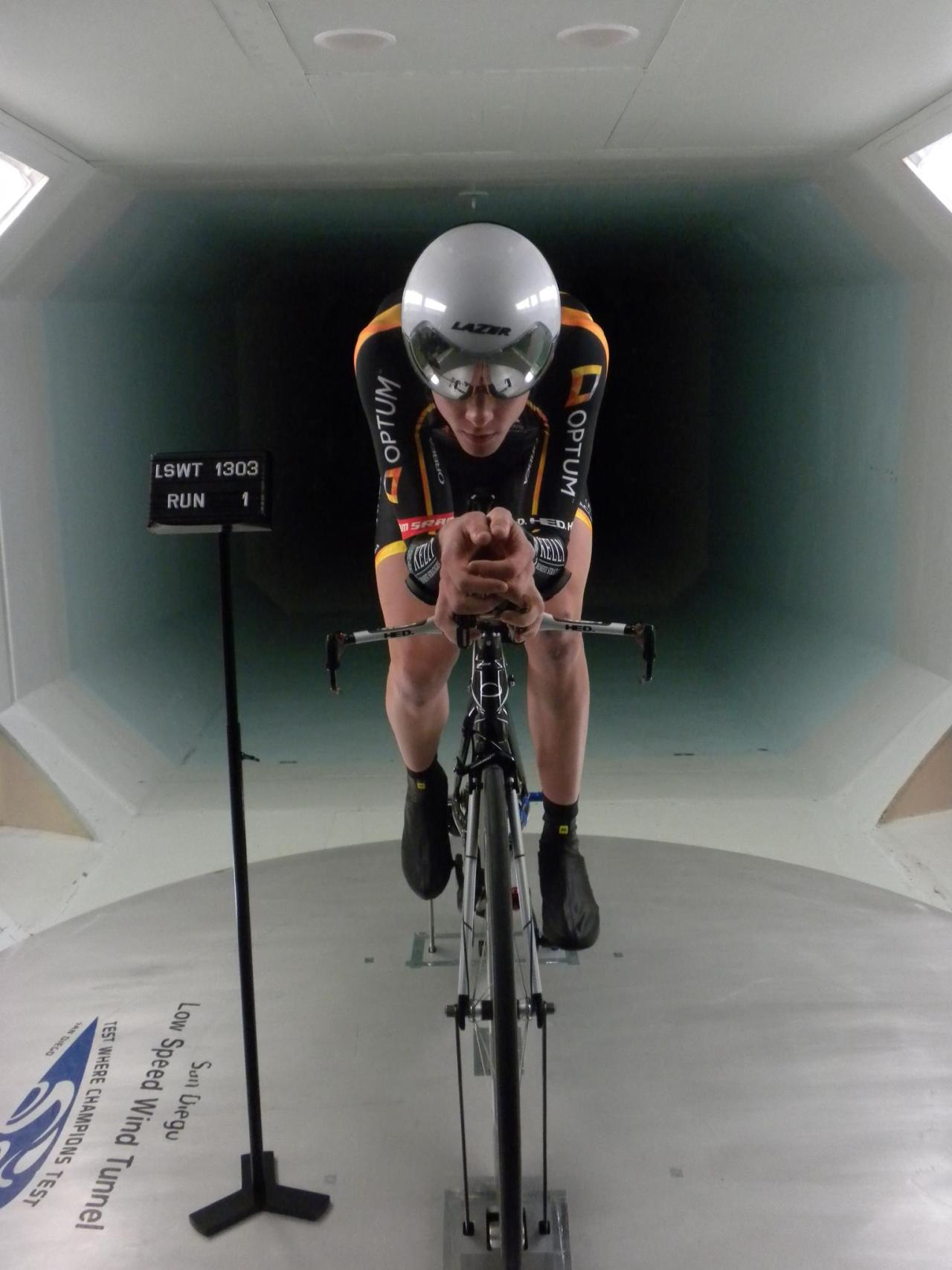
Reader Question: Drafting in Triathlons
Reader juleztalks writes:
I’ve just entered an amateur triathlon, and there’s a whole load of rules about not “drafting” in the cycle stage (basically, not sitting in other cyclists’ slipstream). However, there are no such rules for the swim or run stage; I thought the effects would be the same from drafting other swimmers and runners. Any ideas?
As in many endurance sports, it’s all a question of energy savings from drag reduction. Drag on an object, like a triathlete, is roughly proportional to fluid density (air for cycling or running, water for swimming), frontal area, and the velocity squared. Because drag increases more drastically for an increase in velocity, it makes sense one would worry most about drag when one’s velocity is highest – on the bike.
Drafting has major benefits in cycling and can reduce drag on a rider by 25-40%. Aerodynamic drag accounts for 70% or more of a cyclist’s energy expenditure, so that reduction can really add up. The energy saved by drafting during cycling can even increase a triathlete’s speed during a subsequent running leg. So it makes sense for a sport’s governing body to be concerned with it.
That said, there’s plenty of room for drag reduction in swimming as well. Even though the velocities are much lower, water’s density is 1,000 times higher than air’s, generating plenty of drag for an athlete to overcome. For swimmers at maximum speed, drafting can reduce drag by 13-26%, depending on relative positioning. Such drafting has been found to increase stroke length and may (or may not) improve subsequent cycling performance.
Although a similar reduction in drag is possible by drafting when running, drag on a runner only accounts for about 8% of his/her energy expenditure so such savings would matters very little next to the swimming and cycling legs. There could be some psychological benefits, though, in terms of pacing oneself. (Photo credit: Optum Pro Cycling p/b Kelly Benefit Strategies)
Droplet Impact Visualized
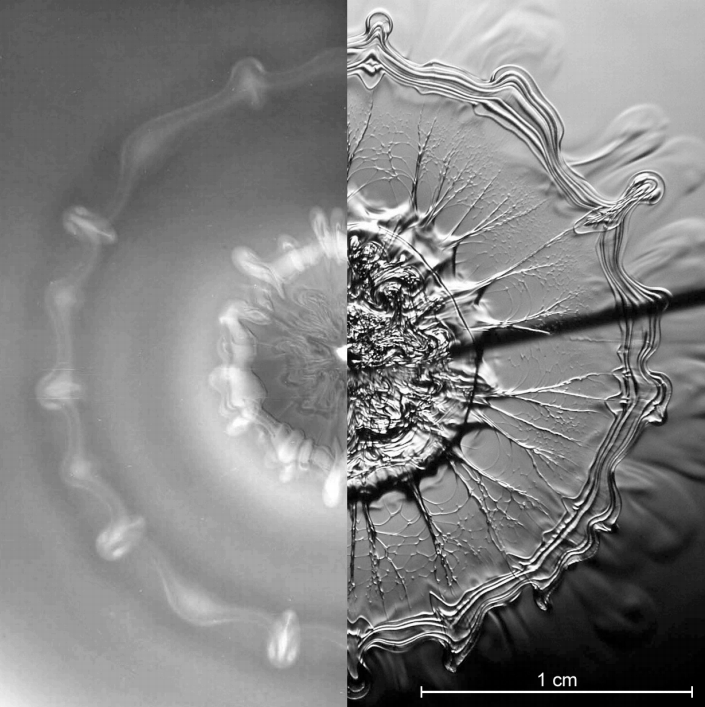
When a drop falls from a moderate height into a shallow pool, its impact creates a complicated pattern. The photo above is a composite image showing a top-down view 100 ms after such an impact. On the left side, the flow is visualized using dye whereas the right shows a schlieren photograph, in which contrast indicates variations in density. Both methods show the same general structure – an inner vortex ring generated at the edge of the impact crater and formed mostly of drop fluid and an outer vortex ring, consisting primarily of pool fluid, formed by the spreading wave. Both regions show signs of instability and breakdown. (Photo credit: A. Wilkens et al.)
Internal Wave Demo
This video has a fun and simple demonstration of the importance of fluid density in buoyancy and stratification. Fresh water (red) and salt water (blue) are released together into a small tank. Being lighter and less dense, the red water settles on top of the blue water, though some internal waves muddy their interface. After the water settles, a gate is placed between them once more and one side is thoroughly mixed to create a third fluid density (purple), which, when released, settles between the red and blue layers. In addition to displaying buoyancy, this demo does a great job ofaa showing the internal waves that can occur within a fluid, especially one of varying density like the ocean. (Video credit: UVic Climate Modeling Group)

Shock Waves in Flight
Schlieren photography allows visualization of density gradients, such as the sharp ones created by shock waves off this T-38 aircraft flying at Mach 1.1 around 13,000 ft. Although shock waves are relatively weak at this low supersonic Mach number, they persist, as seen in the image, at significant distances from the craft. The sonic boom associated with the passage of such a vehicle overhead is due to the pressure change across a shock wave. The higher the altitude of the supersonic craft, the less intense its shock wave, and thus sonic boom, will be by the time it reaches ground level. (Photo credit: NASA)