The banks of rivers are in constant flux, a pattern most easily captured from above. This satellite image shows a section of the Ivalo River in Finland, swollen with snowmelt after a winter of historic snowfalls. From above we see some of the river’s previous paths. This meandering is a natural result of secondary flows where rivers bend. The water carves away sediment from the outer bank and deposits it on the inner one, exaggerating every curve until the river cuts itself off, leaving behind a sinuous lake detached from the river’s new course. For an interesting (though non-physical) look at meandering, check out this procedural system for generating maps of rivers (thanks to Kam-Yung Soh for sharing). (Image credit: J. Stevens; via NASA Earth Observatory)
Search results for: “art”

Freezing Waves
Vibrate a liquid, and you’ll get a pattern of standing waves known as Faraday waves. In this project, artist Linden Gledhill adds a twist to the usual view of these waves by capturing them in plastic. As the polymer liquid vibrates, Gledhill uses a flash of UV light to cure the polymer, freezing the wave pattern. Check out the original video for an even better look. (Image, video, and submission credit: L. Gledhill, 1, 2, 3, 4)

Shear and Convection in Turbulence
In nature, we often find turbulence mixed with convection, meaning that part of the flow is driven by temperature variation. Think thunderstorms, wildfires, or even the hot, desiccating winds of a desert. To better understand the physics of these phenomena, researchers simulated turbulence between two moving boundaries: one hot and one cold. This provides a combination of shear (from the opposing motion of the two boundaries) and convection (from the temperature-driven density differences).
Please note that, despite the visual similarity, these simulations are not showing fire. There’s no actual combustion or chemistry here. Instead, the meandering orange streaks you see are simply warmer areas of turbulent flow, just as the blue ones are cooler areas. The shape and number of streaks are important, though, because they help researchers understand similar structures that occur in our planet’s atmosphere — and which might, under the wrong circumstances, help drive wildfires and other convective flows. (Image, research, and video credit: A. Blass et al.)

Slow Motion Speech
Sneezing, coughing, and speaking all produce a spray of droplets capable of spreading COVID-19 and other respiratory illnesses. This Slow Mo Guys video is the latest demonstration in a long line of evidence for why wearing masks in public is such an important part of ending our current public health crisis. Also, I think we can all agree: that sneeze footage is gross. (Image and video credit: The Slow Mo Guys)

Hudson Bay Watercolors
Rivers sweep fresh water and sediment into the Hudson Bay in this satellite image. Dark brown plumes mark the mouths of several coastal rivers as they add to the cyclonic sediment flow around the bay and out the Hudson Strait. Paler swirls, like strokes of watercolors, mark turbulent mixing between the sediment-filled shallows and the deep blue waters of the bay. (Image credit: J. Stevens/USGS; via NASA Earth Observatory)

“The Unseen Sea”
San Francisco’s picturesque fogs form “The Unseen Sea” in Simon Christen’s timelapse. Viewed at the right speed, the motion of clouds becomes remarkably ocean-like, with standing waves and surges against the hillside like waves crashing on a beach. Clouds in air don’t have the same surface tension effects as water waves in air, but, for the most part, the physics of their motion is the same, which is why they look so alike. (Image and video credit: S. Christen)

Understanding Stars’ Seismology
Our understanding of Earth’s interior is based mostly on observations of seismic waves, which travel differently through our rocky crust and the molten core. Scientists similarly use seismic waves in stars to determine their interiors. But the pressure and temperature conditions in stars are far beyond anything we have here on Earth, which makes predicting how waves will travel in such exotic material difficult.
To better understand these extreme temperatures and pressures, scientists are using Lawrence Livermore’s National Ignition Facility (NIF) to mimic conditions similar to the outer envelope of a white dwarf star, like the one shown in the center of the image above. NIF’s laser array – shown as the blue lines in the artist’s conception above – can generate spherical shock waves that, as they converge on a solid sample, create pressures as high as 450 Mbar, more than 400 million times sea level atmospheric pressure here on Earth. Although the shock wave takes only 9 ns to travel across the sample, it’s enough to give researchers a glimpse into star-like conditions. (Image credit: NASA/ESA/C. O’Dell/D. Thompson, Lawrence Livermore National Laboratory; via Physics Today)

Spinning Bubbles
Fluid dynamics is largely about figuring out the relationship between forces. For a soap bubble sitting still, that’s primarily the effect of gravity, which makes the fluid in the soap film drain downward, and surface tension, which tries to maintain a spherical shape for the bubble.
Once you start spinning the bubble, though, there are new forces that come into play. One is the centrifugal force caused by the rotation, and another is the drag force between the rotating soap bubble and the air inside and outside of it. The addition of these forces drastically changes the bubble’s shape. It becomes wobbly and flattens out. Watch the contact line where the bubble meets the surface and you’ll also see it creeping outward toward the edge of the platform. (Image credit: C. Kalelkar and S. Paul, source)

Storm Eyes and Mushrooms in a Drop
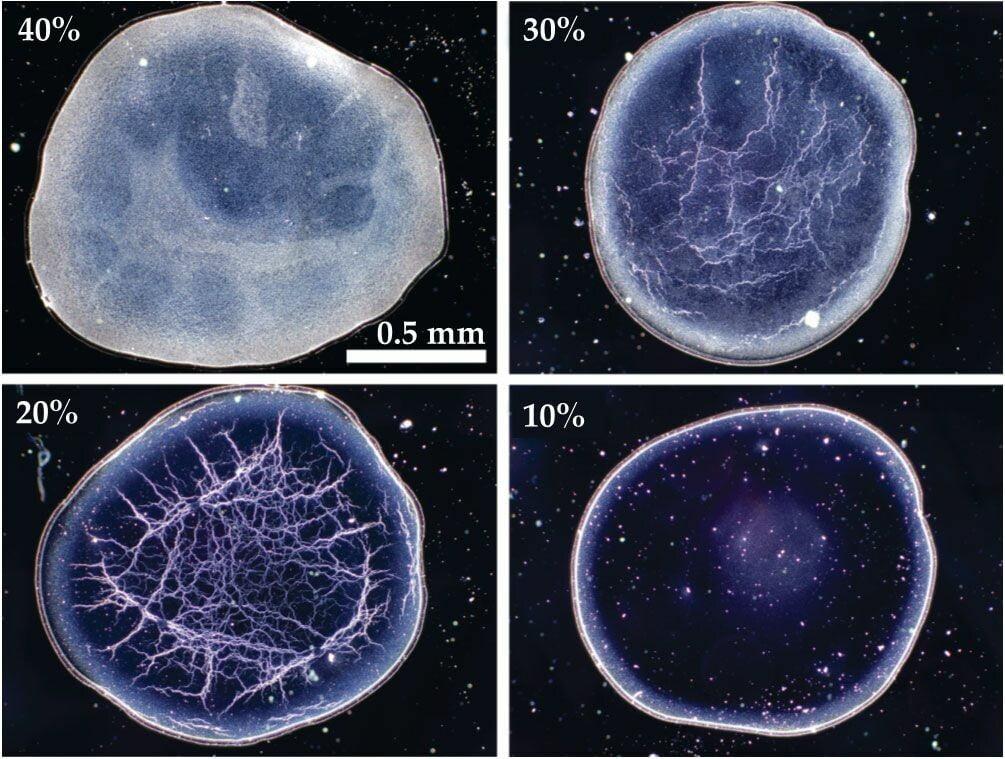
In industry, drying droplets often have many components: a liquid solvent, solid nanoparticles, and dissolved polymers. The concentration of that last component — the polymers — can have a big effect on the way the droplet dries, as seen in the video above.
Without polymers, the droplet dries similarly to a coffee ring stain. But at moderate concentration, we see something very different. The droplet forms an eye in the middle, similar to a hurricane’s, and the edges of the droplet sprout mushroom-shaped plumes that grow and merge with one another along the edge. With even larger polymer concentrations, the mushrooms sweep their way inward, leaving a feathery stain behind. (Video, image, and research credit: J. Zhao et al.)

Granular Fingers
Finger-like shapes often form on fluids injected between glass plates, but what happens when that injected fluid contains particles? That’s the situation in this recent study, where researchers sandwiched a fluid between two glass plates and then injected a second, similar fluid laced with particles.
Despite the differences from the traditional Saffman-Taylor set-up, the granular-filled fluid still forms fingers as long as there’s even a slight density difference between the original and injected fluids. It doesn’t even matter which of the two fluids has the greater density! (Image and research credit: A. Kudrolli et al.)