Search results for: “art”

  • Testing Turbulence’s Limits

    Testing Turbulence’s Limits

    Understanding chaotic, turbulent flows has long challenged scientists and engineers due to their sheer complexity. In turbulent flows, energy cascades from the largest scales — like the kilometer-size cross-section of a cloud — to the very smallest scales, less than a millimeter in size, where viscosity transforms the flow’s motion to heat. For nearly a century, our theoretical understanding of turbulence has posited that there are certain universal behaviors in the statistics of a turbulent flow — essentially that, due to this energy cascade, some aspects of every turbulent flow are the same from clouds to ocean currents to your coffee cup.

    Accordingly, experimentalists have tried for decades to measure this expected universality. Often, there are some signs of agreement, and any deviation was attributed to the finite difference between the large and small scales of the flow. (The theory assumes the difference in these scales’ size is effectively infinite.) But now researchers have achieved the largest range of scales yet — comparable to those found in the atmosphere — and the gaps between theory and experiment remain. The new study does show signs of universality but in a different way than existing theory predicts. As the authors point out, we’ll need new theories to explain these findings. (Image credit: D. Páscoa; research credit: C. Küchler et al.; via APS Physics)

  • Atlantic Blooms

    Atlantic Blooms

    In April 2023, swirls of green and turquoise burst into vivid color in the Atlantic. Much of the color comes from a phytoplankton bloom. Although phytoplankton are individually microscopic, they form eddies a hundred kilometers across that are visible from space. In detailed images like the one above (available here in full resolution) these swirls have amazing turbulent details. Some of the brightest sections almost look like a field of sea ice! (Image credit: L. Dauphin; via NASA Earth Observatory)

    This wider view shows the bloom's location off of the northeastern U.S.
  • Sliding on Sand

    Sliding on Sand

    Getting around on sandy slopes is no easy feat. On steep inclines, even small disturbances will cause an avalanche. The predatory antlion takes advantage of this fact by building a conical pit that makes ants that walk in slide down into its waiting jaws. But a new study shows that it’s more than just pressure that determines when an object slides down the slope.

    To simulate hapless ants sliding into an antlion’s pit, researchers used plexiglass disks with four smaller disks that act as legs on the granular slope. By varying the distance between these points of contact, researchers found that stance also affects when a slide starts. The closer together the contacts are, the more likely the disk would slide. In contrast, spreading the points of contact increased stability, meaning that adopting a wider stance could keep an animal, human, or robot from sliding as easily. (Image credit: NEOM; research credit: M. Piñeirua et al.; via APS Physics)

  • Jovian Swirls

    Jovian Swirls

    Jupiter, our solar system’s stormiest planet, shares many similarities with Earth. But where Earth’s strongest storms are cyclones centered on low-pressure regions, Jupiter’s longest and strongest storms are anti-cyclones, driven by areas of high pressure. They’re often massive — larger than the entire Earth — and persist for weeks, months, or years. This processed image comes from the JunoCam instrument and shows some of the incredible cloud structure in Jupiter’s atmosphere. Jupiter’s highest altitude clouds tend to be the lightest, while darker clouds remain lower. (Image credit: NASA/JPL-Caltech/SwRI/MSSS/K. Gill; via APOD)

  • Featured Video Play Icon

    The Physics of Vowels

    Blow across the top of a glass bottle, and you’ll get a whistle-like sound. Put some liquid in there and the pitch of the sound changes. Our vocal tracts are basically the same thing: a tube with a hole at the end. But as Joe Hanson shows in this Be Smart video, our ability to change the shape and resonance of our vocal tract by moving our tongues and lips enables us to make a wide range of vowel sounds. Enjoy this dive into the world of linguistic physics! (Video and image credit: Be Smart)

  • Puddle Depth Matters for Stalagmites

    Puddle Depth Matters for Stalagmites

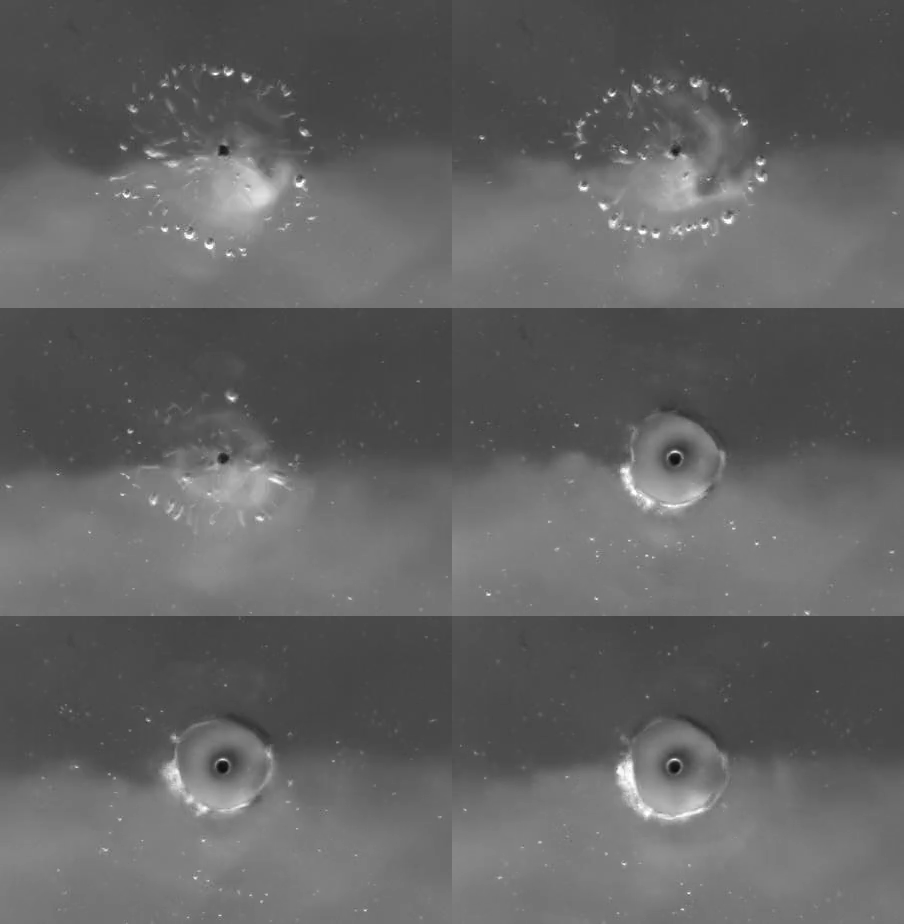
    In a cave, mineral-rich water drips from the ceiling, spreading ions used to build stalagmites. A recent study considers how the depth of a pool affects the droplet’s splash and how material from the droplet spreads. The authors found several scenarios that vary widely depending on pool depth.

    A droplet falling into a shallow pool creates a splash that quickly breaks up into droplets. This flings the red droplet material in many directions.
    A droplet falling into a shallow pool creates a splash that quickly breaks up into droplets. This flings the red droplet material in many directions.

    A drop falling into a shallow pool had a splash that quickly broke up into droplets (above). By dyeing the pool green and the droplet red, they could track where the droplet’s material wound up. The spray of small droplets carried fluid far, but the main point of impact had a strong concentration of the drop’s fluid.

    With a deeper pool, the drop's impact creates a thick crown splash that collapses in on itself. The drop's fluid is quickly mixed into the pool.
    With a deeper pool, the drop’s impact creates a thick crown splash that collapses in on itself. The drop’s fluid is quickly mixed into the pool.

    In contrast, a deeper pool sent up a thick-walled splash crown that collapsed in on itself. This droplet’s material saw lots of mixing with the pool, but only near the point of impact. From their work, the authors concluded that models of stalagmite growth should incorporate pool depth in order to capture how minerals actually concentrate and move. (Image credit: cave – H. Roberson, others – J. Parmentier et al.; research credit: J. Parmentier et al.; via APS Physics; submitted by Kam-Yung Soh)

  • Anabranching Riverways

    Anabranching Riverways

    The Diamantina River in Australia is dry for much of the year. But seasonal rains flood its riverbeds and provoke a bloom of vegetation along its banks. This false-color satellite image shows the river in April 2023; land appears pale and reddish, the river and its sediment blue, and vegetation a bright green. The Diamantina is an anabranching river; rather than the typical meandering paths of a delta, anabranching rivers have semi-permanent paths hemmed in by vegetation-stabilized islands. Look closely, though, and you’ll still see smaller delta-like features known as floodouts dotting some of the islands. (Image credit: A. Nussbaum; via NASA Earth Observatory)

    This close-up shows details like miniature deltas (floodouts) and wind-formed dunes.
    This close-up shows details like miniature deltas (floodouts) and wind-formed dunes.
  • Featured Video Play Icon

    Sniffing in Stereo

    Snakes’ forked tongues have long inspired fear, but, in reality, they are part of a highly-effective sensory system. When snakes flick out their tongues, they waggle them up and down about 15 times a second. That motion draws air inward toward the tongue (Image 2), allowing scent molecules to stick to the saliva on either side of the tongue. Once those molecules are gathered, the snake pulls its tongue back into its mouth, where it settles into two grooves (Image 3). Each one has its own path to the snake’s olfactory organs, giving the snake independent spots to evaluate the left and right forks. That means the snake knows which side has a stronger scent and is better able to track its prey. (Video and image credit: Deep Look)

  • Overheating Slows Large Animals

    Overheating Slows Large Animals

    As climate change and human development continue to encroach on animals’ territories, mass migrations will become more and more common. But animals aren’t all equally able to travel long distances at speed. In general, larger animals are faster than smaller ones. But a new study shows that there’s another important factor in an animal’s top speed: heat dissipation.

    By studying the characteristics of over 500 animals that walk, fly, and swim, the team found that animals were limited in their speed by how well they could dissipate heat. This makes sense, even from a human perspective; we may be able to run long distances, but once we’re too hot, we have to slow down. The same principle holds for animals, and the bigger the animal, the longer it takes to dissipate heat. As a result, the team found that the fastest animals over long distances all have intermediate body mass. At their size, they can balance the mechanical ability to produce speed with the thermodynamic requirement to dissipate heat. (Image credit: N. and Z. Scott; research credit: A. Dyer et al.; via APS Physics)

  • Getting Water Out of Your Ear

    Getting Water Out of Your Ear

    Swimming often results in water getting stuck in our ear canals. The narrow space, combined with the waxy surface, is excellent at trapping small amounts of water. If left in place, that excess fluid distorts hearing, can cause pain, and may eventually lead to an ear infection. So most people’s common response is to tilt their head sideways and shake it or jump to knock the water out. This recent study looks at just how much acceleration is needed to dislodge that water.

    An acceleration of 7.8g isn't enough to remove the water from this artificial ear canal.
    An acceleration of 7.8g isn’t enough to remove the water from this artificial ear canal.

    The team built an artificial ear based on the shape of a human’s ear canal and observed how much acceleration was needed to knock the water out. The answer? Quite a bit. As seen above, nearly 8g of acceleration was enough to distort the interface of the water in the ear canal, but it didn’t move the water out.

    At higher accelerations — above 20 times the acceleration due to gravity – the air-water interface distorts enough to get the water to flow. But accelerations that large are enough to potentially damage brain tissues.

    At over 24g, the acceleration is enough to dislodge the water from this artificial ear canal. But accelerations this high can cause brain damage.
    At over 24g, the acceleration is enough to dislodge the water from this artificial ear canal. But accelerations this high can cause brain damage.

    The problem is worse for children and babies, whose tiny ear canals necessitate even larger accelerations. For them, shaking hard enough to remove water could cause real damage. Instead, a couple drops of vinegar or alcohol in the ear will lower the surface tension and make the fluid easier to remove. (Image credit: top – J. Flavia, others – S. Kim et al.; research credit: S. Kim et al.; submitted by Sunny J.)