Photographer Charles Brooks offers a rare glimpse into the interiors of musical instruments in this series. Whether stringed, wind, or percussion, an instrument’s unseen interior structure creates the acoustic resonance needed for their music. Brooks makes these spaces feel like vast cathedrals of sound, which, to the pressure waves emanating from the instruments, they are. Which is your favorite? Personally, I love the graceful lines of the cello and the rough surface of the didgeridoo. (Image credit: C. Brooks; via Colossal)
Search results for: “art”

How a Leak Can Stop Itself
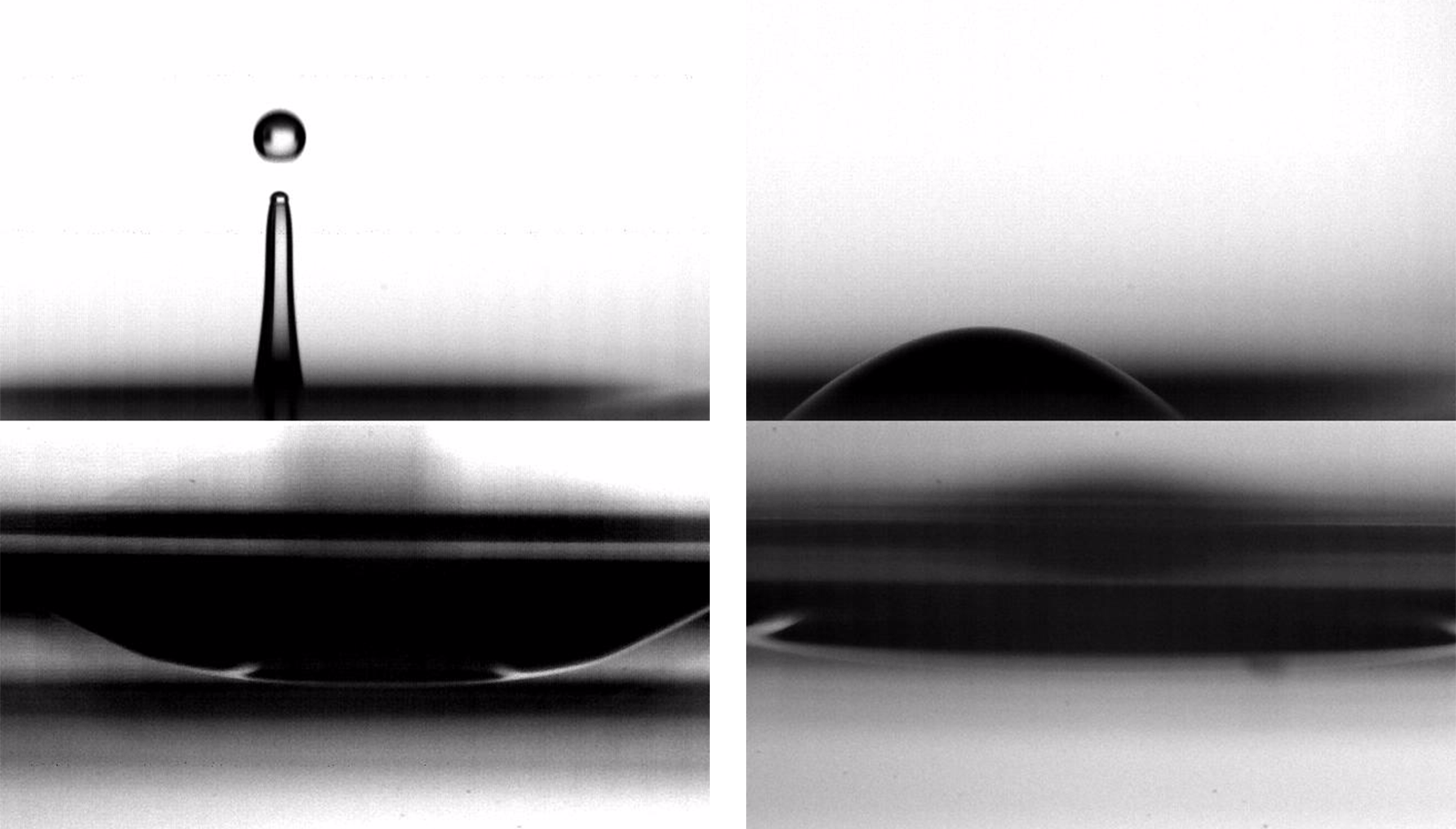
Some leaks can actually stop themselves, and a new analysis shows how. When a vertical pipe has a small hole, water initially spouts out of it, then dribbles, and, finally, drips as the water level in the pipe falls, decreasing the driving pressure of the flow. But the pipe doesn’t have to empty to a level below the hole for the leak to stop. Instead, a final droplet can form a cap over the hole, with its shape providing enough pressure to balance the remaining pressure from fluid in the pipe.

Water leaking from a vertical pipe transitions from continuous flow to discrete drops (left). Dripping continues until the final droplet forms at t = 0 seconds. The researchers found that the final drop’s kinetic energy (as well as its potential energy) was critical to determining which drop would stop the flow. The last drop behaves like a lightly-damped harmonic oscillator; it needs enough potential energy to counter the flow and a small enough inertia that it doesn’t slip away down the pipe. (Image credit: top – G. Crofte, experiment – C. Tally et al.; research credit: C. Tally et al.; via APS Physics)
Splash-Spread Mushrooms
Bird’s nest fungi are tiny — only about a centimeter wide. When mature, they form a curved splash cap containing spore sacs known as peridioles. Then they await rain. When a lucky drop hits the mushroom, it flings the peridioles out of their nest. Some will use sticky cords to cling to nearby blades of grass, setting them up to eventually hitch a ride to elsewhere with a grazing herbivore. It’s an impressive journey for a teeny spore sac, and it all starts with a single drop of rain. (Image and video credit: Deep Look)

Gathering Safely
One effect of the COVID-19 pandemic is a renewed interest in the physics of disease transmission and what measures can protect us from airborne respiratory illnesses. This recent study looks at how meetings — whether in classrooms, conferences, or care facilities — can transmit infections. Their mathematical model is able to handle many variables — room size, number of people, length of meeting, breaks between sessions, masking, ventilation, and so on. Without prescribing any one policy, the authors aim to inform decision makers so that they can choose what methods (testing, masking, ventilation, etc.) work best for their event.
That said, they find that ventilation and periodic breaks between meetings are highly effective in reducing a room’s viral load. Leaving enough time between sessions for ventilation to clear the room was as effective (or more effective) than masking and moderate isolation of those infected. Tools like these are vital in enabling gatherings that keep participants safe. (Image credit: Product School; research credit: A. Dixit et al.; submitted by Kam-Yung Soh)

Predicting Contamination in Urban Environs
The canyons of a city’s streets form a complex flow environment. To better understand the risks of a spreading contaminant, researchers simulated a release in lower Manhattan’s urban jungle. The released particles spread due to the dominant wind pattern of the area. Initially, the particles follow the street pattern and stay at a low elevation. But updrafts on the downwind side of skyscrapers lift the particles higher, spreading them to lower concentrations at more elevations.
Public officials study simulations like these to understand what response is needed to protect people in the event of an accidental or intentional release of harmful materials. (Image and video credit: W. Oaks and A. Khosronejad)

Washing By Vortex Ring
Spraying a surface clean with a jet of fluid can be an energy-intensive operation. But a recent experiment shows that pulsed flow — which creates vortex rings — could be a viable cleaning alternative. Here we see vortex rings impacting a porous, beaded surface that’s covered in oil. Vortex rings with lots of rotation actually pass through the beads, knocking oil off both the front and back surfaces (Image 1). Even with a lower rotation rate, a vortex ring can still help clean the upper surface (Image 2). (Image and research credit: S. Jain et al.; via APS Physics)

Disease and Placental Flows
The human placenta functions as a life-support system for a growing fetus. Despite its frisbee-like appearance, the organ is packed with nearly 10 square meters of blood vessels. On the fetal side, these blood vessels form villous trees where diffusion across the placental boundary exchanges molecules with the maternal blood that fills the space between villous trees. This setup allows oxygen, glucose, carbon dioxide and other key chemicals to cross between the parent and fetus while (ideally) keeping diseases out.

Views of the placenta. Beige areas show the intervillous space where maternal blood flows while pink areas show villous trees where exchanges between the fetus and mother take place. The first three images show a) preeclamptic, b) normal, and c) diabetic placentas. The final image d) shows a 3D view of placental tissue taken with x-ray tomography. But when diseases directly affect the structure of the placenta, flow to the fetus gets disrupted. The image above shows cross-sections of placental tissues, with villous trees marked in pink, under (a) preeclamptic, (b) normal, and (c) diabetic conditions. Preeclampsia is associated with reduced density of villous trees, which restricts the amount of nutrients a fetus receives and can lead to reduced growth or stillbirth. In contrast, with gestational diabetes villous trees can proliferate, causing a high resistance to flow that also affects exchanges.
For more on the complex physics of the placenta, check out this article from Physics Today. (Image credit: sketch – L. da Vinci, placentas – A. Clark et al.; see also A. Clark et al.)

Stirring Up Sediment
In early February, Tropical Cyclone Gabrielle passed over the Bellona Plateau in the Coral Sea, stirring up sediment from the shallow reefs there. Once the storm cleared, large swirls of carbonate sediment mixed into the deeper waters around the plateau. As the sediment sinks to depths of kilometers, it will dissolve into the deep ocean waters, eventually getting captured as part of sedimentary rocks. This is a critical step in the ocean’s carbon capture cycle.
Unfortunately, climate change is disrupting the ocean’s ability to capture carbon. An excess of carbon dioxide acidifies ocean waters, making it harder for creatures like corals and crabs to incorporate carbon into their bodies. That reduces sources for carbonate sediments like those seen here. Changes in ocean chemistry also affect where and how much carbonate can get dissolved. In short, ocean carbon capture has been an important process for Earth’s carbon cycle in the past, but the process is a slow one, and human activity has overloaded the ocean’s system in ways we don’t fully understand. (Image credit: A. Nussbaum; via NASA Earth Observatory)

Fog in the Blue Ridge Mountains
Fog blankets the forest of the Blue Ridge Mountains in this photo by Tihomir Trichkov. It gives the photo the quality of an Impressionist painting. Rain from the day before left lots of moisture in the air and soil, contributing to the ethereal condensation lit by the sunrise. (Image credit: T. Trichkov; via Gizmodo)

Predicting Heat Waves
The United States, Europe, and Russia have all seen deadly, record-breaking heat waves in recent years, largely in areas that are ill-equipped for sustained high temperatures. A new paper presents a theory that predicts how hot these heat waves can get and what mechanism ultimately breaks the hot streak.
Heat waves start when an area of high-pressure air forms over land, with an anticyclone circulating around it. Air at the center of the zone warms and rises, and if the anticylone can’t move, temperatures will just keep rising. Despite the heat, there is still moisture in the rising air of a heat wave. The authors found that if that moist air can reach an altitude where the atmospheric pressure is 500 hPa (a typical altitude of 5-7 km), then the maximum daily temperature will stop rising. At that altitude, the moist air can condense into rain, and, even if that rain evaporates before reaching the ground, it is enough to cool temperatures.
The key variable in the theory is the atmospheric temperature at 500 hPa, something that meteorological models are able to predict well up to three weeks in advance. That means this theory should enable meteorologists to give advanced warning of high temperatures, helping communities prepare. (Image credit: T. Baginski; research credit: Y. Zhang and W. Boos; via APS Physics)