Search results for: “art”

  • Clouds Down Under

    Clouds Down Under

    This large and unusual cloud formation was captured one July morning over western Australia. Stretching over 1,000 kilometers, the clouds have interesting features at both the large and small scale. The small-scale ripples within the clouds are gravity waves triggered by the terrain below. The larger, arced features are tougher to explain, though they may also be related to gravity waves and terrain, just on a much larger scale. They also resemble fallstreak clouds where supercooled droplets evaporate from the inside of the cloud out. (Image credit: W. Liang; via NASA Earth Observatory)

  • Predicting Landslides

    Predicting Landslides

    Landslides can cause catastrophic damage, but historically it’s been difficult to monitor susceptible slopes and predict when they’ll fail. But a recent study looking at the 2017 Mud Creek landslide in California shows that new methods could provide a heads up.

    The researchers used satellite data from the months preceding the landslide to study how areas on the slope moved relative to one another. Within their survey region, they found sub-regions where ground locations largely moved together. These sub-regions, called communities in the researchers’ parlance, were remarkably persistent, showing little variation over long periods. But 56 days before the landslide, the researchers saw a sudden change between the communities on the slope. They believe their methodology could help identify slopes in danger of imminent slides.

    So far, though, they’ve only applied this method to the Mud Creek landslide. It’s a promising start, but they’ll need to show that the technique works for other slides as well. If so, it will be a major step forward in landslide prediction. (Image credit: USGS; research credit: V. Desai et al.; via APS Physics)

  • Featured Video Play Icon

    To Clog or Not to Clog?

    The clear plastic disks use to study clogging appear rather plain — at least until you look at them through polarizers. Then the disks light up with a web of lines that reveal the unseen forces between the particles. In this video, researchers use this trick to explore how spontaneous clogs occur. If particles jam together into an arch, that bridge can be strong enough to hold the weight of all the particles above it, bringing the flow to a halt. Some arches aren’t strong enough to hold for long; they can break in moments. Other more stable arches persist. By watching the flow through polarizers and carefully tracking the ebb and flow of the forces between particles, researchers can predict which clogs will have staying power. (Video credit: B. McMillan et al.)

  • Forming Zigzags

    Forming Zigzags

    Scientists are fascinated by the organized patterns that can emerge from non-living systems. Here, researchers study micron-sized magnetic particles, immersed in a viscoelastic fluid and subjected to an oscillating magnetic field. The peanut-shaped particles roll around their long axis and assemble to form millimeter-sized bands of zigzags. These patterns, the researchers found, do not depend on the particles’ specific shape or on the details of the applied magnetic field. Instead, the zigzags depend only on the symmetry of the flow generated around each particle. In their system, illustrated above, each particle pushed fluid away along their long axis and drew in fluid toward their waist; as a result, particle pairs would attract or repel, depending on their relative orientation. That interparticle force ultimately caused the particles to self-organize into zigzags. (Image, video, and research credit: G. Junot et al.; via APS Physics)

    This sped-up animation shows the zig-zag pattern that the particles self-organization into.
    This sped-up animation shows the zigzag pattern that the particles self-organization into.
  • Painting in Sediment

    Painting in Sediment

    Pale plumes of sediment flow off these islands in the Gulf of Mannar between India and Sri Lanka. As waves erode the land, currents and tides carry the sediment outward, shaping it into swirls and eddies. I rarely tire of satellite images like these because there are always subtle new details of flow to notice. The photos are much like paintings, with layer after layer to decipher the closer you look. (Image credit: A. Nussbaum; via NASA Earth Observatory)

  • Uranus’s Polar Cyclone

    Uranus’s Polar Cyclone

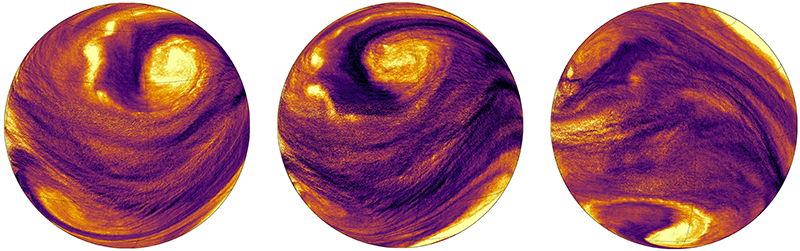
    Uranus is an oddity among the planets of our solar system. Where other planets spin around an axis roughly in line with their orbital axis, Uranus spins on its side, placing its poles in line with the sun. On Earth, the polar regions are naturally colder the equator, but that doesn’t hold true for Uranus. Yet new observations of the ice giant show that it, like the other planets with atmospheres in our solar system, has a polar cyclone.

    Those observations are thanks to improvements in radio astronomy over the past couple decades. Uranus’s odd orbital geometry means that each of its poles are hidden from Earth for 42 years at a time; the current northern-hemisphere spring marks our first view of Uranus’s northern pole since 1965. In the recent observations, researchers saw a bright spot on the pole, surrounded by a faint darker ring. The team modeled the temperature and gas composition necessary to match their observations and found that those patterns were consistent with a cyclone sitting at the northern pole. (Image credit: NASA/JPL-Caltech/VLA; research credit: A. Akins et al.; via Physics Today)

  • Fish Fins Work Together

    Fish Fins Work Together

    Researchers studying how fish swim have long focused on their tail fins and the flows created there. But a fish’s other fins have important effects, too, as seen in this recent study. Researchers built a CFD simulation based on observations of a swimming rainbow trout, focusing on the flow from its back and tail fins. They found that the vortex created by the back fin stabilizes and strengthens the one generated by the tail. It also played a role in reducing drag on the fish by maintaining the pressure difference across the body. When they tried changing the size and geometry of the fins, the fish’s efficiency suffered, indicating that evolution has already optimized the trout’s fins for swimming efficiency. (Image credits: top – J. Sailer, simulation – J. Guo et al.; research credit: J. Guo et al.; via APS Physics)

    Visualization of flow around a digitized rainbow trout.
    Visualization of flow around a digitized rainbow trout.
  • Featured Video Play Icon

    Relax With Hummingbirds

    Quick, agile, and fierce, the hummingbird is an amazing creature. Small for a bird but much larger than an insect, it’s able to hover in place and eat nectar directly from flowers. Many species use a forked tongue with curled edges that help it capture the sweet, viscous fluid. Even their distinctive sounds are fluid-influenced, coming from their wingstrokes and the fluttering of tail and wing feathers. (Image and video credit: BBC Earth)

  • Gravity Changes Droplet Shapes

    Gravity Changes Droplet Shapes

    With small droplets, gravity usually has little effect compared to surface tension. An evaporating water droplet holds its spherical shape as it evaporates. But the story is different when you add proteins to the droplet, as seen in this recent study.

    The protein-filled sessile drop starts out largely spherical, but as the drop evaporates, the concentration of proteins reaches a critical point and an elastic skin forms over the drop. From this point onward, the drop flattens.
    The protein-filled sessile drop starts out largely spherical, but as the drop evaporates, the concentration of proteins reaches a critical point and an elastic skin forms over the drop. From this point onward, the drop flattens.

    As a protein-doped droplet sitting on a surface evaporates, it starts out spherical, like its protein-free cousin. But, as the water evaporates, it leaves proteins behind, gradually increasing their concentration. Eventually, they form an elastic skin covering the drop. As water continues to evaporate, the droplet flattens.

    For a hanging droplet, the shape again starts out spherical. But as the drop's water evaporates and the proteins concentrate, it also forms an elastic skin. As the drop evaporates further, the skin wrinkles.
    For a hanging droplet, the shape again starts out spherical. But as the drop’s water evaporates and the proteins concentrate, it also forms an elastic skin. As the drop evaporates further, the skin wrinkles.

    In contrast, a hanging droplet with proteins takes on a wrinkled appearance once its elastic skin forms. The key difference, according to the model constructed by the authors, is the direction that gravity points. Despite these droplets’ small size, gravity makes a difference! (Image, video, and research credit: D. Riccobelli et al.; via APS Physics)

  • Featured Video Play Icon

    Fresh Fissures

    North of Iceland’s Fagradalsfjall, a new volcanic fissure opened in July 2023. This drone footage from Isak Finnbogason captures that fissure on its first night. Lava fountains jet from the earth, forming a complex, slow-moving river. The similarities between flowing lava and more common liquids like water never ceases to fascinate me. Even with the vast differences in temperature and viscosity, so much of their physics remains recognizably the same. (Image and video credit: I. Finnbogason; via Colossal)