Search results for: “art”

  • Scooting Droplets

    Scooting Droplets

    As a child, I always loved watching rain on the windows as I rode in the car. Hemispherical droplets got stretched by the wind flowing over them. But they never stretched smoothly; instead they seemed to shiver and shake unevenly. A recent study looks at a similar situation: drops of glycerin forced to slide along a horizontal surface under the force of the wind. Like the drops on my parents’ car, the glycerin gets stretched out into an elongated oval. Surface waves develop atop the drop and move downstream. The drops, the authors observe, move a bit like a crawling caterpillar, pilling up and smoothing out as they move. (Image credit: rain – A. Alves, experiment – A. Chahine et al.; research credit: A. Chahine et al.; via APS Physics)
    This series of images shows an elongated droplet subjected to airflow moving from left to right. Waves form on the drop and move downstream in a fashion similar to a caterpillar crawling.
    This series of images shows an elongated droplet subjected to airflow moving from left to right. Waves form on the drop and move downstream in a fashion similar to a caterpillar crawling.
  • Field of Dunes

    Field of Dunes

    Barchan dunes collide in this astronaut image of Brazil’s southern coastline. Barchan (pronounced “bar-kahn”) dunes are crescent-shaped; their tips point downwind into their direction of travel. When many barchan dunes overlap, they coalesce into a dune field like the one seen here. A dune’s speed depends on many factors, including the wind speed, dune size, and its proximity to other dunes. In experiments, dunes have even chased one another and changed speeds to avoid collision. (Image credit: NASA; via NASA Earth Observatory)

  • Featured Video Play Icon

    “Aquakosmos”

    Colorful chandeliers, passing spirits, sprouting mushrooms, and fountains of falling ink appear in Christopher Dormoy’s “Aquakosmos.” Driven by the slight density difference between ink and water, many of these elaborate shapes result from the Rayleigh-Taylor instability. Anytime you see mushroom-like plumes and chandelier-like splitting vortex rings, there’s probably a Rayleigh-Taylor instability behind it. Check out the full video above, and, if you want to give this kind of flow visualization a try yourself, a glass of water and vial of food coloring is a great place to start. (Video and image credit: C. Dormoy)

  • Stopping a Bottle’s Bounce

    Stopping a Bottle’s Bounce

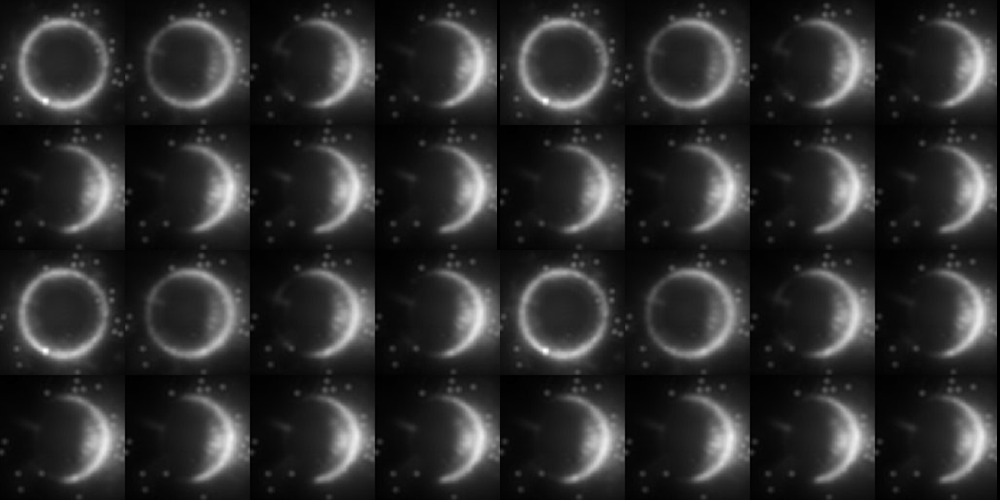
    A few years ago, the Internet was abuzz with water bottle flips. Experimentalists are still looking at how they can arrest a partially fluid-filled container’s bounce, but now they’re rotating the bottles vertically rather than flipping them end-over-end. Their work shows that faster rotating bottles have little to no bounce after impacting a surface.

    This image sequence shows how water in a rotating bottle moves during its fall (top row) and after impact (bottom row). Water climbs the walls during the fall, creating a shell of fluid that, after impact, forms a central jet that arrests the bottle's momentum.
    This image sequence shows how water in a rotating bottle moves during its fall (top row) and after impact (bottom row). Water climbs the walls during the fall, creating a shell of fluid that, after impact, forms a central jet that arrests the bottle’s momentum.

    The reason for this is visible in the image sequence above, which shows a falling bottle (top row) and the aftermath of its impact (bottom row). When the bottle rotates and falls, water climbs up the sides of the bottle, forming a shell. On impact, the water collapses, forming a central jet that shoots up the middle of the bottle, expending momentum that would otherwise go into a bounce. It’s a bit like the water is stomping the landing.

    The authors hope their observations will be useful in fluid transport, but they also note that this bit of physics is easily recreated at home with a partially-filled water bottle. (Image and research credit: K. Andrade et al.; via APS Physics)

  • Weathering Spilled Oil

    Weathering Spilled Oil

    As long as we continue to extract and transport oil, marine oil spills will continue to be a problem. Recent work shows that spilled oil weathers differently depending on both sunlight and water temperature. When exposed to sunlight, crude oil undergoes chemical reactions that can change its makeup. Researchers studied the mechanical properties of crude oil samples kept at different temperatures in both sunlight and the dark.

    They discovered that sunlight-exposed crude oil kept at a high temperature had twice the viscosity of a sample kept in the dark at the same temperature. In contrast, the high-temperature sunlit sample’s viscosity was 8 times lower than a sunlit sample kept at a lower temperature. That’s quite a large difference, and it implies that tropical oil spills may behave quite differently than Arctic ones. Cold-water spills will entrain and dissolve less than warm-water ones, so there may be more surface oil to collect at high-latitude spills. The differences in viscosity may also necessitate different spill mitigation techniques. (Image credit: NOAA; research credit: D. Freeman et al.; via APS Physics)

  • Diving From Above

    Diving From Above

    Blue-footed boobies, like many other seabirds, climb to a particular altitude before folding their wings and diving head-first into the water. This acrobatic feat balances the bird’s force of impact and the depth it can reach to ensnare fish swimming there. It’s an incredible process to watch, a fascinating one to study, and, here, a beautiful glimpse of the natural world from a perspective we don’t typically see. (Image credit: H. Spiers, Bird POTY; via Colossal)

  • Drag Is Greatest Before Submersion

    Drag Is Greatest Before Submersion

    A new study shows that partially submerged objects can experience more drag than fully submerged ones. This unexpected result comes from the excess fluid that piles up ahead of the object, as seen in the image above, where flow is moving from left to right. The experiments used centimeter-sized spheres and showed that the maximum drag on a nearly-submerged sphere could be 300-400% greater than the drag on a fully submerged sphere.

    Even more surprisingly, they found that water-repellent hydrophobic coatings — which are often suggested for drag reduction — actually increased the drag even further on partially submerged spheres. That’s because the water-repelling coating caused an even larger build-up of fluid ahead of the sphere, increasing the pressure on the front side of the sphere and creating even more drag. Spheres with a hydrophilic coating had less water build-up and thus lower drag.

    The study suggests that — at the centimeter-scale — drag physics at the air-water interface may be more complicated than we assume. (Image and research credit: R. Hunt et al.; via Physics World; submitted by Kam-Yung Soh)

  • Featured Video Play Icon

    Surviving the Dry Season

    The Zambezi River winds through eastern Africa, providing much-needed water to plants and animals there. But during the dry season, when rain and river water are scarce, most trees go bare. The apple ring acacia is the exception. These towering trees rely on their taproot, which delves 30 meters or more into the ground, to deliver an ongoing supply of water. Flush with water, the trees remain green, providing vital food and shade to animals during the harshest season of the year. (Image and video credit: BBC Earth)

  • Complex Dunes

    Complex Dunes

    Sometimes landscapes have a beauty that’s hard to see from the ground. This astronaut’s photo shows a dune field in the sand seas of Saudi Arabia. Vast linear dunes line up along the direction of prevailing winds. Atop these dunes are more complex formations, star dunes, that are built up in the wake of changing winds. Built from three or more intersecting arms, the star dunes are steeper than the linear dunes they sit atop. Such complex dune fields — with multiple types of dunes — form in areas with especially abundant sands. (Image credit: NASA; via NASA Earth Observatory)

  • Modeling Wildfires With Water

    Modeling Wildfires With Water

    Turbulence over a burning forest can carry embers that spread the wildfire. To understand how wildfire plumes interact with the natural turbulence found above the forest canopy, researchers modeled the situation in a water flume. Dowel rods acted as a forest, with turbulence developing naturally from the water flowing past. For a wildfire, the researchers used a plume of warmer water, which buoyancy lofted into the turbulence over their model forest.

    The experiment used to model wildfire flows. Dowel rods represent the forest and a plume of warm water (right side; distorting the background) represents the wildfire. The dark device in the foreground is a probe used to measure turbulence.
    The experiment used to model wildfire flows. Dowel rods represent the forest and a plume of warm water (right side; distorting the background) represents the wildfire. The dark device in the foreground is a probe used to measure turbulence.

    The flow over the forest canopy naturally forms side-by-side rolls of air rotating around a horizontal axis. As the buoyant plume rises, it can be torn apart by these rollers, as well as carried downstream. Varying the turbulence, they found, did not affect the average trajectory of the plume. But the more intense the turbulence, the greater the vertical fluctuations in the plume. Those large variations, they concluded, could lift more embers into stronger winds that distribute them further and spread a fire faster. (Image credit: wildfire – M. Brooks, experiment – H. Chung and J. Koseff; research credit: H. Chung and J. Koseff; via APS Physics)