Drip some ethanol on a hot surface, and you’d expect it to spread into a thin layer and evaporate. But that doesn’t always happen, and a recent study looks at why.
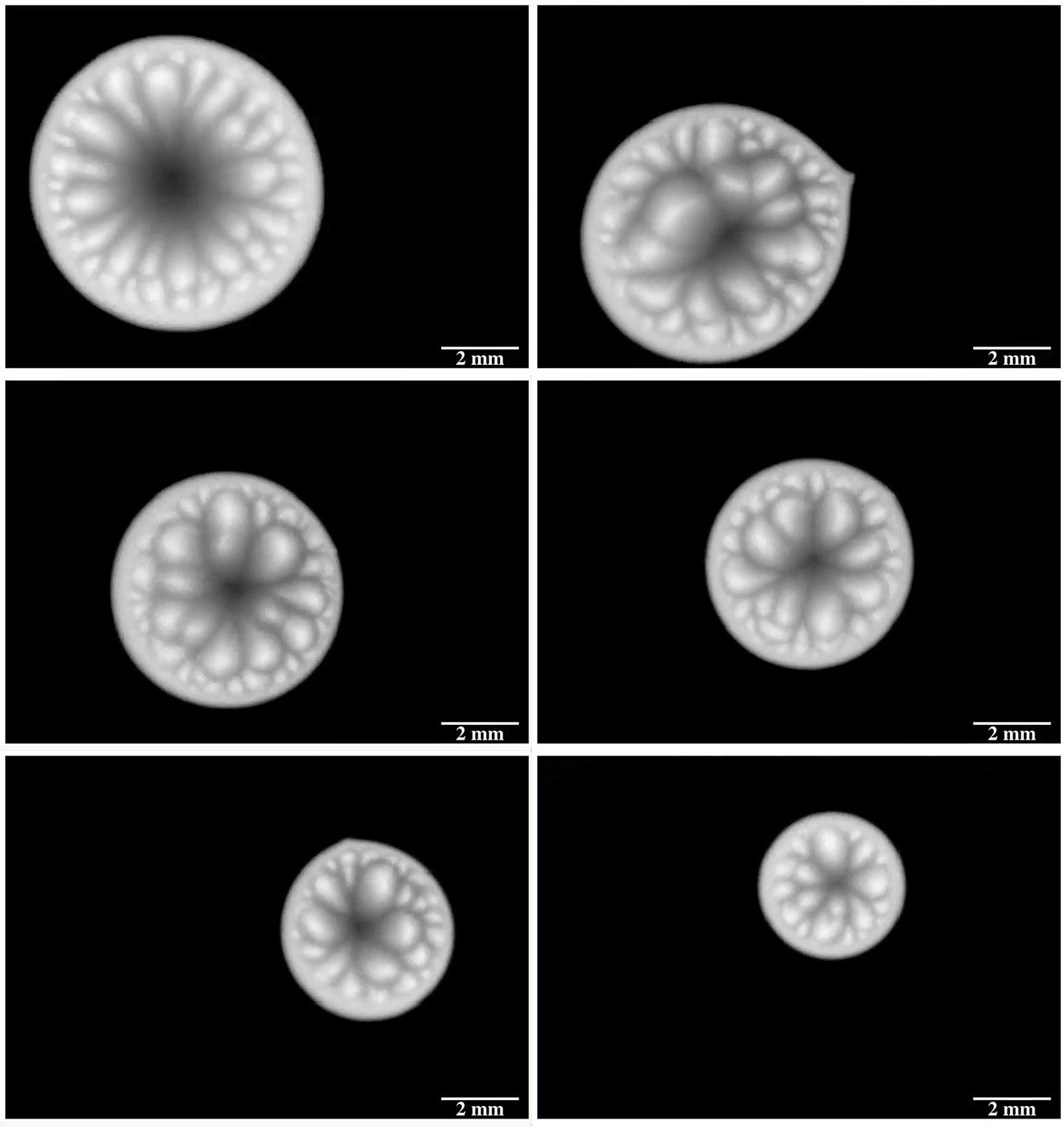
Ethanol is what’s known as a volatile liquid, meaning that it evaporates easily at room temperatures, well below its boiling point. When dropped on a uniformly heated surface above 45 degrees Celsius, the drop contracted into a hemisphere and then began to wander randomly across the surface. Researchers trained an infrared camera on the drop from below (above image), and found an unsteady, roiling motion inside the drop. These asymmetric flows, they concluded, drive the drop’s erratic self-propulsion. They suspect the mechanism may explain why some ink droplets wind up in the wrong place on a page during ink-jet printing. (Image and research credit: P. Kant et al.; via APS Physics)
In fluid dynamics, we’re often concerned with flow moving past a solid surface — air past an airplane wing, water past fish scales, oil between moving parts — and those surfaces are rarely perfectly smooth. Rough surfaces affect the flow near them, sometimes in unexpected ways. Here, researchers show a rough surface’s effect on the eddies of the atmospheric boundary layer. Put differently, this poster shows how buildings, trees, and other features influence the lowest layer of the atmosphere. From the tiny gaps between buildings to the eddies towering many times higher, the turbulence reflects roughness’s effects. (Image credit: J. Kostelecky and C. Ansorge)
It’s all blue skies in Roman De Giuli’s short film, “Perfect Sky.” Created with paint, ink, and glitter on paper, it’s a relaxing piece of fluid art. Put on your headphones, take a deep breath, and plunge in. You’ll see lots of gorgeous Marangoni effects, some low Reynolds number mixing, and various instabilities. (Video and image credit: R. De Giuli)
Earth, Saturn, and Jupiter have auroras at their poles, generated by the interaction of their global magnetic fields with the solar wind. Mars has no global magnetic field, only remnants of one frozen into areas of its crust; yet it, too, has auroras. Mars’s auroras are rarer and discrete. They occur most often over the southern hemisphere, and researchers now think they know why.
Four billion years ago, we think Mars had a global magnetic field, much like Earth does. But somehow the planet lost that field. The traces that remain are caught in the minerals of its crust, much like the ancient magnetic fields recorded in areas of the Earth’s sea floor. These magnetized regions of Mars’s crust, shown above as contours in pink and blue, are where the discrete auroras occur.
Using data from NASA’s MAVEN spacecraft, which orbits Mars, the team discovered a pattern. They found that auroras occur most often when the magnetic lines of the incoming solar wind run antiparallel to the magnetic field lines of the crust. This suggests that the auroras happen as a result of magnetic reconnection, a process where antiparallel magnetic field lines rearrange themselves, releasing energy as a result. Reconnection events provide an opportunity for electrons from the solar wind to accelerate into Mars’s atmosphere, exciting molecules there and generating the auroras. So far we’ve only caught the auroras in UV light, but hopefully one day we’ll see them in visible light as well. (Image credit: R. Lillis et al.; research credit: C. Bowers et al. and B. Johnston et al.; via APS Physics)
In fluid dynamics, researchers are often challenged with complicated, messy flows. With so much going on at once, it’s hard to work out a way to keep track of it all. Here, researchers are looking at the break-up of two colliding liquid jets. This setup is often used to break rocket fuel into droplets prior to combustion. This video shows off a new data analysis tool that lets researchers break the flow into different parts, track them in time, and extract data about the changes that happen along the way. (Video and image credit: E. Pruitt et al.)
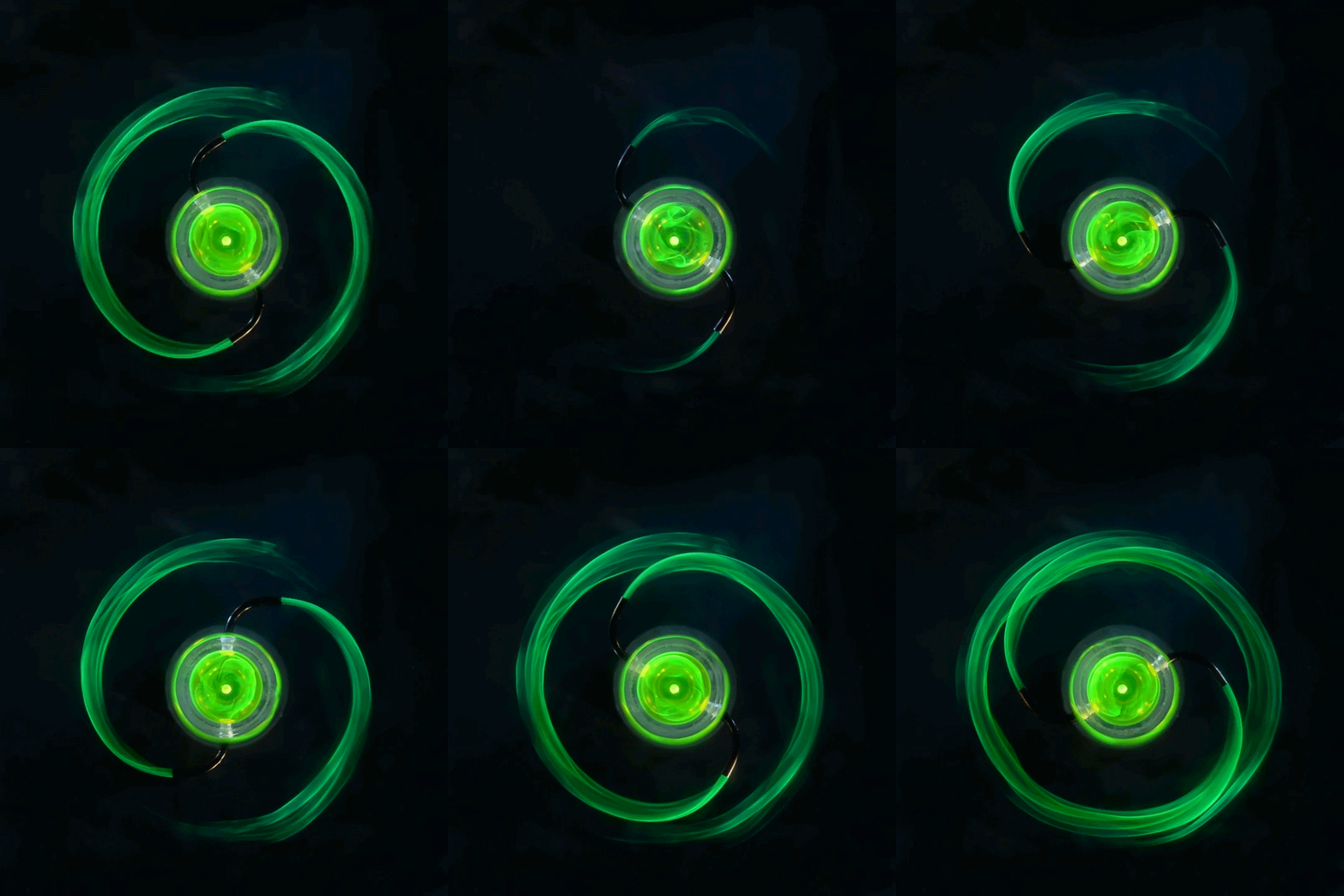
In graduate school, my advisor introduced us to a particularly vexing fluid dynamical thought experiment known as the Feynman sprinkler. After observing an S-shaped sprinkler that rotated when water shot out its arms, physicist Richard Feynman wondered what would happen if the device were placed in a tank of water with the flow reversed. If the sprinkler was sucking in water, would it rotate and, if so, in what direction?
This seemingly simple question has confounded physicists ever since, in part because you can make believable arguments for multiple different results. Attempts to build the apparatus experimentally produced differing results, too — often due to variables that don’t appear in the thought experiment, like friction in the sprinkler’s bearing. But, at long last, a group posits they have the final answer to the problem.
They cleverly built their sprinkler so that it floats in its tank, with the addition or removal of water from the sprinkler controlled by a second siphon-connected tank. With no solid-solid contacts, the sprinkler can rotate with very little friction.
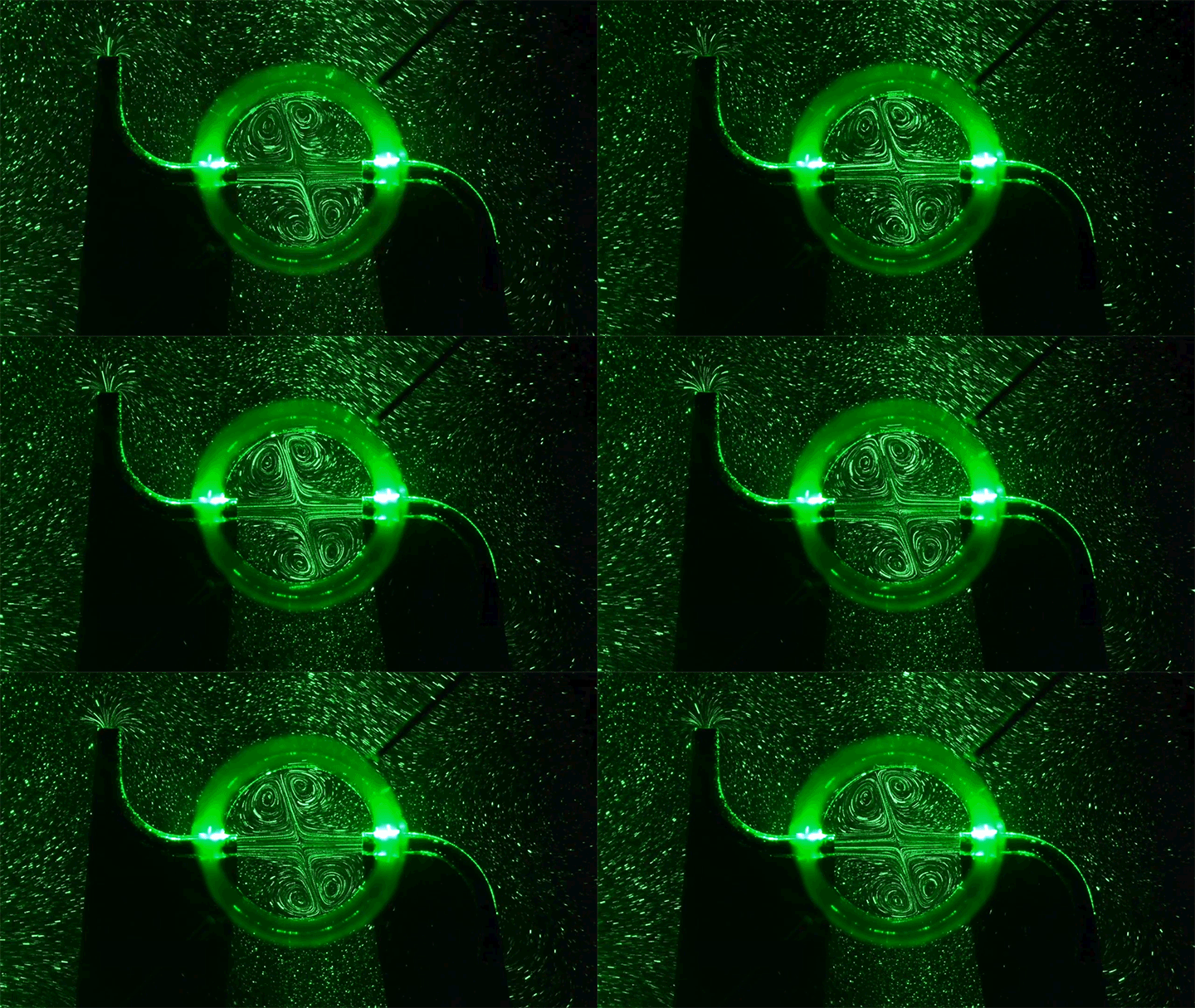
Flow visualization of the sprinkler in reverse (suction) mode. For image clarity, the device is held in place to prevent spinning. Notice how the jets coming into the hub glance off one another and form counter-rotating vortex pairs at an angle. This asymmetry is the source of the sprinkler’s rotation when allowed to move.
The team found that sucking water into the sprinkler does, indeed, reverse the sprinkler’s rotation, but it’s not a simple reversal of the forward sprinkler’s flow. To see why, check out the video above, which visualizes flow inside the sprinkler during suction. For clarity, the device is held fixed in place during flow visualization. Notice that the two arms of the sprinkler sit directly opposite one another in the hub. Thus, you’d expect their two jets to collide and form counter-rotating vortices along a vertical axis. But the vortex pairs are offset from the centerline.
This asymmetry takes place because the velocity profiles of flow across the hub inlets are skewed. Instead of the largest velocity occurring on the centerline of the inlet, each occurs slightly to one side. So when the jets collide, they do so off-center and impart a torque to the sprinkler. The reason for the skewed profiles at the inlets lies further upstream in the curved arms of the sprinkler. Centrifugal force from turning the corner leaves a mark on the flow, leading, ultimately, to the skewed velocity profiles, offset jets, and spinning sprinkler. (Image and research credit: K. Wang et al.; via APS Physics)
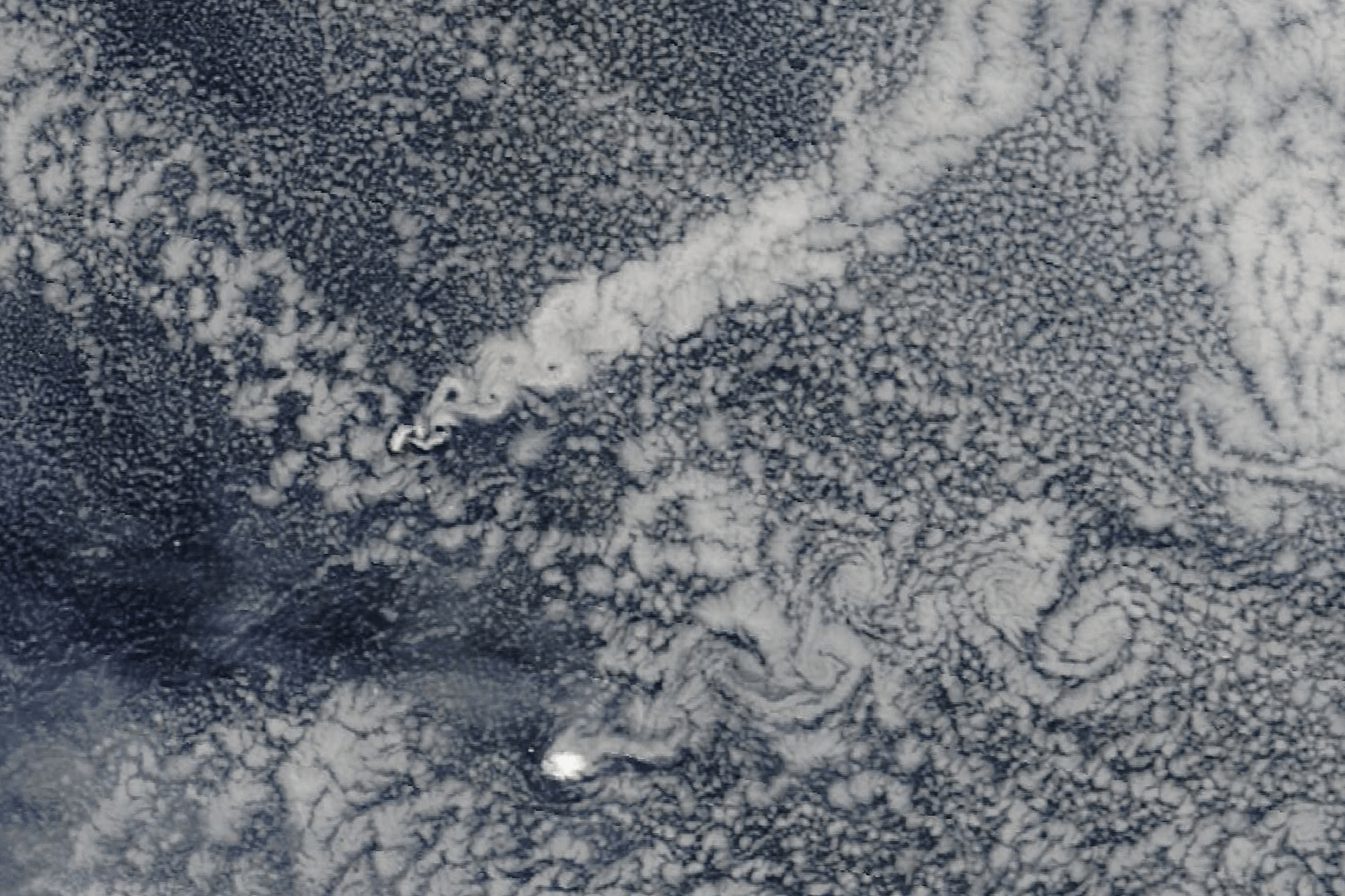
In the remote South Atlantic, north of the Antarctic Circle, sit the volcanic Zavodovski and Visokoi islands. Though only roughly 500 and 1000 meters tall, respectively, each island disrupts the atmosphere nearby, often generating cloudy wakes. In today’s pair of images, the northerly Zavodovski has a particularly bright cloud wake, thanks to sulfate aerosols degassing from its volcano, Mount Curry. Though it’s hard to pick out the effect in the natural-color image above, the false-color version below shows the bright wake clearly. The filtering on this image turns snow and ice — like that on Visokoi’s peak — red and makes the water vapor of clouds white. The sulfates from Mount Curry act as nucleii for water droplets, forming many small, reflective drops that stand out against the rest of the sky. (Image credit: W. Liang; via NASA Earth Observatory)
This false-color satellite image highlights the volcanic seeding by filtering snow and ice as red and water vapor in clouds as white.
In their natural habitat, fire ants experience frequent floods and so developed the ability to form rafts. Entire colonies will float out a flood in a two-ant-thick raft anchored to whatever vegetation they can find. Because ants in the upper layer of the raft are constantly milling about, the rafts have some ability to “self-heal” as they’re stretched.
Pulling slowly gives the ants time to “heal” their stretching raft.
In these experiments, researchers slowly (above) and quickly (below) stretched ant rafts to see how they responded. Given a slow enough stretch, the ants were able to adjust and keep the raft together until it doubled in length. In contrast, a faster stretching rate overwhelmed the raft by the time it was 30% longer. (Image credit: top – Wikimedia Commons, others – C. Chen et al.; research credit: C. Chen et al.; via APS Physics)
Pulling quickly breaks an ant raft because the ants cannot react fast enough to heal the raft.
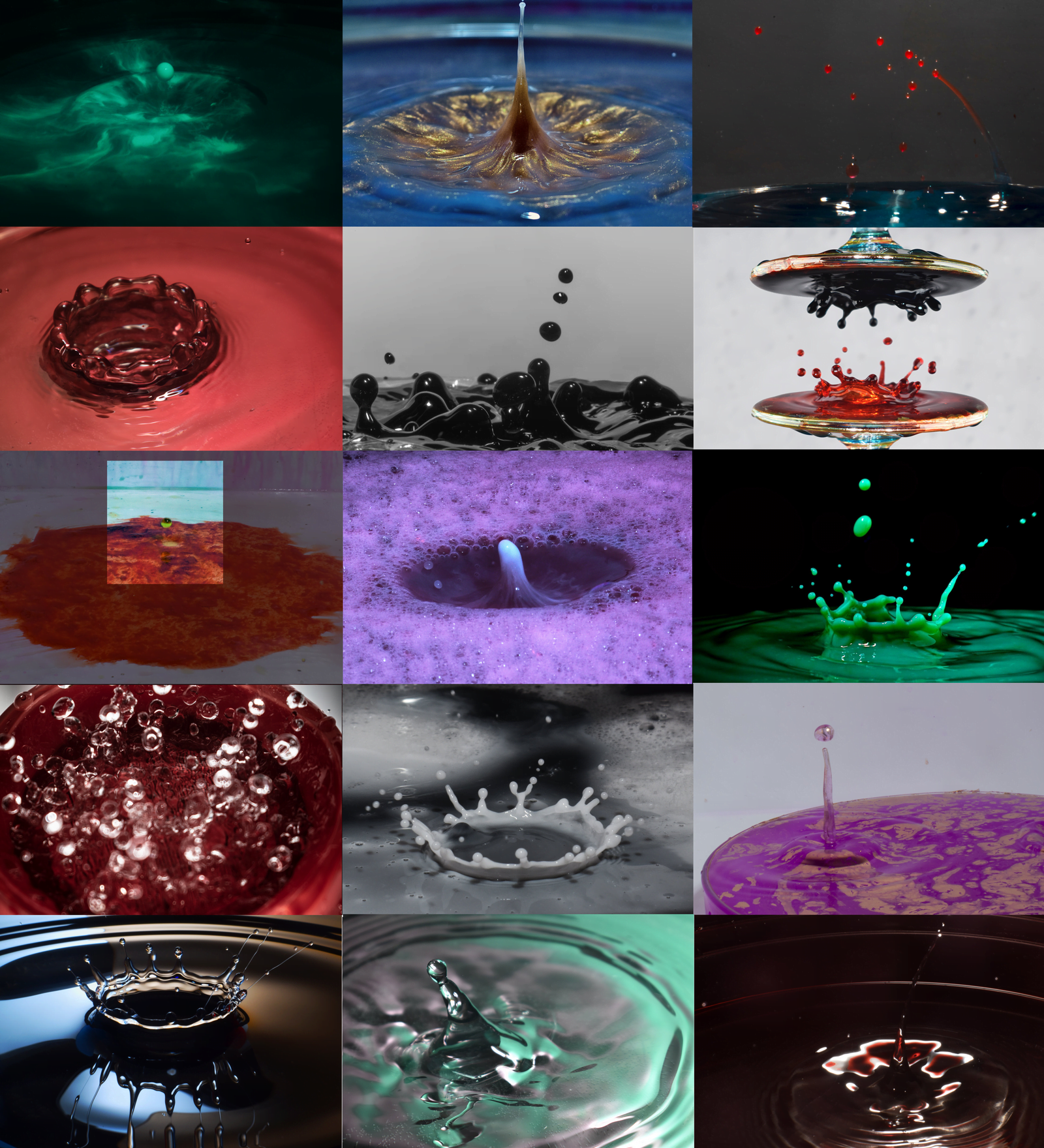
In the 1930s, Harold Edgerton used strobed lighting to capture moments too fast for the human eye, including his famous “Milk-Drop Coronet”. Recreating his set-up is far easier today, thanks to technologies like Arduino boards that make timing the drop-strobe-camera sequence simple. This poster is a collage of Edgerton-like images captured by students at Brown University. Even nearly a century after Edgerton, there are countless variations on this beautiful slice of physics: all from the splash of a simple drop striking a pool. (Image credit: R. Zenit et al.)
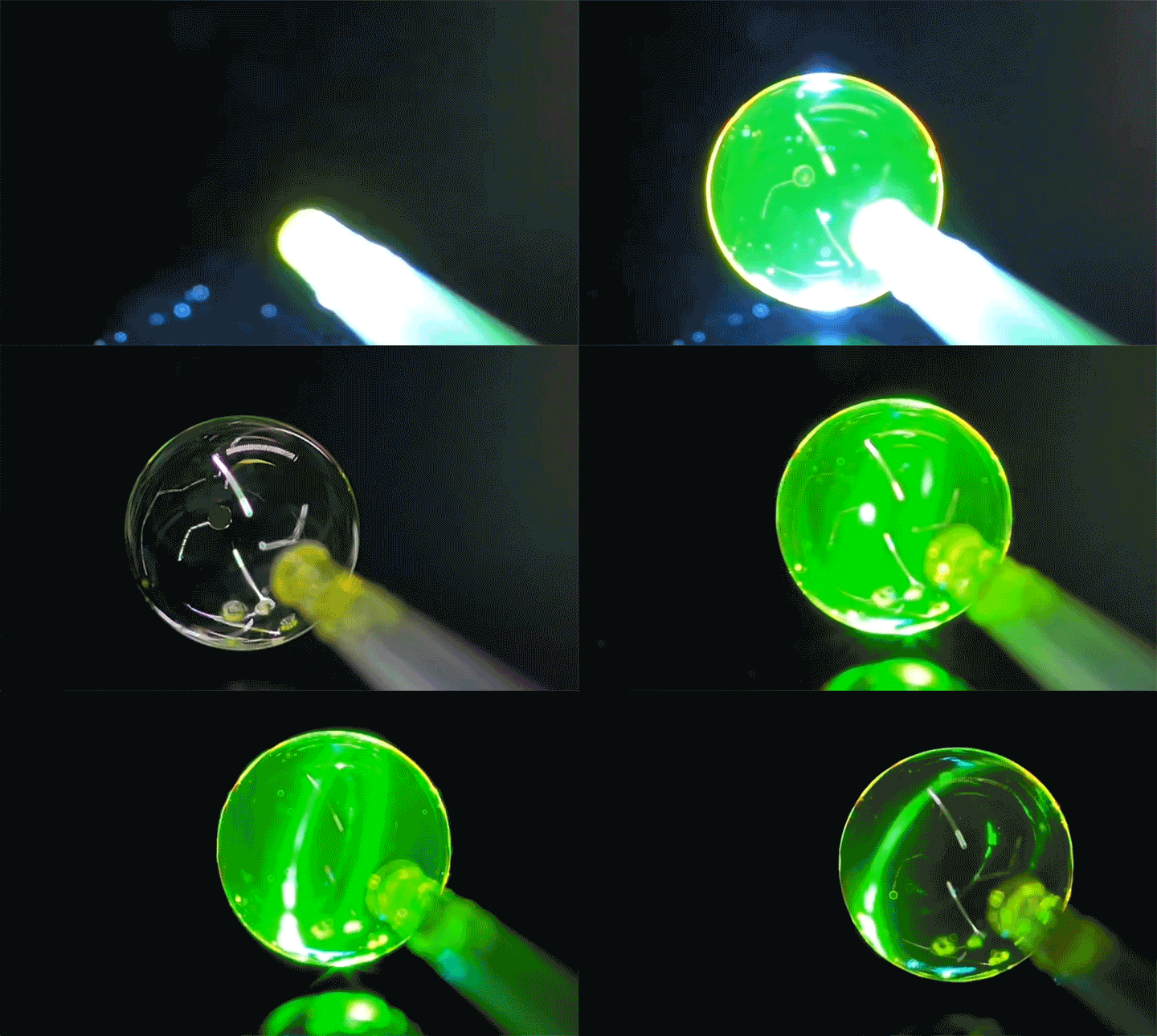
The thin shells of bubbles interact with light in fascinating ways; that is, of course, the source of their brilliant colors. In this recent study, researchers discovered that bubbles can serve as tunable lasers. A laser has three major components: an energy source, an optical resonator, and a gain medium that amplifies light in the resonator. For bubble lasers, an external pump laser provides energy and the bubble’s thin shell acts as a resonator. Fluorescent dye in the bubble serves as the gain medium.
Once formed, the bubble lasers are incredibly sensitive to electric fields and pressure changes, making them excellent sensors. For added stability, the team is using smectic liquid crystal bubbles, which, unlike soap bubbles, don’t evaporate easily. (Video, image, and research credit: Z. Korenjak and M. Humar; via APS Physics)