Computational fluid dynamics (CFD) sometimes gets a bad rep as “colorful fluid dynamics”, but as computers get faster and faster, more complicated and physically accurate simulations are possible. Shown here are simulations of vortex rings and wingtip vortices in stunningly gorgeous detail. Understanding the evolution of these vortices from a fundamental level helps fluid mechanicians design better methods of controlling them. As mentioned in the video, wingtip vortices are a particularly hazardous everyday example; the time it takes for one plane’s wingtip vortices to disperse determines how quickly the next airplane can take-off or land on that same runway. Being able to break down these vortices faster would allow more frequent use of existing facilities.
Search results for: “art”

Solar Fluid Dynamics
The sun is a wild place fluid dynamically. The surface is riddled with convection cells the size of the Earth, and prominences of plasma (ionized gas) erupt from the surface following the sun’s magnetic field lines. Violent, but beautiful. #

Aerodynamics with Bill Nye and Samuel L. Jackson
Bill Nye, Samuel Jackson, golf balls, Reynolds number, dimples, and boundary layers. It doesn’t get much better than this. – Khristopher O (submitter)
It definitely beats Jackson’s other foray into aerodynamics! The dimples on a golf ball cause turbulent boundary layers, which actually decrease drag on the ball and make it fly farther. Why bluff bodies experience a reduction in drag as speed (and thus Reynolds number) increases was a matter of great confusion for fluid mechanicians early in the twentieth century, but it’s not too hard to see why it happens with some flow visualization.


On the top sphere, the laminar boundary layer separates from the sphere just past its shoulder. This results in a pressure loss on the backside of the sphere and, thus, an increase in drag. On the bottom sphere, a trip-wire placed just before the shoulder causes a turbulent boundary layer, which separates from the sphere farther along the backside. This late separation results in a thinner wake and a smaller pressure loss behind the sphere, thereby reducing the overall drag when compared to the laminar case. (Photo credit: An Album of Fluid Motion)
Tsunami Simulation
This simulation shows how tsunami waves are expected to spread from the epicenter of the Japanese magnitude-8.9 earthquake. Note the complicated interference and reflection patterns. The main wavefront moved at a speed of about 230 m/s (830 km/h) between Japan and Hawaii.

Wright Brothers’ Wind Tunnel
A large part of the Wright Brothers’ ultimate success in creating the first powered heavier-than-air craft came as a result of work done in their homemade wind tunnel, shown above. In the aftermath of the failure of their 1901 Glider, the brothers decided that the lift and drag data they had used from Otto Lilienthal must be inaccurate. They built this wind tunnel and its force balances to measure lift and drag on two hundred different airfoils themselves and were rewarded with far more successful flights with their 1902 Glider, which led directly to the Wright Flyer in the following year. #
Pouring Paint
In this artwork by Holton Rower, paint (typically a non-Newtonian fluid) is poured down a rectangular prism; the result is a neat demonstration of shearing in laminar flows. Paint is usually shear-thinning, meaning that its viscosity decreases under shear; this is why the color stripes on the vertical panels expand more than those on the horizontal surfaces do. # (submitted by Stephan)
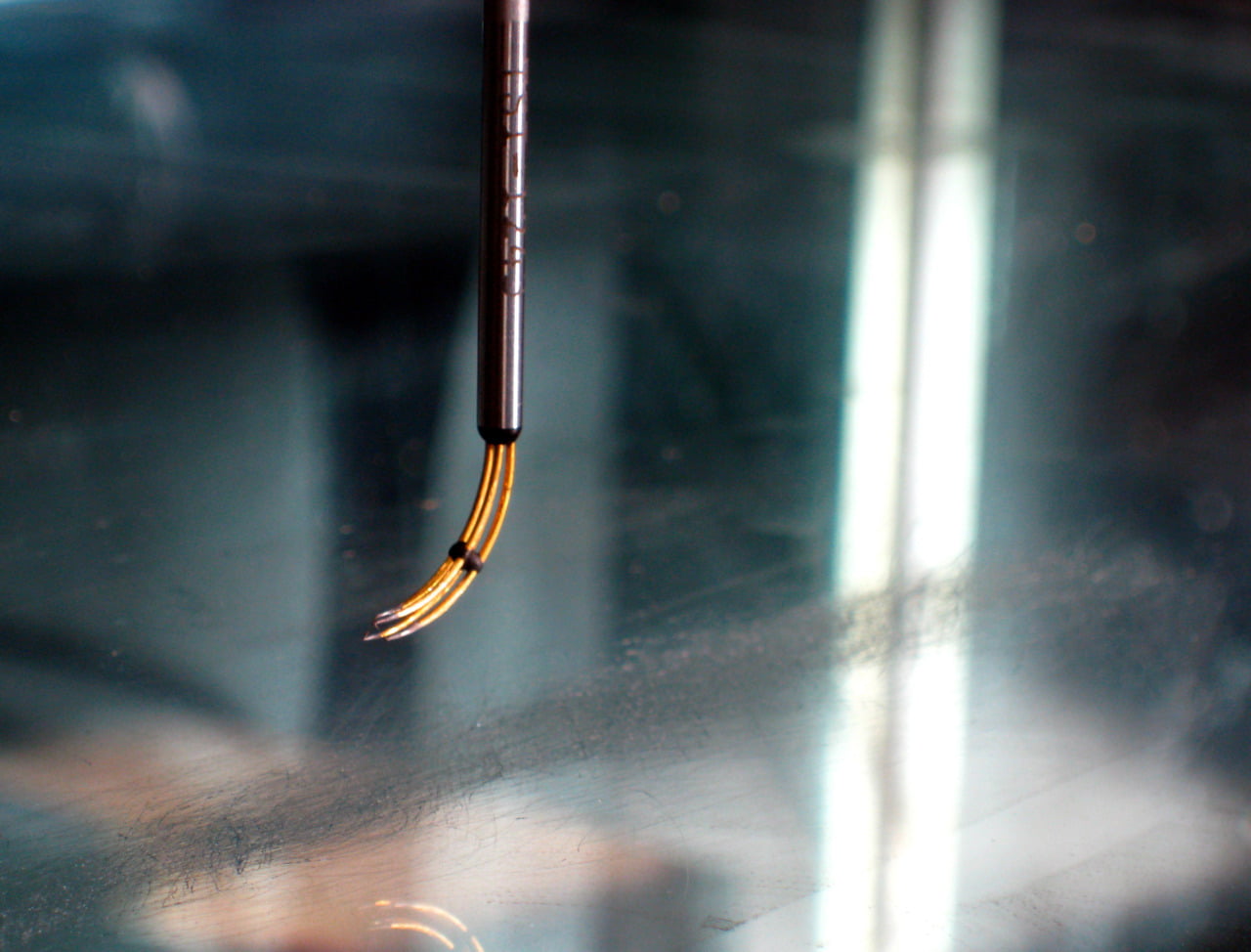
Hotwire Anemometry
Hotwire anemometry is used in experimental fluid dynamics to measure velocities with high temporal resolution. The boundary layer crosswire probe shown here was used for turbulence research. Between the prongs, which are about the thickness of a sewing needle, are tiny wires about 3 microns in diameter. A human hair is about 80 microns in diameter. Hotwires actually measure voltage; when part of an electrical circuit, the hotwire’s temperature rises above ambient. As air flows over the wire, it cools, which causes the wire’s resistance to drop. By tracking this change in resistance, it is possible to determine the speed of the air moving over the wire.

Neutron Superfluids in Stars?
This image shows a composite X-ray (red, green, and blue) and optical (gold) view of the supernova remnant Cassiopeia A, located about 11,000 light years away. At the heart of this supernova remnant is a neutron star. After ten years of observations, astronomers have found a 4% decline in the temperature of this neutron star, which cannot be accounted for in current theory. Two research teams have independently found that this cooling could be due to the star converting the neutrons in its core into a superfluid. As the neutron superfluid is formed, neutrinos are emitted; this decreases the energy in the star and causes more rapid cooling. See Wired for more. #

Swimming Sandfish Lizards
Sandfish lizards can “swim” through granular flows like sand using an undulating, sinusoidal motion. Having studied this motion, engineers have built a robot that swims similarly through large glass beads and have now created a numerical simulation of the physics that matches the measured forces on the swimmer to within 8%. This type of flow is, in some respects, tougher than actual fluids because individual particles have to followed, while in most of fluid mechanics, we can use the continuum assumption to treat a liquid or gas as a continuous medium. #
Shock Waves
Flow visualization really can be considered a form of art. Though we fluid mechanicians are looking for physics, we’re quite aware of the beauty of what we study. The clips in this video mostly show transient shockwave behavior, including lots of shock reflection and even a few instabilities. It’s unclear what the speeds are, aside from faster than sound; the medium is air.