Landslides, despite their inclusion of solid materials, function essentially as gravity-driven fluid flows. This timelapse video shows a recent earthflow in Wyoming near the Snake River. Rapid snowmelt and heavy rainfall combined to cause a seven day landslide over the highway and into the river. # (via Bad Astronomy)
Search results for: “art”

Hot Spheres Sink Faster
New research shows that the Leidenfrost effect–which causes water droplets to skitter across a hot pan–can drastically reduce the drag on objects moving through a liquid. When raised to a high enough temperature, a sphere falling water will be coated in a protective layer of vapor (see video above) that acts like a lubricant as the sphere moves through the water. If the temperature of the object drops too low, the vapor layer will dissolve into a mess of bubbles (~35 secs into video). One way that this mechanism reduces drag is by keeping flow attached to the sphere for longer as shown in this video. Preventing this flow separation increases the pressure recovered after the point of lowest pressure (the shoulders of the sphere), which reduces overall drag.
See also:
- PRL Article and Supplemental Materials
- Wired article
- The Photonist
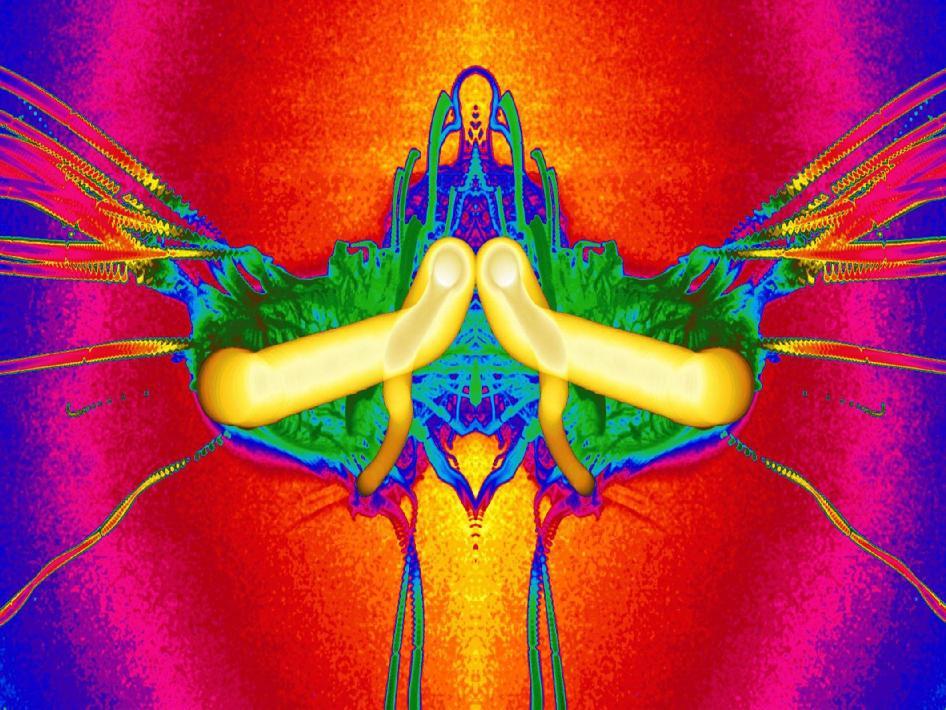
Microgravity Combustion
Combustion in microgravity is markedly different than that on earth, due to a lack of buoyant convection. The combustion of a droplet of heptane is shown here as a composite image. The bright yellow structure shows the path of the droplet, which gets smaller as it burns. The green structures show the initial development of soot, which eventually streams outward as long streaks. # (submitted by jshoer)
Viscous Fingers
The Saffman-Taylor instability occurs when a less viscous fluid is injected into a more viscous one, usually in a Hele-Shaw cell. Here oil paint and mineral spirits were painted onto flat surfaces that were pressed together before being pulled apart. The result is viscous fingering of the fluids. #
Volcanic Ash Plume
Video footage of Iceland’s Grimsvotn volcano erupting shows a massive turbulent plume of ash. The largest scales of the plume are of the order of hundreds, if not thousands of meters, and the eddies of the plume appear to move very slowly, especially far from the base. According to Kolmogorov, however, at the smallest scales of the flow (< 1 mm), the turbulent motions are isotropic. No one has been able to achieve Reynolds numbers high enough to fully prove or disprove Kolmogorov’s hypothesis, but natural events like volcanic eruptions produce some of the largest Reynolds numbers on earth. (See also: interview with videographer; via Gizmodo, jshoer)
Flowing Up a Waterfall
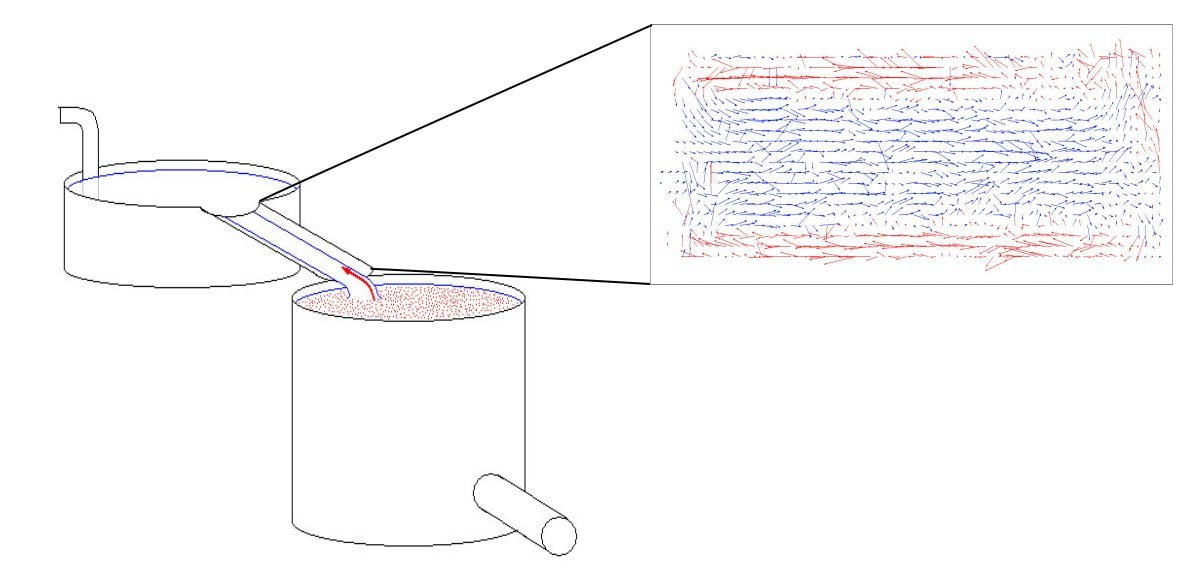
Tea-drinking physicists found that it’s possible for particles to flow up a short (< 1 cm) waterfall to contaminate pure upstream sources. Their apparatus is shown above, along with an inset showing the velocity field on the surface of the channel. The blue arrows indicate flow downstream and the red arrows indicate counterflow that carries particles upstream. The researchers suspect that Marangoni effects may play a role in setting up the counterflow. The finding could have implications for pollution control and manufacturing. # (submitted by Gabe)

Upside-Down Umbrellas
When a heavier fluid is suspended over a lighter fluid (as with ink or food coloring in water), the interface between fluids is subject to the Rayleigh-Taylor instability. As the heavier fluid starts to sink, it forms “fingers”, which develop into mushroom-cap shapes as the fluid continues falling. Sometimes the shear stress between the heavier fluid and lighter fluid causes secondary Kelvin-Helmholtz instabilities as well. (Photo by Leonardo Aguiar)

Rocket Exhaust
This image of the Apollo 11 launch shows the Saturn V’s underexpanded nozzle (identifiable by the excessive width of the exhaust jet) shortly after liftoff. The faint diamond shape of the exhaust is a series of shock waves and expansion fans that equalize the exhaust pressure to the ambient. In general, a rocket nozzle is most efficient when it expands the exhaust to ambient pressure, but, since ambient pressure changes with altitude, designers have to choose a particular altitude for peak efficiency or design a nozzle capable of changing its shape with altitude.
Reynolds on Transition
For although only the disciplined motion is recognized in military tactics, troops have another manner of motion when anything disturbs their order. And this is precisely how it is with water: it will move in a perfectly direct disciplined manner under some circumstances, while under others it becomes a mass of eddies and cross streams, which may be well likened to the motion of a whirling, struggling mob where each individual particle is obstructing the others. The larger the army, and the more rapid the evolutions, the greater the chance of disorder; so with fluid, the larger the channel, and the greater the velocity, the more chance of eddies.
Laminar Flow Control
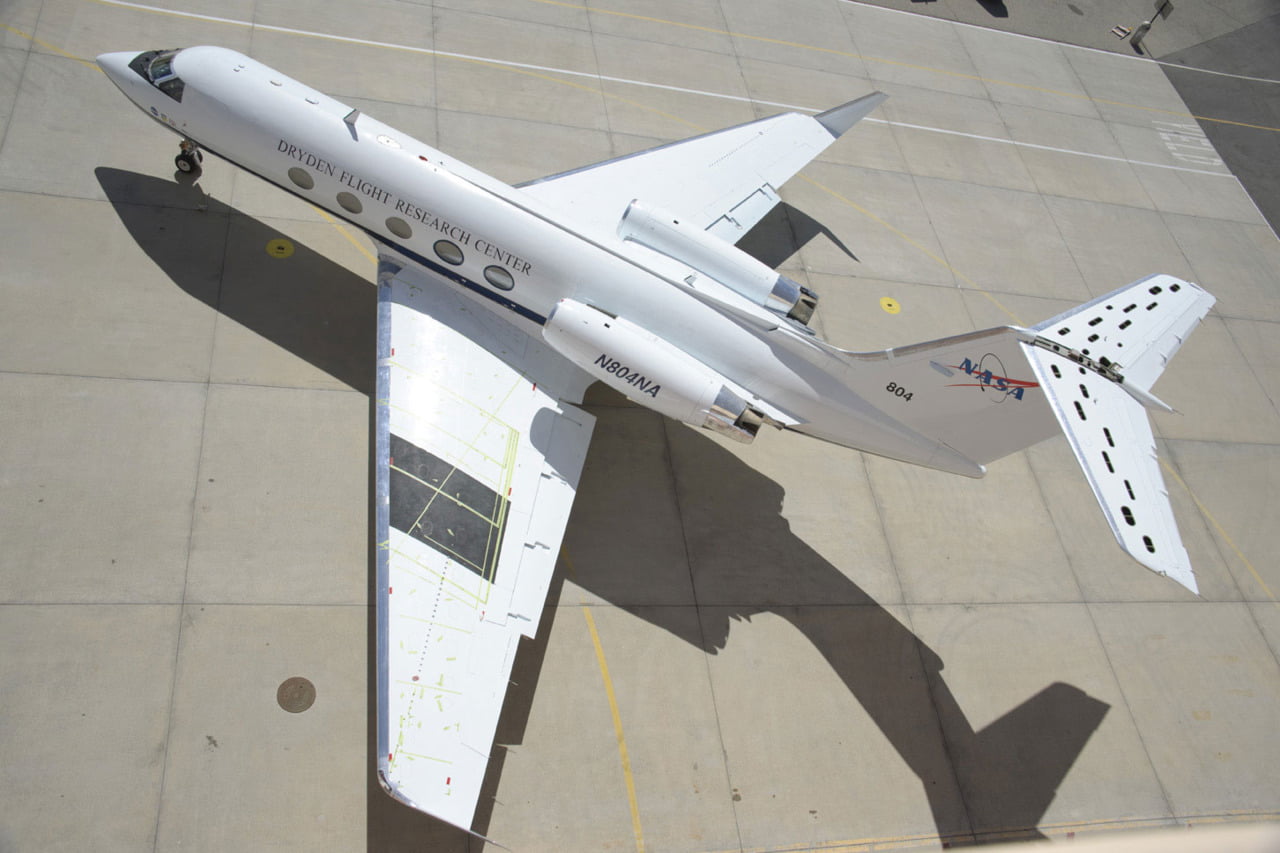
On Wednesday, March 30, 2011 at 3:00 EDT NASA engineers are holding an online chat about a current project to achieve laminar flow control on business jet-class airplanes. Keeping flow over an airplane’s wings laminar could decrease the total drag on an airplane by as much as 15%. In particular, this project involves placing tiny hockey-puck-shaped discrete roughness elements (DREs) along the front of the wing. These DREs are positioned such that they perturb the mean-flow over the wing at a higher frequency than the naturally most unstable frequency; as a result, flow actually remains laminar over a greater extent of the wing than would normally be the case. For more on the technical ideas, see this NASA blog post or feel free to ask questions in the comments. #
Full disclosure: This project is being conducted in joint with professors with whom I work, and the subject matter is related to my own research.
