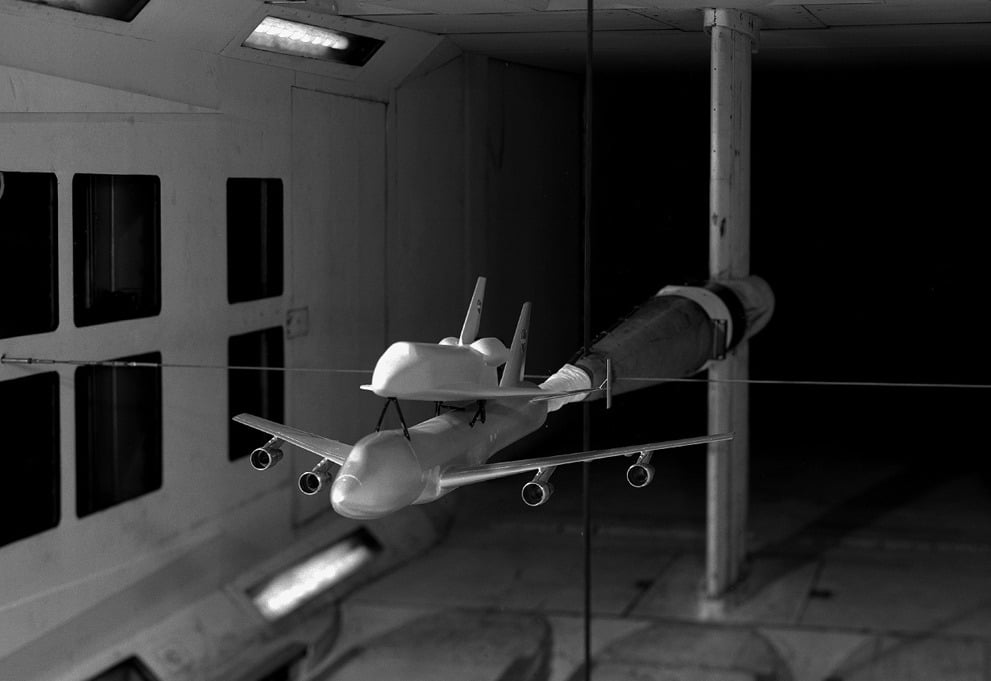
The pterosaur was an enormous prehistoric reptile that flew with wings of living membrane stretched over a single long bone, unlike any of today’s flying creatures. New research using carbon fiber wing analogues and wind tunnel testing suggests that the pterosaur would have been a slow, soaring flyer well adapted to using thermals for lift. Once on a thermal, the pterosaur could coast, perhaps for hours at a time, with little to no flapping necessary. See the research paper or the Scientific American article for more. #
Search results for: “art”

Calcium Plasma on the Sun
This high-resolution photo of our sun shows the structure of calcium plasma on the surface of the sun. Plasmas are governed by the same physics as our familiar earthbound fluids but are also extremely sensitive to magnetic fields. Their branch of fluid dynamics is often referred to as magnetohydrodynamics (MHD), where the Navier-Stokes equations have to be solved in conjunction with Maxwell’s equations. (via Bad Astronomy)

Oil Chandeliers
What you see above is a composite of images of an oil droplet falling into alcohol from two different heights. The top row of images is from a height of 25 mm and the bottom from a height of 50 mm. The first droplet forms an expanding vortex ring which breaks down via the Rayleigh-Taylor instability due to its greater density than the surrounding alcohol. The second droplet impacts the alcohol with greater momentum and is initially deformed by viscous shear forces. Eventually it, too, breaks down by the Rayleigh-Taylor mechanism. This image is part of the 2010 Gallery of Fluid Motion. # (PDF)

Swimming in Corn Syrup
Highly viscous laminar flows exhibit kinematic reversibility, meaning: if you move the fluid one direction and then execute the same motion in the opposite direction, every fluid particle will return to its initial, undisturbed position. Above, you see a swimming device attempting to move through corn syrup by flapping. Because of this kinematic reversibility, it cannot propel itself. For the same reason, many microscopic organisms do not utilize flapping to move.

How Cats Drink
While humans use suction and dogs scoop water using their tongues*, cats use a dainty fluid mechanism to drink. Researchers used high-speed video to find that cats drink by touching the surface of their tongue to the water and drawing their tongue rapidly back into their mouth. Friction between their tongue and the water creates a fluid column about which the cat closes its jaw before gravity breaks off the column. They also built an artificial tongue to test different frequencies and found an optimal lapping frequency dependent upon the mass of the feline.
- Reis et al. in Science (11/11/10 edition)
- Wired article
- Scientific American article
*ETA: More recent research show that dogs actually use the same technique as cats, not a scooping method.
(Image credit: P. Reis et al.)

Physics Tattoos
This is a man with great commitment to fluid dynamics. He writes:
This, on my leg, is the incompressible form of the conservation of mass equation in a fluid, also known as the continuity equation. When people ask what it means, I say it defines flow. Sometimes I say it means you should have studied more physics, but that is only when I am feeling like being funny. What it means in more detail is that, for an incompressible fluid, the partial derivative of the velocity of the fluid in the three spatial dimensions must sum to zero. It therefore concisely states the fundamental nature of a fluid. #
(via physicsphysics)

Morpho Towers
Artists Sachiko Kodama and Yasushi Miyajima use ferrofluids and magnetic fields to create their “Morpho Towers – Two Standing Spirals” artwork. Ferrofluids are formed from a suspension of ferrous material in a oil or water and are a popular subject for fluid dynamics as art. You can even make your own ferrofluid at home. (via ageekmom)

Flow Visualization
This video, created by undergraduates as part of a fluid dynamics laboratory course, shows flow visualization of a von Karman vortex street in the wake of a cylinder in comparison to a computational fluid dynamics (CFD) simulation of the same phenomenon. If you’re wondering about the black-and-white segments and the peculiar speech patterns, look no further. The students are parodying a series of videos made by MIT in the 1960s that are still used in classrooms today.

Water Balloon Photography
Photographer Edward Horsford uses high-speed photography to capture water balloons as they burst. On Earth, of course, gravity wins over surface tension, but the results are very different in microgravity. See the technical description for how Horsford gets his shots and look at more of his work on Flickr. (via NPR)