
The spray thrown up by a rolling tire is simulated in the lab by running a single-grooved tire (top) against a smooth tire (bottom) that simulates the road. A supply of water flows from the left at the speed of the rolling tires (6 m/s). The resultant sheet of water is a familiar site to motorists everywhere. Holes in the the sheet of water collide to form the smallest droplets, whose diameters are comparable to the thickness of the sheet, of the order of 100 microns. Thicker parts of the sheet form ligaments and break down into large droplets through the Plateau-Rayleigh instability. (Photo credit: Dennis Plocher, Fred Browand and Charles Radovich) #
Search results for: “art”

Guinness Physics
Take a look at the physics of a pint of Guinness, including the formation of foam, the circulation of bubbles, and the importance of nitrogen and surfactants. The Physics of Fluids paper the host refers to is available here. (And, yes, I will admit to debating the physics occurring in my pint glass while in a pub.) # (via Martin)

Fluid Sculpture
Droplet collisions captured instantaneously create beautiful fluid sculptures that, though common, are too fast for the human eye. Here a bubble was blown onto the surface of the fluid, then a droplet was released to fall into the center of the bubble, bursting it. As that droplet rebounded in a Worthington jet, a second droplet was released and impacted the jet, creating the umbrella-like shape in the center. See Liquid Droplet Art for more photos. (Photo credit: Corrie White and Igor Kliakhandler) #
“Compressed 02”
This timelapse video shows the spreading of food coloring and a ferrofluid through soap suds surrounding a magnet. Capillary action, the same force that enables sap to flow up through a tree against gravity, helps draw the fluids through the interfaces between the soap bubbles without disturbing the suds. The magnet’s field provides a preferred direction for the ferrofluid flow. (via Gizmodo)

Hurricane Irene
This August 25th satellite image shows Hurricane Irene over the Bahamas and Florida. Hurricanes are fueled largely by the release of heat as warm water vapor in the rising air condenses. The hurricane requires a body of warm water to sustain the process, which is why hurricanes weaken drastically after they make landfall. Over open water, the heat released by condensation fuels higher winds, which lowers the pressure at the center of the system and helps increase the rate of evaporation near the ocean surface, providing additional warm vapor for future condensation. See more photos of Irene from space, along with video from the ISS. #
Feynman: The Universe in a Glass of Wine
Some wisdom for you this Friday from the incomparable Richard Feynman:
A poet I think it is who once said the whole universe is in a glass of wine. I don’t think we’ll ever know in what sense he meant that for the poets don’t write to be understood. But it is true that if you look at a glass of wine closely enough, you’ll see the entire universe.
There are the things of physics: the twisting liquid, the reflections in the glass, and our imagination adds the atoms. It evaporates, depending on the wind and weather. The glass is a distillation of the earth’s rocks and in its composition, as we’ve seen, the secret of the universe’s age and the evolution of the stars. What strange array of chemicals are in a wine? How did they come to be? There are the ferments, the enzymes, the substrates and the products, and there in wine was found great generalization: all life is fermentation. Nor can you discover the chemistry of wine without discovering, as did Pasteur, the cause of much disease. How vivid is the claret, pressing its existence into the consciousness that watches it?
And if our small minds for some convenience divides this glass of wine, this universe, into parts: to physics, biology, geology, astronomy, psychology and all, remember that nature doesn’t know it. So we should put it all back together and not forget at last what it’s for. Let it give us one final pleasure more: drink it up and forget about it all.
(submitted by @jerrodh)
How Coffee Rings Form
Coffee rings (an ubiquitous feature of academia) are formed by the deposition of particles as the liquid evaporates. When a coffee drop evaporates, capillary action draws the coffee particles toward the edges of the drop, where they congregate into a ring. Research now suggests that this is due to the spherical nature of the particles. Ellipsoidal particles, in contrast, clump together and result in a uniform stain once their carrier liquid evaporates. The effect seems to be due to the particles’ effects on surface tension; the ellipsoidal particles deform the surface of the droplet as it evaporates such that they are not pulled to the edges. Adding a surfactant, like soap, that decreases surface tension caused the ellipsoidal particles to form rings just as the spherical particles do. (submitted by Neil K) #
Underwater Cloaking
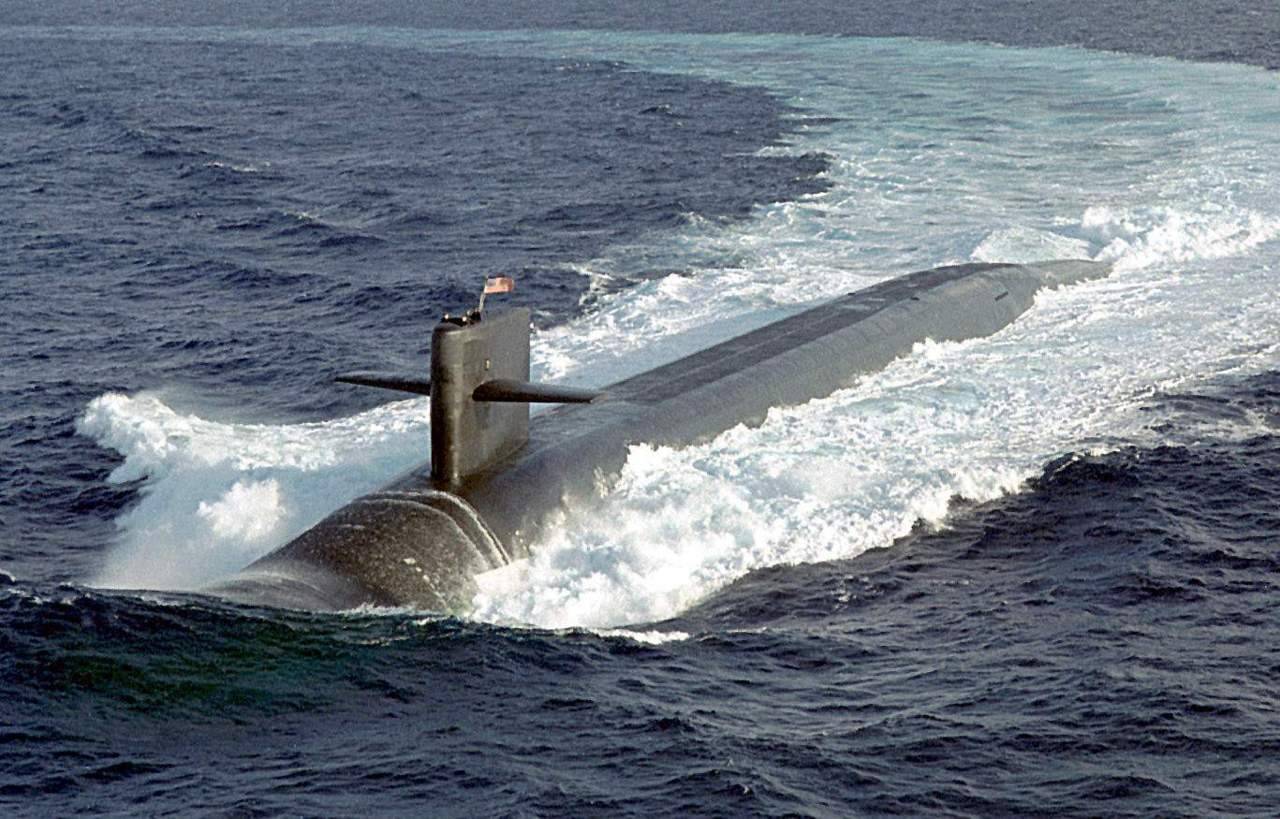
Researchers have suggested that it may be possible to cloak submerged objects as they move through a fluid using layers of mesh and micro-pumps. By redirecting the fluid so that it enters and leaves the mesh surrounding the object in the same speed and direction that it entered, it is theoretically possible to have zero drag and no wake. So far researchers have only simulated this set-up computationally using a sphere with 10 layers of mesh. It’s also unfortunately limited in size and speed: a vehicle 1 cm across could only remain wake-free at speeds below 1 cm/s. (Photo credit: Michael J Rinaldi) #
Spiky Ferrofluid
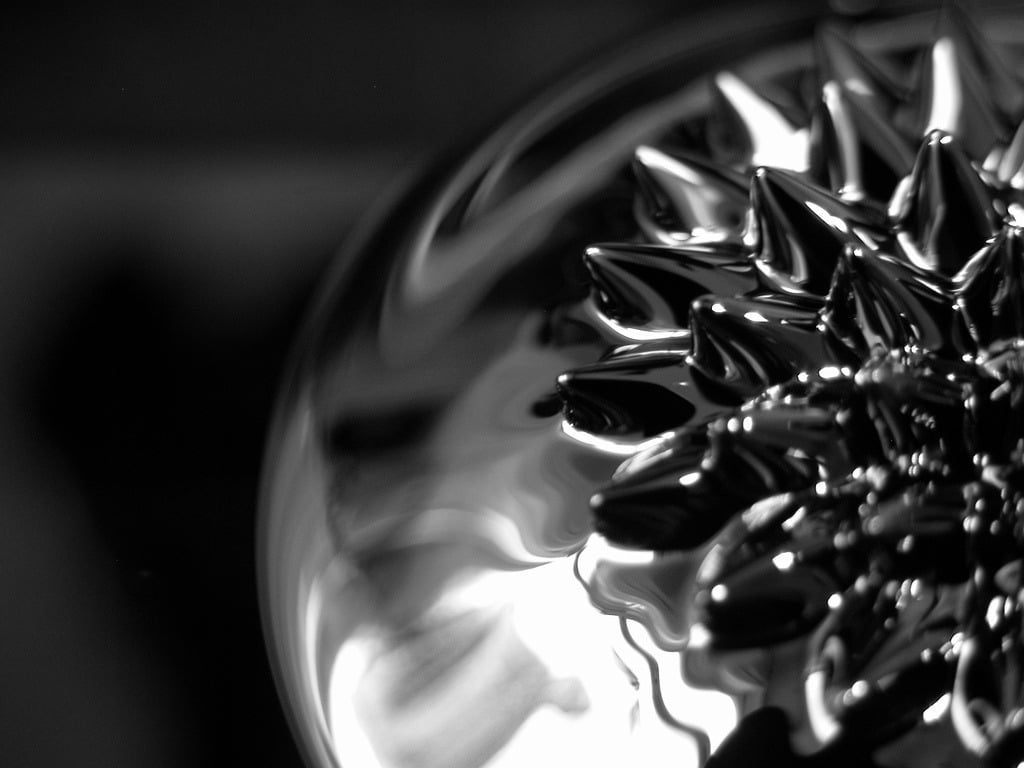
Ferrofluids consist of ferromagnetic nanoparticles suspended in a fluid. When subjected to strong magnetic fields, they develop a distinctive peak-and-valley formation due to the normal-field instability. The shape is a result of minimizing the magnetic energy of the fluid. Both gravity and surface tension resist the formation of these peaks. Ferrofluids, in addition to appearing in art exhibits, can be used as liquid seals, MRI contrast agents, and loudspeaker cooling fluids. (Photo credit: Maurizio Mucciola)
The Spinning Underwater Vortex
Vortex rings are a topic we’ve covered before with dolphins, whales, humans, volcanoes and even moss, but this video is particularly fun thanks to the addition of a bottle cap. By sticking the bottle cap next to the ring, these swimmers are able to demonstrate the forceful spinning of the fluid near the vortex. This spinning is what helps the vortex hold its shape over distances much larger than its diameter. As you can also see, though, sticking a bottle cap in the ring causes it to break up faster than it would otherwise! (submitted by Kris S)
.jpg)