
Everyone knows the familiar plonk of a stone falling into a pond but few realize the complexity of the physics. When a solid object falls into a pool, a sheet of liquid, the crown splash, is sent upward. Simultaneously, the object pulls a cavity of air down with it. As the water moves inward, this cavity is pinched, creating an hourglass-like shape reminiscent of the shape of a rocket’s nozzle. As the diameter of that pinched cavity shrinks, the velocity of the upward escaping air increases, resulting in the formation of an air jet moving faster than the speed of sound. This air jet is followed by a slower liquid jet that may rebound to a height higher than then original height of the dropped object. So next time you throw a stone into a pond, enjoy the knowledge that you’ve broken the sound barrier. (Photo credit: D. van der Meer; see also Physics World)
Search results for: “art”

Creating Lava
In Syracuse, NY, artists and scientists work together to study volcanic flows by melting crushed basalt in a special furnace before releasing the lava into the parking lot. This particular flow is very prone to boiling behavior, likely because of the cold air and ground temperatures (less than 0 C). The outer layers of rock cool quickly, leaving bubble-shaped chambers which hotter lava can fill before melting out. (via It’s Okay To Be Smart; submitted by @jpshoer)

Homemade Astronomy
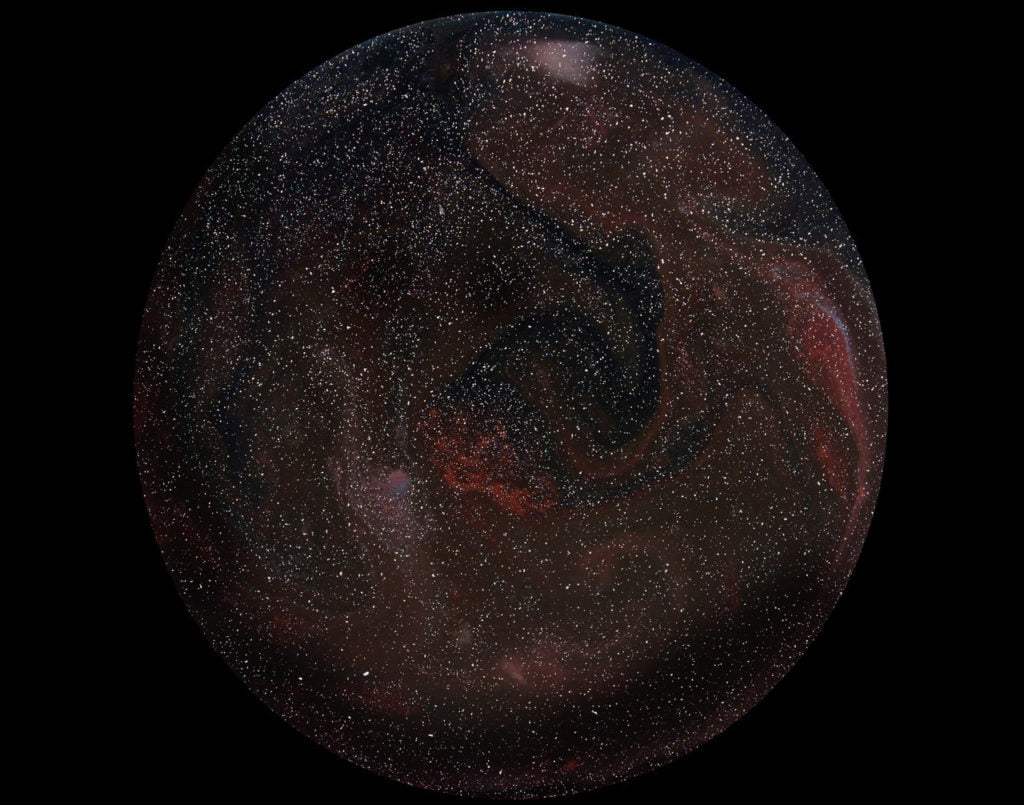


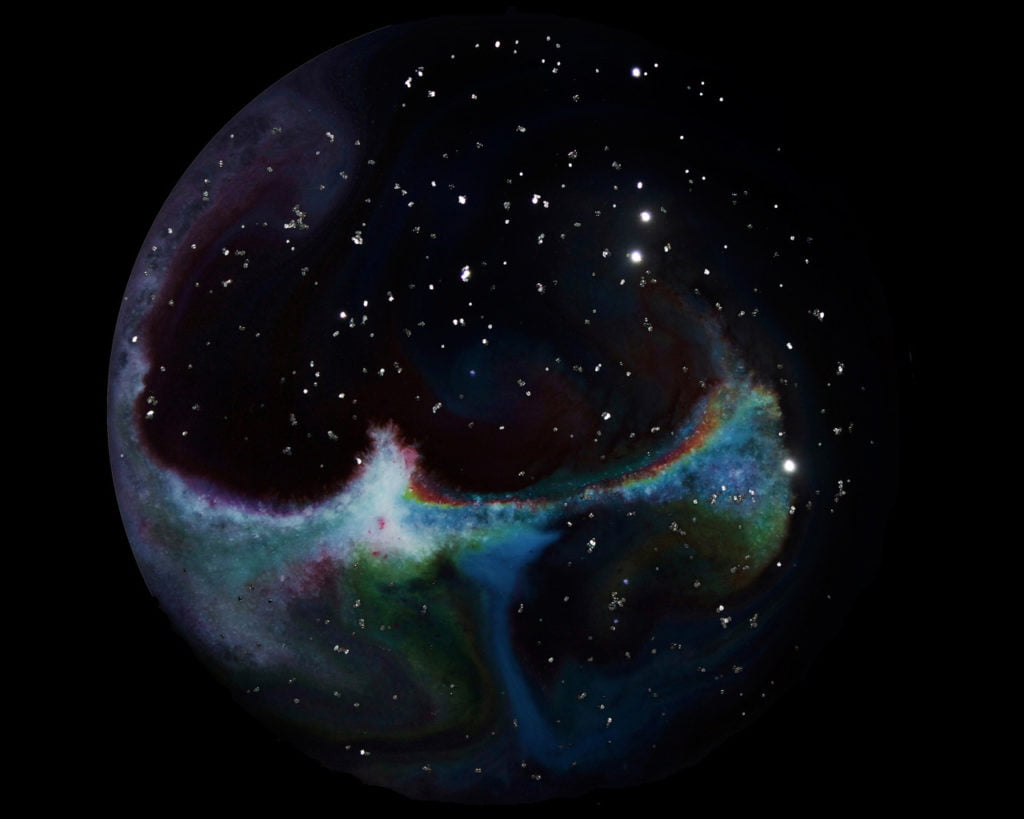


Artist Julia Cuddy uses liquids, soaps, and glitter to create photographs that replicate the look of deep space astronomy. By adding soap to the dyes, she uses Marangoni effects to drive surface tension instabilities that cause swirling colors and motions reminiscent of galaxies and nebulae. Although I’ve seen fluid dynamics used in art before, this may be one of the cleverest usages I’ve seen! (Photo credits: Julia Cuddy)
Fractal Fluids
Part of the beauty of numerical simulation is its ability to explore the physics of a situation that would difficult or impossible to create experimentally. Here the Rayleigh-Taylor instability–which occurs when a heavier fluid sits atop a lighter fluid–is simulated in two-dimensions. Viscosity and diffusion are set extremely low in the simulation; this is why we see intricate fractal-like structures at many scales rather than the simulation quickly fading into gray. (The low diffusion is also what causes the numerical instabilities in the last couple seconds of video.) The final result is both physics and art. (Video credit: Mark Stock)

Flapping Flags
The flapping of flexible objects like flags have long fascinated mankind. The figure above from Shelley and Zhang 2011 shows several possible flapping states. In (a) a thread immersed in a running soap film displays the standard von Karman vortex street of shed vortices in its wake. Parts (b) and © show the thread in coherent flapping motion; (b) shows an snapshot of the flapping thread in the soap film whereas © is a timelapse of the thread showing its full range of motion. Image (d) shows the effects of a higher flow speed–the flapping motion becomes aperiodic. Image (e) shows a stiff metal wire bent into the shape of a flapping filament; note the strong boundary layer separation around the wire compared to the thread in Image (b). As one might expect, the drag on the unflapping wire is significantly greater than the drag on the flapping thread. (Image credit: M. Shelley and J. Zhang, Shelley and Zhang 2011)
Astro Puffs
Microgravity continues to be a fascinating playground for observing surface tension effects on the macroscale without pesky gravity getting in the way. Here astronaut Don Pettit has created a sphere of water, which he then strikes with a jet of air from a syringe. Initially, the momentum from the jet of air creates a sharp cavity in the water, which rebounds into a jet of water that ejects one or more satellite drops. Surface waves and inertial waves (inside the water sphere) reflect back and forth until the fluid comes to rest as a sphere once more. Note how similar the behavior is to the pinch-off of a water column. Both effects are dominated by surface tension, but on Earth we can only see this behavior with extremely small droplets and high-speed cameras! (Video credit: Don Pettit, Science Off the Sphere)
Vortex Cross-Sections

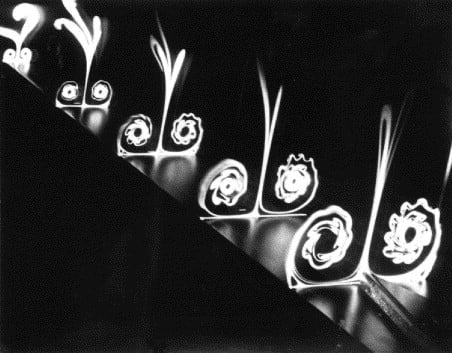
The photos above show cross-sections through the leading edge vortices on a highly swept delta wing at angle of attack. Flow in the photos is from the upper left to lower right. Notice how the vortices grow and develop waviness as they move downstream. When perturbations enter the vortex–for example, due to the shear between the vortex fluid and the freestream–some will grow and eventually cause a break down to turbulence, as in the lower picture. (Photo credits: R. Nelson and A. Pelletier)

London 2012: Discus Physics


Like the javelin, the discus throw is an athletic event dating back to the ancient Olympics. Competitors are limited to a 2.5 m circle from which they throw, leading to the sometimes elaborate forms used by athletes to generate a large velocity and angular momentum upon release. The flight of the discus is significantly dependent on aerodynamics, as the discus flies at an angle of attack. Spin helps stabilize its flight both dynamically and by creating a turbulent boundary layer along the surface which helps prevent separation and stall. Unlike many other events, a headwind is actually advantageous in the discus throw because it increases the relative velocity between the airflow and the discus, thereby increasing lift. The headwind also increases the drag force on the discus, but research shows the benefits of the increased lift outweigh the effects of increased drag, so much so that a discus flies further in air than it would in a vacuum. (Photo credits: P Kopczynski, Wiki Commons, EPA/K Okten)
FYFD is celebrating the Olympics by featuring the fluid dynamics of sports. Check out our previous posts, including why corner kicks swerve, what makes a pool fast, how an arrow flies, and how divers avoid splash.
London 2012: Soccer Aerodynamics
Corner kicks and free kicks are tough to defend in football (soccer for Americans) because the ball’s trajectory can curve in a non-intuitive fashion. Known as the Magnus effect, the fluid dynamics around a spinning ball cause this curvature in the flight path. When an object spins while moving through the fluid, it drags the air near the surface with it. On one side of the spinning ball, the motion opposes the direction of freestream airflow, causing a lower relative velocity, and on the opposite side, the spin adds to the airflow, creating a higher velocity. According to Bernoulli’s principle, this causes a lower pressure on the side of the ball spinning with the flow and a higher pressure on other side. This difference in pressure results in a force acting perpendicular to the direction of travel, causing the unexpected curvature in the football’s path. In the case of the corner kick above, the player kicks the ball from the right side, imparting an anti-clockwise spin when viewed from above. As the ball travels past the goal, air is moving faster over the side nearest the goal and slower on the opposite side. The difference in velocities, and thus pressures, creates the sideways force that drives the ball into the goal even without touching another player. The same effect is used in many other sports to complicate play and confuse opponents. In tennis and volleyball, for example, topspin is used to make the ball drop quickly after passing the net.
ETA: Check out this other great example of a free kick sent in by reader amphinomos.
FYFD is celebrating the Olympics by featuring the fluid dynamics of sport. Check out some of our previous posts including the flight of a javelin, how divers reduce splash, and what makes a racing hull fast.

London 2012: Javelin Physics


Few Olympic events can boast as long as history as the javelin. Though the event has existed since the ancient Olympics, humans and our ancestors have been throwing spears for hundreds of millennia. But today’s javelin, oddly enough, is designed so that it cannot be thrown as far as those that came before. After a world record throw in 1984 that nearly reached the edge of the track, the sport’s governing body authorized new rules that shifted the weight of the javelin forward, causing the center of mass of the javelin to lie in front of its center of pressure. This causes the javelin to tip forward in flight, ensuring it will land nose down. Simultaneously, they made changes to the nose of the javelin to reduce its lift during flight, resulting in a javelin that flies only 90% of the previous distance. Since then manufacturers have introduced other innovations to try to increase the javelin’s flight, such as a roughened tail to prevent flow separation, only to later have these changes banned. (Photo credits: Getty Images, Zeenews)
FYFD is celebrating the Olympics by featuring the fluid dynamics of sport. Check out some of our previous posts, including what makes a pool fast, how divers reduce splash, how cyclists get “aero”, and how rowers overcome drag.