At your next party, you can break the bottom of a glass bottle with the palm of your hand and the power of fluid dynamics. As shown in the video above, striking the mouth of the bottle accelerates fluid at the bottom, lowering the local pressure below the vapor pressure and causing the formation of cavitation bubbles. When these bubbles collapse, they form very high temperatures and pressures for an instant, and it is this which can break the glass. (Video credit: J. Daily et al., BYU Splash Lab)
Search results for: “art”

The Beauty of the Great Red Spot

Jupiter is home to one of the most famous storms in the solar system, the Great Red Spot, which Earth observations place at a minimum of 180 (Earth) years in duration. Some evidence suggests that it may have been observed by humans as early as 1665. The magnitude of such a storm is almost unimaginable. At its narrowest point, the storm is still as wide as our entire planet and observations from the Voyager crafts indicate that the storm has 250 mph winds. The scale of mixing and turbulence around the storm, seen in photographs, is stunning and beautiful. (Photo credits: NASA/Voyager 1 and Michael Benson; submitted by oneheadtoanother)

Reader Question: How Useful is Flow Viz?
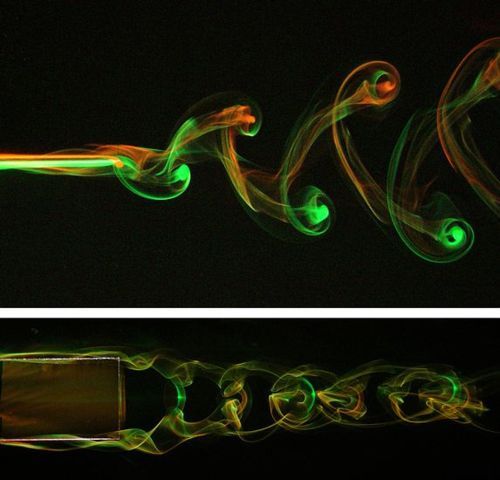


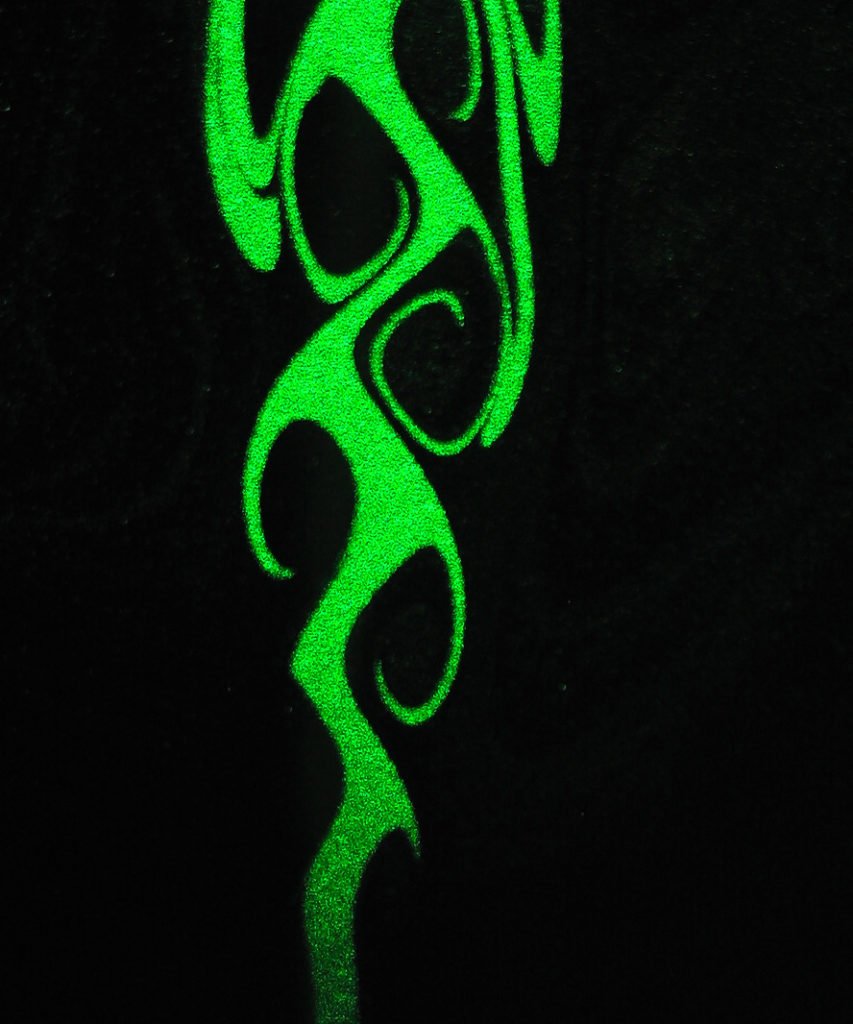

Reader Andrew asks:
I’ve noticed you’ve posted a bunch of flow visualization/wind tunnel content. I’m just curious where how useful information is obtained from these. Is it just observation? Or are there instruments that are usually used in conjunction with these techniques to provide data?
Great question, Andrew! The answer can vary based on the technique and application. In some cases, flow visualization is used for purely qualitative observation, but in others it can provide more quantifiable data. For example, the water tunnel flow visualization of Google’s heliostat array gave very qualitative data about flow around a given configuration but allowed quick evaluation of many configurations. Flow visualization can also help identify key features for additional study like vortices in a wake. This identification of structure can be so useful that even in computational fluid dynamics, where researchers have all possible information about pressure, temperature, and velocity in a flow field, flow visualization is regularly used to identify underlying structures.
Some flow visualization methods can also give very specific information. Oil-flow visualization gives a snapshot of shear stress at the surface of an object, letting an engineer identify at a glance areas of laminar and turbulent flow as well as regions with vortices and streaks. Naphthalene flow visualization and infrared thermography are both great for identifying the location of laminar-turbulent transition and can do so across the span of an object, which is much easier than trying to traverse a probe across the entire object. And some forms of flow visualization allow for extraction of velocity field information, as in particle image velocimetry. In this technique, tiny particles seed the flow and carefully timed image pairs are taken and correlated to determine the flow field velocity based on the changes in particle positions between images.
Like every measurement, flow visualization methods have their strengths and limitations. But for many applications, flow visualization provides much more than just pretty pictures and thus remains an important tool in any fluid dynamicist’s arsenal!

Accidental Painting
Artist D. A. Siqueiros sometimes used a technique he referred to as “accidental painting” in his work, in which he would pour a layer of one color of paint and then pour a second color over it. The two colors would mix in striking patterns. Here researchers recreate the technique and analyze the fluid dynamics of it. Each paint has a slightly different density thanks to the pigments used to color them. When a denser paint is poured over a less dense one (as in the white on black in the video), this activates the Rayleigh-Taylor instability. The white paint will tend to sink down below the black paint due to gravity. At the same time, the spreading of the two paints also affects the shapes and patterns through mixing and diffusion. (Video credit: S. Zetina and R. Zenit)
“Millefiori”
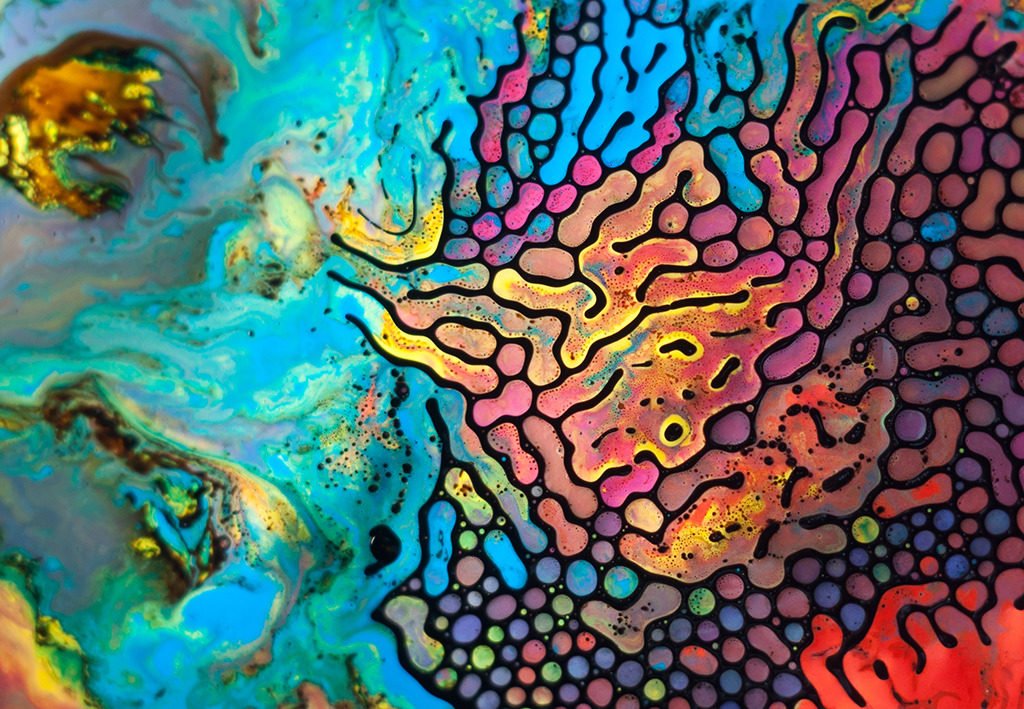
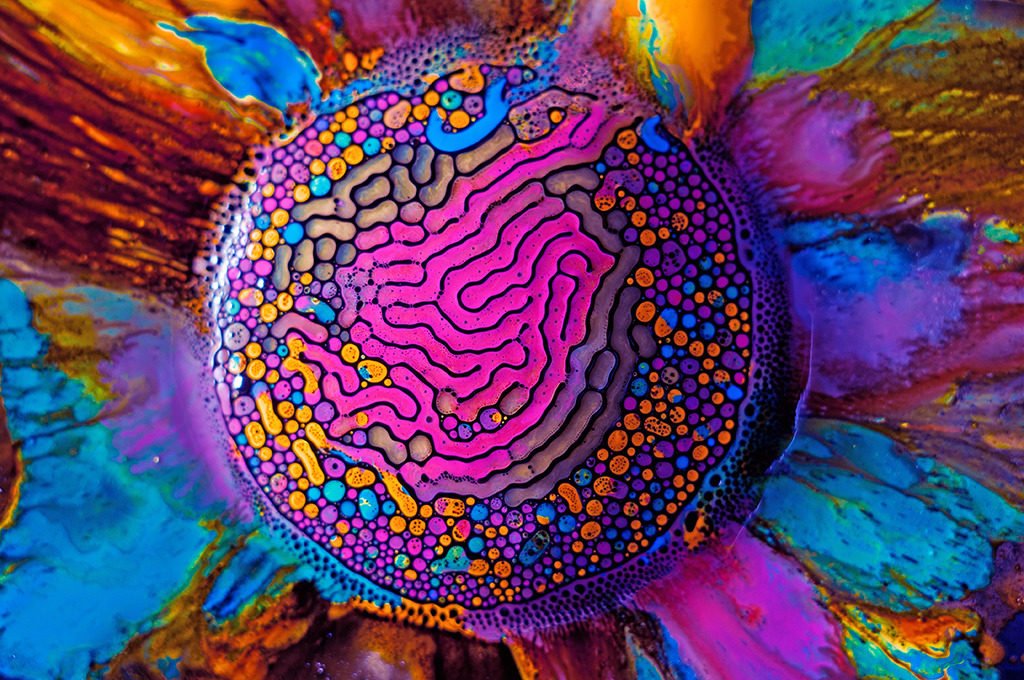
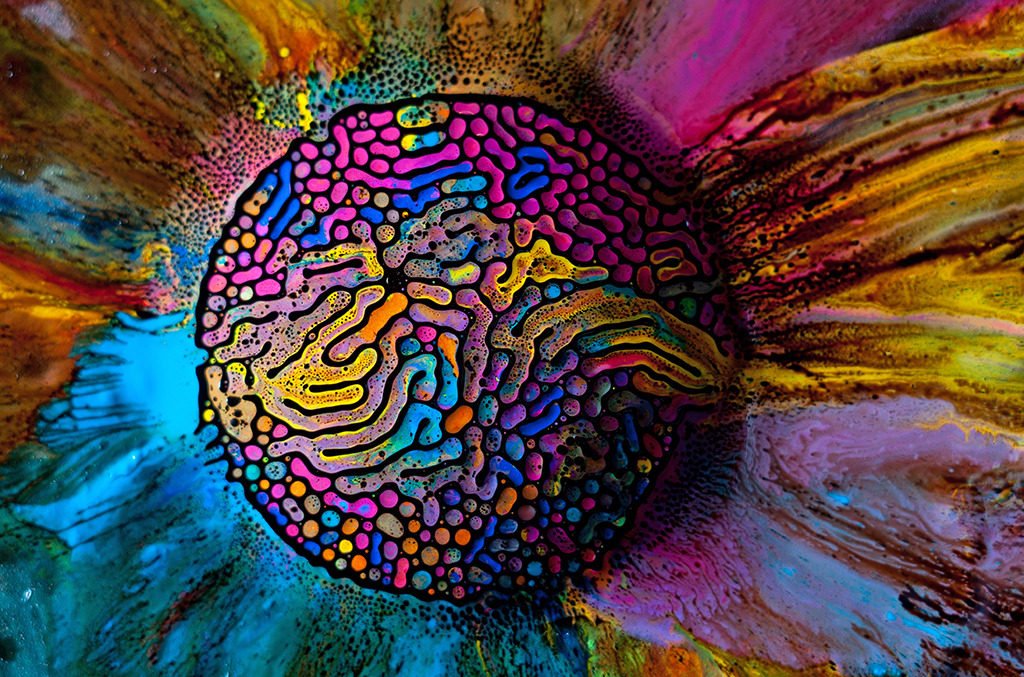
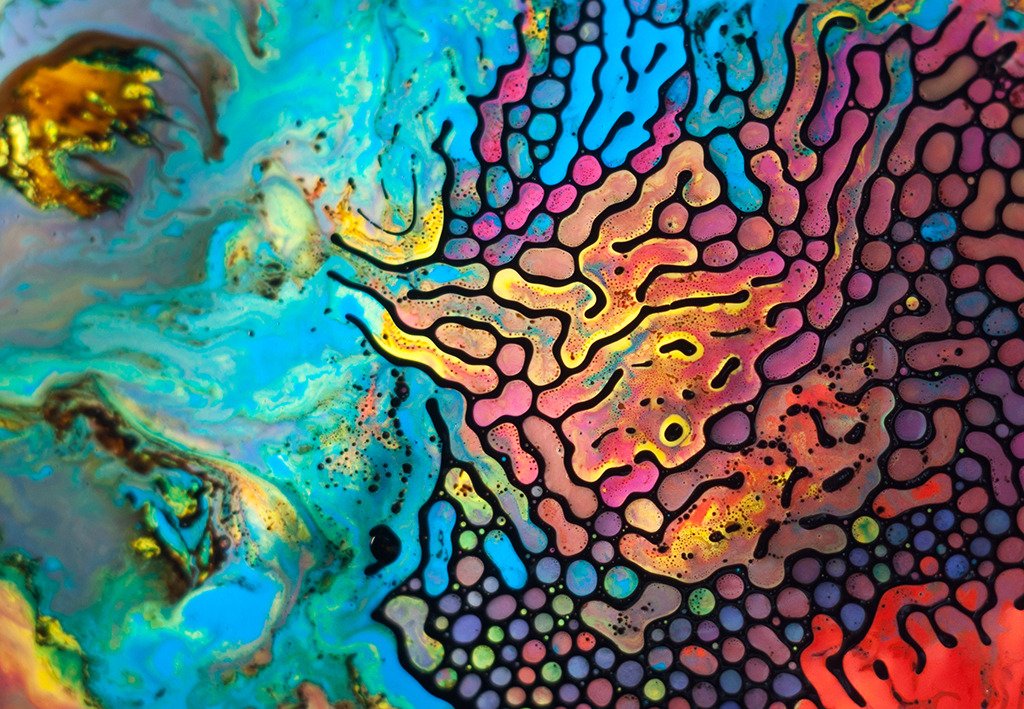
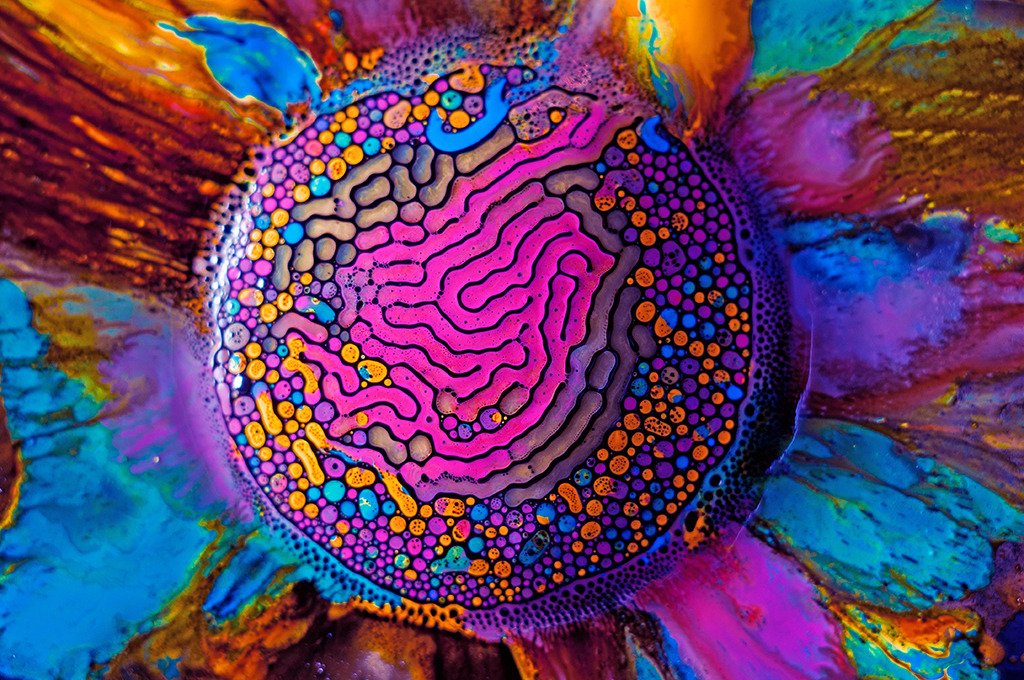
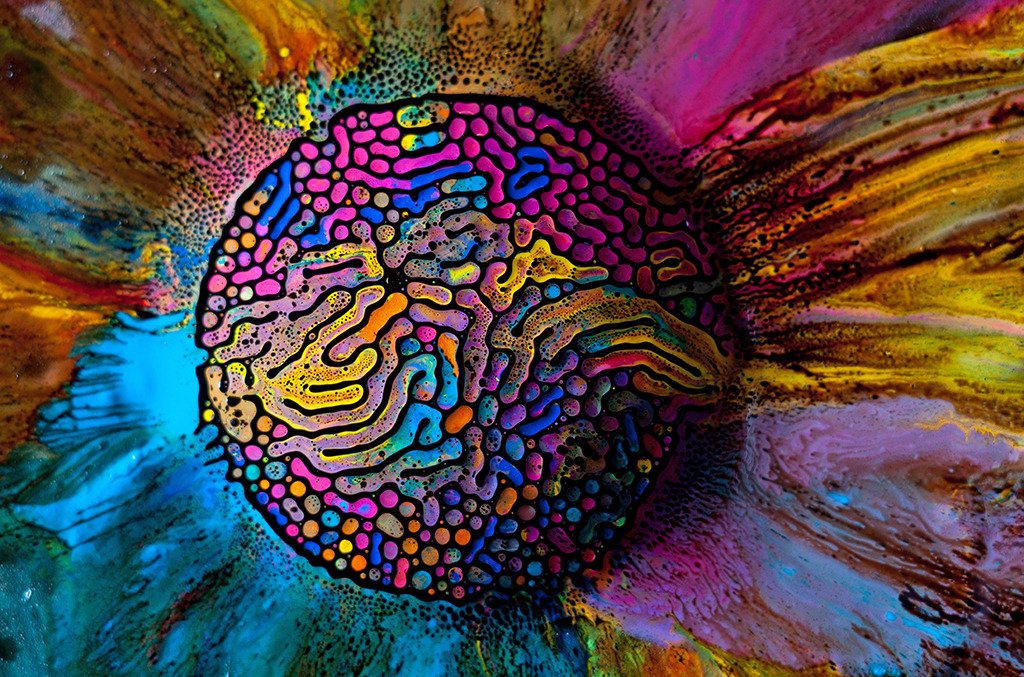
In “Millefiori” artist Fabian Oefner mixes watercolors with ferrofluids to create bright fluid microcosms. Each photograph represents an area about the size of a thumbnail. Ferrofluids contain iron-based nanoparticles suspended in a carrier fluid and thus respond to magnetic fields. They can form sharp points, labyrinthine mazes, or even brain-like patterns depending on the magnetic field and the substances surrounding them. For more on this art project, see this interview with the artist. (Photo credit: Fabian Oefner)
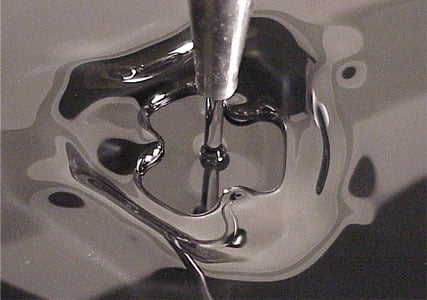
Polygonal Jumps
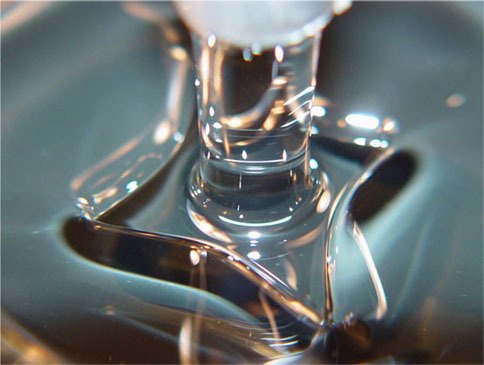
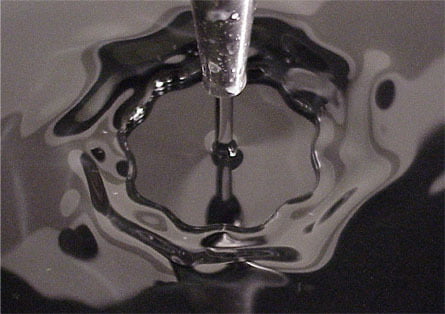
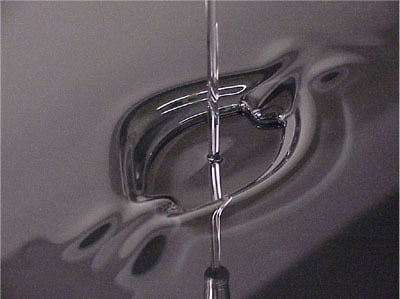
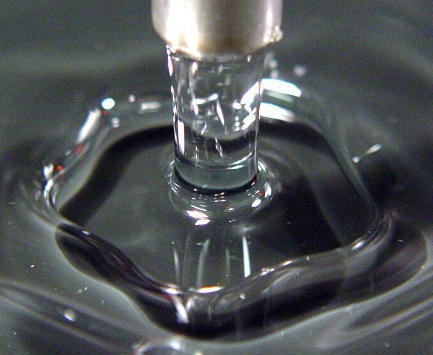
Hydraulic jumps occur when a fast-moving fluid enters a region of slow-moving fluid and transfers its kinetic energy into potential energy by increasing its elevation. For a steady falling jet, this usually causes the formation of a circular hydraulic jump–that distinctive ring you see in the bottom of your kitchen sink. But circles aren’t the only shape a hydraulic jump can take, particularly in more viscous fluids than water. In these fluids, surface tension instabilities can break the symmetry of the hydraulic jump, leading to an array of polygonal and clover-like shapes. (Photo credits: J. W. M. Bush et al.)

The Archer Fish’s Arrows

The archer fish hunts by shooting a jet of water at insects in the leaves above and knocking them into the water. How the fish achieve this feat has been a matter of contention. A study of high-speed video of the archer’s shot shows that fluid dynamics are key. The fish releases a pulsed liquid jet, imparting greater velocity to the tail of the jet than the head. As a result, the tail tends to catch up to the head and increase the jet’s mass on impact while decreasing the duration of impact. Simultaneously, the jet tends to break down into droplets via the Rayleigh-Plateau instability caused by surface tension. Surface tension’s power to hold the water in droplets combined with the inertial effects of the pulsed jet create a ball of fluid that strikes the archer’s prey with more than five times the power than vertebrate muscles alone can impart. For more on archer fish, check out this video and the original research paper by A. Vailati et a. (Photo credits: Scott Linstead and BBC; submitted by Stuart R)

“Surface Tension”

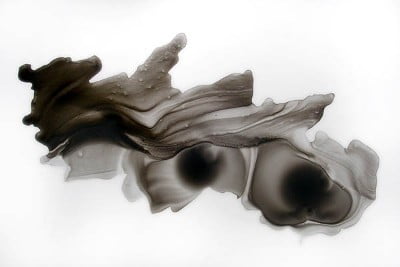
From a series called “Surface Tension,” these ink and water drawings by Marguerite French explore the effects of diffusion, surface tension, and evaporation. The forms left by the thin layer of liquids suggest other natural processes like erosion, weathering, and the rings inside trees. (Photo credits: Marguerite French)
Cavitation in a Bottle
Sudden changes in the pressure or temperature in a liquid can create bubbles in a process known as cavitation. Underwater explosions are just one of the ways to induce cavitation in a liquid. As identified in the above video, the shock waves traveling through the liquid force a change in pressure that creates bubbles. When these bubbles collapse, the container is subjected to an enormous oscillation in pressure, which often results in damage. The same phenomenon is responsible for damage on boat propellers as well as this beer bottle smashing trick. Check out these other high-speed videos of cavitation in a bottle: (Video credit: Destin/Smarter Every Day; submitted by Juan S.)

Liquid Mushrooms
The Rayleigh-Taylor instability can form at the interface between two liquids of different density under the influence of gravity, but a similar instability can occur in the absence of gravity. The image sequence above shows the Richtmyer-Meshkov instability, which occurs between two liquids of differing densities (regardless of their orientation) when impulsively accelerated. In this case, the experiment was conducted in a drop tower to simulate microgravity with the apparatus dropped on a spring to provide the impulse. As the instability grows, asymmetries appear. Nonlinear dynamics will amplify these distortions, eventually leading to turbulent breakdown. (Photo credit: C. Niederhaus/NASA Glenn, J. Jacobs/University of Arizona)
