
Over the past few years, researchers have been exploring the dynamics of droplets bouncing on a vibrating fluid. These systems display many behaviors associated with quantum mechanics, including wave-particle duality, single-slit and double-slit diffraction, and tunneling. A new paper examines the system mathematically, showing that the droplets obey many of the same mathematics as quantum systems. In fact, the droplet-wave system behaves as a macroscopic analog of 2D quantum behaviors. The implications are intriguing, especially for teaching. Now students of quantum mechanics can experiment with a simple apparatus to understand some of the non-intuitive aspects of quantum behavior. For more, see the paper on arxiv. (Image credit: D. Harris and J. Bush; research credit: R. Brady and R. Anderson)
Search results for: “art”

Simulating Early Planetary Impacts
Early in our geological history, Earth was a hellish landscape of molten oceans into which metallic impactors would sometimes collide. Geophysicists have been curious how the impactors behaved after collision: did they maintain their cohesion, or did they break up into a cloud of droplets? Here the UCLA Spinlab simulates this early planetary formation by dropping liquid gallium through a tank of viscous fluid. As the video shows, the impactor’s behavior varies strongly with size. Smaller impactors stick together as a single diapir, but, as the initial size increases, the diapir becomes unstable, eventually breaking down into a cascade of droplets – a metallic rain through an ocean of magma. (Video credit: J. Wacheul et al./UCLA Spinlab; submitted by J. Aurnou)
“Porgrave”
Artist Sandro Bocci uses macro imagery of fluids in his new piece “Porgrave” to create scenes reminiscent of celestial landscapes and the first moments of life. Surface tension, the Marangoni effect, and diffusion create pulsating motion in some frames whereas immiscible liquids form untouchable islands in others. “Porgrave” reminds me of work by Pery Burge and Julia Cuddy as well as sequences from films like 2001 and The Fountain, both of which created some of their effects with macro photography of fluids. Still images from “Porgrave” are available on Bocci’s site. (Video credit and submission: S. Bocci)
ETA: This article originally misprinted the artist’s name as “Sandro Bocchi” and has been updated with the correct spelling.

Solution to a Millennium Prize Problem?
Reports emerged this weekend that Kazakh mathematician Mukhtarbay Otelbaev has published a proposed solution to the Navier-Stokes existence and smoothness problem, one of the seven Millennium Prize problems offered by the Clay Mathematics Institute. Today I want to explain some of the background of this problem, what is known about Otelbaev’s proposed solution, and what a solution would mean for fluid dynamics.
The Navier Stokes Equation
The Navier-Stokes equation is one of the governing equations of fluid dynamics and is an expression of conservation of momentum in a fluid. With the exception of a few very specific and simplified cases, there is no known general solution to equation. Instead, the equation, or a simplified model, is solved numerically using supercomputers as part of direct numerical simulation (DNS) or other forms of computational fluid dynamics (CFD). These methods allow scientists and engineers to solve the equations of fluid motion for practical problems from flow through a pipe to flow around a re-entering spacecraft.
Existence and Smoothness
Although the Navier-Stokes equation has been known for more than 150 years and can be solved numerically for many situations, some basic mathematical aspects of the equation have not yet been proven. For example, no one has proven that a general solution always exists in three-dimensions and that the energy of such a solution is bounded at all points. Colloquially, this is known as the Navier-Stokes existence and smoothness problem. The Clay Mathematics Institute has a very specific problem statement (PDF) asking for a proof (or counter-proof) of the existence and smoothness of the Navier-Stokes equation for an incompressible fluid in three-dimensions. Otelbaev contends that he has provided such a proof.
Otelbaev’s Proposed Solution
Mukhtarbay Otelbaev is an experienced mathematician with numerous papers addressing related mathematical problems. His latest paper, entitled “Existence of a strong solution to the Navier-Stokes equation,” is freely available online (PDF, in Russian, with an English abstract at the end). There is an ongoing project to translate the paper into English, and mathematicians are already evaluating the validity of this proposed solution. From what I can gather of the paper, it specifically address the Millennium Prize problem and presents Otelbaev’s proposed solution for the existence and smoothness of an incompressible fluid in three dimensions with periodic boundary conditions.
What It Means
As with any announcement of a major technical breakthrough, skepticism is warranted while experts evaluate the proposal. If the mathematical community upholds the validity of Otelbaev’s proof, he may be offered the Millennium Prize and other honors. More importantly, his solution could lead to a better understanding of the nature of the equation and the flows it describes. It is not, in itself, a general solution to the Navier-Stokes equation, but it may be a stepping stone in the path toward one. In the meantime, scientists and engineers will continue to rely on a combination of theory, experiment, and computation to progress our understanding of fluid dynamics.
For More
The story of Otelbaev’s proof and the community’s evaluation of its validity is on-going. You can follow @fyfluiddynamics and the #NavierStokes hashtag on Twitter for updates and commentary. I’d like to specially thank Catriona Stokes, Praveen C, David Sarma, and Glenn Carlson for their helpful links and observations as this story develops.

Fluids Round-up – 11 January 2014
It’s a big fluids round-up today, so let’s get right to it.
- Over at txchnologist, there’s a great article on controlling combustion instabilities in rocket engines with sound.
- Quanta Magazine asks if knot theory can help unravel turbulence. (submitted by iamaponyrocket)
- SciAm takes a look at how FIFA finally got their aerodynamics right so that their video game football (soccer) balls fly correctly.
- The Smithsonian considers an important question: can you fry foods in space?
- The Navy unveiled a fantastic new facility for simulating ocean waves (via J. Ouellette)
- At SciAm, there’s a nice explanation of the polar vortex and its effects on recent freezing weather. For additional background, check out this excerpt from a presentation by meteorology professor Jennifer Francis. (via Nicholas Travers)
- Cold weather also brings a host of new viral videos; NatGeo explains some of the science behind instant snow, ice fog, and frozen bubbles. See also: our own explanation of the instant snow phenomenon.
- io9 looks at the physics of knuckleballs.
- Over at Wired, Rhett Allain questions whether dwarves should stand in floating barrels. Also on the subject of The Hobbit, here’s an analysis of fire-breathing in dragons.
- At SciAm, Kyle Hill explains how inertia lets one pour a drink toward the sky.
- SciAm reports on a manufacturing process for superhydrophobic paper.
- I don’t know what banking has to do with a pool of non-Newtonian fluids, but this Malaysian ad sure makes it look fun. (via physicsphysics and jmlinhart)
- Wired has a great write-up on the mantis shrimp, which kills its prey with cavitation.
- io9 tackles explaining one of the most vexing brain teasers in fluid dynamics, the Feynman sprinkler.
- Finally, today’s lead image comes from our friends at Think Elephants, who study elephant intelligence over in Thailand and occasionally capture the animals’ mastery of fluid dynamics. Be sure to check them out and follow them on Twitter and Facebook.
(Photo credit: Think Elephants International/R. Shoer)
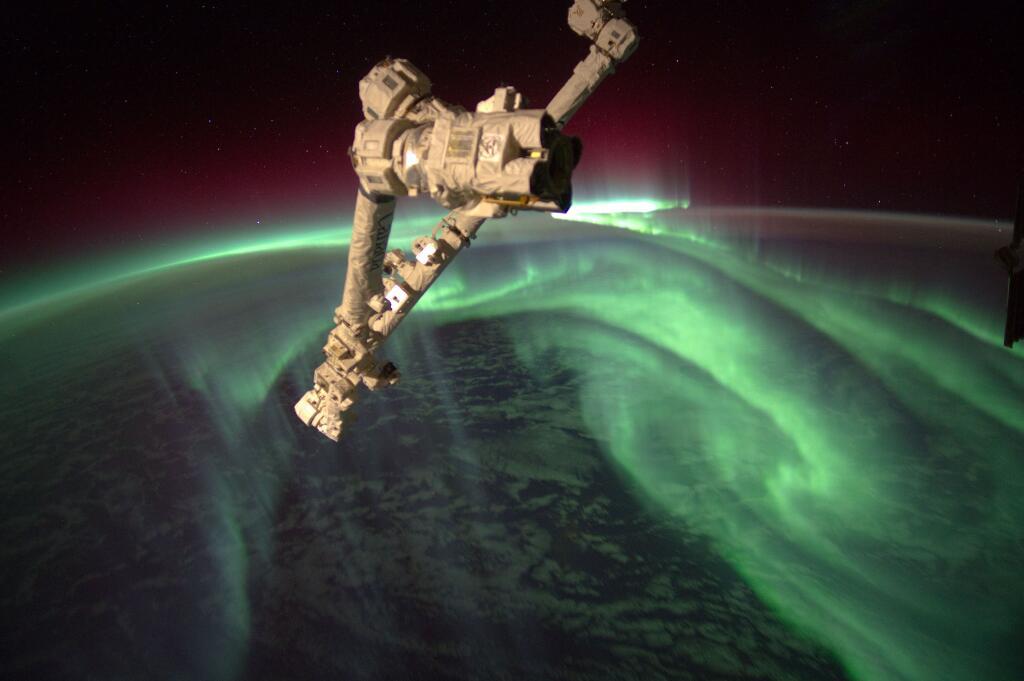
Aurora From Space
An aurora, as seen from the International Space Station, glows in green and red waves over the polar regions of Earth. These lights are the result of interactions between the solar wind–a stream of hot, rarefied plasma from the sun–and our planet’s magnetic field. A bow shock forms where they meet, about 12,000-15,000 km from Earth. The planet’s magnetic field deflects much of the solar wind, but some plasma gets drawn in along field lines near the poles. When these energetic particles interact with nitrogen and oxygen atoms in the upper atmosphere, it can excite the atoms and generate photon emissions, creating the distinctive glow. Similar auroras have been observed on several other planets and moons in our solar system. (Photo credit: NASA)

Is the Star Trek Voyager Opening Sequence Physically Realistic?
Today’s post is largely brought to you by the fact that I have been sick the past four days and my fiance and I have been bingeing on Star Trek Voyager. At some point, we began wondering about the sequence from 0:30-0:49 in which Voyager flies through a nebula and leaves a wake of von Karman vortices. Would a starship really leave that kind of wake in a nebula?
My first question was whether the nebula could be treated as a continuous fluid instead of a collection of particles. This is part of the continuum assumption that allows physicists to treat fluid properties like density, temperature, and velocity as well-defined quantities at all points. The continuum assumption is acceptable in flows where the Knudsen number is small. The Knudsen number is the ratio of the mean free path length to a characteristic flow length, in this case, Voyager’s size. The mean free path length is the average distance a particle travels before colliding with another particle. Nebulae are much less dense than our atmosphere, so the mean free path length is larger (~ 2 cm by my calculation) but still much smaller than Voyager’s length of 344 m. So it is reasonable to treat the nebula as a fluid.
As long as the nebula is acting like a fluid, it’s not unreasonable to see alternating vortices shed from Voyager. But are the vortices we see realistic relative to Voyager’s size and speed? Physicists use the dimensionless Strouhal number to describe oscillatory flows and vortex shedding. It’s a ratio of the vortex shedding frequency times the characteristic length to the flow’s velocity. We already know Voyager’s size, so we just need an estimate of its velocity and the number of vortices shed per second. I visually estimated these as 500 m/s and 2.5 vortices/second, respectively. That gives a Strouhal number of 0.28, very close to the value of 0.2 typically measured in the wake of a cylinder, the classical case for a von Karman vortex street.
So far Voyager’s wake is looking quite reasonable indeed. But what about its speed relative to the nebula’s speed of sound? If Voyager is moving faster than the local speed of sound, we might still see vortex shedding in the wake, but there would also be a bow shock off the ship’s leading edge. To answer this question, we need to know Voyager’s Mach number, its speed relative to the local speed of sound. After some digging through papers on nebulae, I found an equation to estimate speed of sound in a nebula (Eq 9 of Jin and Sui 2010) using the specific gas constant and temperature. Because nebulae are primarily composed of hydrogen, I approximated the nebula’s gas constant with hydrogen’s value and chose a representative temperature of 500 K (also based on Jin and Sui 2010). This gave a local speed of sound of 940 m/s, and set Voyager’s Mach number at 0.53, inside the subsonic range and well away from any shock wave formation.
Of course, these are all rough estimates and back-of-the-envelope fluid dynamics calculations, but my end conclusion is that Voyager’s vortex shedding wake through the nebula is realistic after all! (Video credit: Paramount; topic also requested by heuste11)
The Inside of an Evaporating Drop
[original media no longer available]
Evaporating droplets may not look like much to the naked eye, but they contain complicated flow patterns. The type of pattern observed depends strongly on the contact line, the place where the liquid, solid, and air meet. When the contact line is pinned–kept unchanged–during evaporation, any particulates in the drop get pulled toward the edges as the drop evaporates. This is what leaves the classic coffee ring stain. It is also what is shown in the first clip in the video above. Contrast this with the second clip, in which the contact line is unpinned and varies irregularly as the drop evaporates. In the unpinned drop, particles are drawn inward during evaporation. The flow patterns are very different as well, complicated by swirling that is the result of force imbalances caused by the irregularly receding contact line. (Video credit: H. Kim)
What Makes Squids Fast
Cephalopods like the octopus or squid are some of the fastest marine creatures, able to accelerate to many body lengths per second by jetting water behind them. Part of what makes its high speed achievable, though, is the way the animal changes its shape. In general, drag forces are proportional to the square of velocity, meaning that doubling the velocity increases the drag by a factor of four. The energy necessary to overcome such large drag increases generally prevents marine animals from going very fast (compared to those of us used to moving through air!) But drag is also proportional to frontal area. Like the bio-inspired rocket in the video above, jetting cephalopods begin their acceleration from a bulbous shape and then shrink their exposed area as they accelerate. Not only does this shape change help mitigate increases in drag due to velocity, it prevents flow from separating around the animal, shielding it from more drag. The result is incredible acceleration using only a simple jet for thrust. For example, the octopus-like rocket in the video above reaches velocities of more than ten body lengths per second in less than a second. (Video credit: G. Weymouth et al.)
Impacts on Sand
Granular materials like sand are sometimes very fluid-like in their behaviors. The high-speed video above shows a ball bearing being dropped into packed sand. Many features of the splash are fluid-like; the initial impact creates a spreading crownlike splash, followed by a strong upward jet that eventually collapses back into the medium. At the same time, many of the impact characteristics are decidedly non-fluidic. Sand has no surface tension, so both the crown and the jet readily break up into small particles. The granular jet is very narrow and energetic, reaching heights greater than the impacter’s drop height. Interestingly, the column begins collapsing on its lower end before the jet even reaches its highest peak. This may be due to the lower energy of the sand particles that were ejected later in the crater formation process. (Video credit: J. Verschuur, B. van Capelleveen, R. Lammerink and T. Nguyen)
