I often receive questions about how fluids react to extremely hard and fast impacts. Some people wonder if there’s a regime where a fluid like water will react like a solid. In reality, nature works the opposite way. Striking a solid hard enough and fast enough makes it behave like a fluid. The video above shows a simulated impact of a 500-km asteroid in the Pacific Ocean. (Be sure to watch with captions on.) The impact rips 10 km off the crust of the Earth and sends a hypersonic shock wave of destruction around the entire Earth. There’s a strong resemblance in the asteroid impact to droplet impacts and splashes. Much of this has to do with the energy of impact. The asteroid’s kinetic (and, indeed, potential) energy prior to impact is enormous, and conservation of energy means that energy has to go somewhere. It’s that energy that vaporizes the oceans and fluidizes part of the Earth’s surface. That kinetic energy rips the orderly structure of solids apart and turns it effectively into a granular fluid. (Video credit: Discovery Channel; via J. Hertzberg)
Search results for: “art”

How Eyelashes Work
New research shows that eyelashes divert airflow around the eye, serving as a passive filter that reduces dust collection and controls evaporation. Mammal hairs in places like the nose act as ram filters that trap the particles that hit them and which require regular cleaning via sneezing. Eyelashes, on the other hand, prevent dust collection by altering airflow at the surface of the eye. At the optimal length of roughly 1/3rd the width of an eye, eyelashes create a stagnation zone near the eye surface that forces air to travel above rather than through the eyelashes. This results in lower shear stress and lower flow speeds at the eye surface, both of which help reduce evaporation and shield the eye from dust. Lashes can get too long, though; the researchers found that longer lashes tended to channel higher flow speeds toward the eye surface, leading to faster evaporation rates. Thus, donning longer fake eyelashes may dry out your eyes. (Image credit: G. Diaz Fornaro; research credit: G. Amador et al.; via skunkbear)

Making a Bottle Resonate
If you’ve ever blown across the top of a bottle to make it play a note, then you’ve created a Helmholtz resonator. Air flow across the top of the bottle causes air in and around the bottle neck to vibrate up and down. Like a mass on a spring, the air oscillates with a particular frequency that depends on the system’s characteristics. We hear this vibration as a a deep hum, but in the high-speed video above, you’re actually seeing the vibration as smoke pulsing in and out of the bottle. Helmholtz resonance shows up more than just in blowing across beer bottles; it’s also a factor in many resonating instruments, like the guitar. To learn more about the physics and mathematics of the effect, check out this page from the University of New South Wales. (Video credit: N. Moore)

Testing a Supersonic Car
How do you test a supersonic car like the Bloodhound SSC in a wind tunnel? With free-flying objects like airplanes, wind tunnel testing is relatively straightforward. Mounting a stationary model in a supersonic flow gives an equivalent flow-field to that object flying through still air at supersonic speeds. The same does not hold true for the supersonic car, though, because you need to account for the effect of the ground on airflow. One option is to build a moving wall in the wind tunnel. For low-speed applications, this is feasible but incredibly complicated and very expensive. For supersonic speeds, it’s impossible. You could achieve the same moving-wall effect at supersonic speeds with a rocket sled, but that is also expensive and difficult to fit in most experimental facilities. The simplest solution is the one you see above – build two models and mount them belly-to-belly. Reflecting the models makes the plane of symmetry a stagnation plane, which, fluid dynamically speaking, acts like an imaginary ground plane relative to the model. For more on the project and the technique, check out this article. (Photo credit: B. Evans; via ThinkFLIP; submitted by G. Doig)

The Milk Crown
This frequently imitated photograph of a drop of milk splashing was taken by engineer Harold Edgerton in 1934. Edgerton pioneered the application of stroboscopic photography to everyday objects, allowing him to capture images with an effective shutter speed much faster than could be mechanically achieved. The photo captures the crown or coronet of a splash. The momentum of the incoming drop flings a thin sheet of liquid radially outward. The rim of this sheet breaks down into thin ligaments that eject tiny droplets at their tips when surface tension can no longer hold the milk together. (Image credit: H. Edgerton, via The Art Reserve; submitted by Vince G)

Snowy Deserts
Windblown snow bears a certain resemblance to desert sands or a Martian landscape. Many of the same aeolian processes–like erosion, transport, and deposition–take place in each. The animation above shows an example of suspension, where fine snowflakes are lifted and carried along near the ground. Larger snowflakes may bounce or skip along the surface in a process called saltation. For more, check out some of the crazy things snow does or learn about how dunes form. (Image credit: Redemption Designs, source video)
Plasma
For those of us who are Earthbound, it’s easy to think of liquids and gases as being the most common fluids. But plasma–the fourth state of matter–is a fluid as well. Plasmas are essentially ionized gases, which, thanks to their freely flowing electrons, are electrically conductive and sensitive to magnetic fields. Their motions are described by a combination of the Navier-Stokes equations–the usual equations of motion for a fluid–and Maxwell’s equations–the equations governing electricity and magnetism. Studies of plasma motion often fall under the subject of magnetohydrodynamics and can include topics like planetary auroras, sunspots, and solar flares. (Video credit: SciShow)
Underwater Currents
Like the atmosphere, the ocean is constantly in motion, churned by currents that often go unnoticed by humans watching the surface. Filmmaker Julie Gautier and free diver Guillaume Néry demonstrate the power and speed of some of these underwater currents in the film above. The footage was shot in Tiputa Pass, part of an atoll northeast of Tahiti. In it, Néry serves as a human-shaped seed particle in the flow, illustrating just how swift the current is. (Video credit: J. Gautier; via Colossal; submitted by jshoer)
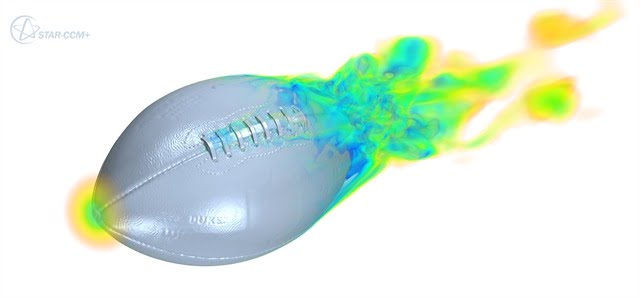
American Football Aerodynamics
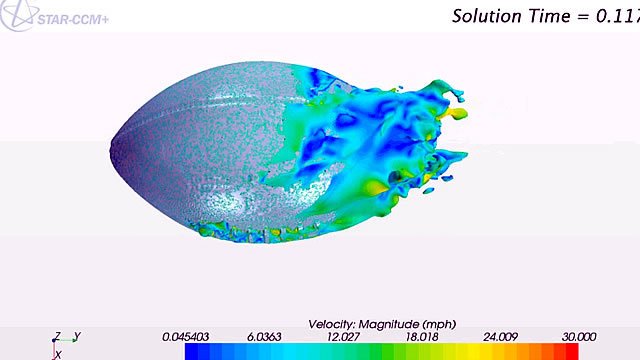


Like many sports balls, the American football’s shape and construction make a big difference in its aerodynamics. Unlike the international football (soccer ball), which undergoes significant redesigns every few years thanks to the World Cup, the American football has been largely unchanged for decades. The images above come from a computational fluid dynamics (CFD) simulation of a spiraling football in flight. Although the surface is lightly dimpled, the largest impact on aerodynamics comes from the laces and the air valve (just visible in the upper right image). Both of these features protrude into the flow and add energy and turbulence to the boundary layer. By doing so, they help keep flow attached along the football longer, which helps it fly farther and more predictably. For more, check out the video of the CFD simulation. (Image credits: CD-adapco; via engineering.com)
Inside a Can of Compressed Air
Many gases are stored in liquid form at high pressures. This video takes a look at tetrafluoroethane, better known as the substance in compressed air cans used for dusting electronics. At atmospheric pressure, tetrafluoroethane boils at about -26 degrees Celsius, but in an air duster, at around 7 atmospheres of pressure, it is a liquid. As demonstrated in the video, releasing the pressure causes the liquid to boil off. Even exposed to atmospheric pressure, though, the liquid doesn’t boil off instantly – the act of boiling requires thermal energy and, without a sufficient source of heat, the liquid consumes its own heat until it drops to a temperature below the boiling point. As it warms up from the surrounding air, it will start boiling again. I don’t recommend trying to open up an air duster can at home, though. High-pressure containers can be dangerous to open up, and tetrafluoroethane is now being phased out in some parts of the world due to its high global warming potential. (Video credit: N. Moore)