
Liquid plastics are often extruded–or pressure-driven through a die–during manufacturing. Early on manufacturers discovered that they could only extrude plastic at low flow rates, otherwise the plastic’s surface begins undulating in what became known as melt fracture. These corrugations result from the viscoelasticity of the plastic. Viscoelastic fluids have a response to deformation that is part viscous–like any fluid–and part elastic. At low flow rates, viscous forces dominate in the plastic, but at higher speeds, elasticity increases and the polymers in the plastic get stretched along the direction of flow. In response to this stretching, the polymers exert normal stresses, much like a rubber band that’s being stretched. Because this force acts only along the flow direction, different parts of the fluid are experiencing different forces, and these internal stresses cause the plastic to change shape. (Image credit: D. Bonn et al.)
Search results for: “art”

Lava Coiling
It’s tough to get much closer to flowing lava than this video of freshly forming coastline in Hawaii. Lava is complex fluid, with viscous properties that vary significantly with chemical composition, temperature and deformation. Here, despite being very viscous, the lava flows quickly–perhaps even turbulently. Several times it forms a heap and even shows signs of the rope-coiling instability familiar from viscous fluids like honey. All in all, it’s quite mesmerizing. (Video credit: K. Singson; submitted by Stuart B.)
How Rain Gets Its Smell
Light rain after a dry spell often produces a distinctive earthy scent called petrichor that is associated with plant oils and bacteria products. How these chemicals get into the air has been unclear, but new research suggests that the mechanism may come from the rain itself. When water falls on a porous surface like soil, tiny air bubbles get trapped beneath the drop. These bubbles rise rapidly due to buoyancy and, upon reaching the surface, burst and release tiny droplets known as aerosols. Depending on the surface properties and the drop’s impact speed, a single drop can produce a cloud of aerosol droplets. The research team is now investigating how readily bacteria or pathogens in the soil can spread through this mechanism. Other human-focused research has already shown that these tiny aerosol droplets can persist in the air for remarkably long periods and may help spread diseases. (Video credit: Massachusetts Institute of Technology; research credit: Y. Joung and C. Buie; submitted by Daniel B and entropy-perturbation)

Interrupting Sediments
The pier at Progreso extends 6.5 kilometers into the Gulf of Mexico, creating an artificial obstruction to ocean flow and sediment transport near the shore. The first 2 kilometers of the pier are built on arches that allow some flow through, but the newer sections do not. Prevailing winds act from the east-northeast, driving flow roughly right to left in the image. The sediment traces flow around the pier and reveals the complicated flow-shadow downstream of the newer parts of the pier. (Image credit: NASA Earth Observatory)

Top 10 FYFD Posts of 2014


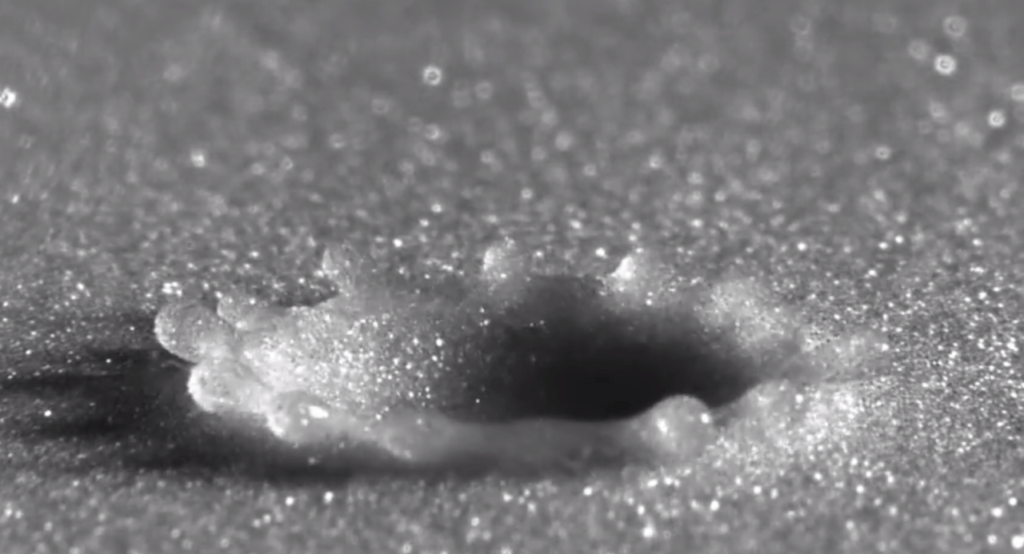


It’s only fitting to take a moment to look back at 2014 as we step into the New Year. It was a big year in many respects – we hit 1000 posts and broke 200,000 followers; I started producing FYFD videos on our YouTube channel; and, on a personal note, I finished up my PhD. But since we’re all about the science around here, I will give you, without further ado, the top 10 FYFD posts of 2014:
1. Bioluminescent crustaceans use light for defense
2. What happens when you step on lava
3. Flapping flight deconstructed
4. Wingtip vortices demonstrated
5. Saturn’s auroras
6. Raindrops’ impact on sand
7. Water spheres in microgravity
8. The surreal undulatus asperatus cloud
9. Inside a plunging breaker
10. A simply DIY Marangoni effect demoI can’t help but notice that 9 out of the 10 posts feature animated GIFs. Oh, Tumblr, you rascals. Happy New Year! (Image credits: BBC; A. Rivest; E. Lutz; Nat. Geo/BBC2; ESA/Hubble; R. Zhao et al.; D. Petit; A. Schueth; B. Kueny and J. Florence; Flow Visualization at UC Boulder)
Growing Snowflakes
It’s easy to miss the beauty of a snowflake if you don’t take a close look. These tiny crystals form when water freezes onto a dust particle or other nucleation site, and they grow as water vapor freezes on to the nucleus. The structured appearance of a snowflake comes from the bonds formed between water molecules, but the exact type and shape of crystal formed–not all snowflakes are six-sided!–depends on the local temperature and humidity during freezing. This microscopic timelapse video by Vyacheslav Ivanov lets you watch the process in action. (Video credit: V. Ivanov; via io9)
“Marco Polo” Theme
Netflix’s new original series “Marco Polo” has a distinctive and fluidsy title sequence. The artistic team at the Mill created the effect by painting images in water atop dense paper before introducing Japanese sumi-ink. Using high-speed photography, they filmed the diffusion of the ink into the water as it reveals the larger picture. There’s a great behind-the-scenes break down and video over at their blog. (Video credit: The Mill, submitted by jshoer)
Simplified Schlieren Set-up
Schlieren photography offers a glimpse into flows that are usually invisible to the human eye. With a relatively simple set-up–a light source, collimating mirror(s), and a razor blade–it becomes possible to see differences in density. The technique lets one visualize temperature-driven flows like the buoyant convection from a flame or other heat source, and it can also be used to visualize shock waves and sound. The video above has several neat schlieren demos, including some non-air examples using hydrogen (lighter than air) and sulfur hexafluoride (denser than air), both of which are transparent to the naked eye. (Video credit: Harvard University, via Jennifer Ouellette)
Phytoplankton Flow Viz
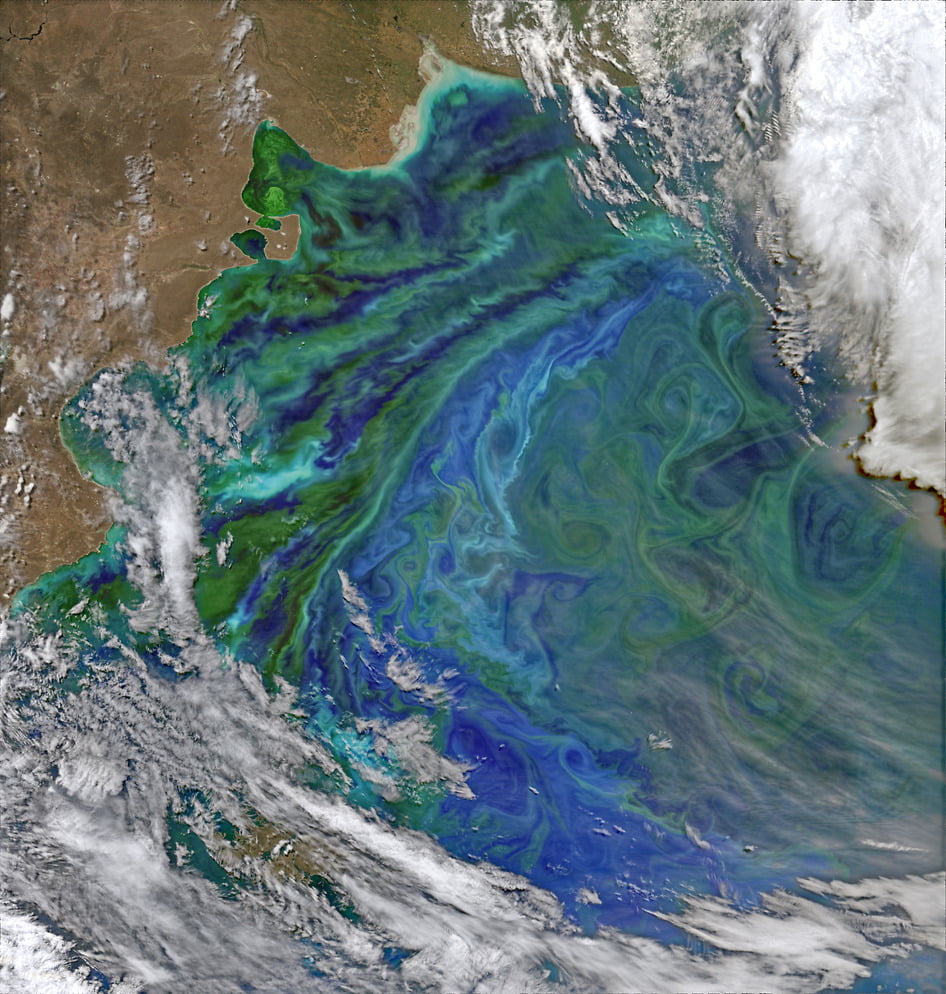
Nutrient-rich waters off Patagonia in South America blossom with phytoplankton in this satellite image. When present in large quantities, these microscopic photosynthesizers lend a green hue to the water. They act as seed particles in the flow, highlighting the currents and flow that carry them. If you check out the full resolution version of the photo, you can admire the rich detail in the whorls of ocean mixing. There even seem to be Kelvin-Helmholtz-like instabilities creating trains of vortices along the interface between separate bands. (Photo credit: NASA/ASU; via SpaceRef; submitted by jshoer)

Frog Tongues and Parrot Laser Safety Goggles
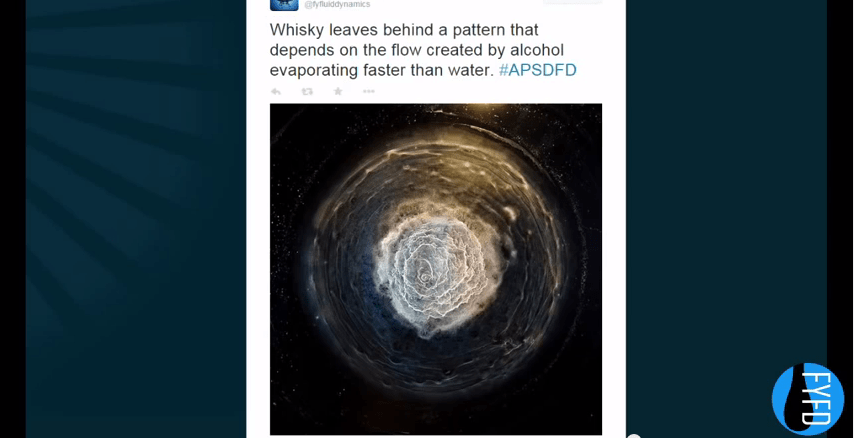

What do frog tongues, whisky, tattoos, and parrot laser safety goggles have in common? They’re all a part of the latest FYFD video! Check out my behind-the-scenes look at the biggest fluid dynamics conference of the year and find out what science everyone was talking about. (Image credits: N. Sharp, source video)
