Like humans, plants can spread pathogens to one another. Although scientists had observed correlations between rainfall and the spread of diseases among plants, this study is one of the first to look at the fluid dynamics of leaf and rainfall interaction. When a raindrop hits a leaf, it doesn’t simply splash as it would against an immobile surface. The impact of the drop deforms the leaf, and the plant’s rebound significantly affects the trajectory and size of the resulting droplets. Depending on factors like the leaf’s stiffness, a large drop, carrying many pathogens, may rebound and splatter onto a neighboring leaf. Other leaves tend to catapult out many smaller droplets, which may fly farther afield but carry fewer pathogens. For more, check out the press release or the original research paper. (Video credit: Massachusetts Institute of Technology; research credit: Bourouiba Research Group)
Search results for: “art”

Kitchen Fluid Dynamics


The kitchen is a fantastic place to witness the everyday beauty of fluid dynamics. Daria Khoroshavina and Olga Kolesnikova capture these delectable cooking-related GIFs on their Buttery Planet Tumblr. From pouring cream to drizzling syrup, there are countless examples of fluids in daily life. Check out their site for more awesome images and be sure to keep your eyes open for great examples of fluid behavior in your day-to-day life. (Image credits: Buttery Planet; via Colossal)
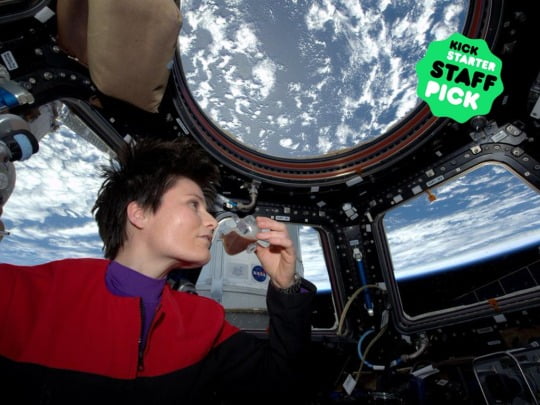
Get Your Own Space Coffee Cup
A few weeks ago, we reported on the espresso machine NASA and the ESA sent to astronauts aboard ISS. The Capillary Beverage Experiment, known colloquially as the “Space Coffee Cup”, is an accompanying project that aims to use our understanding of fluid behavior in microgravity to design an open cup that simulates earthbound drinking experiences. As you can see above, astronauts are already enjoying drinks with it. The cup’s special shape is optimized so that surface tension can replace the role gravity plays in drinking on Earth. Where we pour drinks on Earth, the cup wicks liquid to the spout using surface-tension-driven capillary action. Right now there are only a handful of 3D printed cups on-orbit and here on Earth, but the company that designed them wants to manufacture glass versions for use here on the ground. So if you’d like your own space coffee cup, be sure to check out their Kickstarter campaign! (Video credit: IRPI LLC; image credit: NASA/IRPI LLC; Kickstarter project link)
ETA: To those who have been asking, that’s European astronaut Samantha Cristoforetti, who is (clearly) a Star Trek fan. I believe she’s doing a tribute to Captain Janeway’s coffee. (Black.)

Coalescence Cascade
The simple coalescence of a drop with a pool is more complicated than the human eye can capture. Fortunately, we have high-speed cameras. Here a droplet coalesces by what is known as the coalescence cascade. Because it has been dropped with very little momentum, the droplet will initially bounce, then seem to settle like a bead on the surface. A tiny film of air separates the drop and the pool at this point. When that air drains away, the drop contacts the pool and part–but not all!–of it coalesces. Surface tension snaps the remainder into a smaller droplet which follows the same pattern: bounce, settle, drain, partially coalesce. This continues until the remaining droplet is so small that it can be coalesced completely. (Image credit: Laboratory of Porous Media and Thermophysical Properties, source video)

How Loud Can Sound Get?
Sound and acoustics often intersect with fluid dynamics. Most of the sounds we experience are pressure waves traveling through air. In this video, Joe of It’s Okay To Be Smart takes a closer look at sound: what it is; how we measure it; and just how loud a sound can get. For air at sea level, the loudest possible sound is 194 dB. Add any more energy and it distorts the pressure wave from what we recognize as sound into what’s known as a shock wave. (Video credit: It’s Okay To Be Smart/PBS Digital Studios)
Acoustic Levitation
Destin from Smarter Every Day has a great new video exploring acoustic levitation. With carefully placed speakers, you can create a standing wave with sound that’s capable of levitating lightweight objects against the force of gravity. Around 4:00, Destin demonstrates this with colored water droplets, which is where the real fireworks start. As he turns up the volume on the speakers, the big droplets explode. This happens when surface tension can no longer hold the drop together. But the high-speed footage offers other clues about what’s going on. Notice how the drops flatten out as the sound volume increases. If you look back to the standing wave animation at 1:33, you’ll notice that just to either side of the nodes (the spots that don’t move), the wave is still oscillating back and forth a little bit. As you increase the sound volume, that standing wave gets stretched to a larger amplitude, which means that those little oscillations just to either side of the node get stronger (and steeper), too. This change in acoustic pressure squishes the drops into pancakes as the fluid tries to stay right at the node. Eventually the droplet is just too flattened for surface tension to keep it together and it bursts into smaller droplets. (Video credit: Smarter Every Day; submitted by Matthew P.)

The Free Surface of a Typhoon

Gazing across the top of of Typhoon Maysak highlights the three-dimensionality of the storm. Like a swirling vortex seen in a bathtub, hurricanes are a kind of free surface vortex with a surface indentation near their eye. To understand this shape, imagine spinning a container of water on a rotating plate. Like the vortex, the water’s surface would take on a parabolic shape. The two forces acting on the rotating water are gravity in the downward direction and centrifugal force in the radial direction. By taking on a parabolic shape, the fluid remains perpendicular to the combination of these two forces at every point along the surface, thereby ensuring that pressure is a constant across the free surface of the fluid. (Image credits: S. Cristoferreti/ESA/NASA; T. Virts/NASA)
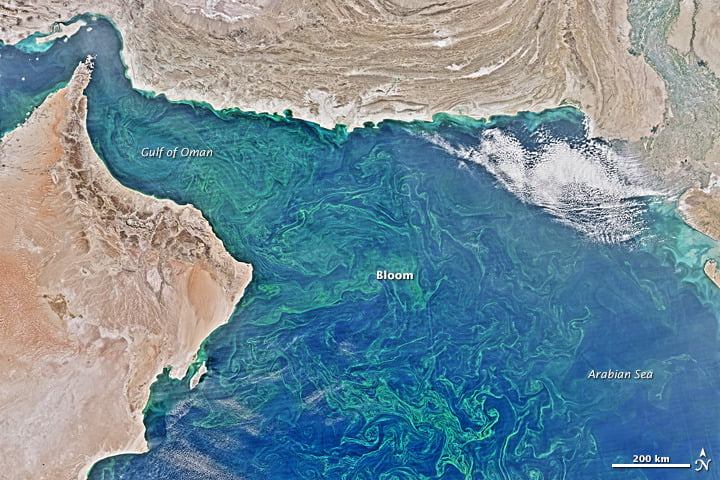
Phytoplankton Blooms
When the right nutrients come together in coastal waters, it can feed a phytoplankton bloom large enough to be visible to satellites. The phytoplankton themselves are microscopic organisms that are easily carried along by oceanic flows. In fluid dynamics terms, they are passive scalars or seed particles–additives that reveal the structure of the flow without altering it. Here the phytoplankton uncover the large-scale turbulent structure of flow in the Arabian Sea. Check the scale in the lower right. Many of the green eddies and swirls in this satellite image are hundreds of kilometers across. Yet, if we could zoom way in, we would still see turbulence acting on scales down to the millimeter length or below. This incredibly large range of length scales–eight or more orders of magnitude here–is a common characteristic of turbulence and part of what makes it such a challenge to understand or model. (Image credit: NASA Earth Observatory)
Cloud Formation
Clouds are so ubiquitous here on Earth that it’s easy to take them for granted. But there’s remarkable complexity in the mechanics of their formation. This great video from Minute Earth steps through the processes of evaporation and condensation that drive basic cloud formation. After evaporation, buoyancy lifts warm, moist air upward. That warm air expands and cools until it reaches an altitude where water droplets can condense onto dust particles in the atmosphere. These droplets form the wispy cloud we see. Turbulence mixes these droplets and helps them collide and grow. Interestingly, although we understand the basic process of cloud formation, relatively little is understood about the details, and the subject is still very much an area of active research. (Video credit: Minute Earth; via io9)
Dead Water
Sailors have long known about the “dead water” phenomenon, which can bring ships to a near-standstill, but it was only within the last century that an explanation for the behavior was found. The underlying cause is a stratification of fluids of different densities. As seen in the video above, when a boat moves by exerting a constant force, such as with propellers, it generates an internal wave along the interface between two density layers in the water. As the wave grows in amplitude, it speeds up, chasing and eventually breaking against the boat. The energy that drives the internal wave’s growth comes from the energy the boat expends for propulsion; the larger and closer the wave gets, the slower the boat goes because its energy is sapped by the wave. In the ocean, particularly near sources of freshwater run-off, like melting glaciers, the water can be extremely stratified, with many layers of different salinity and density. The end of the video simulates this with a three-fluid demonstration in which the boat’s motion generates internal waves across multiple density interfaces. (Video credit: M. Mercier et al.)
