
These are the vocal folds of a woman singing. Human speech (and song) results from interactions between elastic muscles and aerodynamics. As we exhale, the vocal folds are initially pushed apart, then the flow of air moving past creates low pressure (via the Bernoulli effect) that helps pull the folds together. As the folds close, high pressure again forms to force them open. This sets a cycle of oscillation or vibration that produces sound. To change the pitch of the sounds we create, we can lengthen or shorten the vocal folds or change their tension. In this respect, they behave somewhat similarly to the strings of a musical instrument. If you’d like to admire more vocal folds in action, check out this endoscopic video for four singers performing together. (Image credit: LinguaHealth, source)
Search results for: “aerodynamics”
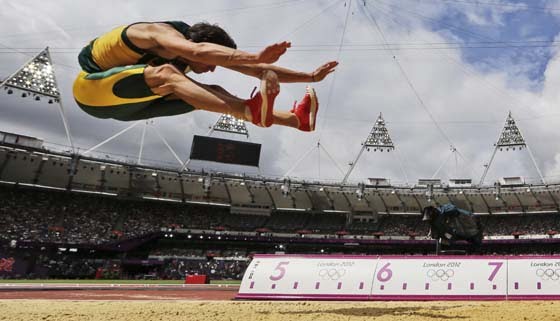
Rio 2016: Long Jump


Long jump, like many track and field events, is affected by fluid dynamics in subtle ways. Both wind speed and altitude can modify a jumper’s performance – first, by changing the maximum speed they reach in their sprint, and second, through aerodynamic drag while in flight. Air resistance accounts for roughly 10% of a sprinter’s energy expenditure. A slight tailwind gives an athlete a minor boost in speed that can translate into a more significant increase in jump distance. On the other hand, though, a headwind of the same magnitude has an even stronger negative effect on performance.
The other factor, altitude, comes into play through air density. The official Olympic record for the long jump was set by Bob Beamon in the 1968 Mexico City Games. The high altitude of Mexico City results in an air density that’s only 75% of that at sea level. That’s tougher on athletes in terms of oxygen levels, but it’s a big reduction in the overall drag they face, resulting in both a higher sprinting speed and less aerial drag. This is part of why Beamon’s jump stood as a world record for well over 20 years! (Image credits: AP Photo; AFP/GettyImages; Reuters)
Previously: Can dimpled shoes help runners?; the unusual aerodynamics of the javelin; the physics of the discus
Join us throughout the Rio Olympics for more fluid dynamics in sports. If you love FYFD, please help support the site!

Rio 2016: Track Cycling


Track cycling is a sport where speed is everything. As much as 90% of the resistance a rider has to overcome is aerodynamic drag. To minimize drag, riders wear form-fitting one-piece skinsuits and wear special, streamlined helmets. They have aerodynamic bikes (unique left-side-drive ones, if you’re the Team USA women) and ride with their arms close together and thrust in front of them to minimize the frontal area they expose.
Even the tactics of racing rely heavily on aerodynamics. In events like team pursuit cyclists stay extremely close to the wheel of the rider ahead of them in order to remain in that rider’s slipstream and experience less drag. When switching off the position of lead rider, cyclists use the curvature of the track to help them move to the back of the paceline quickly to minimize the time spent outside of their teammate’s draft. (Image credits: GettyImages via the Guardian and the IOC, source)
Previously: Cycling’s aero equipment helps them beat the clock; the effect of cyclists being followed by a motorbike or car
Join us throughout the Rio Olympics for more fluid dynamics in sports. If you love FYFD, please help support the site!
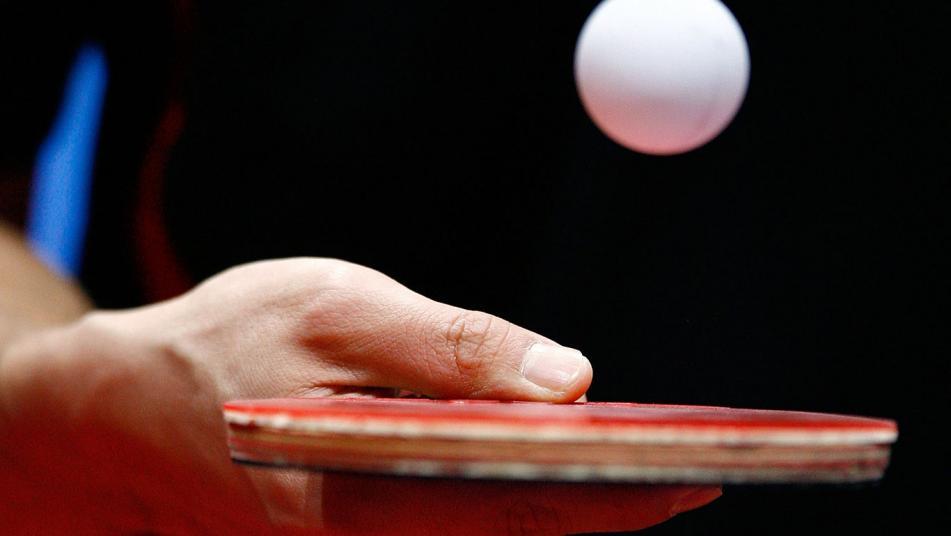
Rio 2016: Table Tennis


Many sports use spherical balls, but the small size and weight of a table tennis ball makes it the one where aerodynamics have the strongest effect. Spin also plays a big role in the game by creating asymmetry in the flow around the ball.
Consider a table tennis ball with topspin, meaning that its upper surface is rolling in the direction of travel. That means that air flowing over the top of the ball is moving in the opposite direction as the ball’s surface. This will tend to make the flow separate from the ball at its widest point.
On the other side, the ball’s surface is spinning in the same direction as the air flow. This helps hold the air to the surface so that it follows the curve of the ball longer and doesn’t detach until well after the ball’s widest point. As a result of both these effects, air flowing around the ball experiences a net upward force, which in turn pushes the table tennis ball downward. This is known as the Magnus effect, and it plays a significant role in many sports. (Image credits: GettyImages; AFP)
Previously: The Magnus effect and the reverse Magnus effect in soccer; curveballs and knuckleballs in baseball
Join us throughout the Rio Olympics for more fluid dynamics in sports. If you love FYFD, please help support the site!
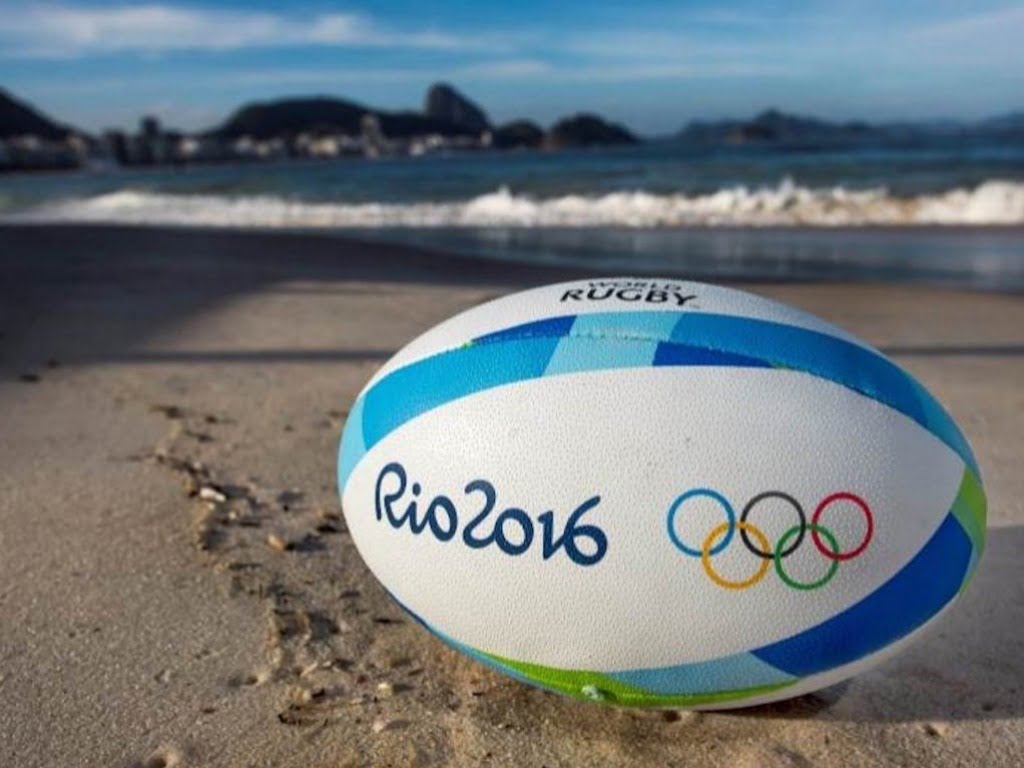
Rio 2016: Rugby


The sport of rugby returns to the Olympics in Rio this year. Rugby’s ball is somewhat similar in size and shape to an American football, but it is a little wider and more rounded. Aerodynamically, this means that the rugby ball has more drag, but it is also more stable in flight, allowing players to pass and kick accurately, with or without a spiral.
As seen in the flow visualizations above, air travels up and around the ball before separating on the far side. The more the ball is tilted, the larger this separated region is and the greater the drag. At the same time, though, that tilt provides lift on the ball. The ideal orientation is the one with the largest ratio of lift force and drag force. For a rugby ball, this occurs at about 40 degrees.(Image credits: Planet Rugby; A. Vance et al.)
Previously: The aerodynamics of the American football
Join us throughout the Rio Olympics for more fluid dynamics in sports. If you love FYFD, please help support the site!

Daily Fluids, Part 2
We play with fluid dynamics all the time, though we don’t always think of it as such. Here are a few ways it shows up in the ways we play:
Aerodynamics
This is the study of air moving past an object. Whether you’re throwing a paper plane, flying a kite, or riding a bike, aerodynamics has an impact on what you’re doing.
Lift
Skipping a rock won’t work unless its impact generates some lift, but we see lift in lots of other places, too, from birds and planes to racecars and sailboats.
Magnus Effect
The Magnus effect relates to lift forces on a spinning object. It can affect the way a frisbee flies, but we see it a lot in ball-related sports, too. The flight of golf balls, volleyballs, baseballs, and soccer balls can all be significantly impacted by the Magnus effect. Check out these videos for a primer on the Magnus effect and the reverse Magnus effect.
Bubbles
Everybody loves playing with bubbles. But they may have more of a impact than you realize, whether it’s in making the foam on your latte, enhancing the aroma of your champagne, or making your joints pop.Tune in all week for more examples of fluid dynamics in daily life. (Image credit: S. Reckinger et al., source)

Wingtip Vortices Visualized

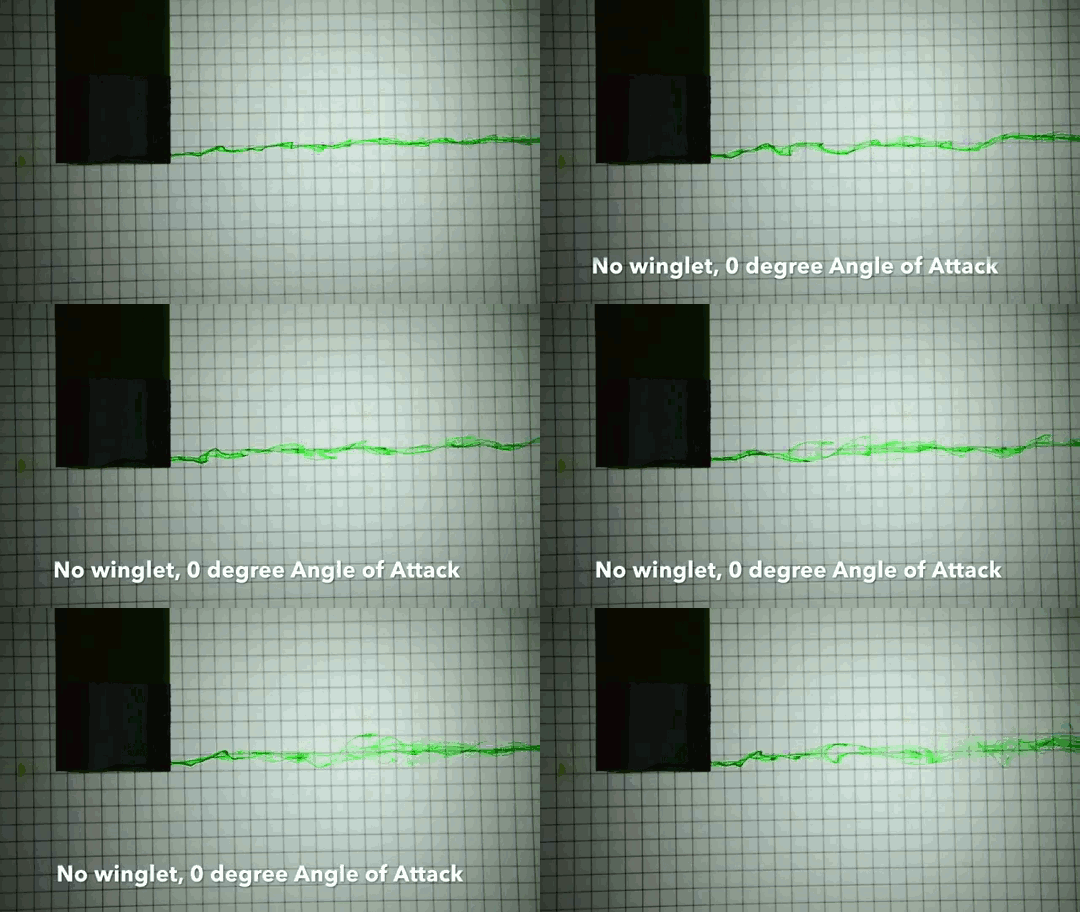


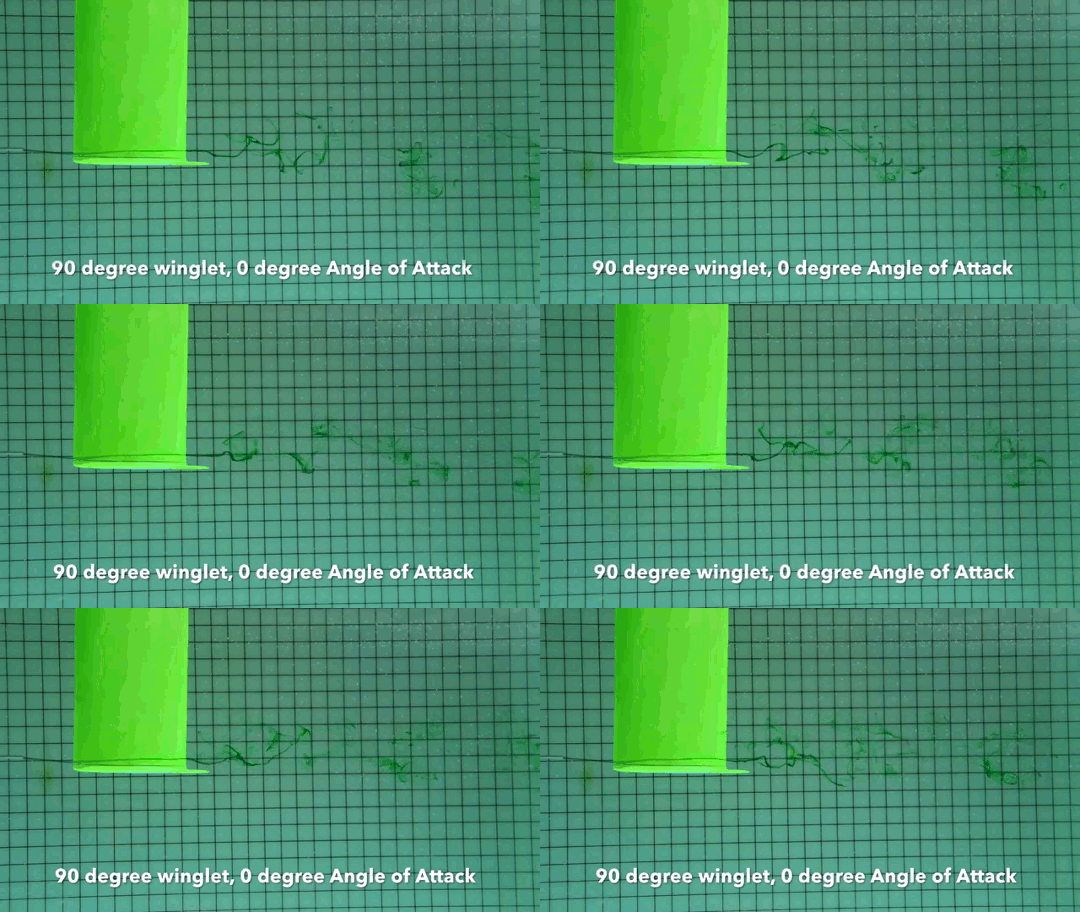
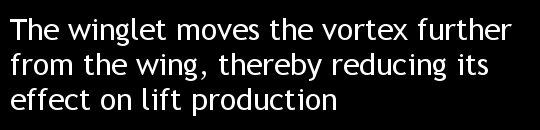

In flight, airplane wings produce dramatic wingtip vortices. These vortices reduce the amount of lift a 3D wing produces relative to a 2D one. How much they influence the lift depends on both the strength and proximity of the vortex. The stronger and closer it is, the more detrimental its effect. One way airplane designers reduce the effects of wingtip vortices is by adding an extra section, called a winglet, to the end of the wing. Among other effects, the winglet moves the wingtip vortex further away from the main wing, which reduces its influence and allows the airplane to regain some of the lift that would otherwise be lost. (Image credits: A. Wielandt et al., source)

HIFiRE


Earlier this month, an international team launched a successful hypersonic flight test in Australia. The Hypersonic International Research Experimentation (HIFiRE) Flight 5b was launched atop a two-stage rocket and reached its maximum speed of Mach 7.5, well above Mach 5, which defines the start of the hypersonic regime. The purpose of this particular flight test was not to test new propulsion technologies – there was no scramjet engine on this flight. Instead, researchers wanted to study aerodynamics at high Mach number, specifically the behavior of the air very close to the vehicle, its boundary layer.
The payload being tested was an elliptical cone mounted on the front of the vehicle and shown in images above. The shape of the payload is such that flow will curve around the cone rather than following straight lines. The image on the lower right contains black streamlines that show how air twists around the cone. This complex flowfield complicates the physics of the boundary layer near the cone’s surface and increases the likelihood that the boundary layer will transition from laminar flow to turbulent flow, thereby increasing heating on the payload. Ideally, the data from the test flight will let engineers test their ability to understand and predict this boundary layer transition in the future. For more on boundary layer transition and its effects at hypersonic speeds, check out my latest FYFD video. (Image credit: Australia Department of Defense, R. Kimmel et al., F. Li et al.; topic requested by Guido)

Cars Helping Cyclists
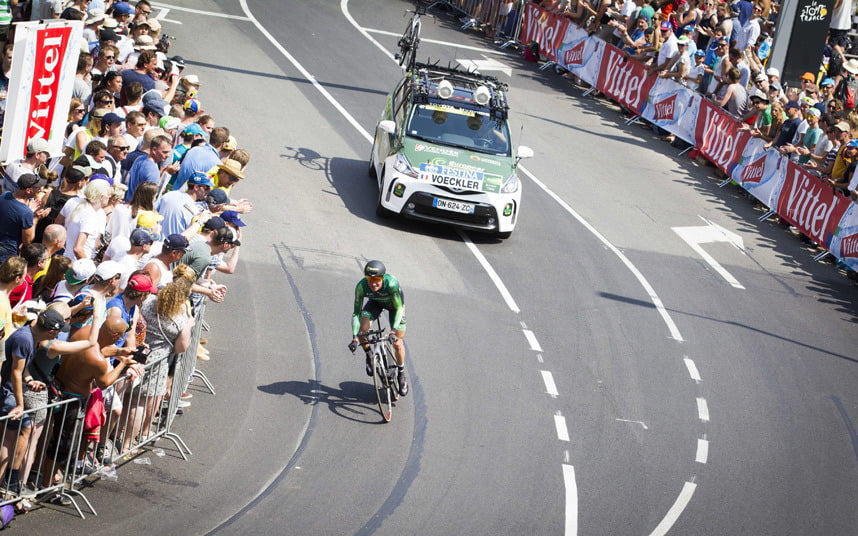
This year’s Tour de France opened with an individual time trial stage in which riders competed solo against the clock. But, according to numerical simulations, some riders may get an unfair aerodynamic advantage in the race if they have a following car. The top image shows the pressure fields around a rider with a car following 5 meters behind versus 10 meters behind. The size of the car means that it displaces air well in advance of its arrival. By following a rider closely, that car’s high pressure region can help fill in a cyclist’s wake, thereby reducing the drag the rider experiences. For a short time trial like the 13.8 km race that kicked off this year’s tour, a rider whose car follows at 5 meter could save 6 seconds over one whose car followed at the regulation 10 meter distance. (As it happens, the stage was decided by a 5 second margin.) Since not all riders get a team follow car, it’s especially important to ensure that those who do aren’t receiving an additional advantage. For more about cycling aerodynamics, check out our previous cycling posts and Tour de France series. (Image credit: TU Eindhoven, EPA/J. Jumelet; via phys.org; submitted by @NathanMechEng)

Testing a Supersonic Car
How do you test a supersonic car like the Bloodhound SSC in a wind tunnel? With free-flying objects like airplanes, wind tunnel testing is relatively straightforward. Mounting a stationary model in a supersonic flow gives an equivalent flow-field to that object flying through still air at supersonic speeds. The same does not hold true for the supersonic car, though, because you need to account for the effect of the ground on airflow. One option is to build a moving wall in the wind tunnel. For low-speed applications, this is feasible but incredibly complicated and very expensive. For supersonic speeds, it’s impossible. You could achieve the same moving-wall effect at supersonic speeds with a rocket sled, but that is also expensive and difficult to fit in most experimental facilities. The simplest solution is the one you see above – build two models and mount them belly-to-belly. Reflecting the models makes the plane of symmetry a stagnation plane, which, fluid dynamically speaking, acts like an imaginary ground plane relative to the model. For more on the project and the technique, check out this article. (Photo credit: B. Evans; via ThinkFLIP; submitted by G. Doig)