Category: Research

  • Capturing River Waves

    Capturing River Waves

    Rainfall, ice jams, and dam breaks create surges of high flow that make their way down a river in a wave that stretches tens to thousands of kilometers in length. Traditionally, scientists monitor such flow waves using river gauges, which measure river height at specific locations. But gauges are few and far between on many rivers, so a group of researchers are supplementing that data with the SWOT (Surface Water and Ocean Topography) spacecraft. SWOT bounces microwaves off the water to precisely measure the water’s height, giving researchers a glimpse of the flow wave’s shape along the entire river.

    In their paper, the team identify and describe flow waves on three different rivers — the Yellowstone, Colorado, and Ocmulgee rivers — ranging in height up to 9 meters and stretching up to 400 kilometers. (Image credit: CNES; research credit: H. Thurman et al.; via Gizmodo)

    Fediverse Reactions
  • Lava Meets Leidenfrost

    Lava Meets Leidenfrost

    Drop water on a surface much hotter than its boiling point, and the liquid will bead up and skitter over the surface, levitated on a cushion of its own vapor. In addition to making the drop hypermobile, this vapor layer insulates it from the heat of the surface, allowing it to survive longer than it would at lower temperatures. Known as the Leidenfrost effect, this phenomenon can show up in lava flows, as well.

    Pillow lava is a smooth, bulbous rock formed when lava breaks out underwater. The exiting lava is incandescent and, therefore, incredibly hot — hot enough to vaporize a layer of water surrounding it. The lava can continue to expand until it cools too much to sustain the vapor layer. An elastic skin builds up over the cooling lava. Eventually, a new pillow will bud off, possibly due to a surge in the lava flow or a weak point in the developing skin. (Image credit: J. de Gier; research credit: A. Mills; via LeidenForce)

    Fediverse Reactions
  • Venusian Gravity Currents

    Venusian Gravity Currents

    Radar measurements of Venus‘s surface reveal the remains of many volcanic eruptions. One type of feature, known as a pancake dome, has a very flat top and steep sides; one dome, Narina Tholus, is over 140 kilometers wide. Since their discovery, scientists have been puzzling out how such domes could form. A recent study suggests that the Venusian surface’s elasticity plays a role.

    According to current models, the pancake domes are gravity currents (like a cold draft under your door, an avalanche, or the Boston Molasses Flood), albeit ones so viscous that they may require hundreds of thousands of Earth-years to settle. Researchers found that their simulated pancake domes best matched measurements from Venus when the lava was about 2.5 times denser than water and flowed over a flexible crust.

    We might have more data to support (or refute) the study’s conclusions soon, but only if NASA’s VERITAS mission to Venus is not cancelled. (Image credit: NASA; research credit: M. Borelli et al.; via Gizmodo)

    Fediverse Reactions
  • Glimpses of Coronal Rain

    Glimpses of Coronal Rain

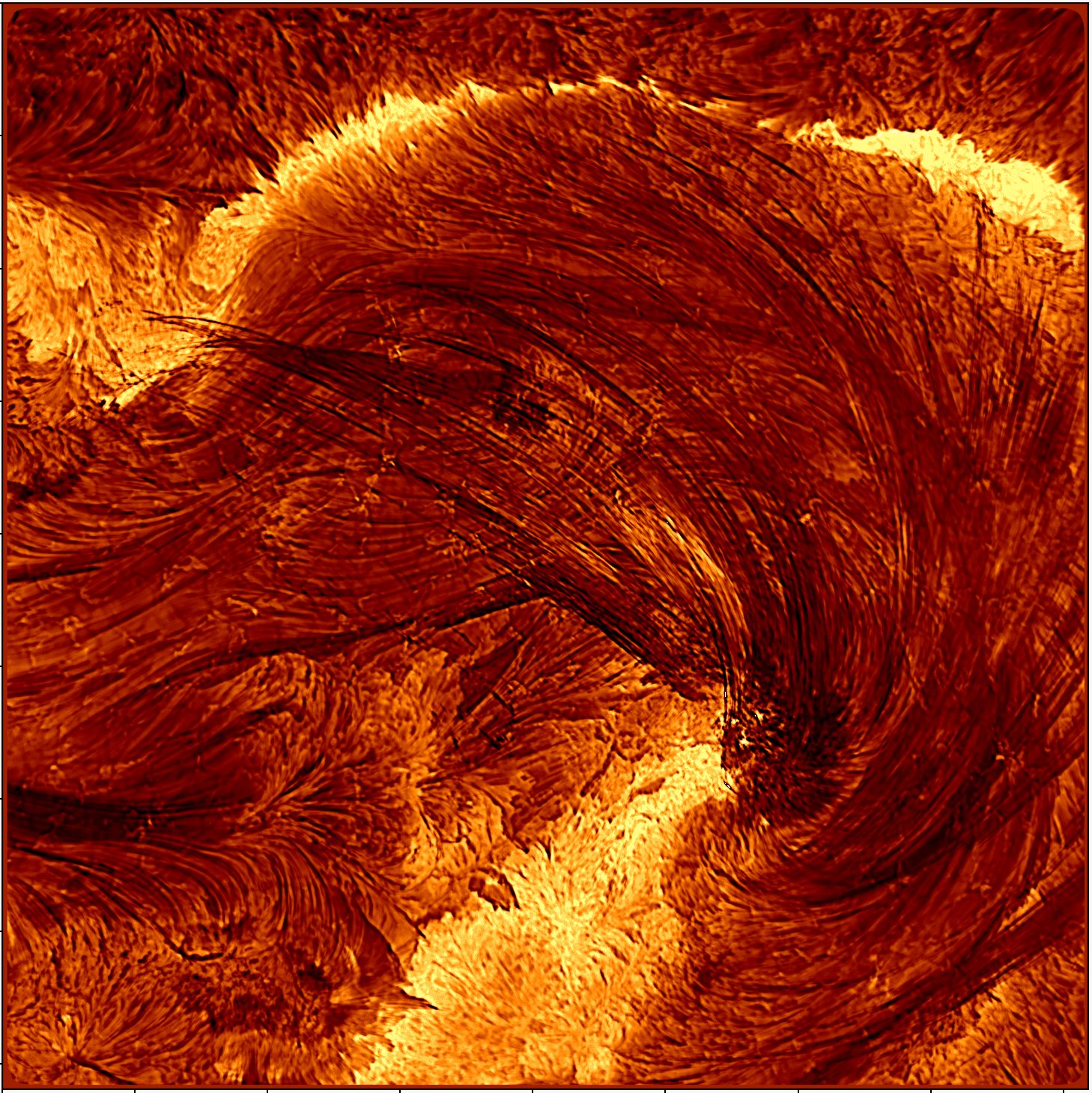
    Despite its incredible heat, our sun‘s corona is so faint compared to the rest of the star that we can rarely make it out except during a total solar eclipse. But a new adaptive optic technique has given us coronal images with unprecedented detail.

    A solar prominence dancing in the Sun's magnetic field lines.

    These images come from the 1.6-meter Goode Solar Telescope at Big Bear Solar Observatory, and they required some 2,200 adjustments to the instrument’s mirror every second to counter atmospheric distortions that would otherwise blur the images. With the new technique, the team was able to sharpen their resolution from 1,000 kilometers all the way down to 63 kilometers, revealing heretofore unseen details of plasma from solar prominences dancing in the sun’s magnetic field and cooling plasma falling as coronal rain.

    Coronal rain -- cooler plasma falling back down along magnetic lines.

    The team hope to upgrade the 4-meter Daniel K. Inouye Solar Telescope with the technology next, which will enable even finer imagery. (Image credit: Schmidt et al./NJIT/NSO/AURA/NSF; research credit: D. Schmidt et al.; via Gizmodo)

  • Building a Better Fog Harp

    Building a Better Fog Harp

    On arid coastlines, fog rolling in can serve as an important water source. Today’s fog collectors often use tight mesh nets. The narrow holes help catch tiny water particles, but they also clog easily. A few years ago, researchers suggested an alternative design — a fog harp inspired by coastal redwoods — that used closely spaced vertical wires to capture water vapor. At small scales, this technique worked well, but once scaled up to a meter-long fog harp, the strings would stick together once wet — much the way wet hairs cling to one another.

    The group has iterated on their design with a new hybrid that maintains the fog harp’s close vertical spacing but adds occasional cross-wires to stabilize. Laboratory tests are promising, with the new hybrid fog harp collecting water with 2 – 8 times the efficiency of either a conventional mesh or their original fog harp. The team notes that even higher efficiencies are possible with electrification. (Image credit: A. Parrish; research credit: J. Kaindu et al.; via Ars Technica)

    Fediverse Reactions
  • Martian Streaks Are Dry

    Martian Streaks Are Dry

    Dark lines appearing on Martian slopes have triggered theories of flowing water or brine on the planet’s surface. But a new study suggests that these features are, instead, dry. To explore these streaks, the team assembled a global database of sightings and correlated their map with other known quantities, like temperature, wind speed, and rock slides. By connecting the data across thousands of streaks, they could build statistics about what variables correlated with the streaks’ appearance.

    What they found was that streaks didn’t appear in places connected to liquid water or even frost. Instead, the streaks appeared in spots with high wind speeds and heavy dust accumulation. The team included that, rather than being moist areas, the streaks are dry and form when dust slides down the slope, perhaps triggered by high winds or passing dust devils.

    Although showing that the streaks aren’t associated with water may seem disappointing, it may mean that NASA will be able to explore them sooner. Right now, NASA avoids sending rovers anywhere near water, out of concern that Earth microbes still on the rover could contaminate the Martian environment. (Image credit: NASA; research credit: V. Bickel and A. Valantinas; via Gizmodo)

    Fediverse Reactions
  • Rolling Down Soft Surfaces

    Rolling Down Soft Surfaces

    Place a rigid ball on a hard vertical surface, and it will free fall. Stick a liquid drop there, and it will slide down. But researchers discovered that with a soft sphere and a soft surface, it’s possible to roll down a vertical wall. The effect requires just the right level of squishiness for both the wall and sphere, but when conditions are right, the 1-millimeter radius sphere rolls (with a little slipping) down the wall.

    Rolling requires torque, something that’s usually lacking on a vertical surface. But the team found that their soft spheres got the torque needed to roll from their asymmetric contact with the surface. More of the sphere contacted above its centerline than below it. The researchers compared the way the sphere contacted the surface to a crack opening (at the back of the sphere) and a crack closing (at the front of the sphere). That asymmetry creates just enough torque to roll the sphere slowly. The team hopes their discovery opens up new possibilities for soft robots to climb and descend vertical surfaces. (Image and research credit: S. Mitra et al.; via Gizmodo)

    Fediverse Reactions
  • Predicting Yield

    Predicting Yield

    We’ve all experienced the frustration of ketchup refusing to leave the bottle or toothpaste that shoots out suddenly. These materials are yield stress fluids, which transition from solid-like behavior to liquid flow once the right amount of force is applied. A new study suggests that — despite their wide range of characteristics — these fluids share a universal relation: their yield transition (when they start to flow) depends on their characteristics when at rest. Interestingly, this relationship seems to hold not only for polymeric fluids like the one in the study but also nonpolymeric ones. (Image credit: haideyy; research credit: D. Keane et al.; via APS Physics)

    Fediverse Reactions
  • Io’s Missing Magma Ocean

    Io’s Missing Magma Ocean

    In the late 1970s, scientists conjectured that Io was likely a volcanic world, heated by tidal forces from Jupiter that squeeze it along its elliptical orbit. Only months later, images from Voyager 1’s flyby confirmed the moon’s volcanism. Magnetometer data from Galileo’s later flyby suggested that tidal heating had created a shallow magma ocean that powered the moon’s volcanic activity. But newly analyzed data from Juno’s flyby shows that Io doesn’t have a magma ocean after all.

    The new flyby used radio transmission data to measure any little wobbles that Io caused by tugging Juno off its expected course. The team expected a magma ocean to cause plenty of distortions for the spacecraft, but the effect was much slighter than expected. Their conclusion? Io has no magma ocean lurking under its crust. The results don’t preclude a deeper magma ocean, but at what point do you distinguish a magma ocean from a body’s liquid core?

    Instead, scientists are now exploring the possibility that Io’s magma shoots up from much smaller pockets of magma rather than one enormous, shared source. (Image credit: NASA/JPL/USGS; research credit: R. Park et al.; see also Quanta)

    Fediverse Reactions
  • Stunning Interstellar Turbulence

    Stunning Interstellar Turbulence

    The space between stars, known as the interstellar medium, may be sparse, but it is far from empty. Gas, dust, and plasma in this region forms compressible magnetized turbulence, with some pockets moving supersonically and others moving slower than sound. The flows here influence how stars form, how cosmic rays spread, and where metals and other planetary building blocks wind up. To better understand the physics of this region, researchers built a numerical simulation with over 1,000 billion grid points, creating an unprecedentedly detailed picture of this turbulence.

    The images above are two-dimensional slices from the full 3D simulation. The upper image shows the current density while the lower one shows mass density. On the right side of the images, magnetic field lines are superimposed in white. The results are gorgeous. Can you imagine a fly-through video? (Image and research credit: J. Beattie et al.; via Gizmodo)