Category: Research

  • Double Detonation in Type 1a Supernovae

    Double Detonation in Type 1a Supernovae

    Type 1a supernovae are agreed to be explosions of white dwarf stars, the remains of stars similar in mass to our Sun. They’re thought to be triggered when extra mass — from a nearby companion star, for example — triggers a runaway fusion reaction in their carbon and oxygen, elements that white dwarfs generally don’t have enough mass to successfully fuse. The runaway fusion then blows the star apart.

    But there’s another theory — demonstrated through numerical simulations — that suggests an alternate mechanism: a small explosion on the star’s surface could compress the interior enough to trigger fusion of the heavier elements there, thereby triggering a second detonation. The two explosions would happen in quick succession, making them difficult to detect, but astronomers predicted that each explosion could create a shell of calcium; given enough time, those two shells could drift apart, allowing astronomers to see a shell of sulfur between them.

    The team looked to a supernova remnant about 300 years old, and using a spectrograph from the Very Large Telescope, they were able to image — as predicted — a two shells of calcium, separated by sulfur, supporting the double-detonation hypothesis.

    The impact of double-detonation in Type 1a supernovae could be far-reaching. Right now, the intensity of these objects seems to be consistent enough that astronomers use their brightness to estimate their distance. Over the years, those distance estimates have been used to measure the universe’s expansion and provide evidence for the existence of dark matter. But if Type 1a supernovae are not all the same intensity, we may need to reevaluate their use as a universal yardstick. (Image credit: ESO/P. Das et al.; research credit: P. Das et al.; via Ars Technica)
    Fediverse Reactions
  • Studying Hydroelastic Turbulence

    Studying Hydroelastic Turbulence

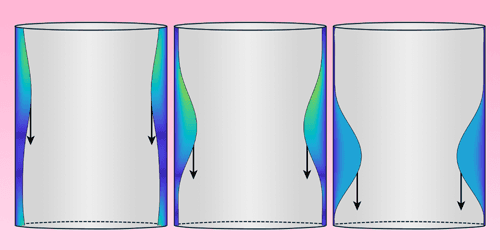
    Can energy at the small-scales of a turbulent flow work its way up to larger scales? That’s a question at the heart of today’s study. Here, researchers are studying hydroelastic waves — created by stretching a thin elastic membrane over a water tank. The membrane gets vibrated up and down in just one location with an amplitude of about 1 millimeter. The resulting waves depend both on the movement of the water and the elasticity of the membrane, mimicking situations like ice-covered seas.

    Rather than simply dying away, the local fluctuations introduced at the membrane spread, coalescing into larger-scale hydroelastic waves. How energy flows between these scales could have implications for weather forecasting, climate modeling, and other turbulent systems. (Image and research credit: M. Vernet and E. Falcon; via APS)

    Fediverse Reactions
  • Roll Waves in Debris Flows

    Roll Waves in Debris Flows

    When a fluid flows downslope, small disturbances in the underlying surface can trigger roll waves, seen above. Rather than moving downstream at the normal wave speed, roll waves surge forward — much like a shock wave — and gobble up every wave in their way.

    Such roll waves are fairly innocuous when flowing down a drainage ditch but far more problematic in the muddy debris flows of a landslide. Debris flows are harder to predict, too, thanks to their combined ingredients of water, small grains, and large debris.

    A new numerical model has shed some light on such debris flows, after showing good agreement with a documented landslide in Switzerland. The model suggests that roll waves get triggered in muddy flows at a higher flow speed than in a dry granular flow but a lower flow speed than is needed in pure water.

    For a great overview of roll waves, complete with videos, check out this post by Mirjam Glessner. (Image credit: M. Malaska; research credit: X. Meng et al.; see also M. Glessmer; via APS)

    Fediverse Reactions
  • Uranus Emits More Than Thought

    Uranus Emits More Than Thought

    Since Voyager 2 visited Uranus in 1986, scientists have debated the odd ice giant’s heat balance. The other giant planets of our solar system — Jupiter, Saturn, and Neptune — all emit much more heat than they absorb from the sun, indicating that they have strong internal heat sources. Voyager 2’s measurements from Uranus indicated only weak heat emissions.

    But a new study indicates that Uranus does, in fact, have an internal heat source contributing to its heat flux. The study combined observations with a global model of Uranus across the planet’s full 84-year orbit and concluded that Uranus emits 12.5% more internal heat than it absorbs from the sun. That suggests that Uranus may not be so different from its fellow giants, but the planet’s large seasonal variations and differences across hemispheres raise plenty of questions about the planet’s interior structure. (Image credit: NASA; research credit: X. Wang et al.; via Gizmodo)

    Fediverse Reactions
  • What Makes a Dune?

    What Makes a Dune?

    Wind and water can form sandy ripples in a matter of minutes. Most will be erased, but some can grow to meter-scale and beyond. What distinguishes these two fates? Researchers used a laser scanner to measure early dune growth in the Namib Desert to see. They found that the underlying surface played a big role in whether sand gathered or disappeared from a given spot. Surfaces like gravel, rock, or moistened sand were better for starting a dune than loose sand was. Each of these surface types affected how much sand the wind could carry off, as well as whether grains bounced or stuck where they landed. Every trapped sand grain made the surface a little rougher, increasing the chances of trapping the next sand grain. Over time, the gathering sand forms a bump that affects the wind flow nearby, further shaping the proto-dune. As long as the wind isn’t strong enough to scour the surface clean, it will keep gathering sand as the process continues. (Image credit: M. Gheidarlou; research credit: C. Rambert et al.; via Eos)

    Fediverse Reactions
  • Seeding Clouds With Wildfire

    Seeding Clouds With Wildfire

    Raging wildfires send plumes of smoke up into the atmosphere; that smoke is made up of tiny particles that can serve as seeds — nucleation sites — where water vapor can freeze and form clouds. To understand wildfire’s effect on cloud growth, researchers sampled air from the troposphere (the atmosphere’s lowest layer) both in and around wildfire smoke.

    The team found that smoke increased the number of nucleating particles up to 100 times higher than the background air, but the exact make-up of the smoke varied significantly by fire. Smoke particles were mostly organic, though inorganic ones appeared as well. The temperature of a fire, as well as what materials it was burning, made a big difference; the fire where they measured the highest particle concentrations included lots of unburned plant material, thought to be carried aloft by turbulence around the fire. (Image credit: K. Barry; research credit: K. Barry et al.; via Eos)

    Fediverse Reactions
  • Forming Vesicles on Titan

    Forming Vesicles on Titan

    Scientists are still debating exactly what shifts nature from chemical and physical reactions to living cells. But vesicles — small membrane-bound pockets of fluid carrying critical molecules — are a commonly cited ingredient. Vesicles help cluster important organic molecules together, increasing their chances of combining in the ways needed for life. Now scientists are suggesting that Titan, Saturn’s moon, could form vesicles of its own.

    On Earth, molecules known as amphiphiles feature a hydrophilic (water-loving) end and a hydrophobic (water-fearing) one. When dispersed in water, amphiphiles crowd at the surface, placing their hydrophilic end in the water and their hydrophobic end outward toward the air. On Titan, the Cassini mission revealed organic nitrile molecules that behave similarly with methane rather than water.

    Their two-sided structure means that these molecules — like Earth’s amphiphiles — will gather at the surface of Titan’s liquids. When methane rain falls on the Titan’s seas, the impact creates aerosol droplets that slowly settle back to the liquid surface. When that happens, the droplet’s molecular monolayer and the lake’s monolayer meet, enclosing the droplet’s contents in a double-layer of molecules that prevent contact between the droplet and the lake.

    Within that newly-formed vesicle, all kinds of molecules can bump shoulders, creating new opportunities for complex chemistry. (Image credit: Titan – ESA/NASA/JPL/University of Arizona, illustration – C. Mayer and C. Nixon; research credit: C. Mayer and C. Nixon; via Gizmodo)

    Fediverse Reactions
  • Cloud Convection on Titan

    Cloud Convection on Titan

    Saturn’s moon Titan is a fascinating mirror to our own planet. It’s the only other planetary body with surface-level liquid lakes and seas, but instead of water, Titan’s are made of frigid ethane and methane. Like Earth, Titan has a weather cycle that includes evaporation, condensation, and rain. And now scientists have made their first observations of clouds convecting in Titan’s northern hemisphere.

    Using data from both the Keck Observatory and JWST, the team tracked clouds on Titan rising to higher altitudes, a critical step in the planet’s methane cycle. This translation took place over a period of days, giving scientists modeling the Saturnian moon new insight into the seasonal behaviors of Titan’s atmosphere. (Image credit: NASA/ESA/CSA/STScI; research credit: C. Nixon et al.; via Gizmodo)

    Fediverse Reactions
  • Searching for the Seiche

    Searching for the Seiche

    A rock and ice face in Dickson Fjord after its collapse.

    On 16 September 2023, seismometers around the world began ringing, registering a signal that — for 9 days — wobbled back and forth every 92 seconds. A second, similar signal appeared a month later, lasting about a week. Researchers tracked the signal’s origin to a remote fjord in East Greenland, where it appeared a glacier front had collapsed. The falling rocks and ice triggered a long-lasting wave — a seiche — that rang back and forth through the fjord for days.

    Simulations showed that a seiche was plausible from a rockfall like the two that caused the seismic signal, but, without first-hand observations, no one could be certain. Now a new study has looked at satellite data to confirm the seiche. Researchers found that the then-new Surface Water and Ocean Topography (SWOT) satellite and its high-resolution altimeters had passed over the fjord multiple during the two landslide events. And, sure enough, the satellite captured data showing the water surface in the fjord rising and falling as the seiche ricocheted back and forth.

    It’s a great reminder that having multiple instrument types monitoring the Earth gives us far better data than any singular one. Without both seismometers and the satellite, it’s unlikely that scientists could have truly confirmed a seiche that no one saw firsthand. (Image credit: S. Rysgaard; research credit: T. Monahan et al.; via Eos)

    Fediverse Reactions
  • Featured Video Play Icon

    See the Solar Wind

    After a solar prominence erupts, strong solar winds flow outward from the sun, carrying energetic particles that can disrupt satellites and trigger auroras if they make their way toward us. In this video, an instrument onboard the ESA/NASA’s Solar Orbiter captures the solar wind in the aftermath of such an eruption. The features seen here extended 3 solar radii and lasted for hours. The measurements give astrophysicists their best view yet of this post-eruption relaxation period, and the authors report that their measurements are remarkably similar to results of recent magnetohydrodynamics simulations, suggesting that those simulations are accurately capturing solar physics. (Video and image credit: ESA; research credit: P. Romano et al.; via Gizmodo)

    Fediverse Reactions