One of my favorite aspects of fluid dynamics is how well it pairs with so many other fields, from mathematics and space exploration to biology, medicine, and even paleontology. That last field is key to today’s question, namely: how did a prehistoric reptile the size of an F-16 manage to fly?
As Joe’s video describes, many factors went into Quetzalcoatlus’ flight. The pterosaur had strong but hollow bones to save on weight while anchoring flight muscles. Its wing shape mimicked an airfoil’s. And, finally, it overcame the challenge of taking off by using both its front and hind limbs to leap off the ground, much like modern bats do.
There’s no doubt that it would be stunning (and probably terrifying!) to see these creatures in action. But you may wonder how scientists piece together these animals from incomplete fossils. Don’t worry! There’s a video for that question, too. (Video and image credit: It’s Okay to Be Smart; see also the video’s references)
Recent changes to the Golden Gate Bridge’s guardrails have created a new soundscape in the Bay Area. Under high winds, the bridge gives off an eerie, otherworldly wail that can be heard even miles away. The new guardrails are substantially thinner than the previous ones, which reduces the wind load the bridge has to endure. But that thinner profile is also what causes the noise, through a well-known phenomena known as vortex shedding.
Animation of vortex shedding behind a cylinder. (Image credit: Wikimedia)
As air moves past a non-streamlined body, like a cylinder, it forms counter-rotating vortices that peel off the body at a set frequency. Fluid dynamicists use a non-dimensional number, the Strouhal number, to characterize this vortex shedding. For a simple shape like a cylinder, the Strouhal number is relatively constant, so I decided to do a quick and dirty calculation to examine the wind velocities responsible for the sound. (See also my analysis of Star Trek Voyager’s opening sequence.)
I began by collecting several videos with samples of the bridge’s singing (1, 2, 3). Then I used Adobe Audition to analyze the frequency content of the bridge noise. Below is a sample snapshot from a video taken on the bridge’s bike path, right next to the guardrail. The analysis shows three broad, but distinct peaks: a primary peak at 430 Hz, a small harmonic of that frequency at 860 Hz, and a separate, secondary peak centered at 1070 Hz. The broadness of the peaks, along with the competition between the primary and secondary peaks, is probably responsible for the disconcerting, discordant nature of the sound.
Frequency analysis of the Golden Gate Bridge’s “singing”, taken from a section of this video. (Image credit: N. Sharp)
Of the other videos I analyzed, a second video from near the bridge also showed the 430 Hz peak, while a video from further away had a dominant frequency of 517 Hz. There’s a lot of uncertainty introduced in not knowing exactly when each video was filmed, but given the agreement between videos 2 and 3, I suspect that video 1’s higher frequency may be caused by interference and modulation as the sound travels.
With the major frequency in hand, I estimated the size of the new guardrail wires as 10mm in diameter. After some tweaking to adjust the Reynolds number and Strouhal numbers, that gave me an estimated wind speed of 21 meters per second, or about 47 miles per hour. That’s right in line with the 43 miles per hour discussed by the news anchors.
What if the guardrails are a little thinner? If the wires are about 7.5 mm in diameter, then it only takes winds at about 15 meters per second (34 miles per hour) to create that 430 Hz note.
Keep in mind that this analysis doesn’t predict the minimum wind speed needed to create the audible noise; all I’m able to do is a back-of-the-envelope calculation of what the likely wind speed was when a video was recorded. Nevertheless, I hope you’ll find it interesting! (Video credit: KPIX CBS News; image credits: vortex shedding – Wikimedia, frequency analysis – N. Sharp; submitted by Christina T.)
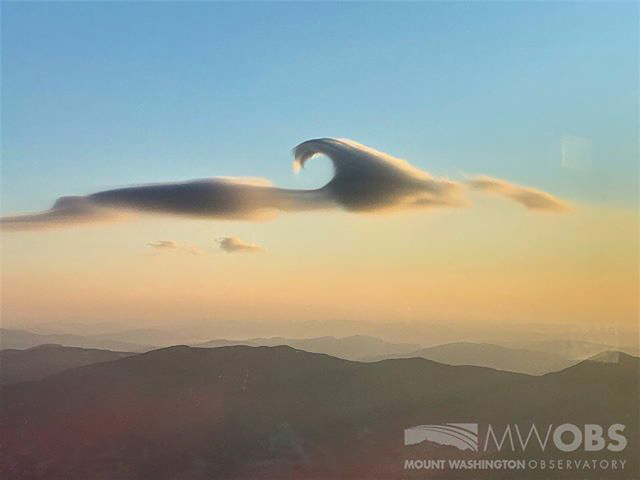
Lens-shaped lenticular clouds are not terribly rare in mountainous areas, but observers at Mount Washington caught a very unusual cloud near sunrise in late February. This lenticular cloud had an added curl on top thanks to the Kelvin-Helmholtz instability!
Lenticular clouds form when air is forced to flow up over a mountain in such a way that its temperature and pressure drop and water vapor in the air condenses. The resulting water droplets form a cloud that appears stationary over the mountain, even though the air continues to flow.
To get that added wave-like curl, there needs to be another, faster-moving layer of air just above the cloud. As that air flows past, it shears the cloud layer, causing the interface to curl. Neither of these cloud types is long-lived — Kelvin-Helmholtz formations often last only a few minutes — so catching such a great dual example is lucky, indeed! (Image credit: Mount Washington Observatory; via Smithsonian Magazine; submitted by Kam-Yung Soh)
The Glen Canyon Dam lies on the Colorado River, upstream of the Grand Canyon. Because the dam blocks sediment from upstream, the region’s only sediment sources are two tributary rivers downstream of the dam. Periodically, the Bureau of Reclamation releases high flows from the dam in order to mimic the seasonal floods that existed on the river before the dam was built. These surge flows pick up hundreds of thousands of tonnes of sediment from the tributary rivers and push it downstream, creating and renewing sand bars and beaches along the Colorado. (Video and image credits: Bureau of Reclamation, 1, 2)
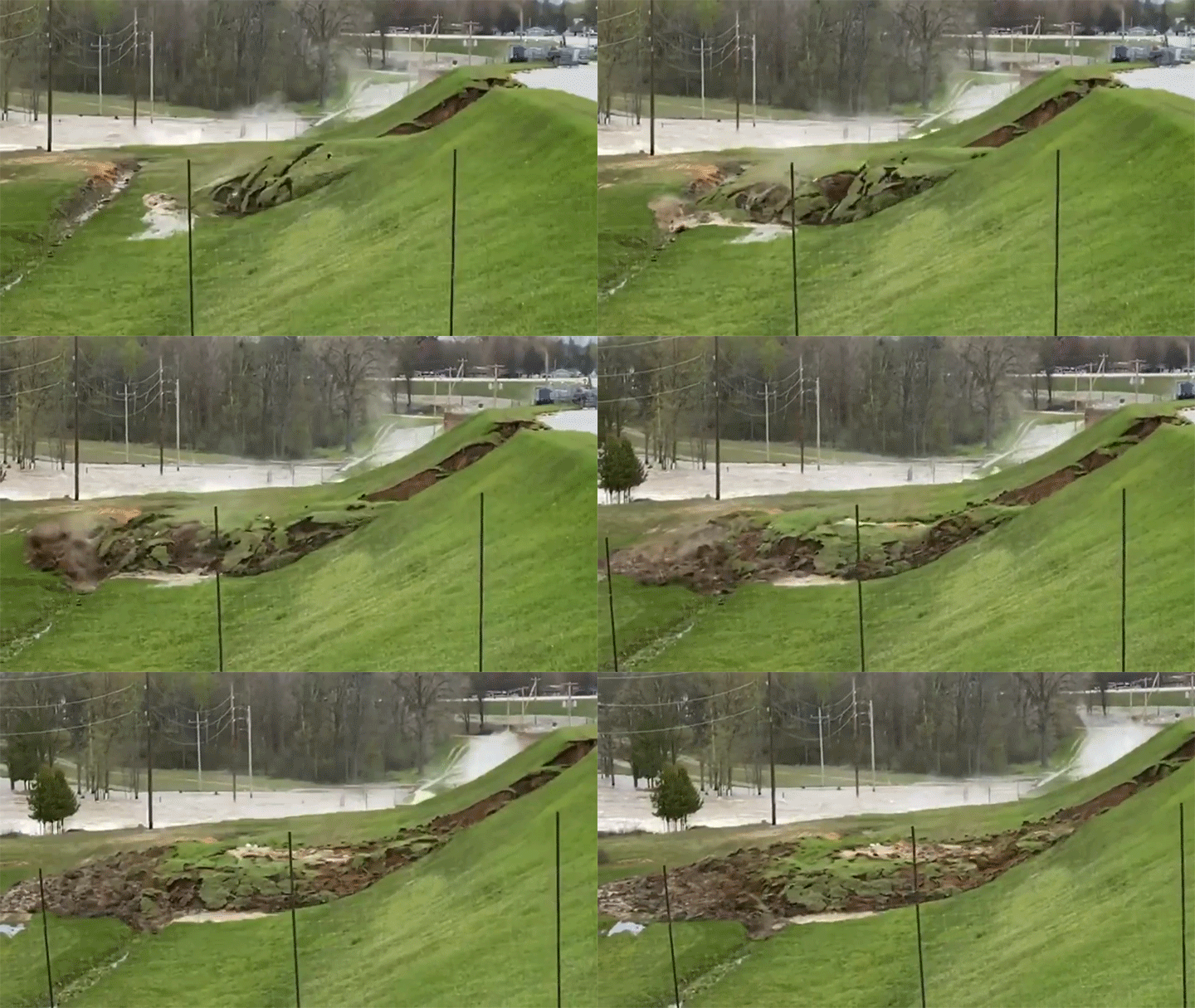
Last week Michigan’s Edenville Dam failed, triggering catastrophic flooding. While the exact causes of dam’s failure are not yet clear, this video of the collapse provides some interesting hints.
As the video begins, we see water that’s already trickled down the slope, potentially a sign that the top of the dam has already degraded. Then a noticeable bulge forms near the bottom of the earthwork slope, followed quickly by a landslide. Water doesn’t pour out immediately, though. That delay suggests that only part of the dam’s thickest section failed in the landslide. During the delay, the remaining interior of the dam is failing from the sudden lack of support. Then, the floodwaters come pouring out.
From the sequence of events, it seems likely that the dam was suffering from soil liquefaction prior to the collapse. With high water levels behind the dam, pressure can drive water into the soil beneath the dam, reducing its strength. You can see this effect in action in this video and this one. For more on the Edenville dam specifically, check out the great analysis over at AGU from Dave Petley (1, 2).
Sadly, failures like these are quite avoidable, provided dams are properly maintained. Climate change is drastically altering precipitation patterns across the world, and without updating and reworking our infrastructure to account for that, we’ll see more failures like this in the future. (Video and image credit: L. Coleman/MLive; via Earther; see also D. Petley 1, 2)
For many engineering students, their first exposure to fluid dynamics comes in a heat transfer class. The typical focus in these classes is not on the underlying physics but on learning to use empirical formulas and correlations that are used in engineering heat exchangers, computer fans, and other applications.
As part of this, students are presented with an extremely simplified view of classical flows like flow over a flat wall, known as a flat-plate boundary layer. Students are told that there are two main features of this and other flows: a laminar region where flow is smooth and orderly, and a turbulent region where flow is chaotic and better at mixing. The transition between these two, according to the undergraduate picture, takes place at a particular point that can be calculated as part of the correlation.
The problem with this picture is that it grossly oversimplifies the actual physics, and for students who may not take dedicated, graduate-level fluid dynamics courses, leaves future engineers with a false understanding that may impact their designs. The truth of transition is far more complicated and nuanced. Transition from laminar to turbulent flow rarely takes place at a single, predictable point; instead it takes place over an extended region and where it begins depends on factors like geometry, vibration, and the level of turbulence already present in the flow.
In an effort to bring undergraduate heat transfer correlations more in line with actual physics — as well as with real, experimental data — a new study revamps the mathematical models. Personally, I applaud any effort to add some nuance to the introduction of this important topic. (Image and research credit: J. Lienhard; via phys.org)
Enormous whirlpools are not simply the work of overactive imaginations. There are several spots in the world, including Japan’s Naruto Strait, that regularly see these spectacular vortices.
Naruto’s whirlpools are formed through the interaction of tidal currents with the local topography. Spring tides funneled through the vee-shaped strait can reach speeds of 20 kph as they rush between the Pacific Ocean and the Inland Sea. Below the surface, there’s also a deep depression that helps bring the tides together in such a way that it generates vortices 20 meters in diameter.
In normal times, the whirlpools are a significant tourist attraction during the springtime. Travelers can view them from tour boats, helicopters, and from the Onaruto Bridge. (Image credits: whirlpools – Mainichi/N. Yamada, Discover Tokushima; artwork: Hiroshige; via Mainichi; submitted by Alan M.)
NASA Goddard has produced another gorgeous visualization of how various aerosols move around our world. This visualization is constructed from data collected between August 2019 and January 2020, which means that it captures numerous typhoons as well as the extreme bushfires that occurred in Australia.
Different colors represent different aerosol sources: carbon (red), sulfate (green), dust (orange), sea salt (blue), and nitrate (pink). The brighter the color, the higher the concentration of aerosols. With this, we see steady patterns of natural sea salt transport and the billowing flow of dust from Saharan Africa. But we can also see manmade pollution from sources across the Northern Hemisphere, as well as major output from the Australian bushfires. It’s a good reminder that none of us is truly isolated in this interconnected world of ours. (Video and image credit: NASA Goddard; via Flow Vis)
This false-color satellite image — the recent winner of NASA Earth Observatory’s Tournament Earth 2020 — shows sands and seaweed off the coast of the Bahamas. Ocean currents and tides eroded these elaborate fluted designs in much the same way that winds sculpt desert dunes. The overlap in form is no accident; as seen in recent work, researchers are finding that both air and water move granular materials like sand according to the same rules. (Image credit: S. Andrefouet; via NASA Earth Observatory)
A bioluminescent phytoplankton bloom is causing a stir among California beachgoers. During the daytime, aggregations of Lingulodinium polyedra appear reddish-brown in color (think the classic ‘red tide’). But at night the phytoplankton bioluminesce, specifically when they’re disturbed by a change in shear force. This is why the brightest glows are visible in crashing waves or around the boards of surfers.
Beautiful as it appears, blooms like these are deadly to marine life. The excess numbers of phytoplankton strip water of oxygen, causing mass die-offs among fish. Even residents several miles inland of the beaches are reporting the unpleasant smell that results. (Image credits: AP; video credit: Scripps Institute of Oceanography; via Gizmodo)