Fire plays an important role in nature, one with which humanity must live without controlling fully. After several disastrous historic wildfires in the American West, the U.S. Forest Service established its own fire lab, where research foresters can study flames firsthand. This video takes us inside the Fire Lab for a look at the facilities and people responsible for helping us better understand this fundamental force of nature. (Video and image credit: Gizmodo + Atlas Obscura)
Category: Phenomena

An Introduction to the Reynolds Number
For those who’d like an overview of the mathematics involved in fluid dynamics, Numberphile has a lovely introduction, given by our friend Tom Crawford. The governing equations in fluid dynamics, the Navier-Stokes equations, are quite complicated, but that’s just been inspiration for scientists and mathematicians to come up with clever ways to simplify them. And, ultimately, that’s what the Reynolds number is — a way to help us judge which forces, and therefore which mathematical terms, are the most important in a given problem. (Video credit: Numberphile; submitted by COMPLETE)


Flow on Commercial Wings
Even in an era of supercomputers, there is a place for quick and dirty methods of flow visualization. Here we see a model of a swept wing like those seen on many commercial airliners. It was painted with a layer of fluorescent oil, then placed in a wind tunnel and subjected to flow. As air blows across the model, it moves the oil, leaving behind streaks that show how air near the surface moves.
We can see, for example, that near the fuselage, the air flows mostly front to back across the wing. That’s what we expect, especially for a wing generating lift. But further out on the wing, the flow moves mostly along the wing, not across it. There’s also a distinctive line running just a short ways behind the leading edge on this outer section of wing. It looks as though air flowing over the wing separated at this point, leaving disordered and unhelpful flow behind. It’s likely that the model was tested at an angle of attack where the outer section of the wing was beginning to stall. (Image credit: ARA)

Inside the Earth’s Mantle
Plate tectonics is a relatively young scientific theory, only gaining traction among geologists in the late 60s and early 70s. One key tenet of the theory is subduction where plates meet and one is forced down into the mantle, like in this illustration of the subduction zone near Japan. In early incarnations of the theory what happens to that subducting slab of rock once it’s in the mantle were ignored. But over the decades, geologists have built maps of the interior of our planet through the seismic waves they record. What they’ve found is that the continental chunks that break off and sink can have long-lasting effects.
Beneath the Earth’s crust, the mantle behaves like an extremely slow-moving fluid under incredibly high temperatures and pressures. It can take tens of millions of years, but those broken slabs sink through the mantle, dragging fluid with them. This creates a large-scale flow known as a mantle wind, which can have far-reaching effects at the Earth’s surface. Through modeling and simulation, geologists have found these deep mantle flows may explain why mountain ranges like the Himalayas and Andes didn’t grow until millions of years after their plates collided and why earthquakes sometimes occur far from plate boundaries. For more, check out this great article from Ars Technica. (Image credit: British Geological Survey; via Ars Technica; submitted by Kam-Yung Soh)

Jovian Vortices
Jupiter continues to mesmerize in the images from JunoCam. With enhanced contrast, the planet’s eddies look like swirls you could just lean forward and fall into. The complexity of the Jovian atmosphere’s mixing is just astounding. It’s like an ever-changing Impressionist painting brought to life. Check out full-size versions of these stunning images here and here. (Image credit: NASA/JPL-Caltech/SwRI/MSSS/Kevin M. Gill, 1, 2; via Planetary Society; submitted by jpshoer)

Swirling Vortex
So much of fluid dynamics comes down to finding the right way to observe a flow. This image of a swirling tropical system was captured by an astronaut aboard the International Space Station in April 2019. The low sun angle at the time makes the shadows stretch long across the cloud tops, giving them greater definition as well as a tint of sunset color. As drastic as the system looks from this angle, it was a short-lived vortex that never made landfall, so it was never officially named. (Image credit: Expedition 59 Crew; via NASA Earth Observatory)

The Microscopic Ocean
When you’re the size of plankton, water may as well be molasses. Viscosity rules at these scales, and swimming plankton leave distinctive wakes that are slow to dissipate. Fish that feed on plankton use these trails to find their prey. But this microscopic world is changing as the ocean warms.
At higher temperatures, water is less viscous, and plankton wakes don’t last as long. To make matters worse for hungry fish, warmer waters have led to an explosion in a species of faster plankton, capable of moving hundreds of body lengths a second. This species is far more difficult to catch, which may explain some of the collapses we’re observing in populations of fish like cod and haddock. (Video and image credit: BBC Earth Lab)

Wave Clouds in the Front Range
Last Sunday night metro Denver was treated to a rare sight: clouds resembling breaking waves formed near sunset. These are Kelvin-Helmholtz clouds, and the comparison to ocean waves is apt, since the same physics is behind both. Winds were unusually calm near the ground Sunday night, but strong winds blew at the altitude just above the lower cloud layer. That velocity difference created strong shear where the two air layers met. With the cloud layer in place to differentiate the slower-moving air from the faster, we can what’s normally invisible: how the two air layers mix.
The Denver Post has several more views of the wave clouds from around the area, and you can learn lots more about the Kelvin-Helmholtz instability here. (Image credit: R. Fields; via the Denver Post)

Coke and Butane Rockets
Rocket science has a reputation for being an incredibly difficult subject. But while there’s complexity in the execution, the concept behind rockets is pretty simple: throw mass out the back really fast and you’ll move forward. Whether you’re talking about a Saturn V or these Coke-and-butane-powered bottles, the basic principle is the same.
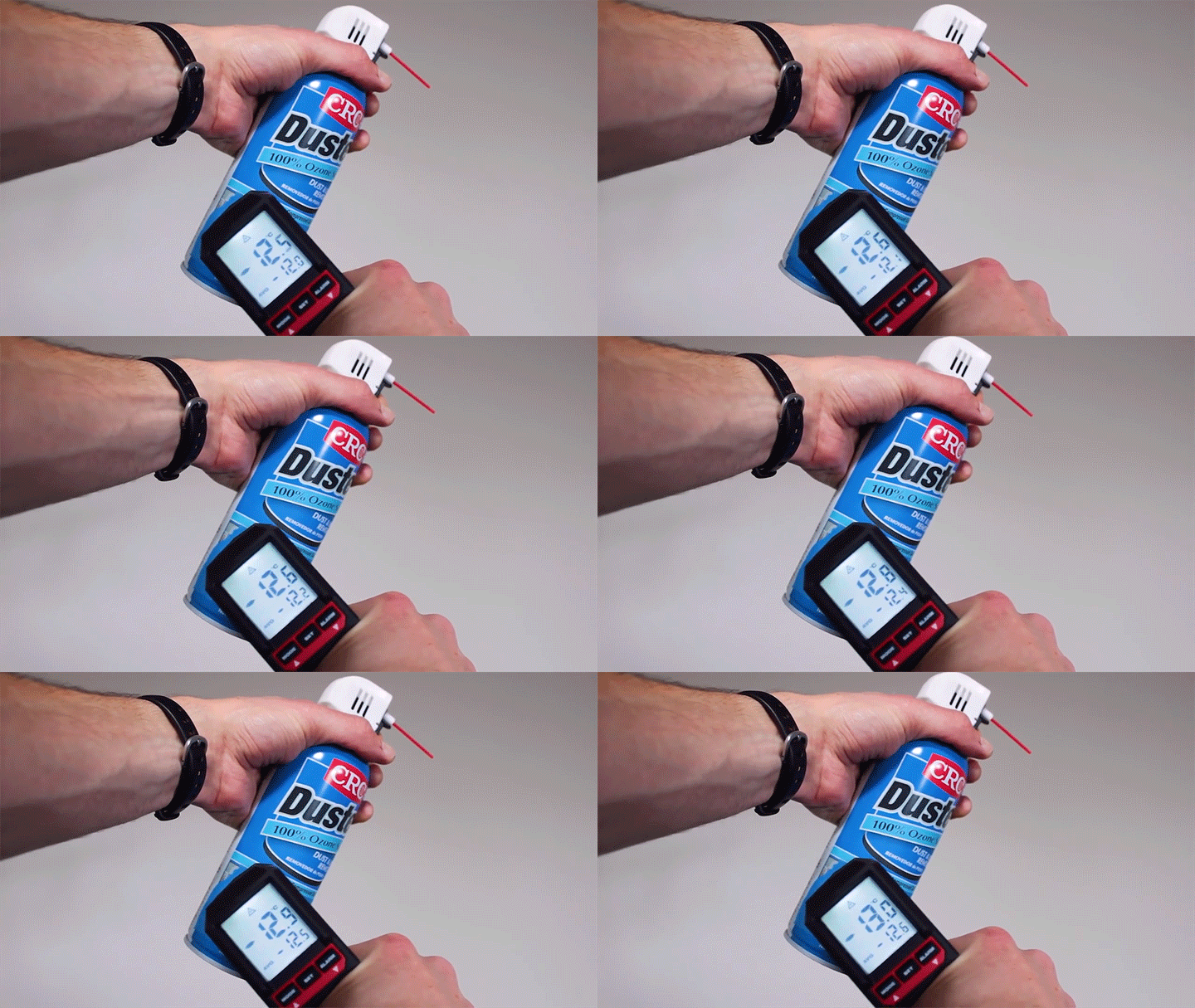
These rockets get their kick mostly from the added butane, which has a very low boiling point. When the bottle is flipped, the lighter butane is forced to rise through the Coke. With a large surface area of liquid butane exposed to the warmer Coke, the butane becomes gaseous. That sudden increase in volume forces a liquid-Coke-and-gaseous-butane mixture out of the bottle, which has a helpful nozzle shape to further increase the propellant’s speed. Once the phase change is underway, the rocket quickly takes off! (Image and video credit: The Slow Mo Guys)

Streaming Fire
I’m just going to start this one with a blanket statement: DO NOT TRY THIS. Instead, enjoy the fact that the Internet enables us to enjoy the sight of burning gasoline in slow mo without any danger to ourselves.
In this video, Gav and Dan capture a burning bucket of gasoline as it’s thrown against glass. One thing this stunt really highlights is that it’s not the liquid gasoline that burns, it’s the vapor. However, since gasoline is volatile – in other words, it evaporates easily – the fire is quick to spread, especially as the toss atomizes droplets near the edge of the fluid. That’s why you see distinct streaks near the edge of the spreading flame and a non-burning liquid in the center. (Image and video credit: The Slow Mo Guys)