Category: Phenomena

  • Featured Video Play Icon

    Sunlight Is Older Than You Think

    Joe Hanson over at “It’s Okay to Be Smart” has a great video on the random walk photons have to make to escape the core of the sun and other stars. Because the high-energy photons born in the star’s core have to bounce their way out rather than flying in a straight line, those photons can spend thousands of years escaping the sun. After that, the eight-and-a-half minute trip to Earth is nothing.

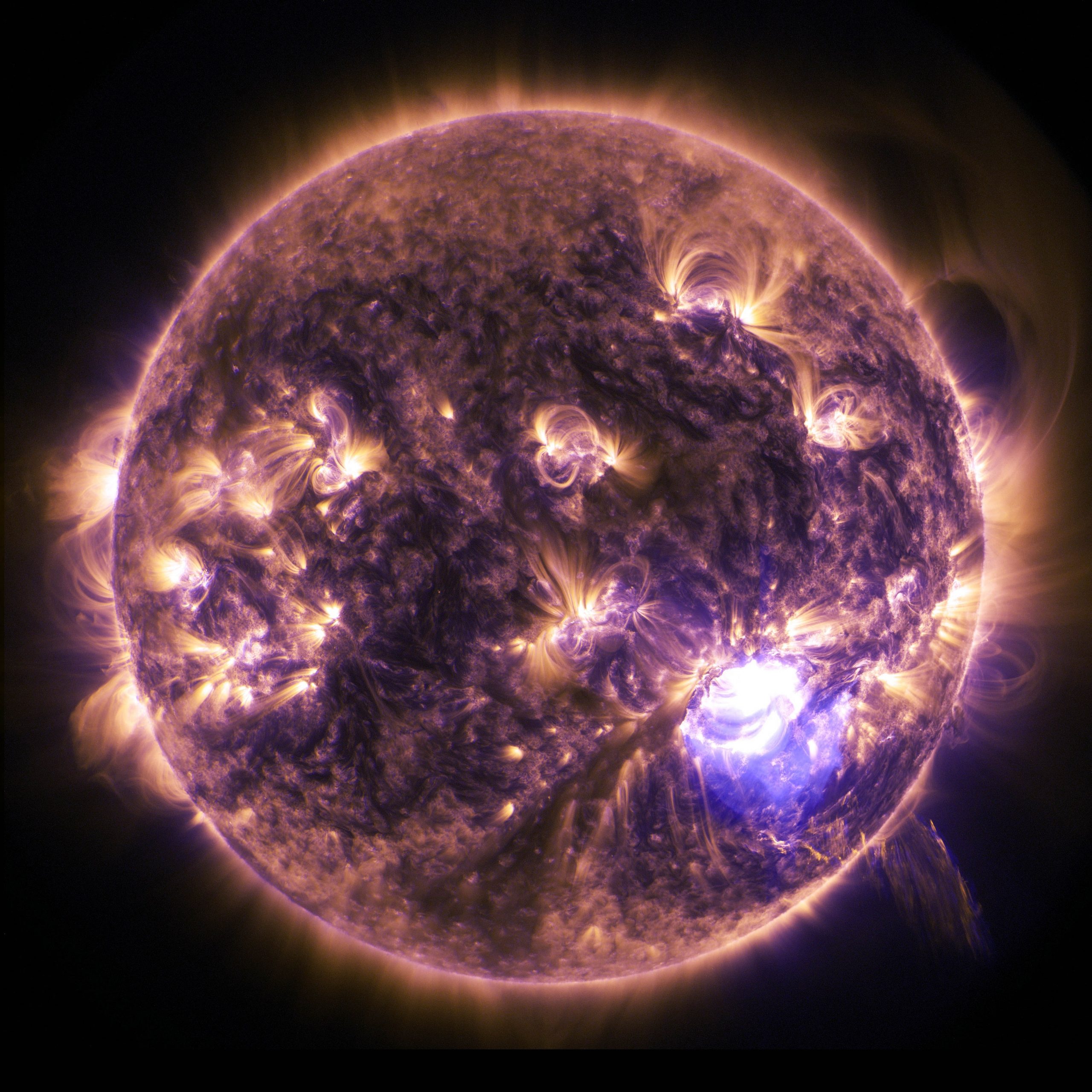
    But there’s a key element missing in this explanation: convection! That radiative random walk photons do doesn’t last all the way from the core of the sun to its surface. From a depth of about 200,000 km onward, the dominant mode of transport in the sun is convection, actual fluid motion that carries heat and light much faster than simple molecular diffusion, or Brownian motion, does. That’s why the surface of the sun shines with convection cells similar to the ones you’ll see in your skillet when heating a layer of oil.

    Fluid motion beyond molecular diffusion is also a big part of the other flows Joe describes in the video. If you had to wait on Brownian motion in order to smell your morning coffee, it would be cold long before you knew it was there! (Video and image credit: It’s Okay to Be Smart; sun surface image credit: Big Bear Solar Observatory/NJIT)

  • Featured Video Play Icon

    The Cricket’s Chirp

    Growing up, my summer nights often featured a chorus of crickets and bull frogs. Even now, the sound of those chirps reminds me of home. So how do crickets make their calls? As this video shows, it’s a matter of scraping the hard edge of one wing along a tiny series of spines, similar to the teeth of a comb, that sit on the other wing.

    How fast the cricket’s wings move affects how frequently the chirps are heard. Being cold-blooded, the insects’ speed is affected by the external temperature, which is why you can count cricket chirps to estimate the temperature. Essentially, the chemical reactions necessary to regulate wing movement are temperature-dependent, so colder crickets produce slower chirps. (Video and image credit: Deep Look)

  • Featured Video Play Icon

    Tranquilizer Darts in Slow Mo

    Like most syringes, tranquilizer darts use pressure to drive flow. But where a typical syringe has that pressurization provided by a human driving the piston, tranquilizer darts must deploy without any hands-on action. As shown in the video above, this is achieved by pressurization prior to firing.

    The tranquilizer dart has a few key features. Its needle, though sharp, does not have a hole in the end. Instead, it has a hole partway down the barrel of the needle, which is covered before launch by a rubber sleeve. The dart also contains two chambers. One is filled with the medicine being deployed. The other gets pressurized with air through a one-way valve. As long as the rubber sleeve stays over the needle’s hole, the dart is then pressurized, but the fluid has nowhere to go.

    Until it’s fired, of course. On impact, the rubber sleeve is pushed away, and the higher pressure inside the air chamber drives the medicine out of the needle and into the animal. (Video and image credit: The Slow Mo Guys)

  • The Sand Sea’s End

    The Sand Sea’s End

    The northern extent of Africa’s Namib Sand Sea ends where the reddish dunes meet the Kuiseb River and the hard, rocky land on its other side. Within the sand sea, dunes stretch as high as 300 meters while the prevailing winds create and march them across the desert. Although dunes rarely occur in isolation, the mechanisms that regulate dune-dune interactions are still poorly understood, though new experiments are beginning to shed light on the processes. (Image credit: USGS/NASA Earth Observatory)

  • Featured Video Play Icon

    “It’s All About Flow”

    Fluid dynamicists, like other scientists, have lives and interests well beyond our research. Ivo Nedyalkov, for example, is a professional rapper in addition to a PhD-level fluid dynamicist. In “It’s All About Flow,” Dr. Ivo brings those areas of expertise together with a rap all about fluid dynamics. The version embedded here is a bit shorter than the full version, which digs not only into experimental fluid dynamics but into computational work as well.

    Check it out, and if you’d like to see the full lyrics and explanation behind them, he’s posted those as well. You can also ping me here or on Twitter if you’d like to know more about the phenomena he discusses. (Video and image credit: I. Nedyalkov/ASME; full video here; lyrics and explanation)

  • A Microfluidic Zoo

    A Microfluidic Zoo

    Microfluidic channels are excellent at creating a steady supply of droplets. But depending on the characteristics of the two viscous fluids being used, as well as factors like flow rate and channel geometry, the results can be anything from well-defined and separated drops to steady jets to wild instabilities. The image above shows a series of different outcomes, including waves that break on the edges of drops and ligaments that stretch around the central fluid. (Image and research credit: X. Hu and T. Cubaud)

  • Ice Patterns

    Ice Patterns

    Periods of freezing and thawing can leave complicated patterns in ice, as seen in this aerial photo of Binnewater Lake in New York. Ice rarely forms evenly on large bodies like this, so there are always underlying weaknesses. A hard freeze may have caused the ice to contract, forming the initial radial pattern. Then warmer periods of melting allowed water to rise into the cracks and expand them. As the process repeats, the visible pattern emerges.

    Also note the star-like crack patterns near the shore. These may have formed in spots where something like a stick protruding from the water’s surface allowed warmer water up onto the ice to melt the snow sitting atop it. (Image credit: D. Spitzer; via EPOD; submitted by Kam-Yung Soh)

  • Featured Video Play Icon

    Boiling Water Using Ice Water

    Steve Mould demonstrates a neat thermodynamic trick in this video by using ice water to boil hot water. The key to understanding this is recognizing that the boiling point of water depends both on its temperature and its pressure.

    Here’s the set-up (which, to be clear, neither he nor I recommend you try yourself): microwave some water in an open bottle until the water is hot enough to boil. Remove the bottle from the microwave and screw on the lid. At this point, you’ve confined any water vapor coming off the hot water, thereby raising the pressure inside the bottle. Even though it’s still quite hot, the water will stop visibly boiling.

    Now pour ice water over the top of the bottle. Because water vapor has a lower heat capacity than liquid water, this will preferentially cool the vapor. As its temperature drops, its pressure will also drop. Liquid water boils at lower temperatures when the pressure is lower. (This is part of why cooking and baking instructions are quite different in Denver than they are in Miami.) When the internal pressure in the bottle drops, the remaining hot water will start to visibly boil. (Image and video credit: S. Mould)

    Animation of boiling water using ice water.
  • Featured Video Play Icon

    The World in a Droplet

    Capturing refracted images in a droplet is a popular pastime among high-speed photographers, and in this solo Slow Mo Guy outing, we get to see that process in video. Physically, the subject is a simple drop of water, which on impact with a pool, rebounds into a Worthington jet and ejects one or more droplets from its tip. Despite hundreds of years of study, it’s still a joy to watch, especially at 12,000 frames per second.

    It’s also not the easiest image to capture, and one thing I rather enjoy about this video is how it gives you a sense of the trial and error involved in capturing just the right view. Even without having to worry about the timing issues, there is a lot of fiddling with lenses, focus, lights, and positioning — something familiar not just to photographers and videographers but to many researchers as well! (Image and video credit: The Slow Mo Guys)

  • Where are Titan’s Deltas?

    Where are Titan’s Deltas?

    Saturn’s moon Titan is the only other planetary body in our solar system known to have bodies of liquid on its surface. But where Earth has lakes and seas of water, Titan’s are hydrocarbon-based, primarily ethane and methane. As on Earth, these liquids rain from skies and run down rivers and streams into larger bodies. What they do not do, as far as scientists can tell, is form deltas.

    On Earth (and ancient Mars), rivers tend to slow and branch out as they run into larger, still bodies. Many of these river deltas — like the Nile, Ganges, and Mississippi — are visible from space. But so far we’ve seen no equivalent formations on Titan, even though the radar resolution of Cassini should have allowed for it.

    There are currently two hypotheses to explain this absence. One posits that density differences between hydrocarbon rivers and lakes mean that deltas do not form. On Titan, the larger bodies are warmer and do not absorb as much atmospheric nitrogen, making them lighter overall. That means a cold, dense river might just sink immediately beneath the lake without slowing to deposit sediment.

    Another hypothesis is that deltas do form but that the shifting shorelines of Titan’s seas wash them out and make them unrecognizable. There’s evidence that Titan’s northern and southern hemispheres can swap their liquid hydrocarbons back and forth on a 100,000 year timescale. If that’s true, those shifts could obscure any evidence of deltas.

    Experiments are underway to test the first hypothesis, but the final answers may have to wait until NASA’s Dragonfly mission reaches Titan in 2034. (Image credit: Titan – NASA/JPL-Caltech/ASI/Cornell, Alaska – NOAA; via AGU Eos; submitted by Kam-Yung Soh)