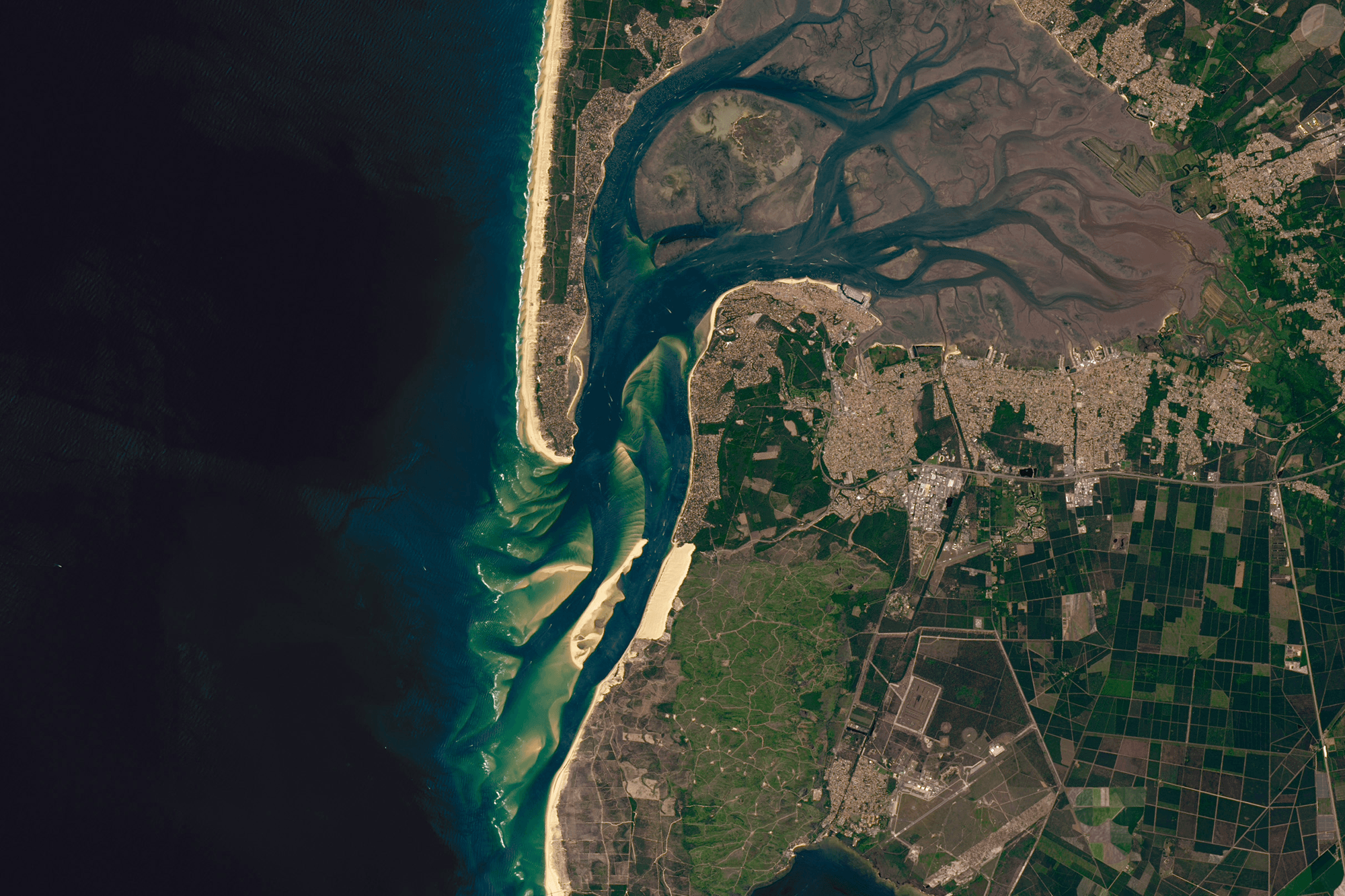
Southwest of Bordeaux in France stands Europe’s tallest sand dune, La Grande Dune du Pilat. Some 2.7 kilometers long and over 100 meters high, this dune took shape here over thousands of years. It moves inland a few meters every year as winds blowing from the Atlantic push sand up its shallow seaward side to the dune’s crest. There, sand will avalanche down the steeper leeward side, advancing the dune little by little. The dune’s accumulation has not been steady; during cooler and drier times, sand has collected there, but it took warmer and wetter climes to grow the forests that have helped stabilize the soil and build the dune higher. Humanity has played a role as well, at times introducing new tree species to stabilize the dune. (Image credit: W. Liang; via NASA Earth Observatory)
Category: Phenomena

Bright Night Lights
A coronal mass ejection from the Sun set night skies ablaze in mid-October 2024. This composite panorama shows a busy night sky over New Zealand’s South Island. A widespread red aurora was joined by a green picket-fence aurora and a host of other magnetohydrodynamic phenomena. To the left shines a bright Stable Auroral Red (SAR) arc. On the right near the Moon hangs the purple arc of a STEVE — strong thermal emission velocity enhancement. All of these auroras (and aurora-adjacent phenomena) take place when high-energy particles from the solar wind interact with molecules in our atmosphere. Which molecules they encounter determines the color of the aurora, and the shape depends, in part, on which magnetic lines the particles get funneled down. With strong solar storms like this one, auroras can reach far from the poles, and, as seen here, can show up in many varieties. (Image credit: T. McDonald; via APOD)
Fediverse Reactions
-

Bow Shock Instability
There are few flows more violent than planetary re-entry. Crossing a shock wave is always violent; it forces a sudden jump in density, temperature, and pressure. But at re-entry speeds this shock wave is so strong the density can jump by a factor of 13 or more, and the temperature increase is high enough that it literally rips air molecules apart into plasma.
Here, researchers show a numerical simulation of flow around a space capsule moving at Mach 28. The transition through the capsule’s bow shock is so violent that within a few milliseconds, all of the flow behind the shock wave is turbulent. Because turbulence is so good at mixing, this carries hot plasma closer to the capsule’s surface, causing the high temperatures visible in reds and yellows in the image. Also shown — in shades of gray — is the vorticity magnitude of flow around the capsule. (Image credit: A. Álvarez and A. Lozano-Duran)
Fediverse Reactions
-

South Island Sediments
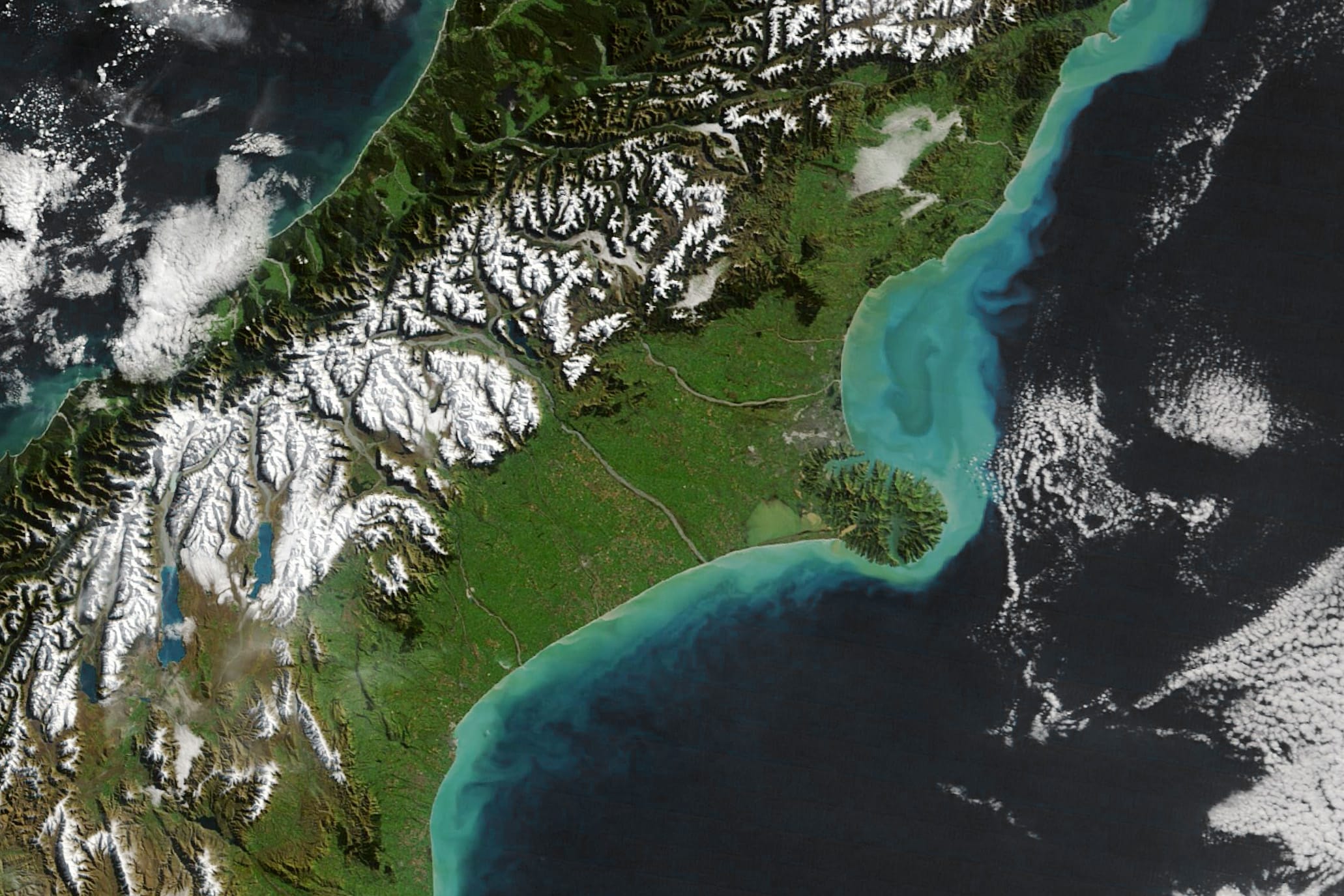
In April and May late autumn storms ripped through Aotearoa New Zealand. This image shows the central portion of South Island, where coastal waters are unusually bright thanks to suspended sediment. We typically think of storm run-off as water, but these flows can carry lots of sediment as well. Here, the large amount of sediment is likely a combination of increased run-off from rivers and coastal sediment stirred up by faster river flows. (Image credit: W. Liang; via NASA Earth Observatory)
Fediverse Reactions
-

Listening for Pollinators
Can plants recognize the sound of their pollinators? That’s the question behind this recently presented acoustic research. As bees and other pollinators hover, land, and take-off, their bodies buzz in distinctive ways. Researchers recorded these subtle sounds from a Rhodanthidium sticticum bee and played them back to snapdragons, which rely on that insect. They found that the snapdragons responded with an increase in sugar and nectar volume; the plants even altered their gene expression governing sugar transport and nectar production. The researchers suspect that the plants evolved this strategy to attract their most efficient pollinators and thereby increase their own reproductive success. (Image credit: E. Wilcox; research credit: F. Barbero et al.; via PopSci)
Fediverse Reactions
-

Seeing the Sun’s South Pole For the First Time
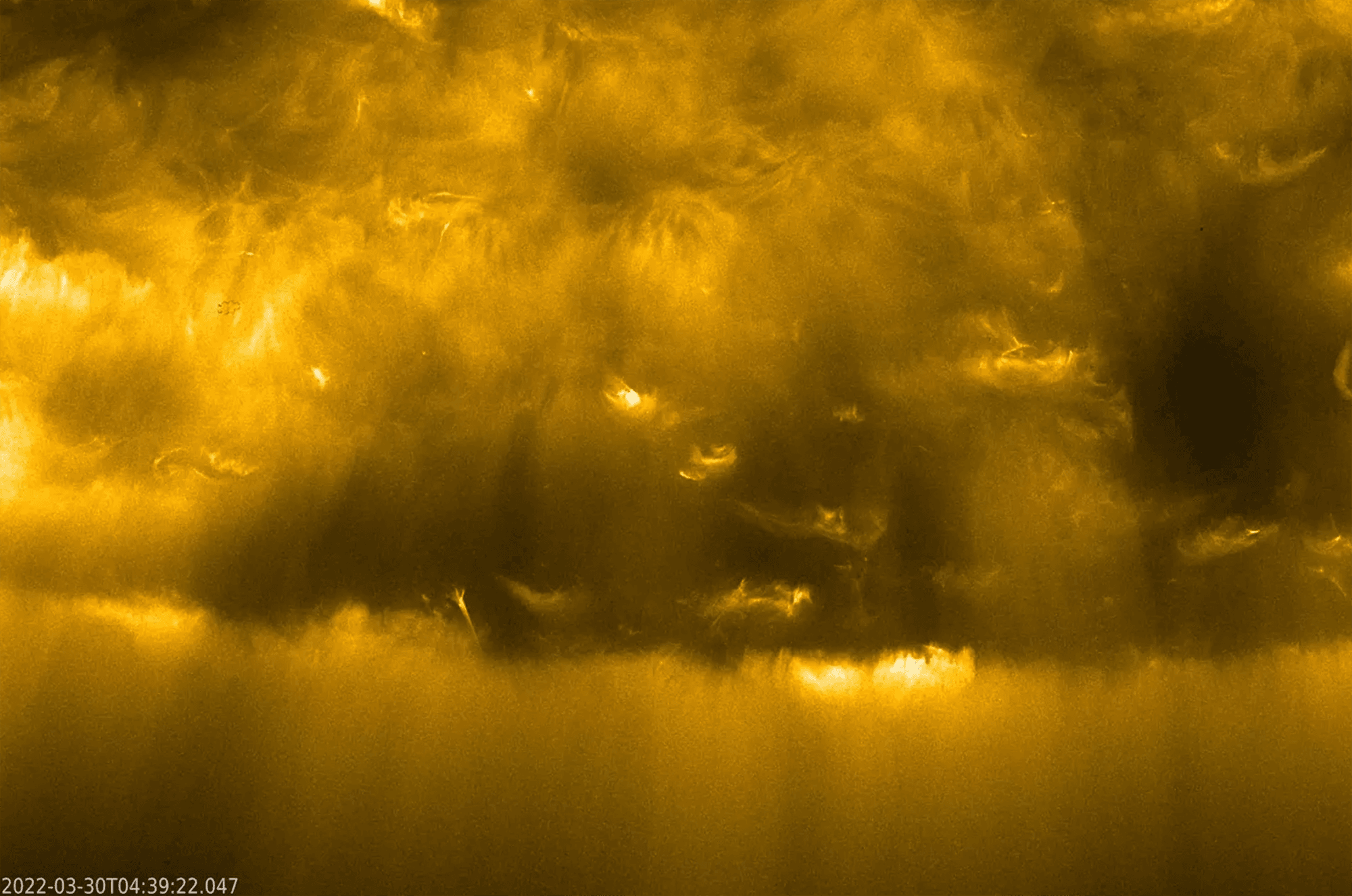
The ESA-led Solar Orbiter recently used a Venus flyby to lift itself out of the ecliptic — the equatorial plane of the Sun where Earth sits. This maneuver offers us the first-ever glimpse of the Sun’s south pole, a region that’s not visible from the ecliptic plane. A close-up view of plasma rising off the pole is shown above, and the video below has even more.
Solar Orbiter will get even better views of the Sun’s poles in the coming months, perfect for watching what goes on as the Sun’s 11-year-solar-cycle approaches its maximum. During this time, the Sun’s magnetic poles will flip their polarity; already Solar Orbiter’s instruments show that the south pole contains pockets of both positive and negative magnetic polarity — a messy state that’s likely a precursor to the big flip. (Image and video credit: ESA & NASA/Solar Orbiter/EUI Team, D. Berghmans (ROB) & ESA/Royal Observatory of Belgium; via Gizmodo)
Fediverse Reactions
-

Evaporating Off Butterfly Scales
This award-winning macro video shows scattered water droplets evaporating off a butterfly‘s wing. At first glance, it’s hard to see any motion outside of the camera’s sweep, but if you focus on one drop at a time, you’ll see them shrinking. For most of their lifetime, these tiny drops are nearly spherical; that’s due to the hydrophobic, water-shedding nature of the wing. But as the drops get smaller and less spherical, you may notice how the drop distorts the scales it adheres to. Wherever the drop touches, the wing scales are pulled up, and, when the drop is gone, the scales settle back down. This is a subtle but neat demonstration of the water’s adhesive power. (Video and image credit: J. McClellan; via Nikon Small World in Motion)

Water droplets evaporate from the wing of a peacock butterfly. Fediverse Reactions
-
“Droplet on a Plucked Wire”

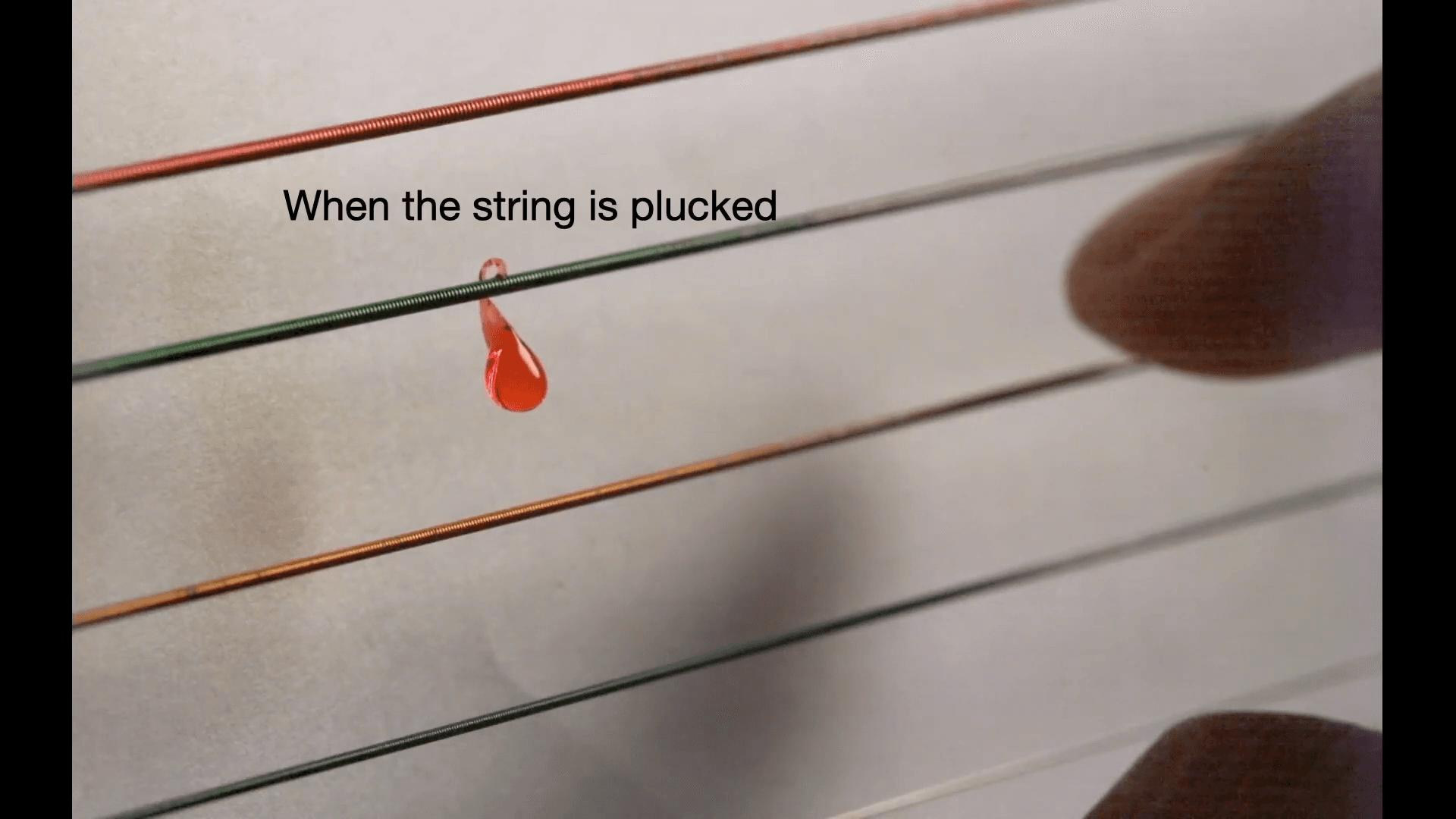


What happens to a droplet hanging on a wire when the wire gets plucked? That’s the fundamental question behind this video, which shows the effects of wire speed, viscosity, and viscoelasticity on a drop’s detachment. With lovely high-speed video and close-up views, you get to appreciate even subtle differences between each drop. Capillary waves, viscoelastic waves, and Plateau-Rayleigh instabilities abound! (Video and image credit: D. Maity et al.)
Fediverse Reactions
-
Ponding on the Ice Shelf
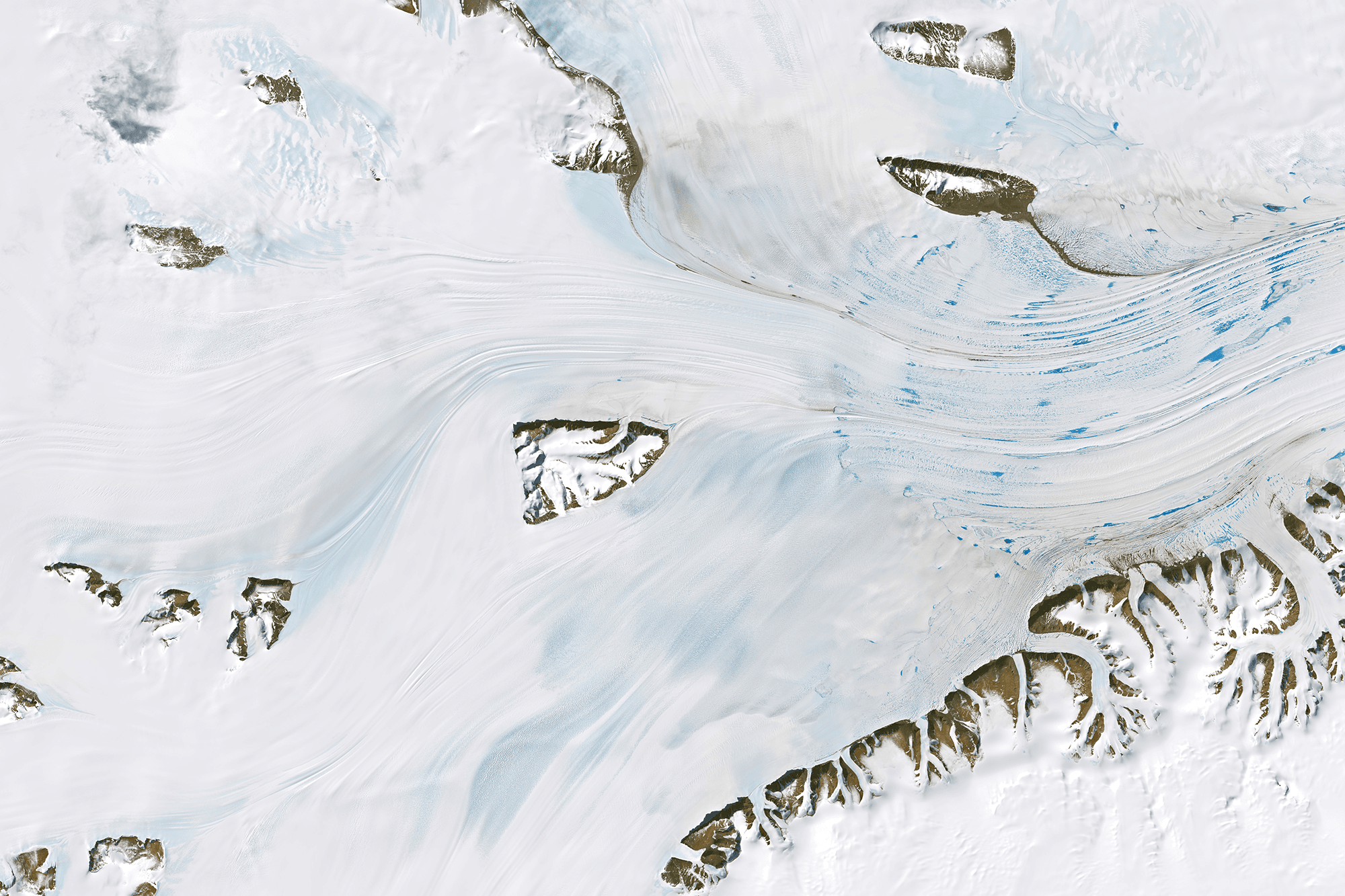
Glaciers flow together and march out to sea along the Amery Ice Shelf in this satellite image of Antarctica. Three glaciers — flowing from the top, left, and bottom of the image — meet just to the right of center and pass from the continental bedrock onto the ice-covered ocean. The ice shelf is recognizable by its plethora of meltwater ponds, which appear as bright blue areas. Each austral summer, meltwater gathers in low-lying regions on the ice, potentially destabilizing the ice shelf through fracture and drainage. This region near the ice shelf’s grounding line is particularly prone to ponding. Regions further afield (right, beyond the image) are colder and drier, often allowing meltwater to refreeze. (Image credit: W. Liang; via NASA Earth Observatory)
Fediverse Reactions
-

Cat’s Eye Halo
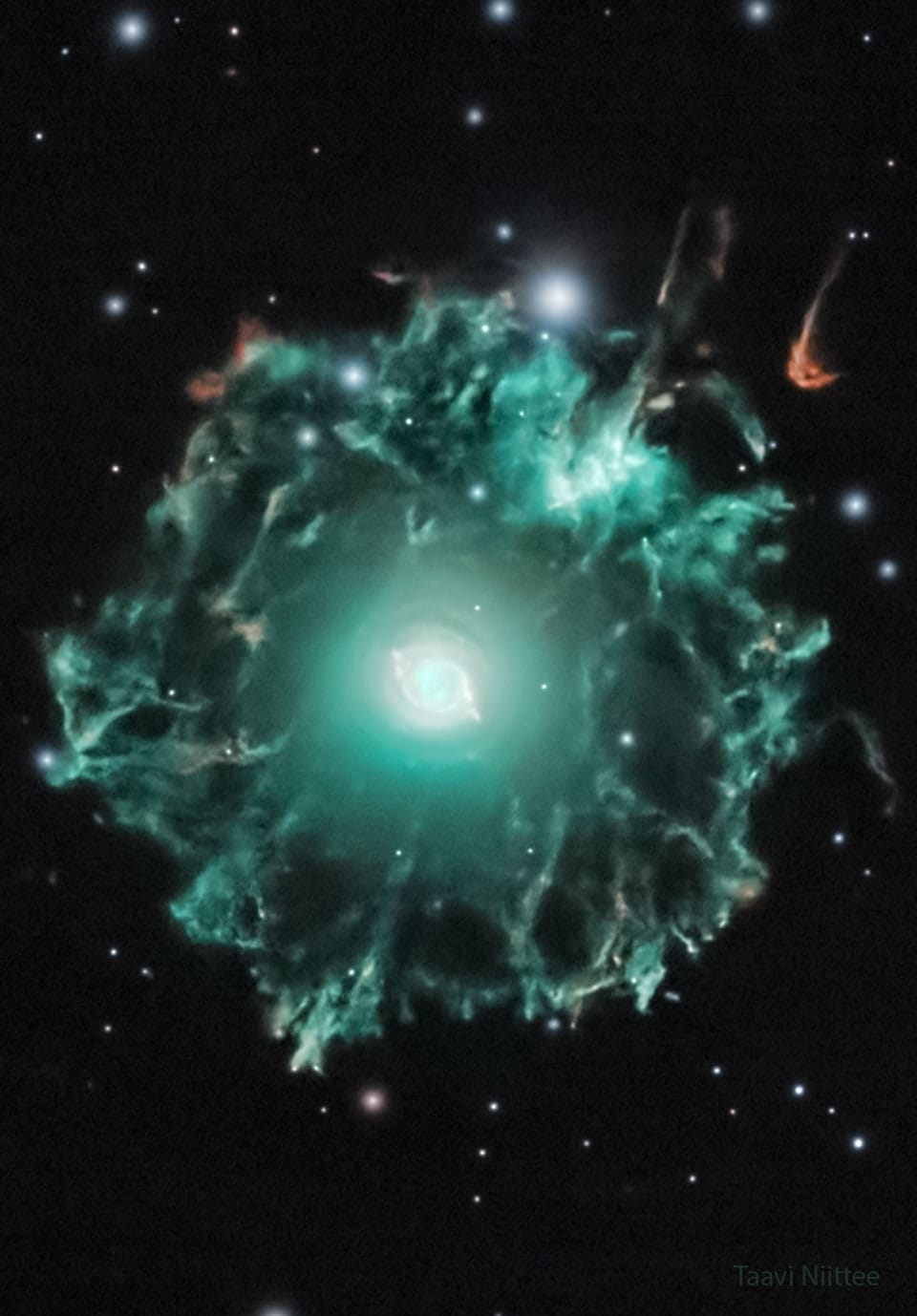
The Cat’s Eye Nebula is a planetary nebula located in the Draco constellation. At its center is a dying star. Seen here is the faint halo that stretches 3 light-years around the central nebula. The filaments of the halo are estimated to be 50,000 to 90,000 years old and were shed during earlier periods in the star’s evolution. Their shape is reminiscent of Rayleigh-Taylor instabilities, to my eye. (Image credit: T. Niittee; via APOD)
Fediverse Reactions
-