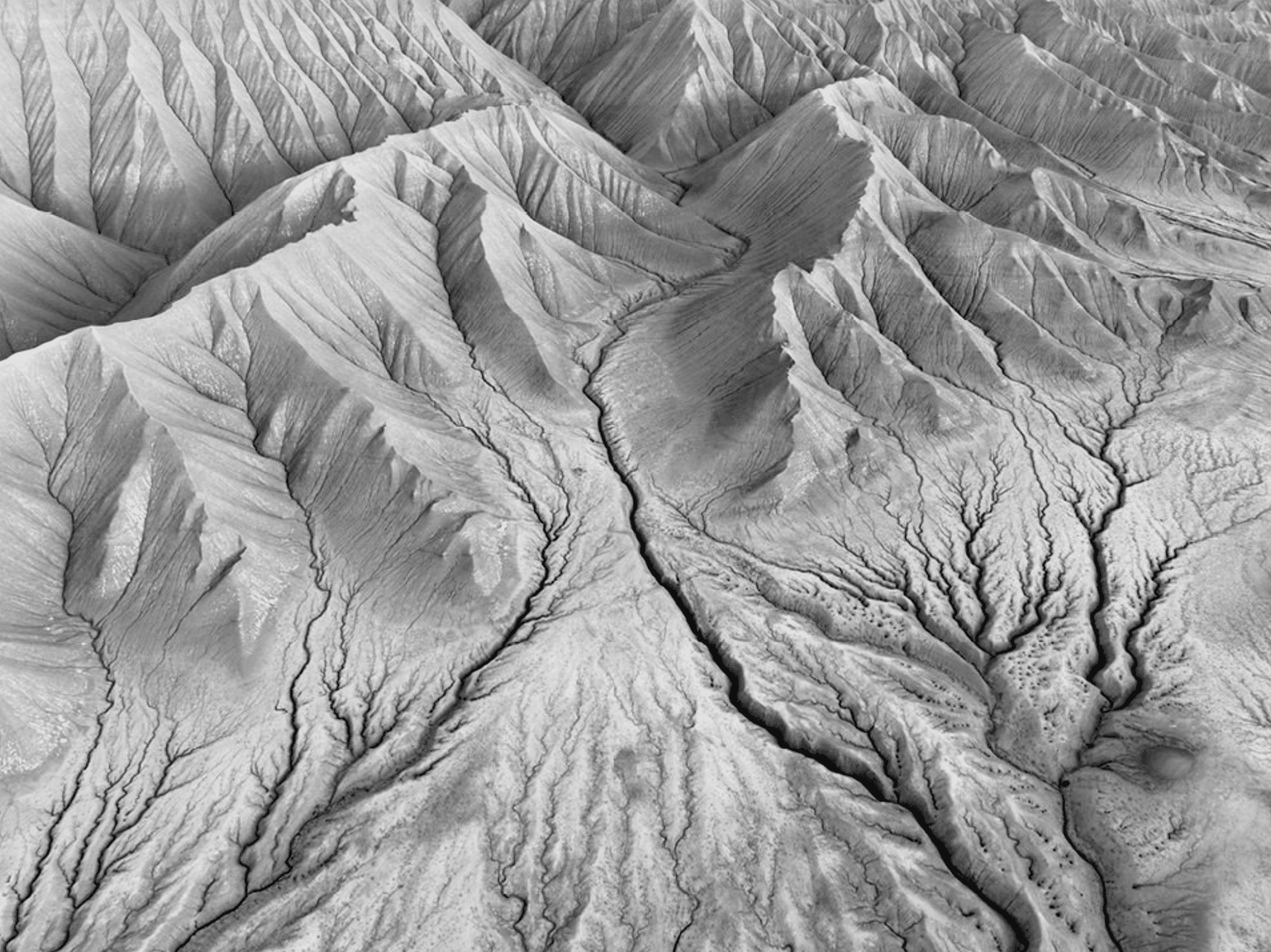
Branching cracks wend through the slopes of Utah in this photograph by Matt Payne. It may seem strange to feature something so dry on a blog about fluid dynamics, but everything seen here depends as much on air and water as on soil, rock, and sand. How water intrudes into the porous landscape and the way it evaporates back out is critical to crack formation. (Image credit: M. Payne; via ILPOTY)
Tag: cracking

Quick-Drying, Fast-Cracking
Water droplets filled with nanoparticles leave behind deposits as they evaporate. Like a coffee ring, particles in the evaporating droplet tend to gather at the drop’s edge (left). As the water evaporates, the deposit grows inward (center) and cracks start to form radially. After just a couple minutes, the solid deposit covers the entire area of the original droplet and is shot through with cracks (right).
Researchers found that the cracks’ patterns and propagation are predictable through a model that balances the local elastic energy and and the energy cost of fracture. They also found that the spacing between radial cracks depends on the deposit’s local thickness. Besides explaining the patterns seen here, these cracking models could help analyze old paintings, where cracks could hide information about the artist’s methods and the artwork’s condition. (Image and research credit: P. Lilit et al.; via Physics Today)
Fediverse Reactions
-

“There is a crack in everything…”


When millimeter-sized drops of water infused with nanoparticles dry, they leave behind complex and beautiful residues. As water continues evaporating, the residues warp, bend, and crack. In this video, researchers set their science to the music of Leonard Cohen. The results resemble blooming flowers and flying water fowl. If you’d like to learn more about the science behind the art, check out the two open-access papers linked below. (Video and image credit: P. Lilin and I. Bischofberger; submitted by Irmgard B.; see also P. Lilin and I. Bischofberger and P. Lilin et al.)

Drying Cracks
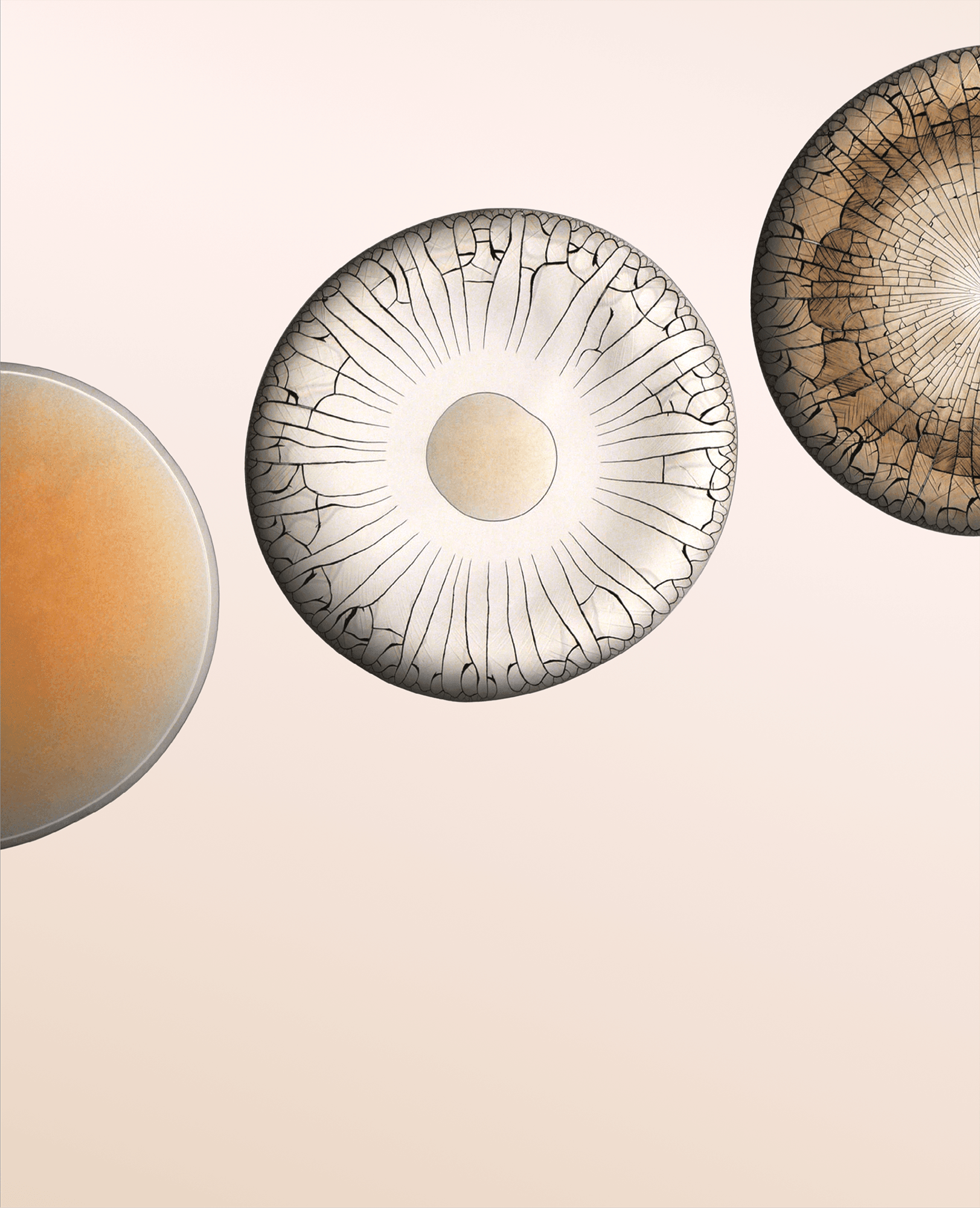
Droplets with particles in them can leave complex stains when they dry — just look at coffee rings and whiskey marks! Here, researchers look at the patterns left on glass by small droplets that evaporated and left behind their nanoparticles. As evaporation takes place, the droplet’s shape changes, adding stress to the growing layer of nanoparticle residue. Cracking is one way to relieve that stress. Another method is delamination — peeling up from the surface. On the leftmost drop, the outer rim of nanoparticles delaminated — as seen from the circular fringes — which released stress without cracking. The rightmost drop, which had a smaller contact angle with the surface, couldn’t delaminate and instead cracked throughout. (Image credit: M. Ibrahim et al.)

Spiral Ice Cracks
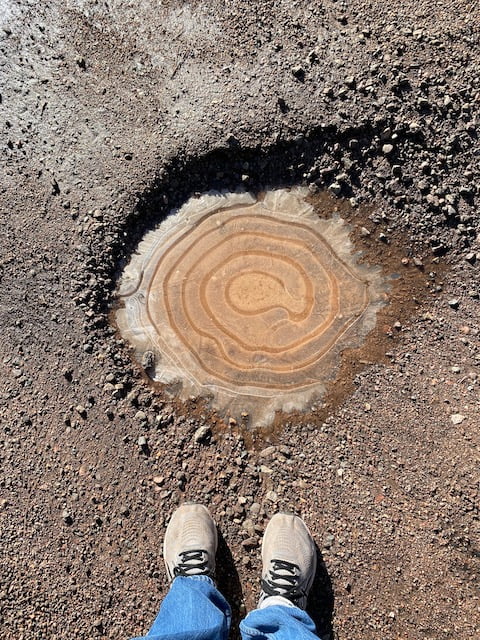
This odd puddle was found in Arizona after a night with low temperatures around -8 degrees Celsius (18 degrees Fahrenheit). Unlike the concentric rings sometimes seen on ice, this puddle formed one spiraling crack. It’s hard to know exactly what factors played into this formation since it was only found after the fact, but one possibility is that the puddle was initially frozen in a continuous sheet. Then, as the temperature cooled overnight, the ice contracted, forming a crack. As the ice kept cooling and contracting inward, the crack grew, spiraling toward the center of the puddle. (Image credit: M. Hendrickson; via EPOD; submitted by Kam-Yung Soh)

Curved Cracks
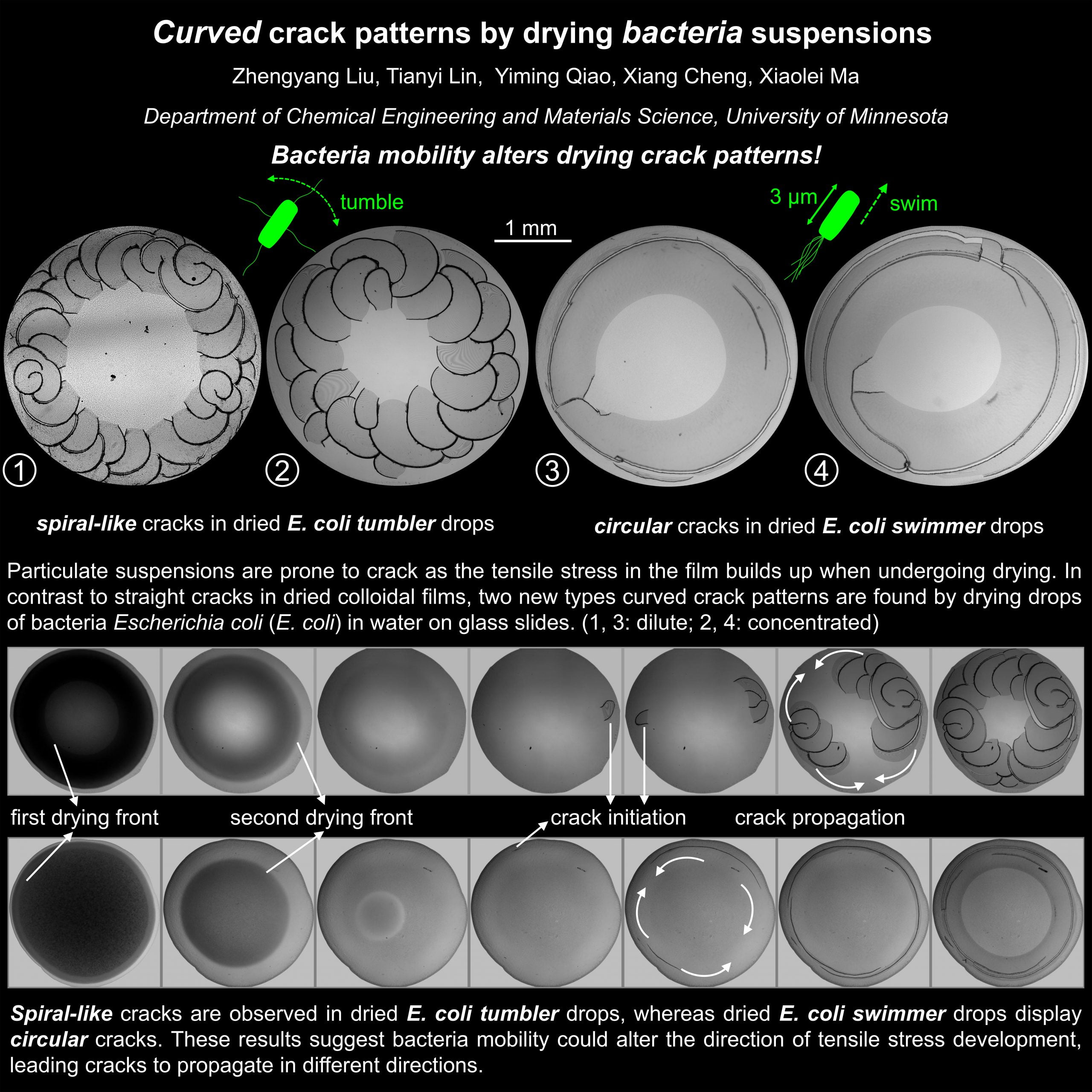
When mixtures of particles and fluids dry, they typically leave a pattern of straight cracks. Here researchers explore what happens when the drying film contains bacteria from the family E. coli. Instead of straight cracks, the films form curved ones. With bacteria that rotate or tumble, the crack pattern is spiral-like. With bacteria that swim, the remaining pattern consists of circular cracks. Thus, the motility of the bacteria affects how cracks form and spread. (Image and research credit: Z. Liu et al.)

Slab Avalanche Physics
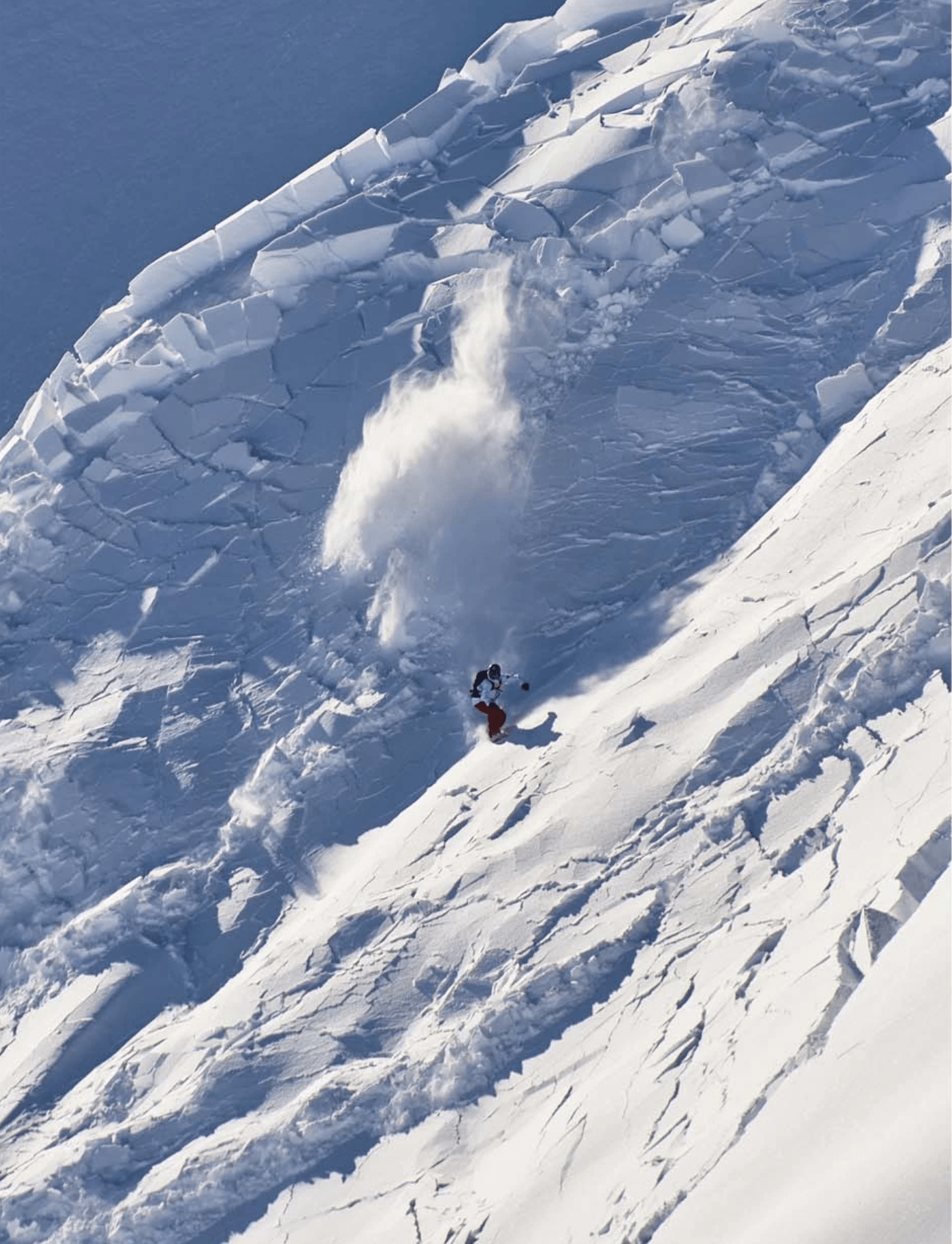
Slab avalanches like the one shown here begin after weak, porous layers of snow get buried by fresher, more cohesive snow layers. On a steep slope, the weight of the new snow can be too great for friction to hold the slab in place, causing the upper layer to crack and slide at speeds up to 150 meters per second. Scientists had two competing theories for how slab avalanches began. One theory presumed that the weak layer of snow failed under shear; the other argued that the collapse of the lower, porous layer was at fault.
In a new study combining large-scale numerical simulation with real-life observations, scientists came to a new conclusion: cracks began to form in the porous layer as the weight of heavier snow crushed down, but once the cracks formed, the shear mechanism took over. Cracks formed by shear could propagate along the existing cracks in the porous layer, allowing faster crack propagation than through undamaged snow. In the end, it’s the combination of the two mechanisms that triggers the avalanche. (Image credit: R. Flück; research credit: B. Trottet et al.; via Physics World)

Rings of Ice
Heavy rains followed by a sudden freeze can produce icy puddles like this one. Because the pool was shallow to begin with, it likely froze rapidly. As the temperature continued dropping, the newly-formed ice contracted; the ring pattern of the cracks tells us the stress in the ice was primarily radial. Once formed, the cracks provided a path for any unfrozen water still in the puddle to get squeezed up onto the surface through capillary action and any further expansion or contraction of the ice. (Image credit: D. Stith; via EPOD; submitted by Kam-Yung Soh)

Ice Patterns
Periods of freezing and thawing can leave complicated patterns in ice, as seen in this aerial photo of Binnewater Lake in New York. Ice rarely forms evenly on large bodies like this, so there are always underlying weaknesses. A hard freeze may have caused the ice to contract, forming the initial radial pattern. Then warmer periods of melting allowed water to rise into the cracks and expand them. As the process repeats, the visible pattern emerges.
Also note the star-like crack patterns near the shore. These may have formed in spots where something like a stick protruding from the water’s surface allowed warmer water up onto the ice to melt the snow sitting atop it. (Image credit: D. Spitzer; via EPOD; submitted by Kam-Yung Soh)

Icy Spikes


Water is one of those strange materials that expands when it freezes, which raises an interesting question: what happens to a water drop that freezes from the outside in? A freezing water droplet quickly forms an ice shell (top image) that expands inward, squeezing the water inside. As the pressure rises, the droplet develops a spicule – a lance-like projection that helps relieve some of the pressure.
Eventually the spicule stops growing and pressure rises inside the freezing drop. Cracks split the shell, and, as they pull open, the cracks cause a sudden drop in pressure for the water inside (middle image). If the droplet is large enough, the pressure drop is enough for cavitation bubbles to form. You can see them in the middle image just as the cracks appear.
After an extended cycle of cracking and healing, the elastic energy released from a crack can finally overcome surface energy’s ability to hold the drop together and it will explode spectacularly (bottom image). This only happens for drops larger than a millimeter, though. Smaller drops – like those found in clouds – won’t explode thanks to the added effects of surface tension. (Image credit: S. Wildeman et al., source)
ETA: A previous version of this post erroneously said this was freezing from the “inside out” instead of “outside in”.