Category: Art

  • Featured Video Play Icon

    Colorful Dissipation

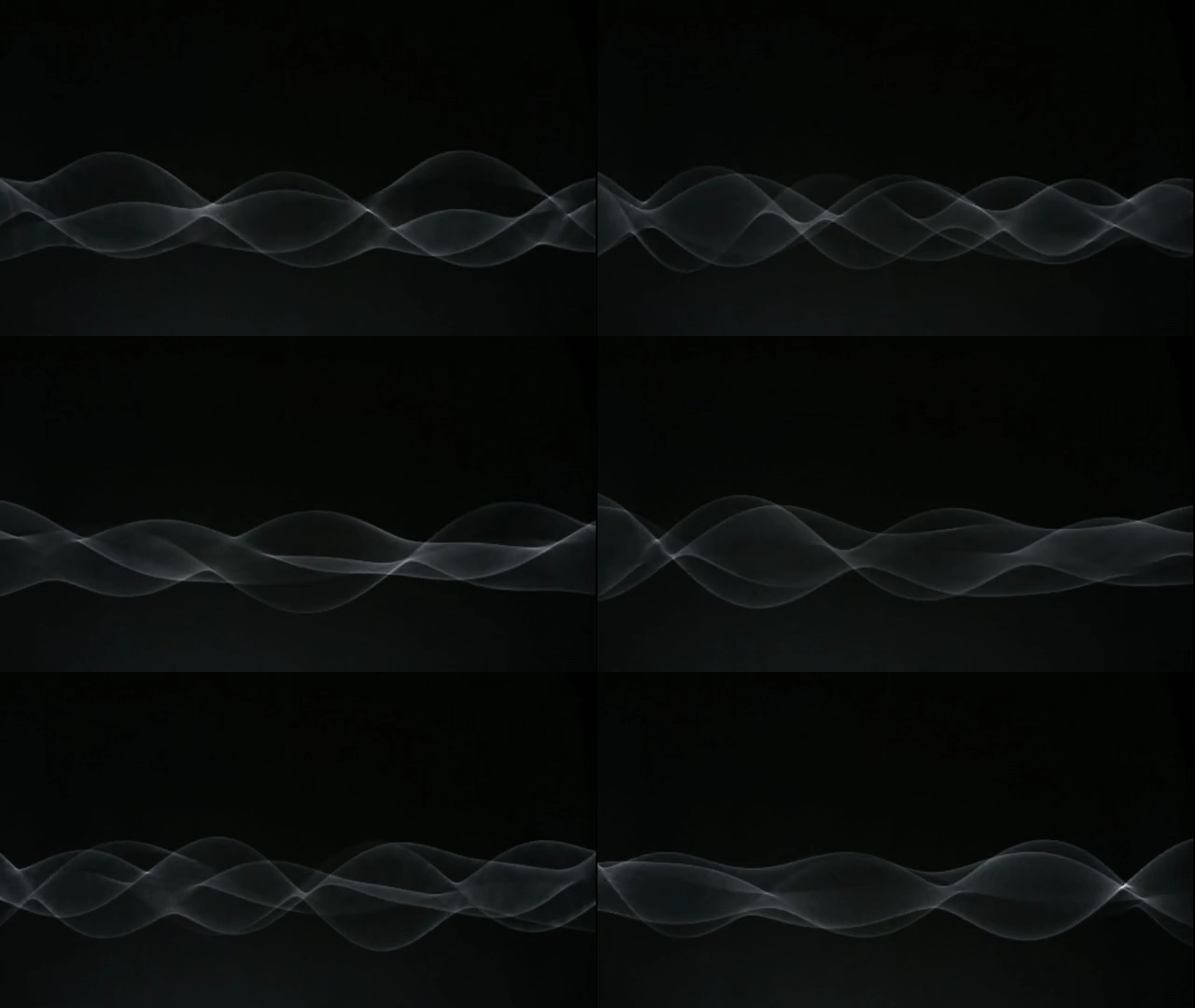
    Colorful eddies swirl in this short video from photographer Karl Gaff. Formed near the boundary at the bottom of the frame, these eddies act to dissipate some of the energy in the flow. Structures like these are key in turbulent flows, where energy must pass from large eddies to smaller and smaller ones until they reach a size where viscosity can extinguish them. (Video, image, and submission credit: K. Gaff)

    P.S. – Today’s post is FYFD’s 2,500th! Crazy, right? That means we have a pretty enormous archive. Want to explore? Click here for a random post.

  • Featured Video Play Icon

    “The Other Side”

    “The Other Side” is a short film imagining fluids on the other side of people’s eyes. The fast-paced editing makes this one feel rather different from Thomas Blanchard’s other films, which often take the time to linger on the mixing of soaps, inks, and paints that form the bulk of the imagery. There are hints of ferrofluids here, too, but like much of the action, if you blink you’ll miss it.

    Strange as it may sound, there’s actually a strong connection between eyes and fluid dynamics, whether you’re considering the optimal length for eyelashes, the way a tear film coats the eye, or how vision changes in microgravity. (Image and video credit: T. Blanchard)

  • Featured Video Play Icon

    Paint Versus Hydrogel

    In this bizarre short film, we get to see a battle between dissolution and absorption. I think the Chemical Bouillon team has coated hydrogel beads in a layer of paint and then immersed them in water. As the beads absorb water, they expand and grow, tearing their fragile outer layer of paint to smithereens.

    One thing that struck me when watching several of the sequences is just how regular the hole spacing in the paint is for the round hydrogels. That hints at an orderly breakdown in the solid paint layer while the interior hydrogel polymer symmetrically expands. It’s a little like watching holes grow in a splash curtain. (Video and image credit: Chemical Bouillon)

  • Happy Valentine’s Day!

    Happy Valentine’s Day!

    To make this heart, photographer Helene Caillaud flung paint off a tool attached to a drill bit, much like Fabian Oefner did in his “Black Hole” series. Caillaud, however, tweaked the set-up to create distinctive shapes at the center of her images, with centrifugal force creating the beautiful filaments spiraling outward. It’s a neat effect and a fitting way to celebrate Valentine’s Day here on FYFD! (Image credit: H. Caillaud)

  • Featured Video Play Icon

    “Otherworld, Vol. 1”

    Roman De Giuli’s “Otherworld, Volume 1” is a beautiful exploration of color and flow. Glittery particulates act as tracers in the flow, reminiscent of the way rheoscopic fluids do. In many sequences, the glitter lends a sense of texture to the flow. Without context, I cannot say whether those are true flow features, but they certainly remind me of instabilities like Tollmien-Schlichting waves. (Image and video credit: R. De Giuli)

  • Featured Video Play Icon

    A Dance of Hydrogen Bubbles

    Hydrogen bubbles rise off zinc submerged in hydrocholoric acid in this short film from the Beauty of Science team. In high-speed video, the rise of the bubbles is stately and mesmerizing. Notice how the smallest bubbles appear as perfect spheres; for them, surface tension is strong enough to maintain that spherical shape even against the viscous drag of their buoyant rise. Larger bubbles, formed from mergers both seen and unseen, have a harder time staying round. In them, surface tension must battle gravitational forces and drag from the surrounding fluid. (Image and video credit: Beauty of Science; via Laughing Squid)

  • River Avon

    River Avon

    One of the challenges in fluid dynamics is considering the instantaneous versus the average. Many flows — especially turbulent ones — are different at every point in space and in time. That’s a lot of data to collect and to wrap one’s head around. So often researchers will average turbulent measurements over a period of time and break that information down into two variables: an average velocity and a fluctuating one.

    What does that have to do with this image? Well, by capturing the River Avon’s flow near Pulteney Bridge as a long exposure, photographer Peter Leadbetter gives us a look at the river’s “averaged” flow. The long exposure smooths out some of the intermittent features visible in a faster picture, and instead draws our attention to the overall path of the flow and regions that may behave differently, like those near the wall in the foreground. The averaging researchers do is much the same. It will erase or obscure some features while making the large-scale patterns more obvious. (Image credit: P. Leadbetter; submitted by Ioanna S.)

  • Twirling Liquids

    Twirling Liquids

    What do you get when you spin a splash? I expect the result is a lot like these whirling fluid structures captured by photographer Hélène Caillaud. I love the fantastical shapes she creates as sheets and filaments are flung outward. These liquid sculptures look like everything from the perfect martini glass to the skirts of a flamenco dancer. Check out the full gallery of images, and be sure to look around at Caillaud’s other stunning liquid art while you’re there. (Images credit: H. Caillaud)

  • “Ornitographies”

    “Ornitographies”

    If birds left trails in the sky, what would they look like? This is the question that haunted photographer Xavi Bou and inspired him to create his “Ornitographies” series. Using video of birds in flight, he combines frames to construct these snapshots of flight. In them, birds become streaklines feathered with wingbeats.

    I love how the technique highlights the patterns of flapping flight. A bird flying steadily over a lake becomes a wavy line with consistent, perfectly matched up- and downstrokes, whereas a bird just taking off has short, fast wingbeats that slowly lengthen and steady out as the bird gets aloft. Flocks of birds turn into a tornado of swirling lines as they land or take-off en mass. (Image credit: X. Bou; via Flow Vis)

  • Featured Video Play Icon

    Envisioning Chemical Patterns

    One of the most beautiful chemical reactions is the Belousov–Zhabotinsky reaction, and it’s the subject of the latest video from Beauty of Science. Known colloquially as the BZ reaction, it begins as growing spots of color that turn into rings and chaotic spirals as the chemical reaction progresses.

    Mathematically, the BZ reaction is a type of reaction-diffusion system, meaning that the patterns we see depend both on the speed of local chemical reactions and the time necessary for chemical reagents to move (or diffuse) throughout the dish. Although the diffusion in these systems can simply be the random wandering of molecules, fluid dynamics also plays a role. Variations in chemical concentration between different regions of the reaction drive fluid flows that continue to feed the pattern-making until all the reagents are consumed. (Image and video credit: Beauty of Science; via PetaPixel; submitted by clogwog)