Category: Art

  • Featured Video Play Icon

    “Unity”

    Rus Khasanov’s latest short film, “Unity,” is all about coming together with droplets coalescing, globules bursting, and colors mixing. Take a glittery, paint-filled break and enjoy some macro-filmed fluid dynamics in action. (Video and image credit: R. Khasanov)

  • Featured Video Play Icon

    “Vorticity 2”

    There’s no better way to appreciate our atmosphere than through timelapse, and photographer Mike Olbinski is a master at capturing the beauty and power of nature at work through this medium. In “Vorticity 2″, he highlights two full seasons of storm chasing in an incredible seven-and-a-half minutes. Prepare yourself for dramatic cloudscapes, torrential rains, and even twin tornadoes. This one deserves a watch on the biggest screen you have available. (Image and video credit: M. Olbinski; via Colossal)

  • Featured Video Play Icon

    “In Perpetual Motion”

    “In Perpetual Motion” follows adventure photographer Krystle Wright underwater where the roiling of the ocean sometimes makes time seem to stop, transporting her to another place entirely. To me, the underside of the ocean’s surface evokes storm clouds and memories of sitting at the bottom of the pool staring up at the way light played on the surface. How about you? What do you see when the waves roll overhead? (Video and image credit: K. Wright et al.)

  • Seeing the Song

    Seeing the Song

    We can’t always see the flows around us, but that doesn’t mean they’re not there. Audobon Photography Award winner Kathrin Swaboda waited for a cold morning to catch this spectacular photo of a red-winged blackbird’s song. In the morning chill, moisture from the bird’s breath condensed inside the vortex rings it emitted, giving us a glimpse of its sound. (Image credit: K. Swaboda; via Gizmodo; submitted by Joseph S and Stuart H)

  • Featured Video Play Icon

    “Aurora”

    In “Aurora”, artist Rus Khasanov uses fluids to create a short film full of psychedelic color and cosmic visuals. As in a soap bubble, the bright colors – as well as the pure black holes – come from the interference of light rays. The colors directly relate to the thickness of fluid, and they allow us to see all the subtle flows caused by variations in surface tension. (Video and image credit: R. Khasanov)

  • Featured Video Play Icon

    “-N- Uprising”

    Although Thomas Blanchard’s latest short film, “-N- Uprising”, is less overtly fluid dynamical, fluids underlie almost every aspect of it. The blossoming of flowers is often driven by osmosis and water pressure. Spiders rely on hydraulic pressure to move their limbs, and many insects first unfurl their wings by pumping hemolymph through the network of veins that lace them. Even when hidden beneath the surface, fluid dynamics is everywhere. (Video credit: T. Blanchard; via Colossal)

  • Featured Video Play Icon

    Ink Explosion

    Sometimes beautiful flows come from simple combinations. Here the artists of Chemical Bouillon combine ink and hydrocarbons to create lovely explosions of color. Eschewing quick cuts between views, they allow us to linger and explore the flow ourselves as it changes. Differences in surface tension drive streaming flows along the surface, but there seem to be some chemical reactions contributing as well. Watch along the edges and you may even see convection pulling ink down and back. The whole video is only 2 minutes long and worth a full watch. (Image and video credit: Chemical Bouillon)
  • Featured Video Play Icon

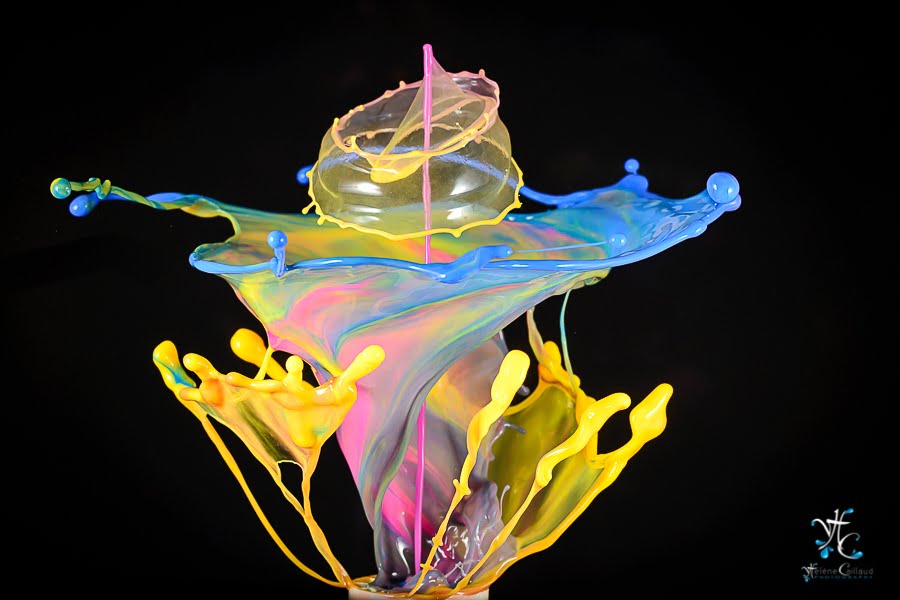
    360 Splashes

    Beautiful as a splash is, why only enjoy it from a single angle? In this video, the artists behind Macro Room offer a 360-degree perspective on various splashes and fluid collisions. I especially enjoy watching the splash crowns falling back over and out of the various containers they use. What’s your favorite part? (Image and video credit: Macro Room)

  • Featured Video Play Icon

    The Art of Paper Marbling

    Known as ebru in Turkey and suminagashi in Japan, the art of paper marbling has flourished in cultures around the world since medieval times. The details of methods vary, but in general, the technique uses a base of oily water to float various dyes and pigments. Artists then use brushes, wires, and other tools to manipulate the dyes into the desired pattern. Paper is spread over the top to soak up the color pattern before being hung to dry. Every print made in this manner is a unique result of buoyancy, surface tension variation, and viscous manipulation. Check out the video above to watch a timelapse video showing the technique in action. (Video and image credit: Royal Hali)

  • Featured Video Play Icon

    The Beauty of Flames

    The flickering yellow and orange flames most of us are used to thinking of are rather different from the flames researchers study. In this video, the Beauty of Science team offers a short primer on different flame shapes studied in combustion, including laminar, swirling, and jet flames. Each has its own distinctive character and may be advantageous or not, depending on the application for the flame. A laminar flame, for example, is steady, which might make it a good choice for something like a Bunsen burner, where consistency is needed. Whereas a turbulent flame is better capable of mixing fuel and oxidizer, which is key in applications like rocket engines, where that mixing can be a limiting factor in the engine’s efficiency. (Image and video credit: Beauty of Science)