Tag: rocket science

  • Featured Video Play Icon

    Ink-Based Propulsion

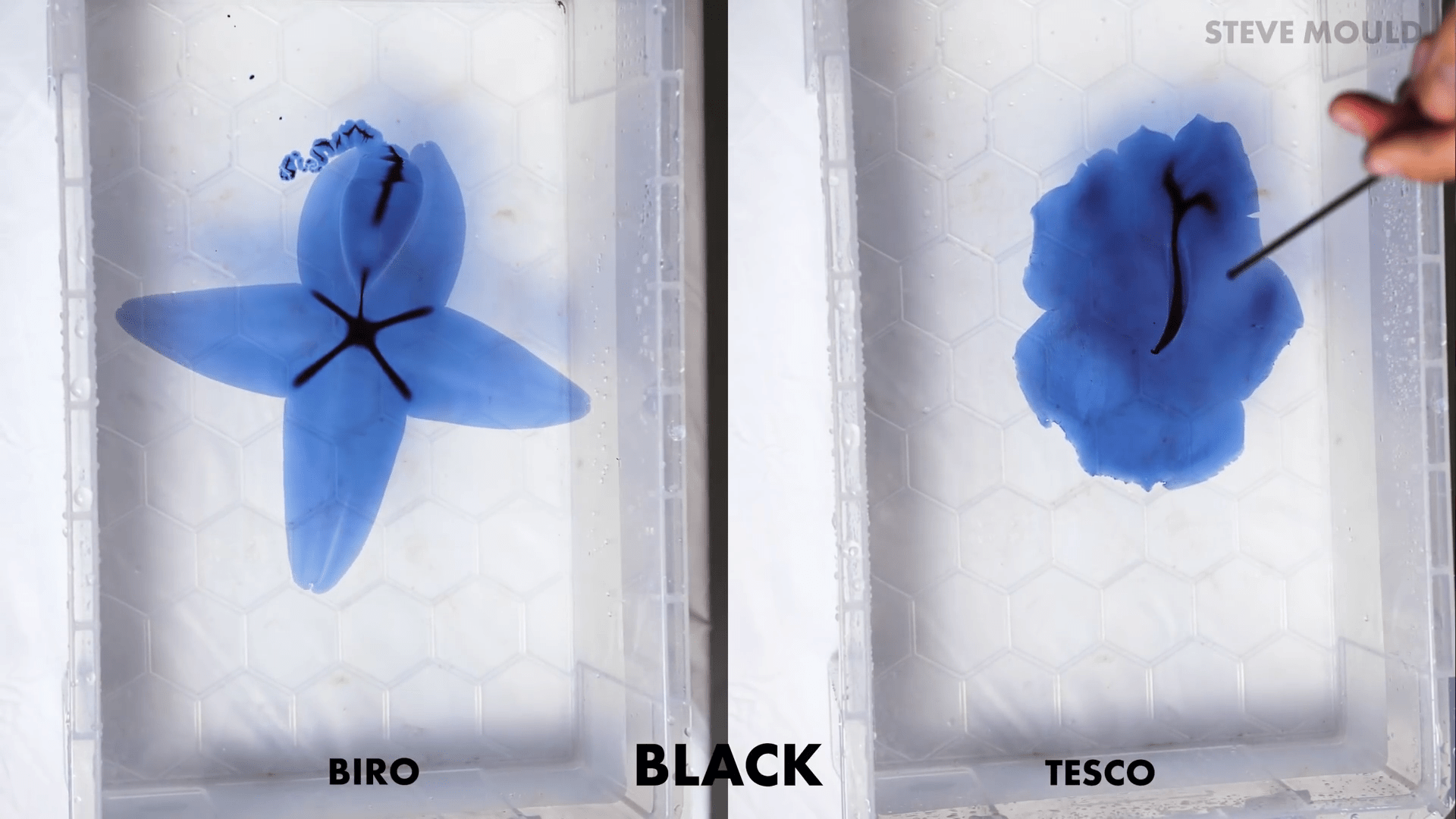
    In this video, Steve Mould explores an interesting phenomenon: propulsion via ballpoint pen ink. Placing ink on one side of a leaf or piece of paper turns it into a boat with a dramatic dye-filled wake. It’s not 100% clear what’s happening here, though I agree with Steve that there are likely several effects contributing.

    Firstly, there’s the Marangoni effect, the flow that happens from an area of low surface tension to high surface tension. This is what propels a soap boat as well as many water-walking insects. I think this is a big one here, and not just because the ink has surfactants. As any component of the ballpoint ink spreads, its varying concentration is going to trigger this effect.

    Secondly, there’s a rocket effect. Rockets operate on a fairly simple principle: throw mass out the back in order to go forward. These dye boats are also doing this to some extent.

    And finally there’s some chemistry going on. Some kind of reaction seems to be taking place between one or more of the ink components and the water in order to create the semi-solid layer of dye. Presumably this is why the dye doesn’t simply dissolve as it does in some of Steve’s other experiments.

    I figure some of my readers who are better versed in interfacial dynamics, rheology, and surface chemistry than I am will have some more insights. What do you think is going on here? (Video and image credit: S. Mould)

  • Featured Video Play Icon

    Coke and Butane Rockets

    Rocket science has a reputation for being an incredibly difficult subject. But while there’s complexity in the execution, the concept behind rockets is pretty simple: throw mass out the back really fast and you’ll move forward. Whether you’re talking about a Saturn V or these Coke-and-butane-powered bottles, the basic principle is the same.

    These rockets get their kick mostly from the added butane, which has a very low boiling point. When the bottle is flipped, the lighter butane is forced to rise through the Coke. With a large surface area of liquid butane exposed to the warmer Coke, the butane becomes gaseous. That sudden increase in volume forces a liquid-Coke-and-gaseous-butane mixture out of the bottle, which has a helpful nozzle shape to further increase the propellant’s speed. Once the phase change is underway, the rocket quickly takes off! (Image and video credit: The Slow Mo Guys)

  • A Groovy Hovercraft

    A Groovy Hovercraft

    Not long ago, researchers discovered that droplets hovering over a hot grooved surface would self-propel. The extension to this was to investigate a hovercraft on a grooved, porous surface (top half of animation)–think an air hockey table with grooves. In that case, air inside the grooves flows from the point toward the edges, and it drags the hovercraft with it, thanks to viscosity. So the hovercraft travels in the direction opposite the points. This raised an obvious question: what happens if the hovercraft is grooved instead of the surface?

    That’s the situation we see in the bottom half of the animation. Air flows from the table and interacts with the grooves on the bottom of the hovercraft. And this time, the hovercraft propels in the direction of the points. That means there’s a completely different mechanism driving this levitation. When the grooves are onboard the hovercraft, pressure dominates over viscous effects. The air still gets directed down the grooves, but now, like a rocket, the exhaust pushes the hovercraft in the other direction – toward the points. For more on this work, check out the mathematical model of the problem and our interview with one of the researchers in the video below. (Research credit: H. de Maleprade et al.; image and video credit: N. Sharp and T. Crawford)

  • Rocket Launch Systems

    Rocket Launch Systems

    If you’ve ever watched a rocket launch, you’ve probably noticed the billowing clouds around the launch pad during lift-off. What you’re seeing is not actually the rocket’s exhaust but the result of a launch pad and vehicle protection system known in NASA parlance as the Sound Suppression Water System. Exhaust gases from a rocket typically exit at a pressure higher than the ambient atmosphere, which generates shock waves and lots of turbulent mixing between the exhaust and the air. Put differently, launch ignition is incredibly loud, loud enough to cause structural damage to the launchpad and, via reflection, the vehicle and its contents.

    To mitigate this problem, launch operators use a massive water injection system that pours about 3.5 times as much water as rocket propellant per second. This significantly reduces the noise levels on the launchpad and vehicle and also helps protect the infrastructure from heat damage. The exact physical processes involved – details of the interaction of acoustic noise and turbulence with water droplets – are still murky because this problem is incredibly difficult to study experimentally or in simulation. But, at these high water flow rates, there’s enough water to significantly affect the temperature and size of the rocket’s jet exhaust. Effectively, energy that would have gone into gas motion and acoustic vibration is instead expended on moving and heating water droplets. In the case of the Space Shuttle, this reduced noise levels in the payload bay to 142 dB – about as loud as standing on the deck of an aircraft carrier. (Image credits: NASA, 1, 2; research credit: M. Kandula; original question from Megan H.)

  • Watching a Model Rocket Burn

    Watching a Model Rocket Burn

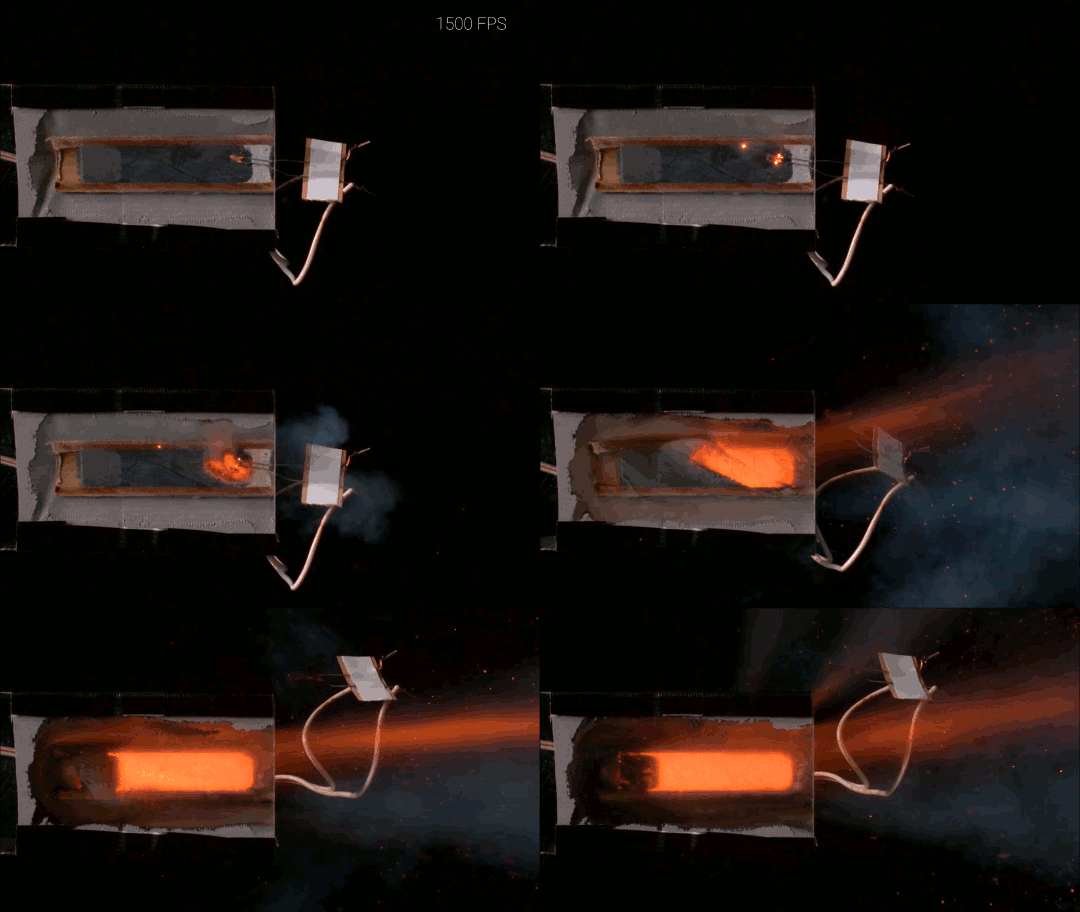
    Rockets operate on a pretty simple principle: if you throw something out the back really fast, the rocket goes forward. Practically speaking, we accomplish this with a combination of chemistry and physics, by burning fuel and oxidizer together and accelerating the exhaust out a nozzle. Solid rocket propellant, like that found in the model rockets shown here, is a combination of fuel and oxidizer that don’t react until they’re ignited. You don’t want your rocket to just explode as soon as it’s lit, though, so solid rocket motors are carefully designed to burn in a particular way. By packing the propellant into different shapes – and even including patterns of propellants with different burn rates – engineers can create a rocket that burns with the thrust pattern they want.

    In the case of this model rocket motor, what we observe is not really how it is intended to burn; you can see how some of the combustion products are working their way out of cracks that wouldn’t normally exist. But the video and animation do show how the burn front moves gradually through the engine, allowing it to produce a relatively steady amount of thrust for a longer period before reaching the darker burning propellant on the left, which would normally launch the model rocket’s parachute. (Image and video credit: Warped Perception; via Gizmodo)

  • Featured Video Play Icon

    Early Rocket Launch

    Pre-dawn launches provide some of the most dramatic rocket footage. This video is from an October 2nd Atlas V launch, and the really fun stuff starts at about 0:34. As the rocket climbs to higher altitudes, the atmospheric pressure around it decreases. As a result of this low pressure, the rocket’s exhaust gases balloon outward in a giant plume many times larger than the rocket. This happens in every launch, but it’s visible here because the rocket is at such a high altitude that its exhaust is being lit by sunlight while the observers on the ground are still in the dark. The ice crystals in the exhaust–much of the rocket’s exhaust is water vapor–reflect sunlight down to the earth. Around 0:47, a cascade of shock waves ripples through the plume just before the first-stage’s main engine cuts off. Once the engine stops firing, there’s no more exhaust and the plume ends. (Video credit: Tampa Bay Fox 13 News; submitted by Kyle C)

  • Featured Video Play Icon

    Homemade Hybrid Rocket Engine

    In this video, Ben Krasnow details and demos a small hybrid rocket engine he built in his workshop. Hybrid rockets utilize propellants that are two different states of matter, in this case gaseous oxygen as the oxidizer and solid acrylic as the fuel. Krasnow’s verbal explanation of a convergent-divergent nozzle, used to accelerate flow to supersonic speeds is not quite right. In reality, a compressible fluid like air reaches the sonic point (i.e. Mach 1) at the narrowest point of the nozzle, also called the throat. The divergent portion of the nozzle causes the compressible fluid to expand in volume, which drops the temperature and pressure while the velocity increases beyond the speed of sound.

    Krasnow says he did no calculations for his rocket, but I decided to have a little fun by doing some myself. Supersonic flow through the nozzle is only achieved if the flow is choked, meaning that the mass flow rate through the nozzle will not increase if the downstream pressure is decreased further relative to the upstream pressure. For Krasnow’s rocket, the downstream pressure is atmospheric pressure (14.7 psi) and the upstream pressure is provided by the oxygen canister, which he notes was at most 80 psi. Fortunately, the upstream pressure necessary to choke the nozzle is only 27.8 psi, so even with the ball valve partially closed, Krasnow’s rocket is definitely capable of supersonic speeds.

    The Mach number achievable by any given supersonic nozzle is related to the ratio of the nozzle throat to its exit diameter (#). Krasnow gives the throat diameter as ¼-inch and the exit diameter as 5/8-inch. This means that the Mach number at the exit of the nozzle, assuming choked supersonic flow, is about Mach 3.4. (Video credit: Ben Krasnow; via Universe Today; submitted by jshoer)

  • Reader Question: Rocket Propulsion

    Reader Question: Rocket Propulsion

    staunchreality-deactivated20120 asks:

    Hey there – Love the blog. Most interesting science blog I follow 🙂 This may be a silly question – is propulsion through space purely a function of exit velocity and catching gravity slingshots around planets, or is there enough of anything to push against for rocket propulsion?

    Thanks! Glad you enjoy the blog. And your question is not silly at all.

    Whether in the atmosphere or not, rocket engines always operate on the same principle: Newton’s 3rd law.  For every force exerted, there is an equal and opposite reaction force.  For a rocket, this means that the momentum of the rocket exhaust provides forward momentum–thrust–for the rocket.  When acting in an atmosphere, the exhaust doesn’t push against the atmosphere in order to move the rocket–in fact, rockets have to overcome aerodynamic drag when in the atmosphere, which opposes their thrust.

    While the operating principle of a rocket remains the same regardless of its surrounding, the ambient pressure (essentially zero in space and non-zero in an atmosphere) does affect the efficiency of the rocket’s nozzle, which can affect the exit velocity of the exhaust, and, thus, the efficiency of the rocket. Under ideal conditions, the exhaust should exit the nozzle at the same pressure as the ambient conditions–whatever they are. If the exhaust pressure is lower than the ambient, the exhaust can separate from the nozzle, causing instabilities in the flow and potentially damaging the nozzle. On the other hand, if the exhaust pressure is too high, then there is exhaust that could be turned into thrust that is going to waste. Unfortunately, matching the exhaust pressure to the ambient pressure is a function of the geometry of the nozzle, which is usually fixed. Engineers of rockets intended to fly from within the atmosphere to space usually have to pick a particular altitude to design around and deal with the inefficiencies while the rocket flies at other ambient conditions.

    Outside of the physical mechanics of how thrust is produced, propulsion in space is dominated by the influence of orbital mechanics. Once in an orbit, a spacecraft will stay on that orbital path without expending any thrust.  To change between orbits, it is necessary for the spacecraft–rocket or otherwise–to change its velocity–typically referred to as delta-v–by firing an engine or thruster. It’s also possible to change orbits using the gravity of other celestial bodies (Jupiter is a popular one) to change a spacecraft’s delta-v without expending propellant. However, fluid dynamics don’t play a big role in the process aside from the problems of fuel sloshing aboard the spacecraft and the actual mechanism by which thrust is produced.

    That said, if anyone is interested in getting a better feel for how orbit mechanics work, I have two recommendations.  The first is to watch this video of water droplets “orbiting” a charged knitting needle aboard the ISS. And the second is to play the game Osmos. It is like rocket propulsion and orbit mechanics in action!

    (Photo credits: NASA, The Aerospace Corporation, Hemisphere Games)

  • Featured Video Play Icon

    Godspeed, Discovery!

    The space shuttle, despite three decades of service, remains a triumph of engineering. Although it is nominally a space vehicle, fluid dynamics are vital throughout its operation. From the combustion in the engine to the overexpansion of the exhaust gases; from the turbulent plume of the shuttle’s wake to the life support and waste management systems on orbit, fluid mechanics cannot be escaped. Countless simulations and experiments have helped determine the forces, temperatures, and flight profiles for the vehicle during ascent and re-entry. Experiments have flown as payloads and hundreds of astronauts have “performed experiments in fluid mechanics” in microgravity. Since STS-114, flow transition experiments have even been mounted on the orbiter wing. The effort and love put into making these machines fly is staggering, but all things end. Godspeed to Discovery and her crew on this, her final mission!

  • Featured Video Play Icon

    Starting a Rocket

    This computational fluid dynamics (CFD) simulation shows the start-up of a two-dimensional, ideal rocket nozzle. Starting a rocket engine or supersonic wind tunnel is more complicated than its subsonic counterpart because it’s necessary for a shockwave to pass completely through the engine (or tunnel), leaving supersonic flow in its wake. Here the situation is further complicated by turbulent boundary layers along the nozzle walls. (Video credit: B. Olson)