Tag: freezing

  • Milano Cortina 2026: Cortina Sliding Center

    Milano Cortina 2026: Cortina Sliding Center

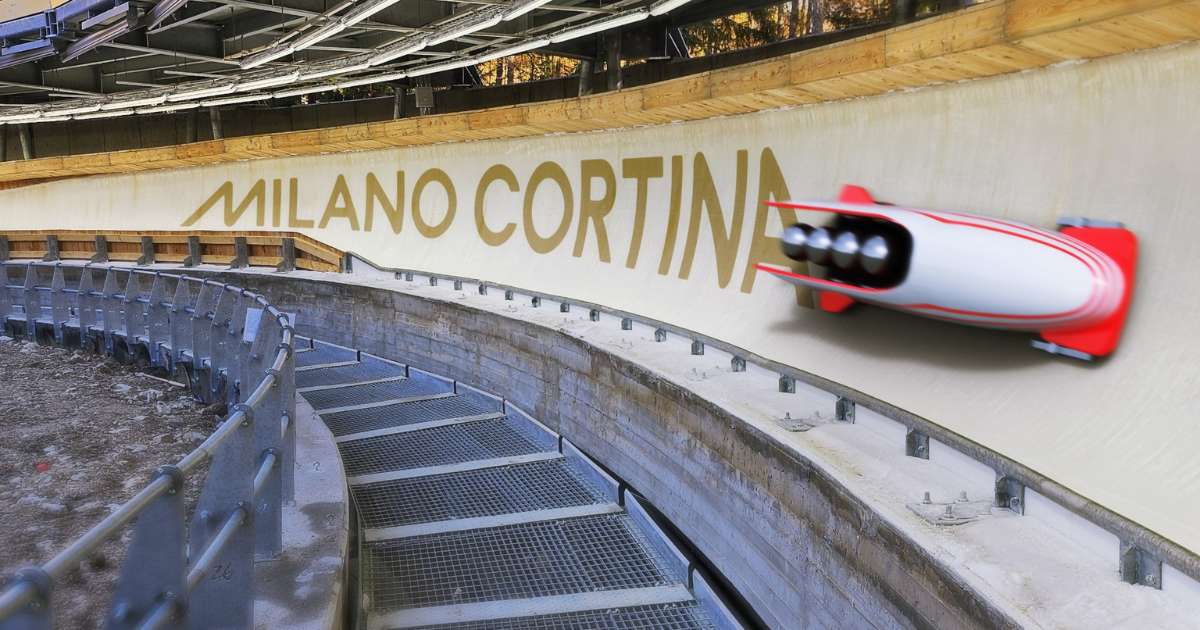
    This year’s sliding events–bobsleigh, luge, and skeleton–will take place at the brand-new Cortina Sliding Center. Built on the site of a historic sliding track, this new venue came together in only the last couple of years. It features a state-of-the-art refrigeration system that pumps a mixture of water and ethylene glycol beneath the track surface to keep the ice properly chilled. Each section of the track is continuously monitored to optimize the flow rate, temperature, and pressure of the refrigerant to keep the track at maximum performance while minimizing environmental impact.

    According to the designers, it’s the first competition track to use a glycol-based refrigeration system, which should be more sustainable than the ammonia-based systems used elsewhere. For a sense of what a run is like, check out this skeleton driver POV run from the facility’s shakedown competition last year. (Image credit: LMSteel; video credit: tuff sledding)

    Fediverse Reactions
  • “Moment of Creation”

    “Moment of Creation”

    Bubbles caught in ice resemble the growth of a cellular organism in this photograph of Tatiewa Lake in Japan, taken by Soichiro Moriyama. When water freezes, gases dissolved in it come out of solution, but depending on the speed and direction of freezing, these bubbles do not always escape before ice forms around them, freezing pockets of gas within the ice’s structure. (Image credit: S. Moriyama; via ILPOTY)

    Fediverse Reactions
  • “Melting Snowflake”

    “Melting Snowflake”

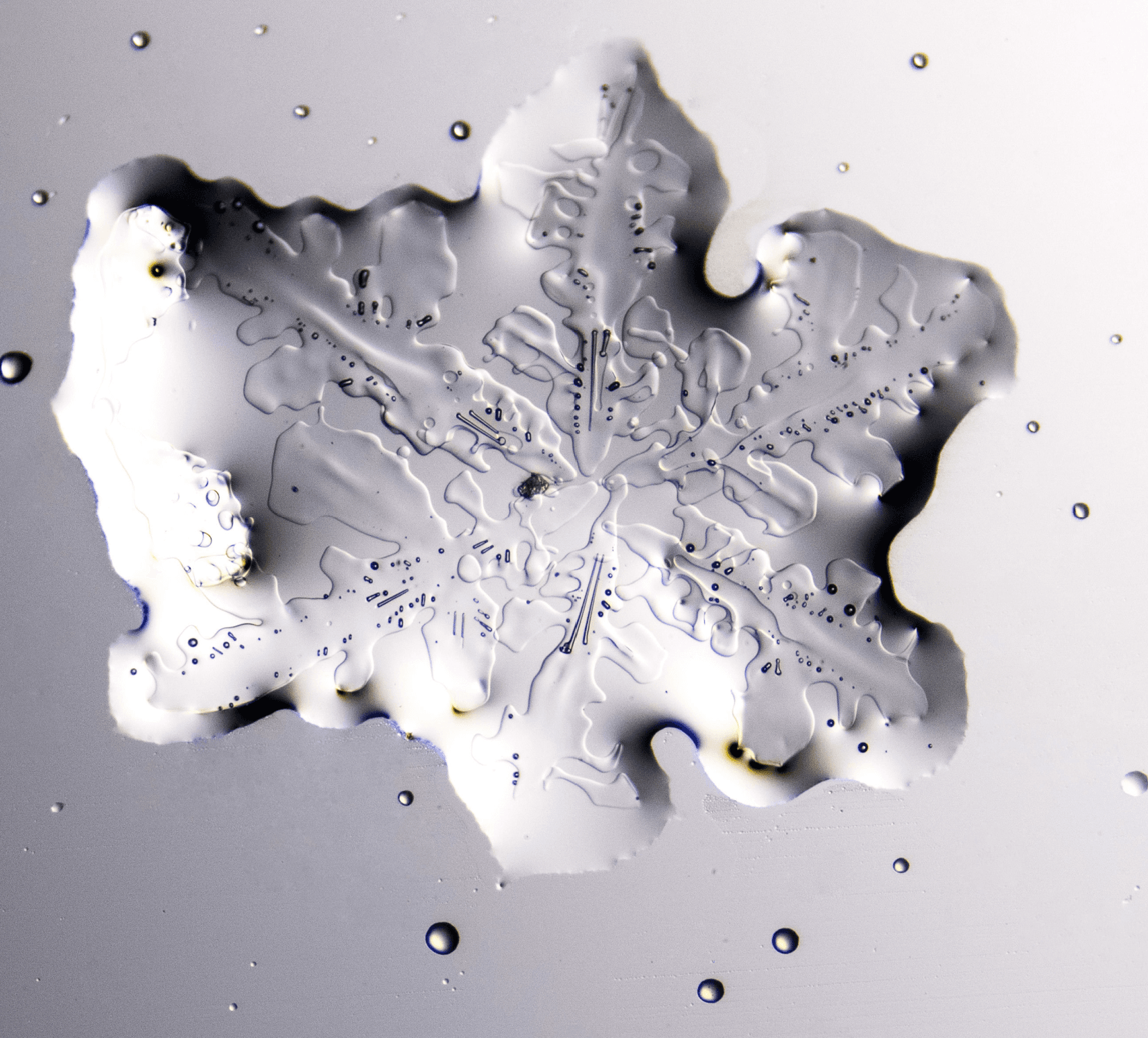
    It’s hard to preserve something as ephemeral as a snowflake, as seen in this microphotograph by Michael Robert Peres. Despite the old adage, it is possible to make identical snowflakes, but it requires mirroring the freezing conditions exactly, including both temperature and humidity. Here, the snowflake’s crystalline structure survives as a ghost in a melting droplet. (Image credit: M. Peres; via Ars Technica)

    Fediverse Reactions
  • Featured Video Play Icon

    How to Keep Water From Freezing

    When supercooled, water can remain a liquid even below its freezing point. As explained in this Minute Physics video, this happens because of a tug-of-war between effects in the water. Generally speaking, having impurities in the water or smacking the bottle will shift that battle enough for freezing to win out. But it’s possible–theoretically, at least–to create a situation where supercooled water can never freeze. (Video and image credit: Minute Physics)

    Fediverse Reactions
  • Frosted

    Frosted

    Frost forms hexagonal columns on a wooden rail in this microphotograph by Gregory B. Murray. Like in snowflakes, when water molecules freeze they position themselves to form six-sided crystals. From this perspective, it looks like a miniature version of the Giant’s Causeway. (Image credit: G. Murray; via Ars Technica)

    Fediverse Reactions
  • Salt and Sea Ice Aging

    Salt and Sea Ice Aging

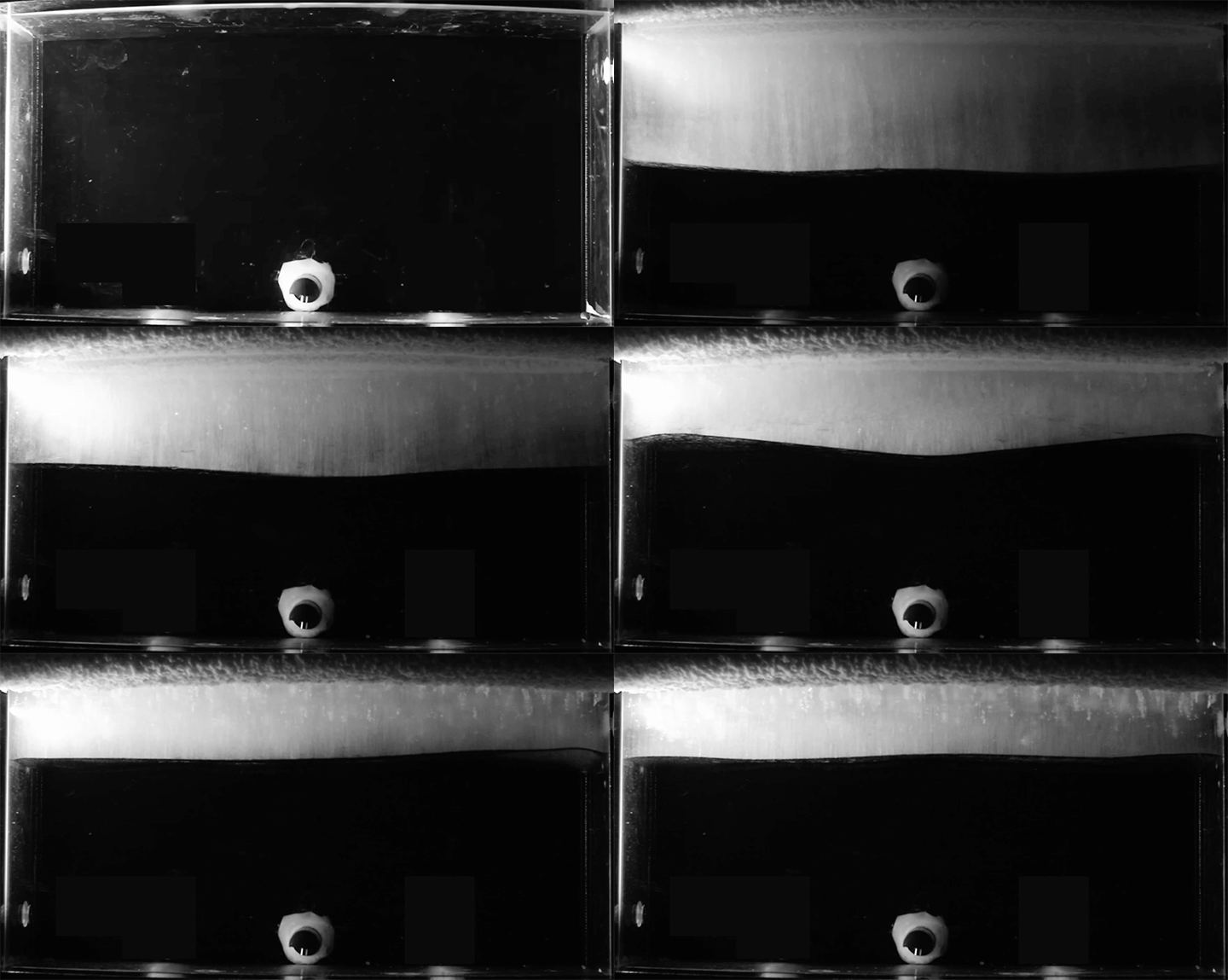
    Sea ice’s high reflectivity allows it to bounce solar rays away rather than absorb them, but melting ice exposes open waters, which are better at absorbing heat and thus lead to even more melting. To understand how changing sea ice affects climate, researchers need to tease out the mechanisms that affect sea ice over its lifetime. A new study does just that, showing that sea ice loses salt as it ages, in a process that makes it less porous.

    Researchers built a tank that mimicked sea ice by holding one wall at a temperature below freezing and the opposite wall at a constant, above-freezing temperature. Over the first three days, ice formed rapidly on the cold wall. But it did not simply sit there, once formed. Instead, the researchers noticed the ice changing shape while maintaining the same average thickness. The ice got more transparent over time, too, indicating that it was losing its pores.

    Looking closer, the team realized that the aging ice was slowly losing its salt. As the water froze, it pushed salt into liquid-filled pores in the ice. One wall of the pore was always colder than the others, causing ice to continue freezing there, while the opposite wall melted. Over time, this meant that every pore slowly migrated toward the warm side of the ice. Once the pore reached the surface, the briny liquid inside was released into the water and the ice left behind had one fewer pores. Repeated over and over, the ice eventually lost all its pores. (Image credit: T. Haaja; research credit and illustration: Y. Du et al.; via APS)

    Fediverse Reactions
  • Featured Video Play Icon

    “Lively”

    In “Lively,” filmmaker Christopher Dormoy zooms in on ice. He shows ice forming and melting, capturing bubbles and their trails, as well as the subtle flows that go on in and around the ice. By introducing blue dye, he highlights some of the internal flows we would otherwise miss. (Video and image credit: C. Dormoy)

  • Trapped in Ice

    Trapped in Ice

    On lake bottoms, decaying matter produces methane and other gases that get caught as bubbles when the water freezes. In liquid form, water is excellent at dissolving gases, but they come out of solution when the molecules freeze. In the arctic, these bubbles form wild, layered patterns like these captured by photographer Jan Erik Waider in a lake on the edge of Iceland’s Skaftafellsjökull glacier. Unlike the bubbles that form in our fridges’ icemakers, these bubbles are large enough that they take on complicated shapes. I especially love the ones that leave a visible trail of where the bubble shifted during the freezing process. (Image credit: J. Waider; via Colossal)

  • Featured Video Play Icon

    “Microscopic World”

    So many natural processes take place right in front of us, but they’re too small and too fast to see. Here, the Beauty of Science team puts some of those processes — crystallizing solids, nucleating bubbles, and more — front and center. The shapes and colors draw you in, inviting you to engage with science we see daily but rarely appreciate. (Video and image credit: Beauty of Science)

  • Hole Punch Clouds

    Hole Punch Clouds

    At times altocumulus cloud cover is pierced by circular or elongated holes, filled only with the wispiest of virga. These odd holes are known by many names: cavum, fallstreak holes, and hole punch clouds. Long-running debates about these clouds’ origins were put to rest some 14 years ago, after scientists showed they were triggered by airplanes passing through layers of supercooled droplets.

    When supercooled, water droplets hang in the air without freezing, even though they are colder than the freezing point. This typically happens when the water is too pure to provide the specks of dust or biomass needed to form the nucleus of an ice crystal. But when an airplane passes through, the air accelerated over its wings gets even colder, dropping the temperature another 20 degrees Celsius. That is cold enough that, even without a nucleus, water drops will freeze. More and more ice crystals will form, until they grow heavy enough to fall, leaving behind a clear hole or wisps of falling precipitation.

    In the satellite image above, flights moving in and out of Miami International Airport have left a variety of holes in the cloud cover each of them large enough to see from space! (Image credit: M. Garrison; research credit: A. Heymsfield et al. 2010 and A. Heymsfield et al. 2011; via NASA Earth Observatory)